
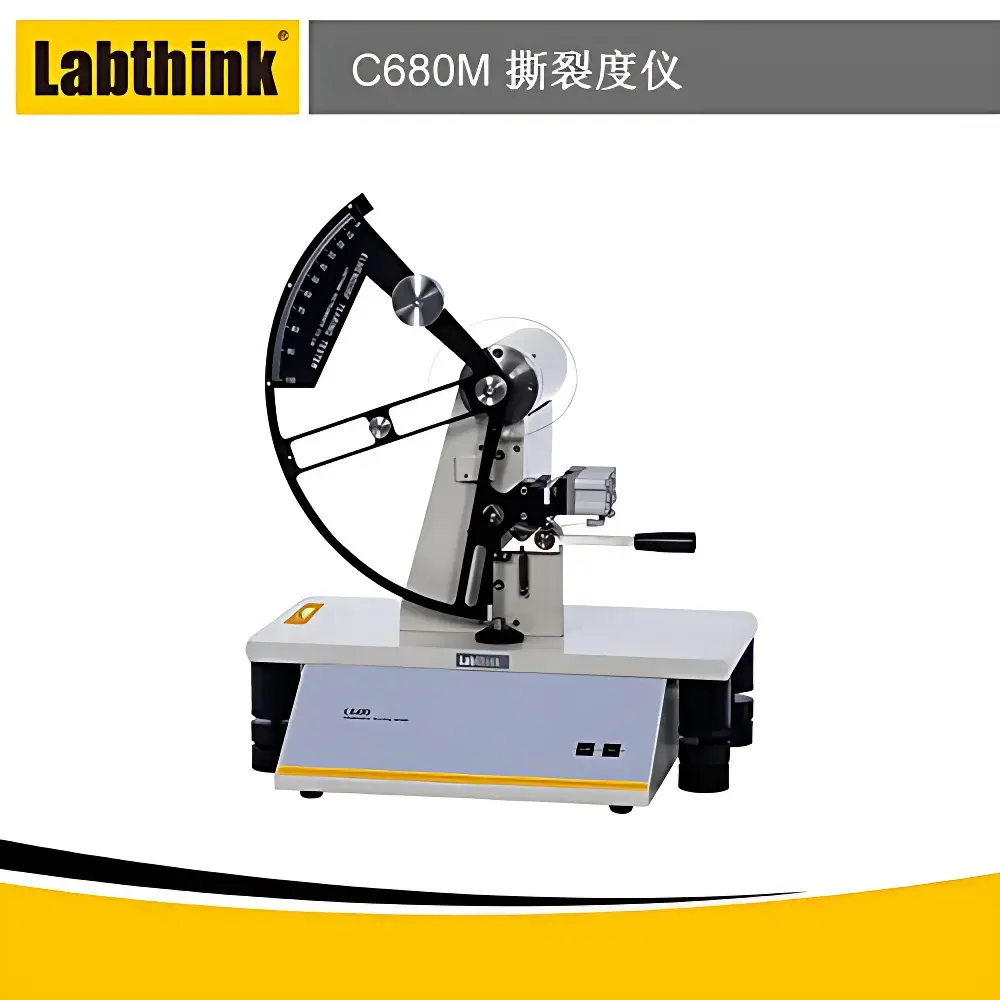
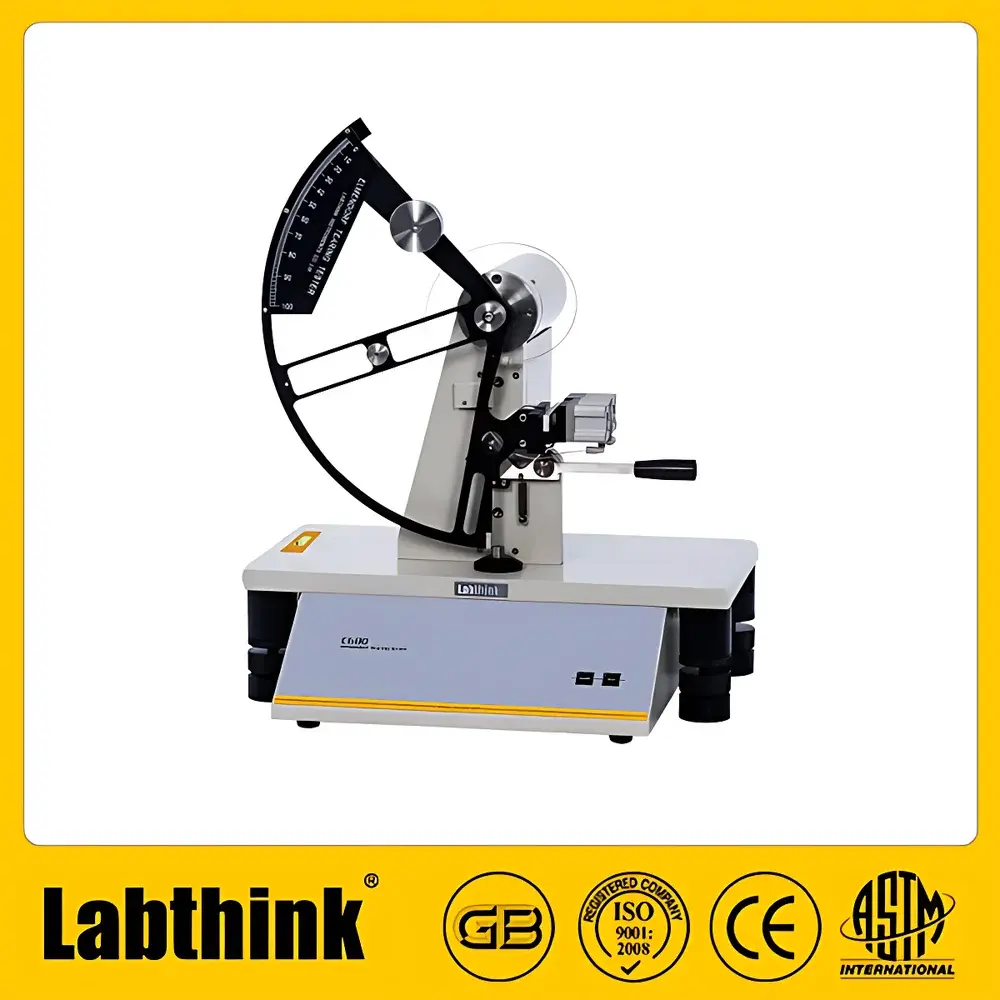
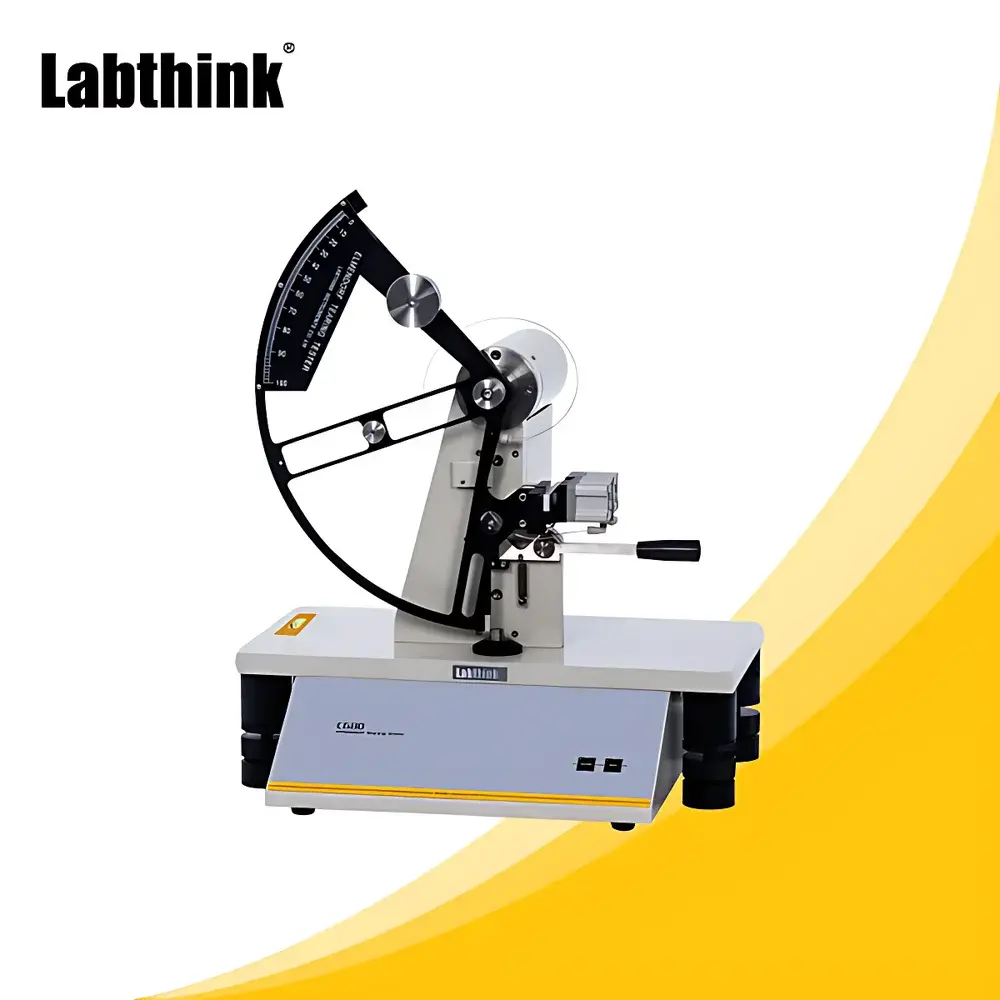
Labthink C680M Elmendorf Tear Tester
| Brand | Labthink |
|---|---|
| Model | C680M |
| Measurement Principle | Elmendorf Method |
| Standards Compliance | ISO 6383-1:1983, ISO 6383-2:1983, ISO 1974, GB/T 16578.2–2009, GB/T 455, ASTM D1922, ASTM D1424, ASTM D689, TAPPI T414 |
| Pendulum Capacities | 200 gf, 400 gf, 800 gf, 1600 gf, 3200 gf, 6400 gf |
| Pneumatic Clamping Pressure | 0.6 MPa |
| Air Interface | Φ4 mm polyurethane tubing |
| Dimensions (L×W×H) | 480 × 380 × 560 mm |
| Weight | 23.5 kg (with 200 gf base pendulum) |
| Power Supply | 220 VAC 50 Hz / 120 VAC 60 Hz |
Overview
The Labthink C680M Elmendorf Tear Tester is an electromechanical instrument engineered for precise and repeatable measurement of tear resistance in flexible sheet materials. It operates on the classical Elmendorf principle—where a notched specimen is clamped in a fixed frame, and a pendulum of known mass and geometry is released from a defined height to propagate a controlled tear across the sample. The energy absorbed during tearing is calculated from the pendulum’s angular displacement after impact, directly correlating to the average force required to extend the tear. This method delivers high reproducibility for comparative quality control and material specification verification across production batches and R&D workflows. Designed specifically for packaging, paper, and nonwoven industries, the C680M meets stringent international test standards including ISO 1974, ASTM D1922, and GB/T 455—ensuring data compatibility with global regulatory and customer acceptance protocols.
Key Features
- Automated pneumatic specimen clamping system eliminates manual alignment variability and ensures consistent clamping pressure (0.6 MPa), reducing operator-induced error.
- Motorized pendulum release mechanism guarantees precise timing and zero human intervention during the tear event.
- Integrated digital leveling assistance enables rapid, on-site horizontal calibration—critical for maintaining measurement fidelity across laboratory or production floor environments.
- Modular pendulum configuration supports six standardized capacities (200–6400 gf), allowing seamless adaptation to low-strength films (e.g., LDPE sealant layers) and high-strength substrates (e.g., woven PP sacks or laminated carton board).
- Dedicated Windows-based software provides real-time force curve visualization, statistical analysis (mean, SD, CV%), and automated unit conversion (gf, mN, cN, N) per user-defined reporting templates.
- RS232 serial interface enables direct integration into LIMS or MES platforms, supporting traceable data export in CSV or XML formats with timestamped audit trails.
Sample Compatibility & Compliance
The C680M is validated for use with a broad spectrum of planar, isotropic, and quasi-isotropic materials up to 1.5 mm thickness. Standard applications include plastic films (polyolefins, PET, PVDC-coated substrates), paper and paperboard grades (kraft, bleached sulfate, corrugated liner), technical textiles (spunbonded polypropylene, filter media), and elastomeric thin sheets (nitrile and latex glove stock). Its mechanical design conforms to dimensional and inertia requirements specified in ISO 6383-1 and ASTM D1922. All pendulum masses are traceably calibrated against NIST-traceable reference weights, and the instrument supports full GLP-compliant operation—including electronic signature-capable test reports, user access levels, and immutable test log archiving when paired with validated software configurations.
Software & Data Management
The included Labthink TestSuite software complies with FDA 21 CFR Part 11 requirements when deployed in validated environments. It enforces role-based authentication, automatic session logging, and tamper-evident electronic records. Each test record captures instrument ID, operator ID, environmental conditions (optional via external sensor input), pendulum selection, specimen dimensions, raw angular displacement data, and final tear resistance value with uncertainty estimation. Export functions support direct import into Excel, statistical packages (e.g., JMP, Minitab), or enterprise QA databases. Audit trail reports detail all user actions—including parameter edits, result overrides, and report generation events—with timestamps and IP metadata where network-enabled.
Applications
- Quality Assurance: Routine incoming inspection of film rolls and paper reels against internal specifications or customer-supplied tear thresholds (e.g., ≥350 mN for pharmaceutical blister lidding).
- Process Development: Correlating extrusion die settings or calendering parameters with tear propagation behavior in multilayer coextrusions.
- Regulatory Submissions: Generating ISO/ASTM-aligned tear data for FDA 510(k) dossiers (medical device packaging) or EU MDR technical files.
- Fatigue & Aging Studies: Quantifying tear resistance degradation after accelerated aging (e.g., 40°C/75% RH for 90 days) per ISTA 3A or ASTM D4332 protocols.
- Failure Analysis: Diagnosing root causes of catastrophic bag rupture by comparing directional tear anisotropy (machine vs. transverse direction) in biaxially oriented films.
FAQ
What standards does the C680M support out-of-the-box?
The instrument is preconfigured for ISO 1974, ASTM D1922, GB/T 455, and TAPPI T414 test methods. Custom protocol definitions can be added via software configuration without firmware modification.
Is compressed air supply included with the system?
No. A clean, oil-free compressed air source delivering 0.6 MPa at ≥10 L/min must be provided by the user. The inlet accepts standard Φ4 mm polyurethane tubing.
Can the C680M measure tear resistance in wet or conditioned specimens?
Yes—provided specimens are equilibrated per ISO 187 or ASTM D685 prior to testing and handled under controlled RH conditions. The instrument itself is not humidity-controlled; ambient lab conditions must be monitored and documented.
How often does the pendulum require recalibration?
Annual calibration is recommended. Labthink offers accredited calibration services with NIST-traceable certificates covering moment of inertia, pivot friction, and damping coefficient verification.
Does the software support multi-language UI and reporting?
English and Simplified Chinese interfaces are available. Reports can be generated in either language, with customizable headers, footers, and corporate branding elements.






