
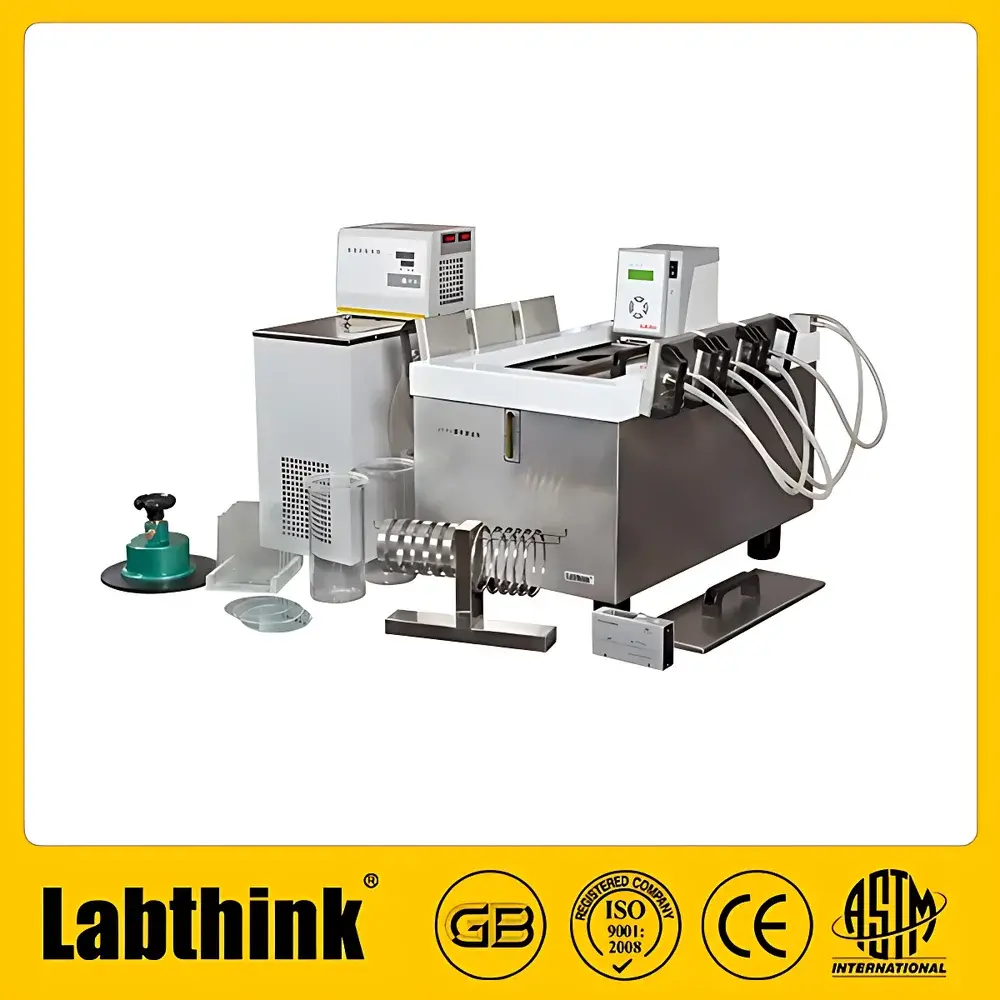
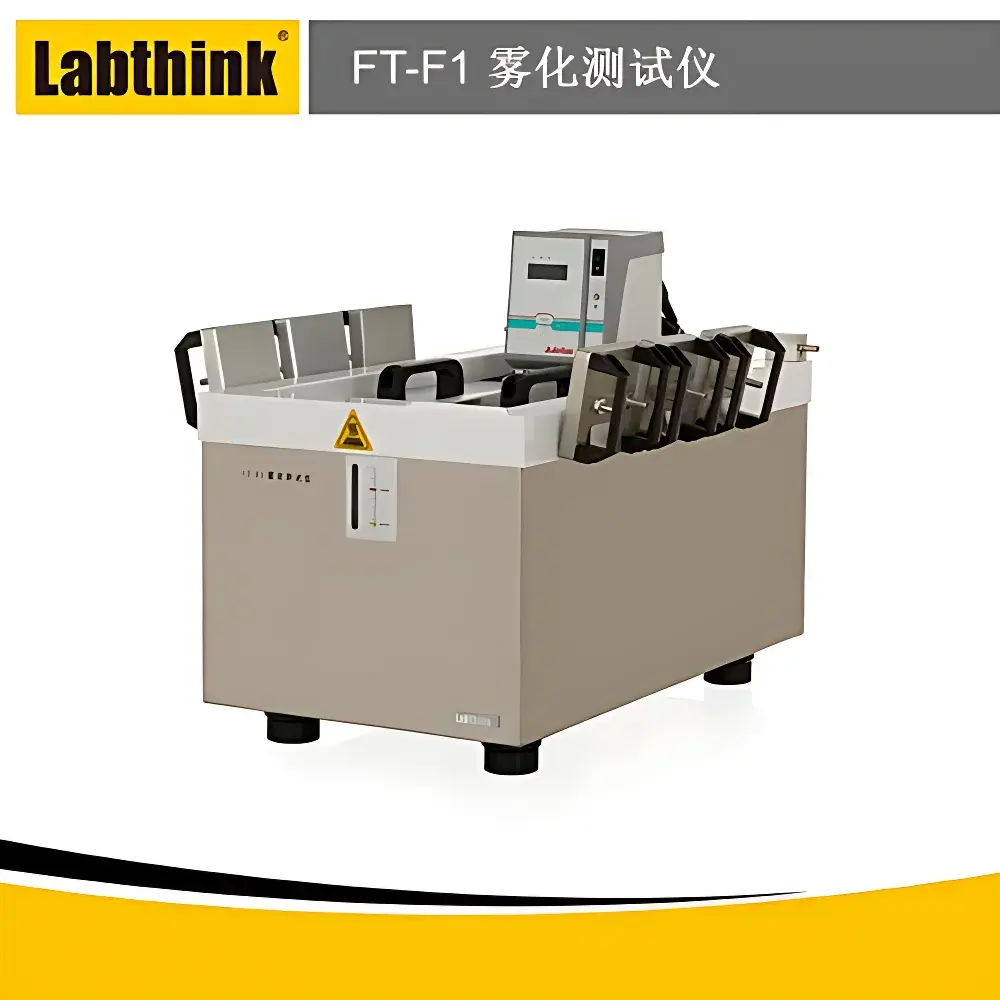
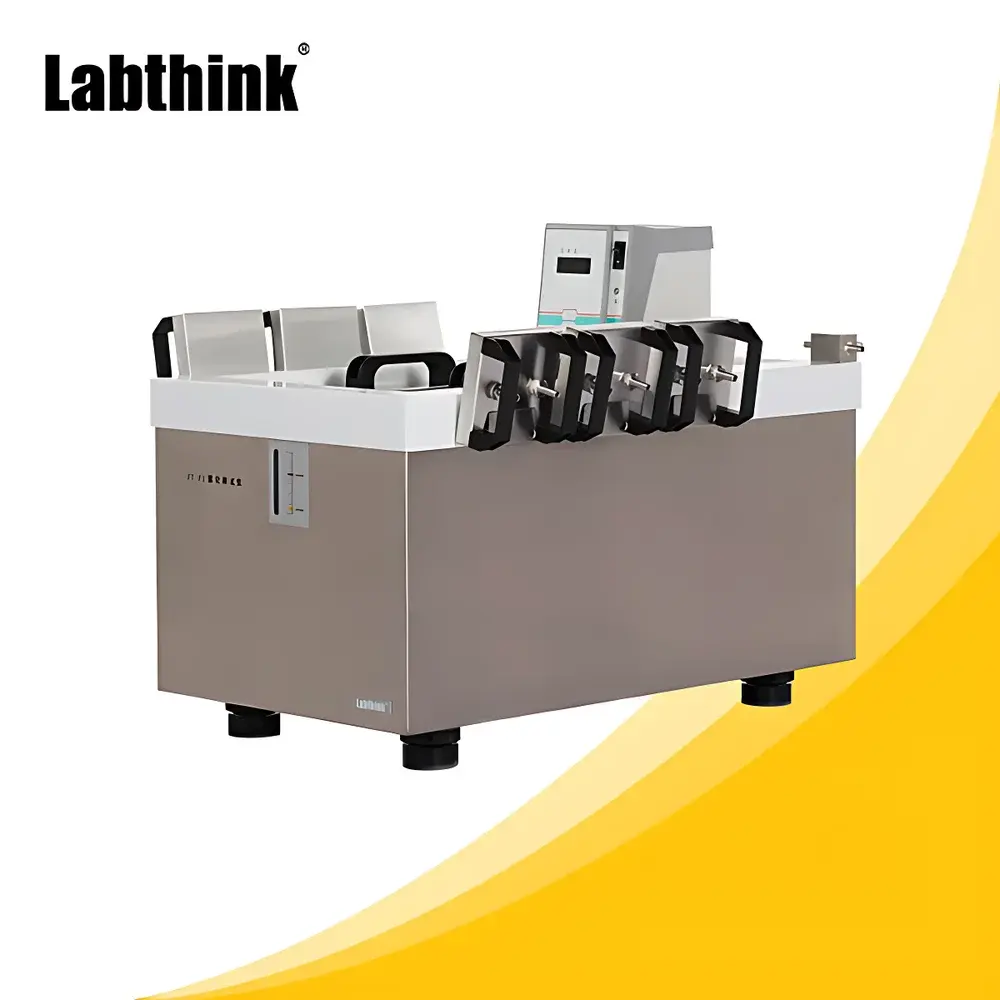
Labthink FT-F1 Automotive Interior Fogging Tester
| Brand | Labthink |
|---|---|
| Model | FT-F1 |
| Type | Benchtop Fogging Test Instrument |
| Standards Compliance | ISO 6452, DIN 75201, SAE J1756, QB/T 2728, BS EN 14288, PV 3920, PV 3015, ES-X83231, NES M0161, D45 1727, GM 9305P, TSM 0503G |
| Temperature Range (Hot Plate) | Ambient to 150 °C (optional up to 280 °C) |
| Temperature Control Accuracy | ±0.1 °C at 150 °C |
| Cold Plate Temperature Range | 0–100 °C |
| Cold Plate Control Accuracy | ±0.1 °C |
| Resolution | 0.1 °C |
| Accuracy | ±2% of reading |
| Response Time | <10 min |
| Measurement Methods | Gloss Loss Method (standard), Haze Method (optional), Gravimetric Method (standard, balance not included) |
| Sample Capacity | 6 parallel test positions |
| Power Supply | 220 VAC 50 Hz / 120 VAC 60 Hz |
| Dimensions (Hot Unit) | 670 × 490 × 540 mm (L×W×H) |
| Net Weight (Hot Unit, no heat transfer fluid) | 32 kg |
| Dimensions (Cold Unit) | 400 × 220 × 520 mm |
| Net Weight (Cold Unit, no coolant) | 15 kg |
Overview
The Labthink FT-F1 Automotive Interior Fogging Tester is a precision-engineered benchtop instrument designed for quantitative evaluation of volatile condensable emissions from interior materials under controlled thermal stress. It operates on the principle of thermal desorption followed by cold-surface condensation — a standardized physical separation method widely adopted in automotive OEM and Tier-1 supplier laboratories. During testing, a conditioned specimen is heated within a sealed glass or metal chamber (the “fogging cup”) to simulate real-world service temperatures. Volatile organic compounds (VOCs) and semi-volatile organic compounds (SVOCs) evaporate, migrate across a defined air gap, and condense onto a chilled optical substrate — either a polished glass plate (for optical measurement) or aluminum foil (for mass-based quantification). This process replicates the fogging phenomenon observed on vehicle windshields, instrument panels, and head-up display surfaces. The FT-F1 delivers traceable, repeatable data essential for material screening, formulation development, and compliance verification against global automotive specifications.
Key Features
- Independent dual-zone temperature control: High-precision hot plate (ambient to 150 °C, ±0.1 °C stability at setpoint) and refrigerated cold plate (0–100 °C, ±0.1 °C stability) ensure strict adherence to ISO 6452 and DIN 75201 thermal profiles.
- Six-position parallel testing architecture enables simultaneous execution of sample trials and blank controls — improving throughput while supporting statistical validation per GLP requirements.
- Modular optical measurement path: Standard integrated glossmeter (60° geometry) supports rapid, non-destructive assessment of condensate-induced surface reflectance loss; optional haze meter (ASTM D1003-compliant) provides complementary turbidity analysis.
- Gravimetric capability via precision balance interface: Aluminum foil substrates allow direct mass gain measurement of condensed volatiles (per ASTM D5116 Annex A), with compatibility for analytical balances down to 0.01 mg resolution.
- Robust mechanical design: Stainless-steel hot chamber housing, fluororubber sealing components, and thermally insulated cold unit minimize ambient interference and ensure long-term calibration stability.
- Universal power input: Auto-switching 220 VAC 50 Hz / 120 VAC 60 Hz operation facilitates deployment in global R&D labs without external transformers.
Sample Compatibility & Compliance
The FT-F1 accommodates a broad spectrum of automotive interior substrates including polypropylene (PP), polyvinyl chloride (PVC), thermoplastic elastomers (TPE), polyurethane (PU) foams, nonwovens, leather substitutes, adhesives, and textile laminates. Its modular fixture system accepts standard 25 mm diameter circular specimens or 50 × 50 mm square samples per ISO 6452 and DIN 75201. All operational parameters — heating ramp rate, dwell time, cold surface temperature, and condensation duration — are fully configurable to align with OEM-specific test protocols such as GM 9305P (100 °C/16 h), Ford CETP 00.00-L-467 (90 °C/16 h), or VW TL 214 (100 °C/16 h). The instrument’s hardware and procedural workflow support full auditability under ISO/IEC 17025, FDA 21 CFR Part 11 (when paired with compliant LIMS), and IATF 16949-aligned internal quality systems.
Software & Data Management
While the FT-F1 operates as a stand-alone hardware platform, its analog and digital interfaces (RS-232, USB) enable seamless integration with third-party laboratory information management systems (LIMS) and electronic lab notebooks (ELN). All temperature logs, test start/stop timestamps, operator IDs, and raw optical/mass readings are exportable in CSV or XML format for traceability and statistical process control (SPC). Calibration records — including hot/cold plate verification using NIST-traceable RTDs — are maintained separately per ISO 17025 Clause 6.5. The system supports user-defined test templates, automated pass/fail flagging against specification limits, and PDF report generation with embedded metadata (e.g., instrument ID, calibration due date, environmental conditions).
Applications
- Pre-release screening of polymer compounds for low-fogging performance in dashboards, door trims, and pillar covers.
- Comparative analysis of plasticizer alternatives (e.g., DIDP vs. DOP) to reduce condensable emissions without compromising mechanical properties.
- Validation of cleaning agent residues or mold release contaminants on injection-molded components.
- Root-cause investigation of windshield fogging incidents in field-return analysis.
- Supporting REACH SVHC screening by correlating fogging mass gain with GC-MS-identified VOC profiles.
- Qualification of recycled content in interior materials per OEM sustainability mandates (e.g., BMW Group Material Standard GS 97035).
FAQ
What standards does the FT-F1 comply with?
The FT-F1 is engineered to meet the physical configuration, thermal control, and measurement requirements of ISO 6452, DIN 75201, SAE J1756, QB/T 2728, BS EN 14288, and multiple OEM specifications including PV 3920, GM 9305P, and TSM 0503G.
Is gravimetric measurement included in the base configuration?
Yes — aluminum foil substrates, foil cutters, and mounting fixtures are supplied standard. However, the analytical balance (0.01 mg resolution) required for mass measurement is not included and must be procured separately.
Can the FT-F1 perform tests above 150 °C?
An optional high-temperature hot plate module extends the upper limit to 280 °C, enabling evaluation of under-hood materials per SAE J2722 or aerospace-grade composites.
How is system accuracy verified?
Labthink provides a certified calibration certificate upon delivery, covering hot/cold plate temperature uniformity and stability. Users perform periodic verification using Class A platinum resistance thermometers traceable to national metrology institutes.
Does the instrument support automated data archiving?
Yes — through RS-232 or USB, the FT-F1 streams real-time temperature and status data to external software. When integrated with validated LIMS platforms, full 21 CFR Part 11 compliance (electronic signatures, audit trails) is achievable.
Related Products







