
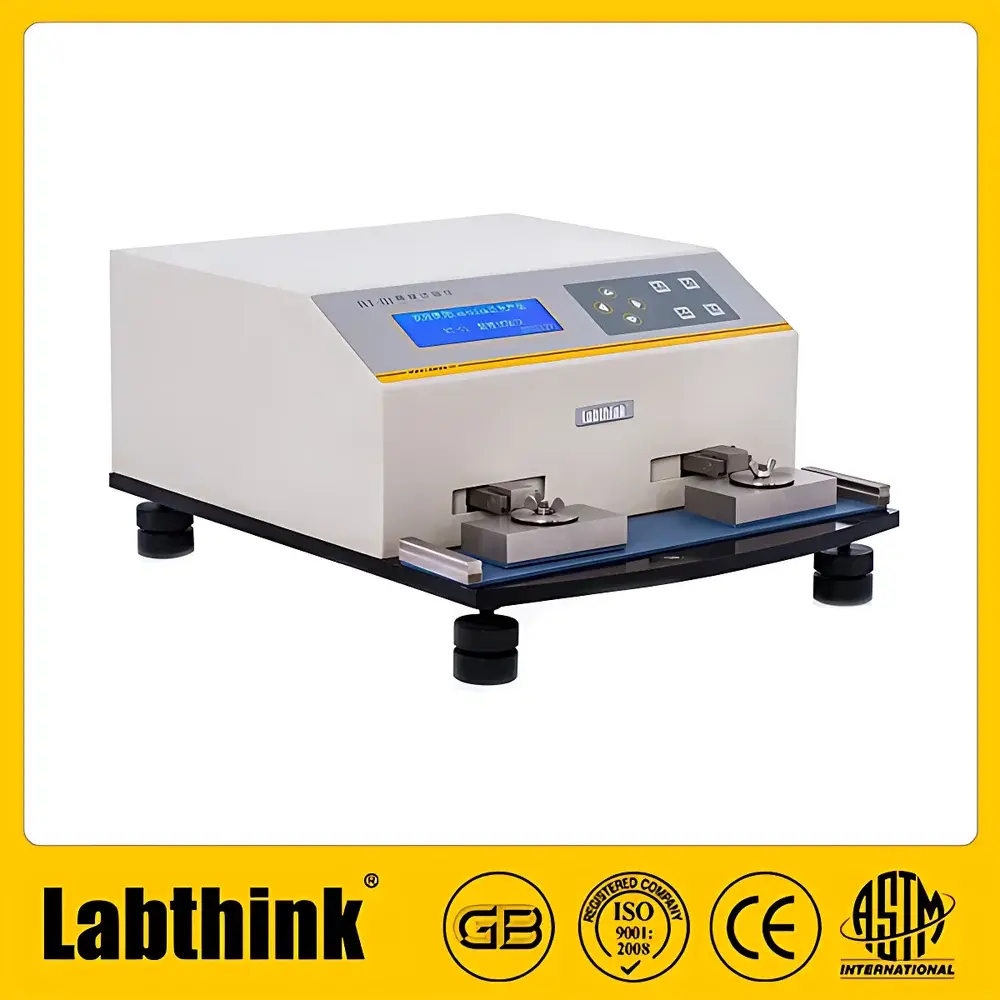

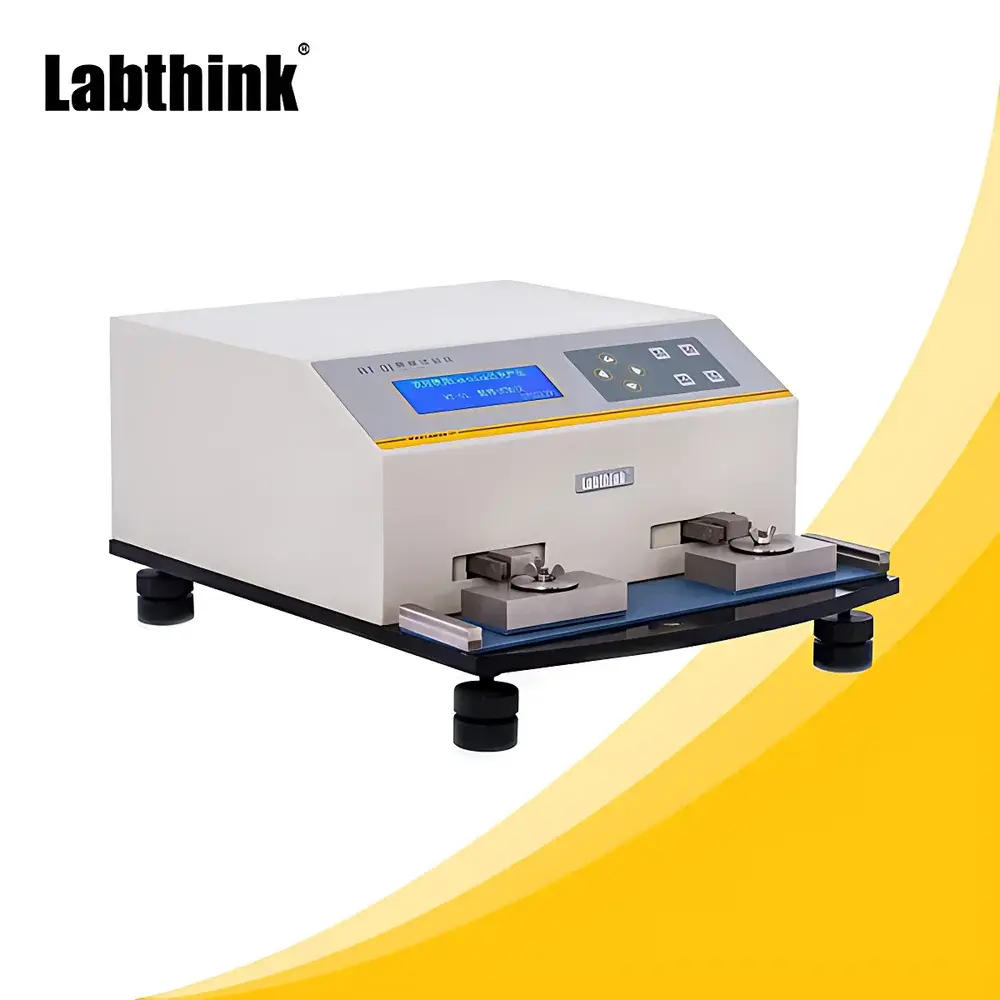
Labthink RT-01 Sutherland Rub Tester for Printing Ink Abrasion Resistance, PS Plate Durability & Coating Rub Fastness Analysis
| Brand | Labthink |
|---|---|
| Origin | Shandong, China |
| Manufacturer Type | Direct Manufacturer |
| Origin Category | Domestic (China) |
| Model | RT-01 |
| Pricing | Upon Request |
| Friction Load | 8.9 N (2 lb) / 17.8 N (4 lb) |
| Friction Speed | 21 / 42 / 85 / 106 cycles per minute (cpm) |
| Motion Profile | Arcuate reciprocating |
| Cycle Range | 0–999,999 |
| Specimen Capacity | 1–2 specimens |
| Power Supply | AC 220 V, 50 Hz |
| Dimensions (L×W×H) | 485 × 390 × 230 mm |
| Net Weight | 40 kg |
| Compliance | ASTM D5264, TAPPI T830 |
Overview
The Labthink RT-01 Sutherland Rub Tester is an engineered precision instrument designed to quantitatively evaluate the surface rub resistance of printed materials, photopolymer plates (PS plates), and functional coatings in packaging, publishing, and industrial printing applications. Based on the standardized Sutherland rub test principle—where controlled arcuate reciprocating motion applies defined normal load and cycle frequency to simulate real-world abrasion conditions—the RT-01 delivers repeatable, traceable data on ink adhesion, photoresist layer durability, and coating integrity. Unlike generic abrasion testers, the RT-01 implements a dual-station arc-motion architecture that enables comparative testing under identical mechanical parameters, supporting both single- and dual-specimen evaluation without cross-contamination or mechanical coupling. Its core function is not merely “scratching” but systematic assessment of material response to dry friction, wet friction, migration-induced smearing, and wet-track transfer—four distinct failure modes recognized in ISO/IEC and industry-standard print quality protocols.
Key Features
- Dual independent test stations with synchronized arcuate reciprocating motion—enabling parallel evaluation of identical or dissimilar specimens under identical load, speed, and environmental conditions
- Four selectable friction modes: dry rub, wet rub, migration test, and wet-track rub—each calibrated to replicate specific end-use stress scenarios encountered during handling, stacking, transport, or humidity exposure
- Four programmable cycle frequencies (21, 42, 85, and 106 cpm) compliant with ASTM D5264 and TAPPI T830 test sequence requirements
- Precision-machined load application system with two certified standard weights: 8.9 N (2 lb) and 17.8 N (4 lb); optional non-standard weights available for specialized validation protocols
- Microprocessor-based control with PVC membrane keypad and backlit LCD display—supporting intuitive menu navigation, real-time cycle counting, and parameter recall
- Intelligent operational safeguards including power-loss memory retention, audible completion alert, and automatic stop upon reaching preset cycle count
- Robust aluminum-alloy chassis and corrosion-resistant bearing assembly ensuring long-term dimensional stability and mechanical repeatability across >100,000 test cycles
Sample Compatibility & Compliance
The RT-01 accommodates rigid and semi-rigid substrates up to 100 mm × 100 mm per station—including offset lithographic PS plates, flexographic printing cylinders (via flat-mounted sections), coated paperboard, metallized films, UV-cured varnishes, and digital inkjet overlaminate layers. Specimen clamping uses low-profile, non-marring vacuum chucks compatible with thin (<0.1 mm) or brittle substrates. All test methodologies align with internationally recognized standards: ASTM D5264 (Sutherland Rub Test for Printed Materials), TAPPI T830 (Ink Rub Resistance of Paperboard), and supplementary guidance from ISO 12647-7 (Process control for digital proofing). The instrument’s mechanical calibration traceability supports GLP-compliant laboratories requiring audit-ready documentation for internal quality systems or third-party certification (e.g., ISO/IEC 17025).
Software & Data Management
While the RT-01 operates as a standalone hardware platform, its digital interface supports RS-232 serial output for integration into laboratory information management systems (LIMS) or custom data acquisition software. Cycle counts, elapsed time, selected mode, and applied load are timestamped and exportable as ASCII text files. For regulated environments—particularly those adhering to FDA 21 CFR Part 11 or EU Annex 11—the instrument can be deployed within validated workflows where operator actions (mode selection, weight installation, start/stop) are logged externally via connected PCs with electronic signature capability. No proprietary cloud service or vendor-hosted platform is required; all data remains under full user control at the instrument level or host system.
Applications
- Quantifying PS plate photopolymer layer endurance during high-volume press runs (measured in impressions per plate life)
- Evaluating rub fastness of water-based, solvent-based, and UV-curable inks on folding cartons and labels per packaging sustainability specifications
- Validating anti-scratch performance of matte/gloss laminates and functional barrier coatings used in pharmaceutical blister packaging
- Supporting R&D of novel ink formulations by correlating rub resistance with binder resin Tg, pigment dispersion quality, and crosslink density
- Conducting supplier qualification audits for print service providers—verifying conformance to brand owner technical data sheets (TDS) and packaging specification documents
- Performing accelerated aging correlation studies when combined with climate-controlled chamber exposure (e.g., 40°C/75% RH preconditioning prior to rub testing)
FAQ
What standards does the RT-01 directly support?
ASTM D5264 and TAPPI T830 are fully implemented in hardware logic and user interface; test parameters (load, speed, stroke geometry) meet the physical definitions specified in both methods.
Can the RT-01 test curved or cylindrical samples?
No—it requires flat specimens mounted on the horizontal test bed. Cylindrical samples must be sectioned or replicated as flat coupons using representative substrate and coating layers.
Is calibration certification included with shipment?
Yes—each unit ships with a factory-issued calibration report referencing NIST-traceable force and timing standards, valid for 12 months under normal operating conditions.
How is wet friction testing performed?
A defined volume of standardized test liquid (e.g., isopropyl alcohol, glycerol/water blend per ASTM D5264 Annex A1) is applied to the abradant pad immediately before initiating the cycle sequence.
Does the RT-01 meet electromagnetic compatibility (EMC) requirements for CE marking?
Yes—the instrument complies with EN 61326-1:2013 for laboratory equipment and carries full CE marking for use within the European Economic Area.




