
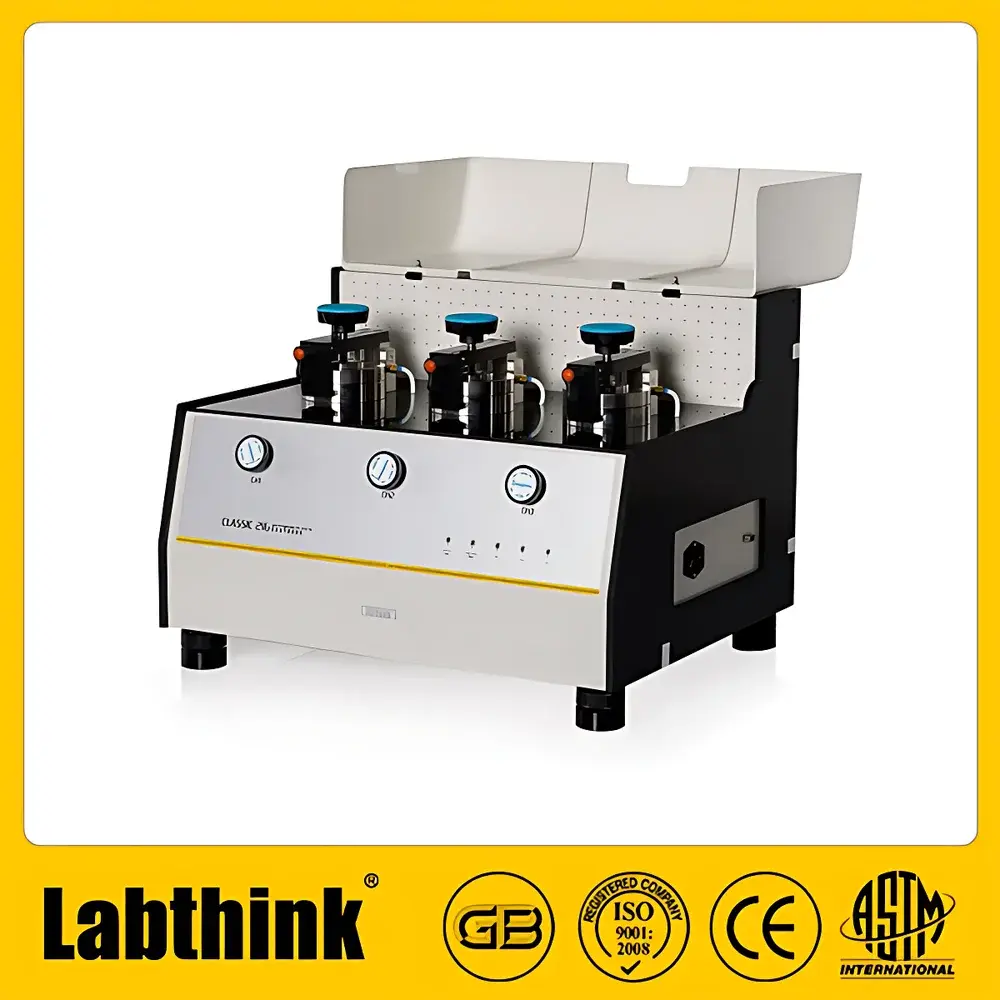
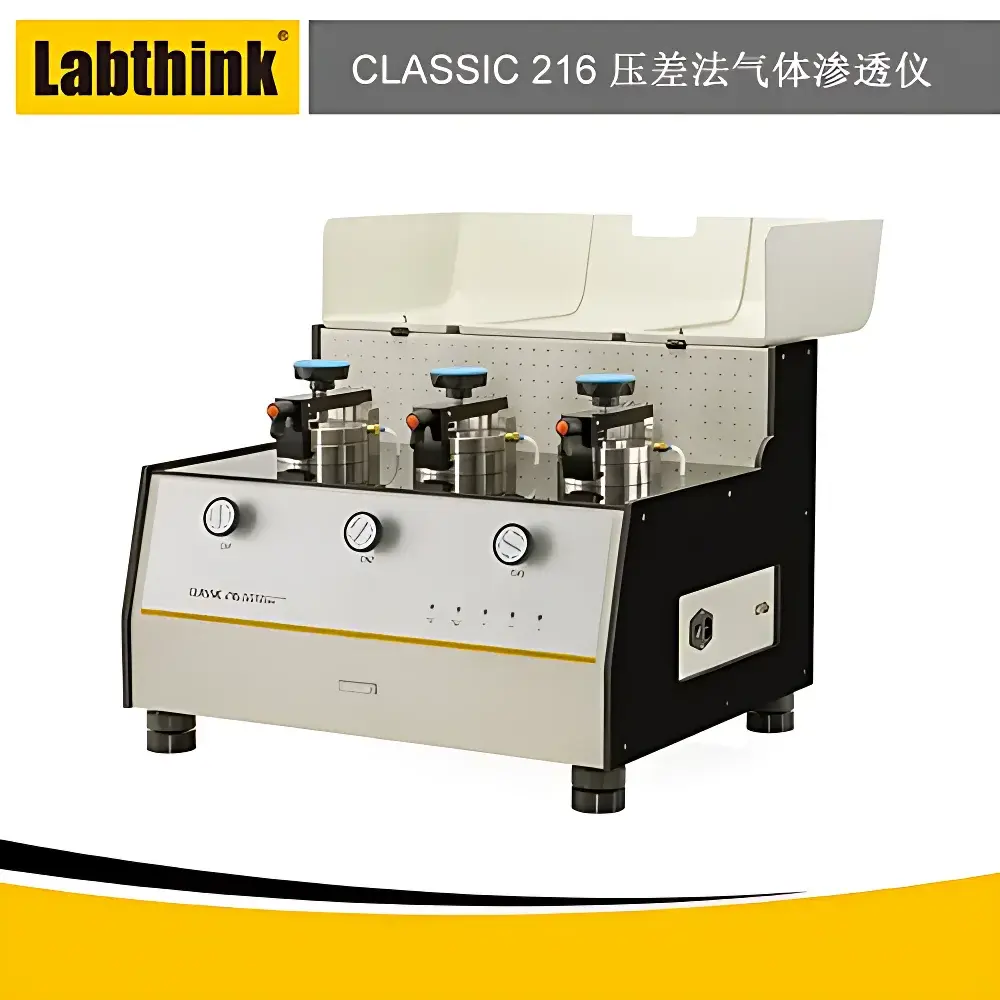
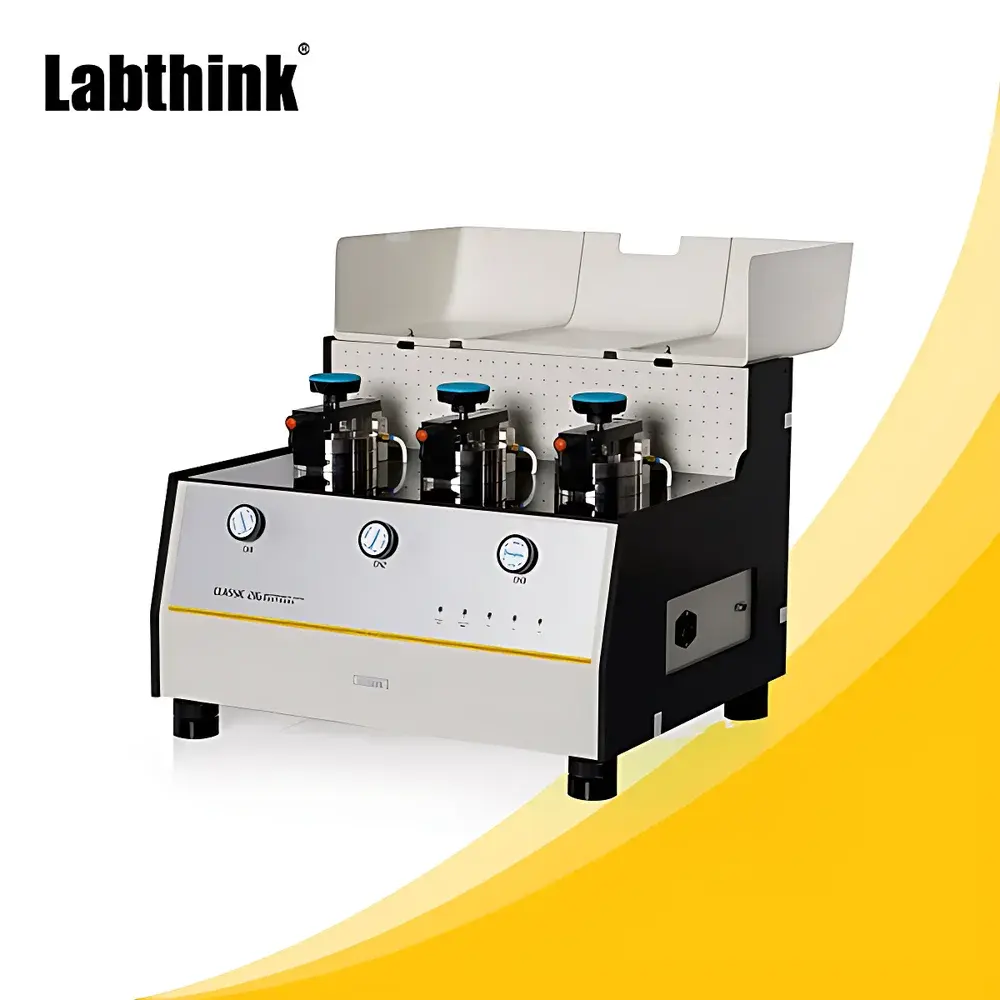
Labthink CLASSICA-216 Differential Pressure Gas Permeability Analyzer
| Brand | Labthink |
|---|---|
| Model | CLASSICA-216 |
| Principle | Differential Pressure (Manometric) Method |
| Test Gases | O₂, N₂, CO₂, Air, He |
| Test Range | 0.1–50,000 cm³/m²·24h·0.1 MPa (standard) |
| Vacuum Resolution | 0.1 Pa |
| Chamber Vacuum Level | <20 Pa |
| Temperature Control Range | 15–55 °C (external chiller/heater required) |
| Humidity Control Options | 0% RH, 100% RH, or intermediate levels per ASTM E104 (humidity generator optional) |
| Specimen Area | 38.48 cm² |
| Specimen Diameter | Φ97 mm |
| Pressure Range | −0.1 to +0.1 MPa |
| Supply Gas Pressure | 0.4–0.6 MPa |
| Interface | Φ6 mm polyurethane tubing |
| Dimensions | 670 × 540 × 430 mm (L×W×H) |
| Weight | 75 kg |
| Power | AC 220 V / 50 Hz or AC 120 V / 60 Hz |
| Standards Compliance | ISO 15105-1, ISO 2556, ASTM D1434, JIS K7126-1, GB/T 1038–2000, YBB 00082003–2015 |
Overview
The Labthink CLASSICA-216 Differential Pressure Gas Permeability Analyzer is a precision-engineered instrument designed for the quantitative determination of gas transmission rates (GTR), permeability coefficients (P), diffusion coefficients (D), and solubility coefficients (S) in flexible barrier materials. It operates on the well-established differential pressure (manometric) principle: a conditioned specimen is sealed between two isolated chambers; the downstream (low-pressure) chamber is evacuated to a stable vacuum baseline (<20 Pa), while the upstream (high-pressure) chamber is pressurized with the test gas (e.g., N₂, O₂, or CO₂) to generate a controlled, adjustable transmembrane pressure gradient (±0.1 MPa). As gas molecules permeate through the film under this driving force, the rising pressure in the downstream chamber is measured with high-resolution piezoresistive transducers (0.1 Pa resolution). Real-time data acquisition enables calculation of steady-state flux, from which fundamental permeation parameters are derived using Fickian diffusion models. This method ensures traceable, reproducible results aligned with international regulatory expectations for barrier characterization in packaging R&D, quality control, and regulatory submission dossiers.
Key Features
- Triple independent test chambers—enabling concurrent, statistically robust evaluation of three identical or dissimilar specimens under identical environmental conditions.
- High-fidelity vacuum architecture with active stabilization, achieving and maintaining <20 Pa base pressure and 0.1 Pa measurement resolution for low-permeability materials (e.g., PVDC-coated films or AlOx/MgF₂ barrier layers).
- Dual-mode process logic—supports both proportional control and fuzzy logic algorithms to dynamically optimize chamber equilibration and permeation ramping, minimizing operator intervention and enhancing inter-laboratory repeatability.
- Modular environmental control—temperature range spans 15–55 °C (requires external chiller/heater unit); humidity options include dry N₂ purge (0% RH), saturated steam (100% RH), or programmable intermediate levels per ASTM E104 (humidity generator sold separately).
- Scalable test range—from ultra-high-barrier materials (0.1 cm³/m²·24h·0.1 MPa) to highly permeable nonwovens or biodegradable films (≥500,000 cm³/m²·24h·0.1 MPa via extended-volume configuration).
- Integrated calibration protocol—includes certified reference membranes and automated validation routines to ensure ongoing metrological traceability per ISO/IEC 17025 requirements.
Sample Compatibility & Compliance
The CLASSICA-216 accommodates flat, flexible specimens up to Φ97 mm (38.48 cm² effective area), including monolayer and multilayer polymer films (e.g., PET, PE, PP, EVOH), metallized foils (Al, SiOₓ), paperboard laminates, textile substrates (glass fiber cloth, spunbonded nonwovens), and emerging biopolymer systems (PLA, PHA, starch-based composites). Its mechanical clamping system ensures uniform sealing without edge leakage—a critical factor for low-GTR measurements. The instrument fully complies with ISO 15105-1 (gas transmission rate), ISO 2556 (differential pressure method), ASTM D1434 (O₂ permeability), JIS K7126-1, GB/T 1038–2000, and YBB 00082003–2015 (Chinese pharmaceutical packaging standards). Data integrity safeguards—including electronic audit trails, user access levels, and password-protected method templates—support alignment with FDA 21 CFR Part 11 and GLP/GMP documentation requirements.
Software & Data Management
The proprietary PermeationSuite™ software provides full instrument control, real-time curve visualization, automatic endpoint detection, and ISO-compliant reporting. All raw pressure vs. time datasets are stored in encrypted binary format with embedded metadata (operator ID, timestamp, calibration status, environmental logs). Export options include CSV, PDF, and XML for LIMS integration. Software modules support Arrhenius modeling (permeability vs. temperature), humidity-dependent coefficient interpolation, and comparative statistical analysis (ANOVA, confidence intervals). Audit trail functionality records every parameter change, report generation event, and user login—fully compliant with ALCOA+ principles for regulated environments.
Applications
- Primary packaging development—quantifying O₂ ingress into snack pouches, N₂ retention in coffee bags, or CO₂ loss in carbonated beverage overwraps.
- Medical device packaging validation—verifying sterility maintenance in Tyvek® pouches or peelable lids per ISO 11607.
- Sustainable material assessment—benchmarking permeability of compostable films against fossil-based benchmarks under standardized RH/temperature profiles.
- Barrier coating optimization—evaluating SiOₓ, AlOₓ, or nanocellulose layer efficacy on PET substrates across accelerated aging conditions.
- Regulatory dossier support—generating test reports admissible for FDA premarket submissions, EU MDR technical files, and PMDA approvals.
FAQ
What gases can be tested with the CLASSICA-216?
N₂, O₂, CO₂, air, and He are routinely supported; other inert or non-corrosive gases may be used with appropriate safety validation and gas-specific calibration.
Is temperature and humidity control included in the base system?
No—precise thermal control (15–55 °C) requires an external recirculating chiller/heater; humidity modulation (0–100% RH) necessitates an optional humidity generator compliant with ASTM E104.
How is instrument calibration verified?
Certified standard membranes with NIST-traceable permeability values are supplied; the software guides users through automated calibration verification with pass/fail criteria based on ±3% tolerance.
Can the system comply with 21 CFR Part 11 requirements?
Yes—when operated with validated PermeationSuite™ software, configured user roles, electronic signatures, and enabled audit trail logging, it meets core Part 11 expectations for electronic records and signatures.
What sample types require special handling?
Highly elastic films (e.g., TPEs) or porous nonwovens may require custom clamping inserts or pre-conditioning protocols to prevent seal failure or edge channeling; application engineering support is available upon request.





