
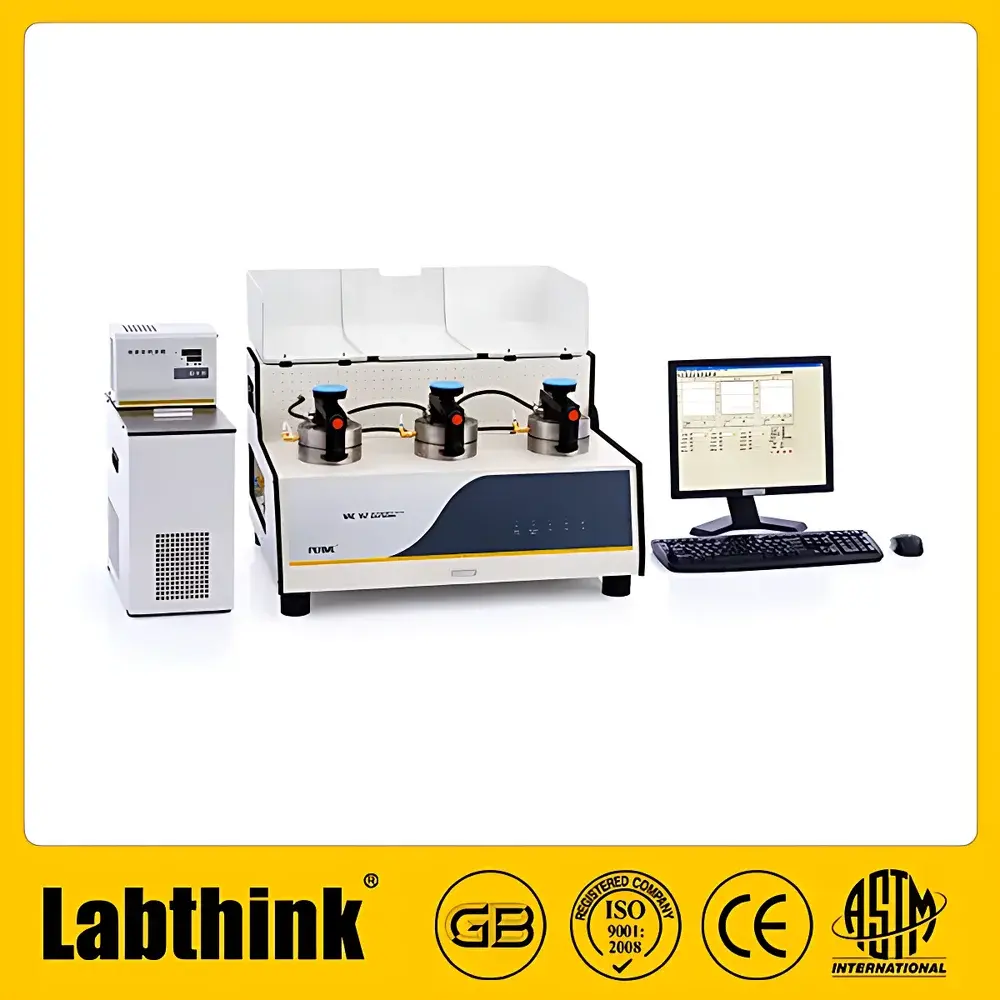
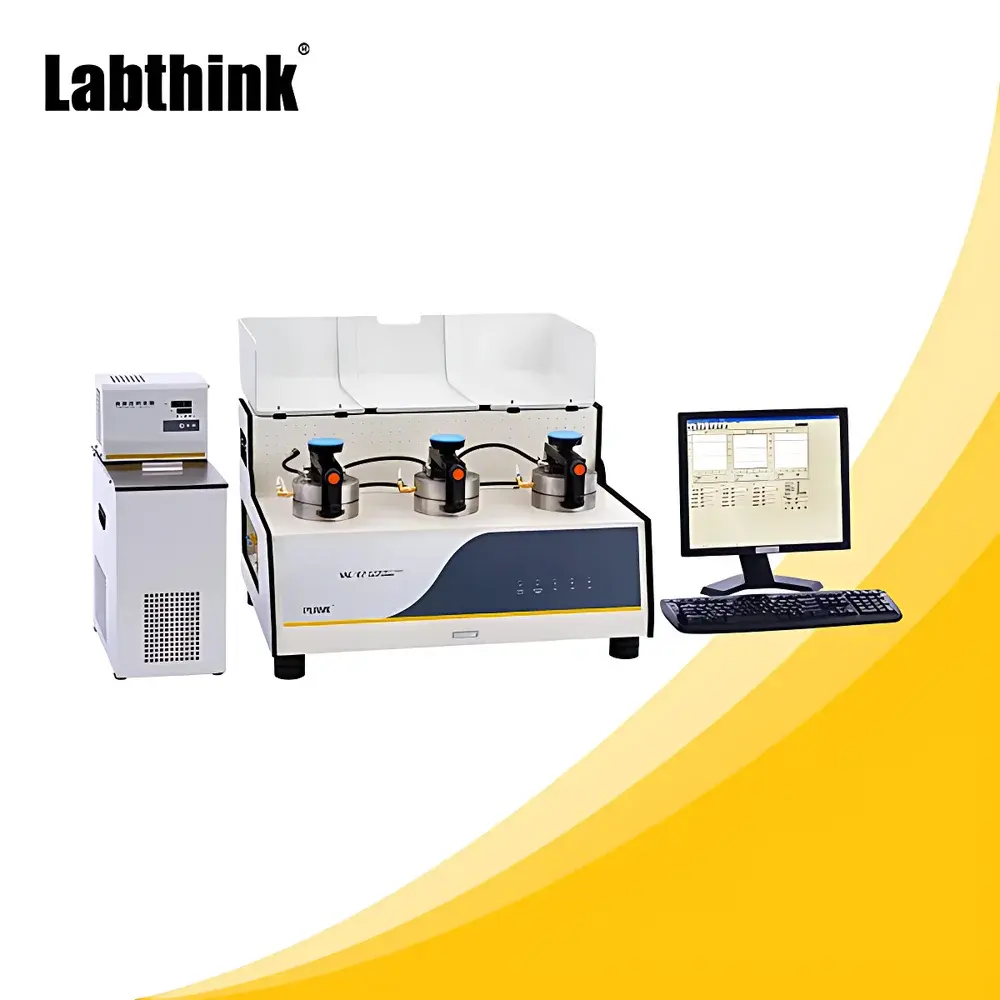
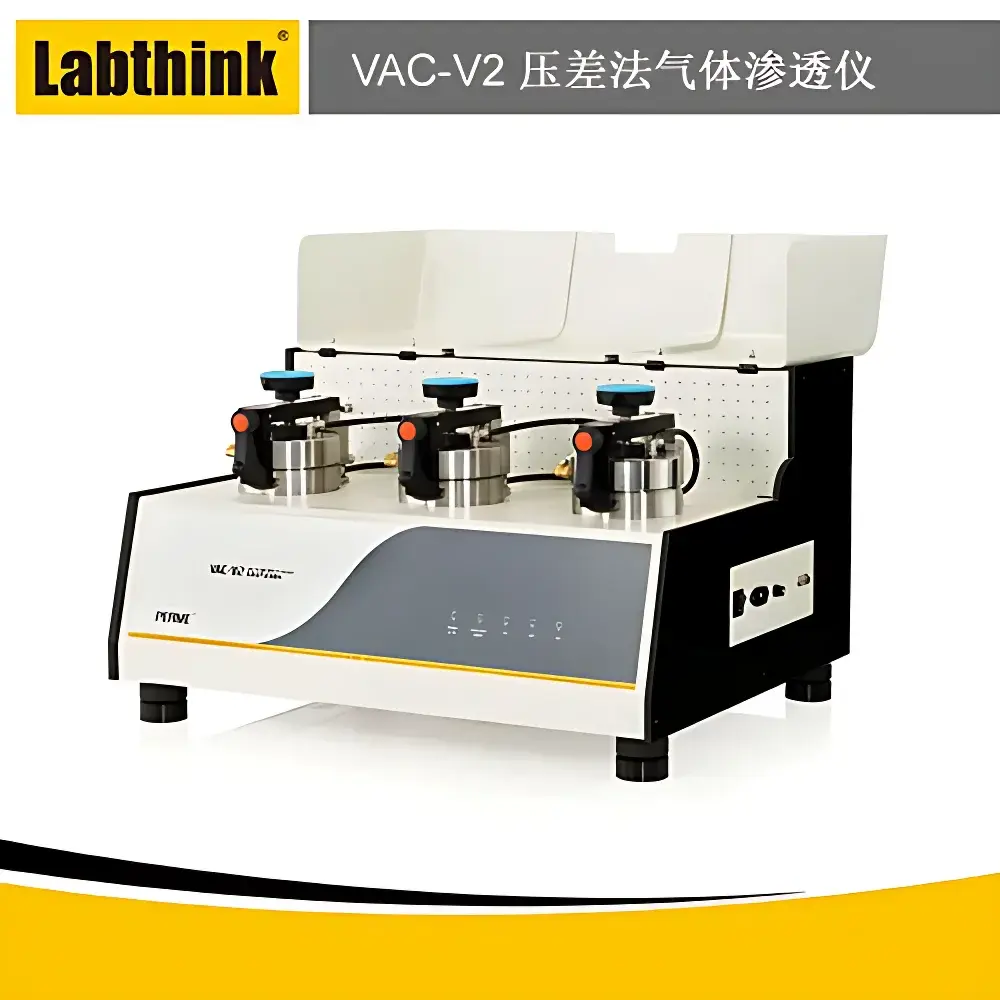
Labthink VAC-V2 Gas Permeability Tester (Methane-Specific Configuration)
| Brand | Labthink |
|---|---|
| Model | VAC-V2 |
| Principle | Differential Pressure Method (ASTM D1434, ISO 15105-1, GB 1038) |
| Test Range | 0.05–50,000 cm³/m²·24h·0.1MPa (standard) |
| Temperature Control | 5–95 °C, ±0.1 °C |
| Humidity Control | 0%RH, 2–98.5%RH, 100%RH (optional humidity generator required) |
| Humidity Accuracy | ±1%RH |
| Vacuum Accuracy | 0.1 Pa |
| Chamber Vacuum Level | <20 Pa |
| Sample Diameter | Φ97 mm |
| Sample Quantity | 3 independent test cells |
| Effective Test Area | 38.48 cm² |
| Test Gases | O₂, N₂, CO₂, CH₄ (CH₄-compatible configuration available with modified gas handling system) |
| Test Pressure Range | –0.1 to +0.1 MPa |
| Supply Gas Pressure | 0.4–0.6 MPa |
| Interface | Φ6 mm polyurethane tubing |
| Dimensions | 760 × 575 × 450 mm (L×W×H) |
| Weight | 88 kg |
| Power | AC 220 V, 50 Hz |
| Compliance | ISO 15105-1, ISO 2556, ASTM D1434, JIS K7126-A, YBB 00082003 |
Overview
The Labthink VAC-V2 Gas Permeability Tester is an engineered differential pressure (manometric) system designed for precise, traceable quantification of gas transmission rates—including methane (CH₄)—through polymeric films, laminates, foils, and high-barrier packaging materials. Operating in strict accordance with ISO 15105-1, ASTM D1434, and GB 1038, the instrument measures gas permeability (P), diffusion coefficient (D), and solubility coefficient (S) simultaneously via real-time low-pressure cavity monitoring under controlled thermal and hygric conditions. Its triple independent test chamber architecture enables statistically robust comparative analysis across material batches, formulations, or environmental stressors—critical for regulatory validation in food, pharmaceutical, and industrial gas containment applications where methane barrier integrity directly impacts shelf life, safety, and emissions compliance.
Key Features
- Triple independent test chambers—each with fully isolated vacuum paths, pressure sensors, and temperature zones—allow concurrent measurement of three identical or dissimilar specimens without cross-contamination or data coupling.
- High-stability thermal control (5–95 °C, ±0.1 °C) and optional humidity conditioning (0–100%RH, ±1%RH) enable accelerated aging studies and climate-specific barrier modeling per ISO 2556 Annex B.
- Dual-mode process logic: proportional control for rapid stabilization and fuzzy logic-based endpoint detection ensure reproducible transition from transient to steady-state permeation—essential for low-permeability materials exhibiting long induction periods.
- Scalable measurement range: standard mode (0.05–50,000 cm³/m²·24h·0.1MPa) extends to 500,000 cm³/m²·24h·0.1MPa using calibrated volume blocks—supporting both ultra-high-barrier films and highly permeable elastomers within a single platform.
- Methane-ready configuration: includes chemically resistant seals, stainless-steel gas pathways, and explosion-proof solenoid valving (ATEX-compliant upon request); compatible with certified CH₄ supply lines and residual gas purge protocols.
- Integrated vacuum system with imported dual-stage rotary vane pump achieves <20 Pa base pressure and 0.1 Pa resolution—meeting ISO 15105-1 vacuum integrity requirements for low-permeability validation.
- Automated calibration routine using certified reference films (e.g., NIST-traceable PET/AlOx standards) ensures inter-laboratory comparability and supports GLP audit readiness.
Sample Compatibility & Compliance
The VAC-V2 accommodates rigid and flexible planar specimens up to Φ97 mm, including monolayer plastics (LDPE, PP, PET), metallized films (Al-coated PET, SiOₓ), multilayer laminates (PA/AL/PE, EVOH-containing structures), aluminum foil, and emerging bio-based barrier coatings. All test configurations adhere to ISO 15105-1’s geometric and sealing specifications, with validated gasket compression profiles preventing edge leakage. For regulated environments, the system supports 21 CFR Part 11-compliant electronic records when paired with Lystem™ Laboratory Data Management Software—including user authentication, audit trails, electronic signatures, and immutable raw data archiving. Full traceability to national metrology institutes (e.g., CNAS-accredited calibration certificates) is maintained through documented uncertainty budgets for pressure, temperature, and time measurements.
Software & Data Management
Lystem™ v3.0 software provides ISO/IEC 17025-aligned data acquisition, curve fitting, and report generation. It implements Fickian diffusion modeling to derive D and S from time-lag and steady-state slope analysis, with automatic outlier rejection based on ASTM D1434 Annex A criteria. Reports export in PDF/A-1b format with embedded metadata (test environment logs, operator ID, instrument serial number, calibration status). Integration with enterprise LIMS via RS232 or TCP/IP enables centralized result aggregation, trend analysis across production lots, and automated nonconformance flagging against predefined specification limits (e.g., CH₄ permeation <5 cm³/m²·24h·0.1MPa for LNG transport liners). Raw sensor data (.csv) and binary acquisition files (.lsm) are retained with SHA-256 checksums for forensic reprocessing.
Applications
- Quantifying methane barrier performance of landfill liner geomembranes and biogas containment films.
- Validating shelf-life predictions for packaged anaerobic foods (e.g., fermented dairy, silage) where CH₄ generation necessitates strict headspace control.
- Characterizing hydrogen and methane co-permeation in fuel cell membrane development.
- Supporting FDA submissions for pharmaceutical blister packaging containing volatile organic actives susceptible to CH₄-mediated degradation.
- Comparative assessment of nanocomposite barrier enhancement (e.g., graphene oxide, MXene) under variable RH and temperature gradients.
- Accelerated permeation testing per ASTM F1307 for medical device packaging exposed to sterilization gases containing hydrocarbon impurities.
FAQ
Can the VAC-V2 be used for methane testing out-of-the-box?
Yes—when ordered with the CH₄-specific configuration, which includes fluorocarbon-elastomer seals, passivated stainless-steel manifolds, and pressure-rated gas regulators compliant with EN 15607 for flammable gas service.
Is humidity control mandatory for methane permeation testing?
No—methane permeation is largely humidity-independent in non-polar polymers; however, RH control is essential when evaluating hydrophilic barriers (e.g., PVA, cellulose derivatives) or simulating tropical storage conditions.
How does the system handle safety-critical tests with explosive gas mixtures?
The optional ATEX Zone 2 package includes intrinsically safe circuitry, spark-resistant actuators, and continuous oxygen depletion monitoring—certified to IEC 60079-0 and EN 60079-15.
What validation documentation is provided for regulatory audits?
Each unit ships with a Factory Acceptance Test (FAT) report, ISO/IEC 17025 calibration certificate (NIST-traceable pressure and temperature sensors), and full compliance matrix mapping all hardware/software components to ISO 15105-1 clauses.
Can diffusion and solubility coefficients be exported independently for kinetic modeling?
Yes—Lystem™ outputs D (cm²/s) and S (cm³(STP)/cm³·Pa) as discrete numeric values alongside permeability (P = D × S), formatted for direct import into COMSOL Multiphysics or MATLAB for multi-layer diffusion simulations.





