
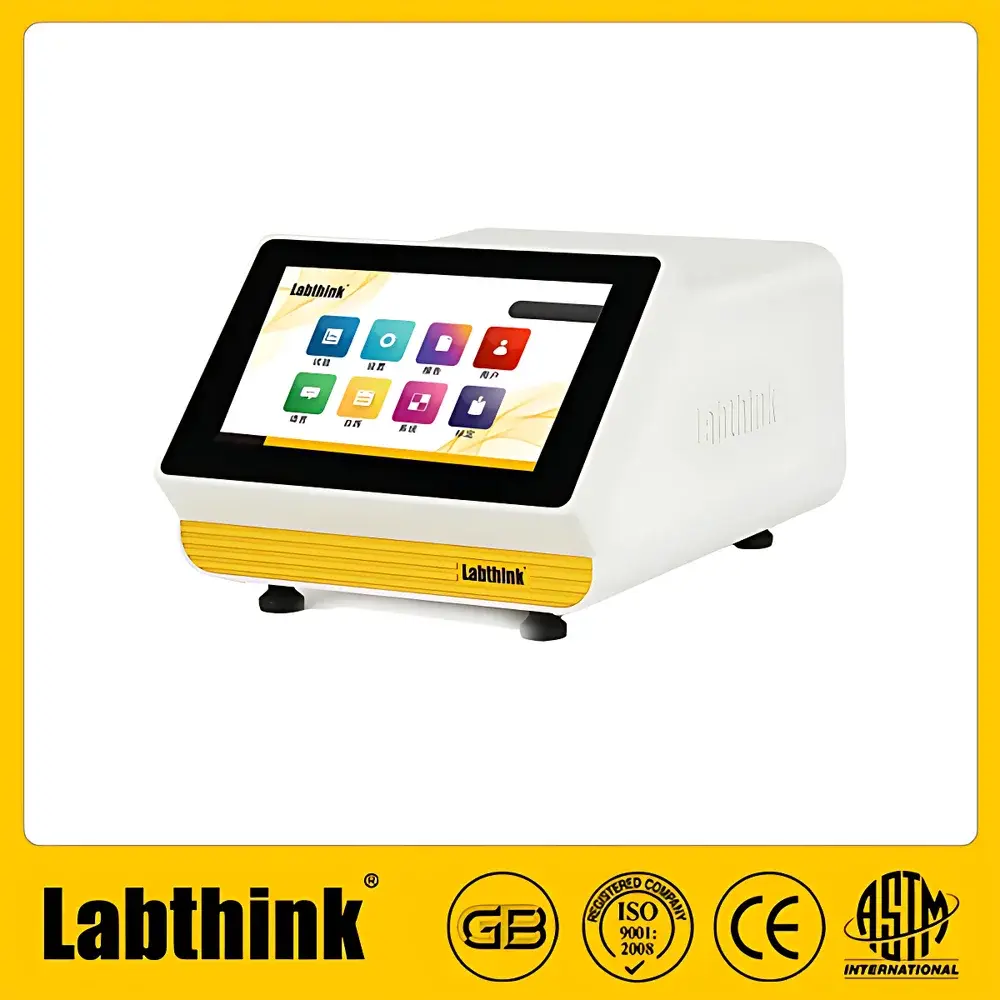
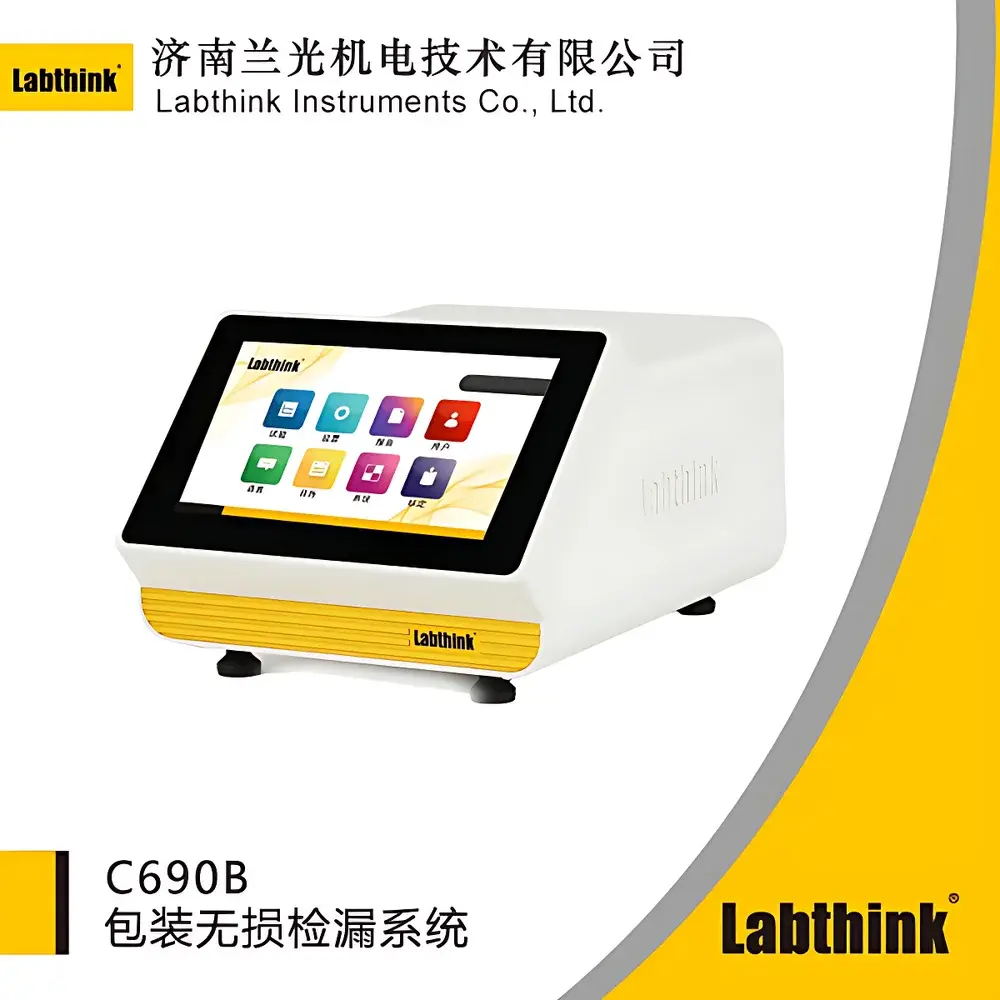
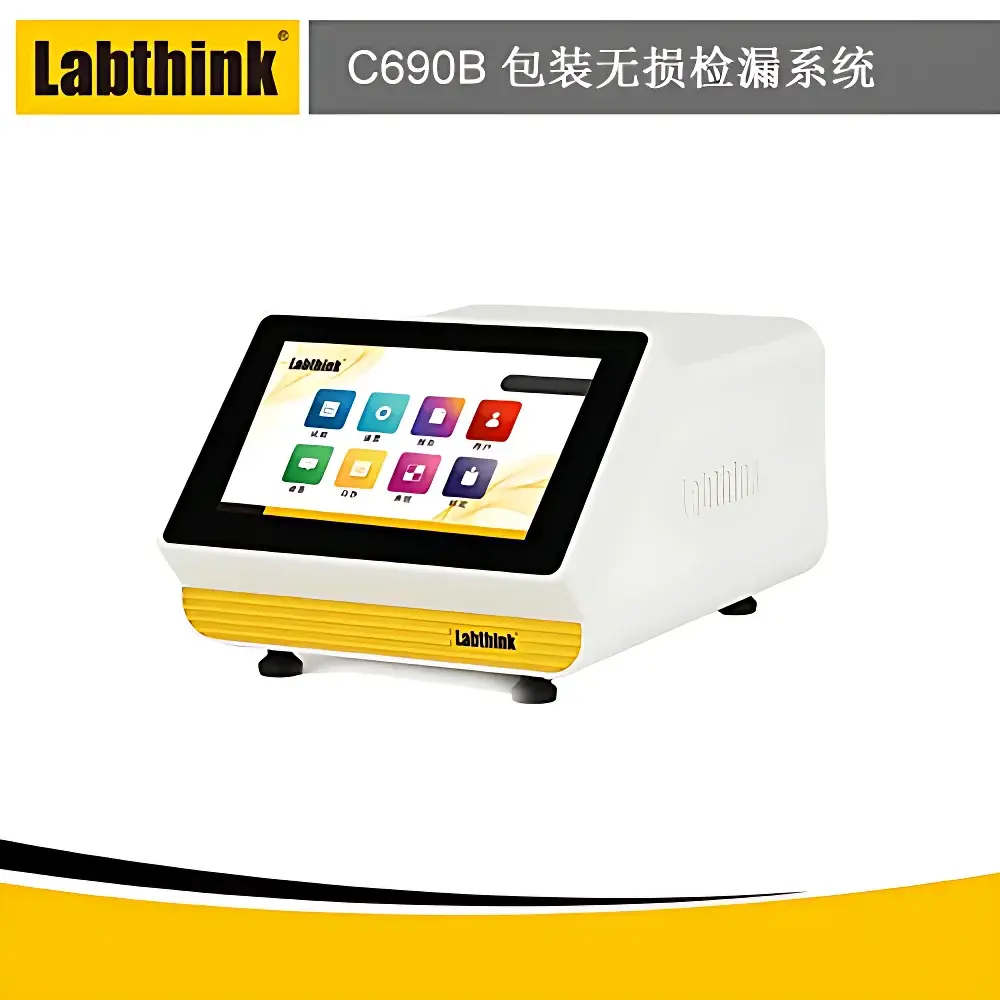
Labthink C690B Vacuum Decay Leak Tester for Packaging Integrity Verification
| Brand | Labthink |
|---|---|
| Model | C690B |
| Principle | Vacuum Decay Method |
| Standards Compliance | ASTM F2338, YY/T 0681.18, USP <1207> |
| Test Range | 3–8 µm (USP <1207> reference orifice) |
| Detection Limit | ≤3 µm |
| Resolution | 0.1 µm |
| Repeatability | ±1 µm |
| Pressure Range | −100 to 0 kPa |
| Chamber Dimensions | ≤Φ45 mm × 80 mm |
| Sample Capacity | 1 unit per test |
| Air Supply | Compressed air ≥500 kPa (60 psi), Φ6 mm polyurethane tubing |
| Power | 120 VAC ±10% / 60 Hz or 220 VAC ±10% / 50 Hz |
| Dimensions (W×D×H) | 250 × 330 × 440 mm |
| Weight | 10 kg |
| Interface | 12.1″ industrial touchscreen, USB port, optional thermal printer |
| Data Traceability | NIST-traceable pressure sensor, audit trail, optional 21 CFR Part 11 electronic signature and GMP-compliant software modules |
Overview
The Labthink C690B Vacuum Decay Leak Tester is an engineered solution for non-destructive, quantitative integrity verification of rigid and semi-rigid pharmaceutical and food packaging. It operates on the vacuum decay principle—a deterministic, pressure-based physical method in which a sealed test chamber containing the sample is evacuated to a user-defined target vacuum level; subsequent pressure rise over time is measured with high-stability differential pressure transducers. The rate of pressure increase correlates directly to leakage flow rate under controlled conditions, enabling precise quantification of leak size in micrometers (µm) referenced to standardized orifice equivalents per USP . Unlike subjective dye ingress or bubble emission methods, vacuum decay delivers objective, repeatable, and statistically defensible results suitable for regulatory submission and process validation. Its design adheres strictly to ASTM F2338–22 (“Standard Test Method for Nondestructive Detection of Leaks in Packages by Vacuum Decay Method”) and supports alignment with ISO 11607-2, FDA guidance on container closure integrity testing (CCIT), and ICH Q5C stability requirements.
Key Features
- High-resolution vacuum decay measurement with ≤3 µm detection limit and ±1 µm repeatability—validated against NIST-traceable pressure standards
- User-configurable vacuum setpoint (−100 to 0 kPa) to accommodate diverse package geometries, materials, and seal strength profiles
- Integrated micro-flow control system enabling dynamic compensation for chamber volume and temperature drift—eliminating manual pressure/flow tuning
- Real-time pressure curve visualization on a 12.1″ industrial-grade capacitive touchscreen with intuitive flat-layout UI optimized for glove-compatible operation
- Automated leakage quantification: software calculates equivalent leak diameter (in µm), normalized leakage rate (Pa·s⁻¹), and pass/fail status per predefined acceptance criteria
- Fully traceable data architecture: timestamped raw pressure readings, environmental metadata (ambient T/P), operator ID, and instrument calibration status are embedded in each test record
- Modular compliance readiness: optional 21 CFR Part 11-compliant software module with role-based access control, electronic signatures, and immutable audit trail generation
Sample Compatibility & Compliance
The C690B accommodates primary packaging formats common across biopharma and food manufacturing, including vials (glass and polymer), ampoules, cartridges (cartridge syringes), pre-filled syringes, blister cards, pouches, trays, and rigid containers up to Φ45 mm × 80 mm. Its single-chamber configuration ensures consistent test environment control, minimizing inter-sample variability. The system meets essential regulatory expectations for CCIT method validation per USP , including specificity, accuracy, precision, linearity, range, and robustness. Optional custom chamber fabrication and certified negative/positive reference standards (e.g., laser-drilled stainless steel orifices per ISO 20483) support IQ/OQ/PQ execution and ongoing performance qualification per GMP Annex 15 and EU GMP Chapter 4.
Software & Data Management
Labthink’s proprietary C690B Control Software provides full lifecycle data governance—from test definition and parameter setup to statistical reporting and export. All measurements are stored in encrypted SQLite databases with SHA-256 hashing; raw pressure vs. time datasets are exportable in CSV and PDF formats compliant with ALCOA+ principles (Attributable, Legible, Contemporaneous, Original, Accurate, Complete, Consistent, Enduring, Available). The system supports automated report generation (including summary statistics, trend charts, and failure root cause flags), scheduled backups to network drives, and integration with LIMS via configurable RESTful API endpoints. When equipped with the GMP Software Package, it enforces multi-level user authentication, session timeouts, change control logs, and electronic signature workflows aligned with 21 CFR Part 11 Subpart B requirements.
Applications
- Pharmaceutical container closure integrity testing: sterility assurance for lyophilized vials, liquid-filled ampoules, and silicone-coated pre-filled syringes
- Food packaging shelf-life validation: detecting micro-leaks in retort pouches, aluminum-laminated sachets, and PET beverage bottles prior to distribution
- Process development support: evaluating seal bar parameters, heat-seal dwell time, and material compatibility during packaging line qualification
- Stability study monitoring: longitudinal CCIT assessment at accelerated and real-time storage conditions per ICH Q1 guidelines
- Supplier quality auditing: objective benchmarking of incoming packaging components against internal specifications and USP thresholds
FAQ
What leak sizes can the C690B reliably detect?
Under standard operating conditions and with proper method validation, the C690B achieves a detection limit of ≤3 µm (equivalent to a USP Class III orifice), with quantification range spanning 3–8 µm and extended capability up to macro-leak levels depending on test duration and chamber configuration.
Is compressed air required—and what specifications apply?
Yes. A clean, dry, oil-free compressed air supply ≥500 kPa (72.5 psi) is mandatory for vacuum pump cooling and pneumatic actuation. Inlet connection uses standard Φ6 mm polyurethane tubing; pressure regulators and particulate/moisture filters are recommended upstream.
How does the system ensure measurement traceability?
All pressure sensors are factory-calibrated against NIST-traceable reference standards, with calibration certificates provided. Each test record embeds sensor serial number, calibration due date, and deviation logs—fully auditable during regulatory inspections.
Can the C690B be integrated into a fully automated production line?
While designed primarily for lab-based QC and R&D, the C690B supports external trigger signals (TTL/RS-232) and programmable test sequences via its SDK. Integration with robotic sample handlers or conveyor-linked fixtures requires custom engineering and is validated on a case-by-case basis.
Does the system support multi-language interfaces or regional regulatory templates?
The base software interface is English-only. However, report templates—including those pre-formatted for EMA Annex 1, PMDA MHLW Notification No. 247, and Health Canada Guidance on Sterile Product Packaging—can be configured upon request as part of the GMP Software Package.





