
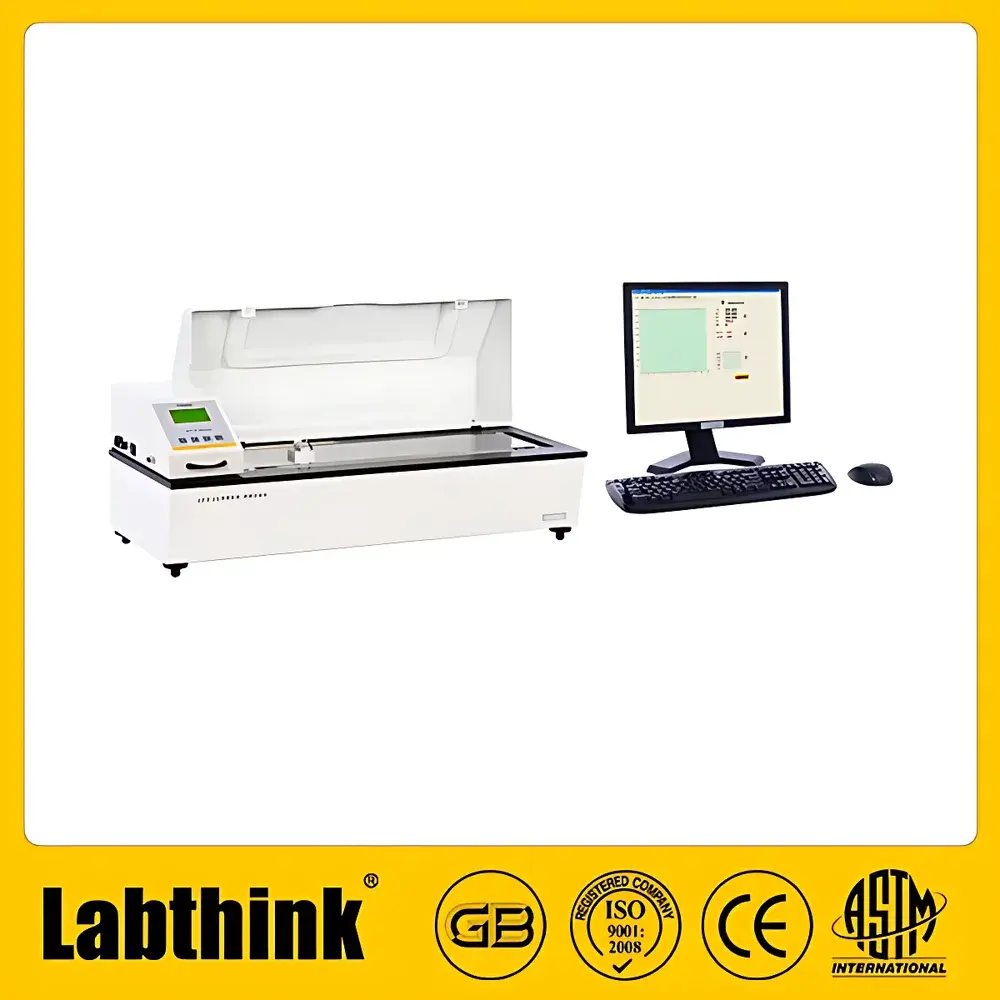
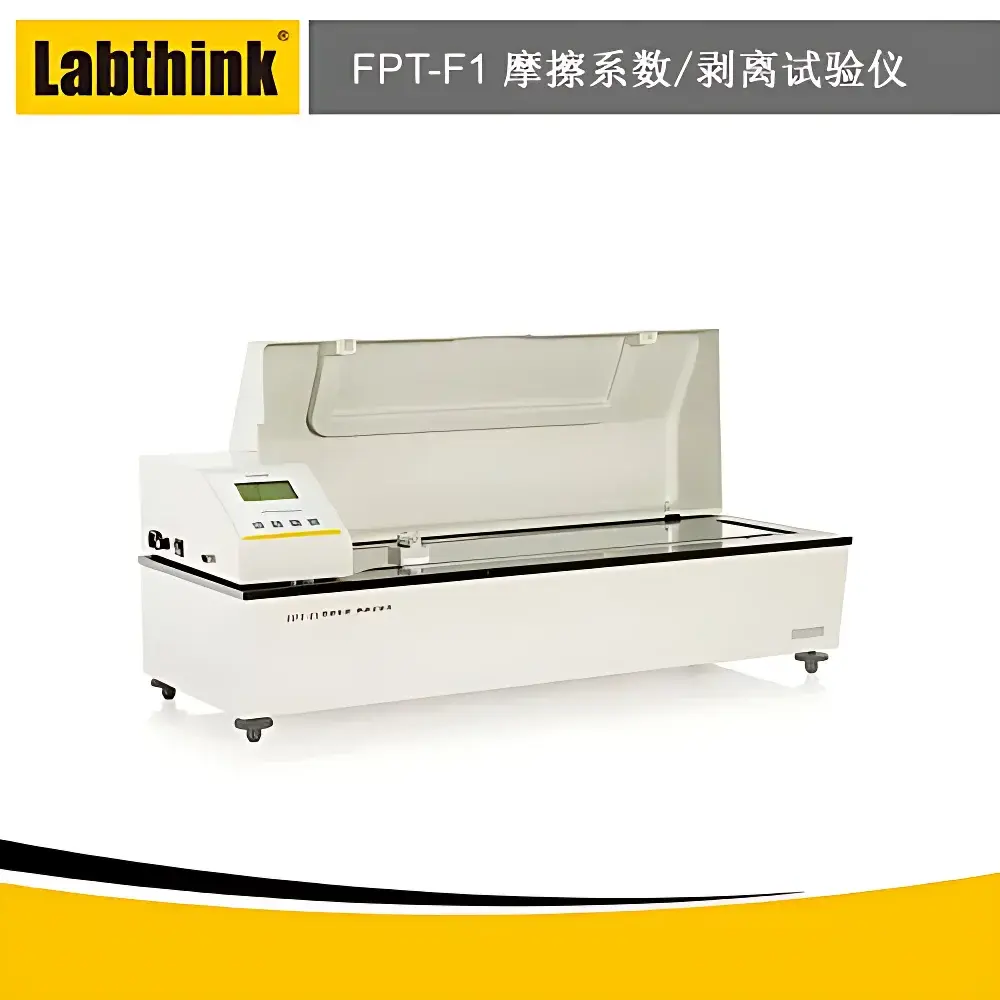
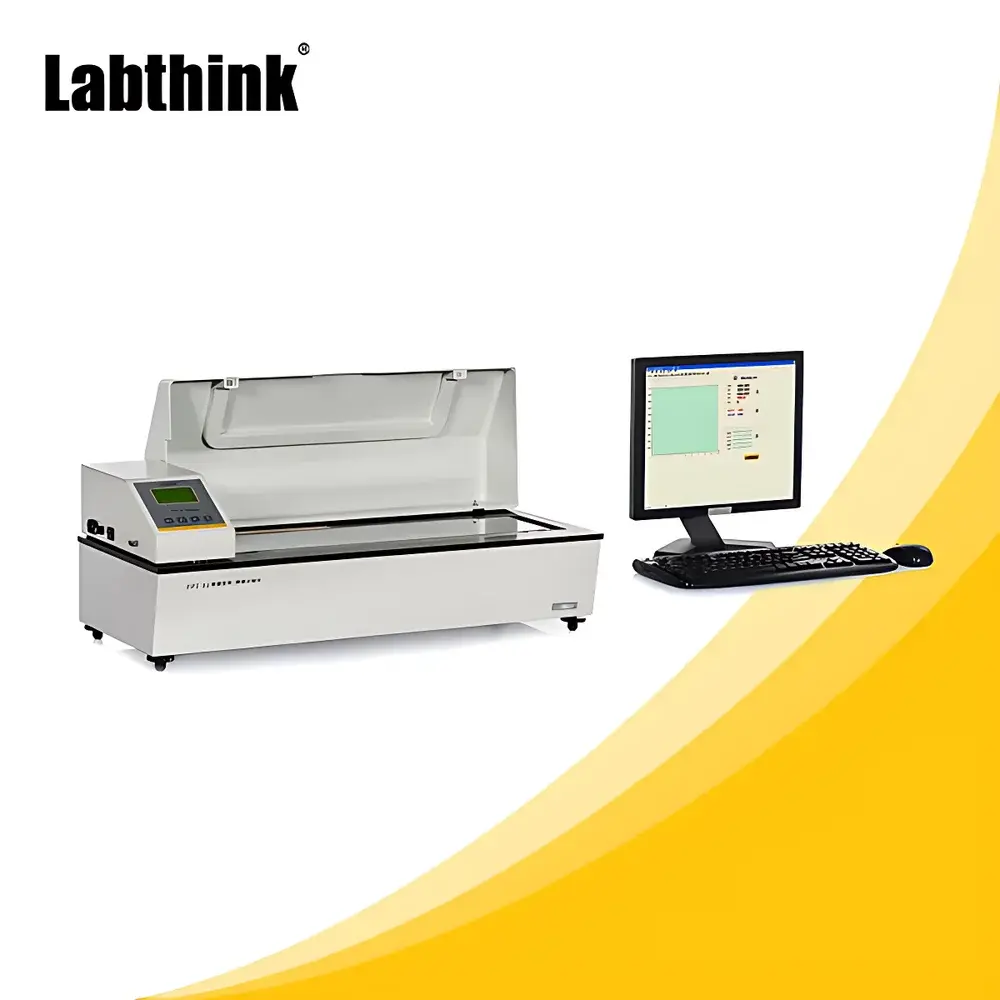
Labthink FPT-F1 Coefficient of Friction and Peel Strength Tester
| Brand | Labthink |
|---|---|
| Origin | Shandong, China |
| Manufacturer Type | Direct Manufacturer |
| Model | FPT-F1 |
| Test Force Range | 0–5 N / 0–10 N / 0–30 N |
| Accuracy Class | 0.5 |
| Standard Slider Masses | 200 g, 500 g (optional: 100 g, 1000 g, 1814 g, 2000 g) |
| Test Speeds | 50, 100, 150, 200, 250, 300, 500 mm/min |
| Temperature Control Range | Ambient to 99.9 °C |
| Power Supply | AC 220 V 50 Hz / AC 120 V 60 Hz |
| Dimensions (L×W×H) | 850 × 350 × 290 mm |
| Net Weight | 30 kg |
| Compliance | ISO 8295, ISO 8510-2, GB 10006, GB/T 2790–2792, ASTM D1894, ASTM D4917, ASTM D3330, TAPPI T816, TAPPI T549 |
Overview
The Labthink FPT-F1 Coefficient of Friction and Peel Strength Tester is an electromechanical testing system engineered for precision measurement of static and kinetic coefficients of friction (COF), as well as peel strength of flexible packaging materials and related laminates. It operates on the fundamental principles of tribological force measurement—applying controlled normal load via calibrated slider mass and measuring tangential resistance during linear motion—and peel mechanics governed by ASTM D1894 and ISO 8295 methodologies. Designed specifically for quality control laboratories in packaging R&D, contract manufacturing, and regulatory compliance units, the FPT-F1 delivers traceable, repeatable data under standardized environmental conditions—including programmable thermal regulation up to 99.9 °C—enabling evaluation of temperature-dependent interfacial behavior critical for hot-fill, retort, or cold-chain applications.
Key Features
- Dual-mode operation: Independent COF testing (static/kinetic) and 180° peel strength measurement using interchangeable fixtures and calibrated load cells.
- Multi-range force sensing: Three selectable test capacities (0–5 N, 0–10 N, 0–30 N) with 0.5-class accuracy per JJG 475 metrological standard, ensuring resolution adequacy across low-force film slip and high-strength laminate delamination.
- Thermally regulated test platform: Peltier-assisted temperature control (ambient to 99.9 °C) with real-time monitoring and stability ≤ ±0.3 °C, supporting ISO 8510-2 and GB/T 2790 thermal preconditioning protocols.
- Seven discrete test speeds (50–500 mm/min): Configurable to match material viscoelastic response, aligning with ASTM D1894 speed requirements and enabling comparative analysis of rate-dependent frictional behavior.
- Demagnetized mechanical train: Test bed and sliders undergo certified degaussing and residual magnetism verification (<0.2 mT), minimizing electromagnetic interference with strain gauge signal integrity.
- Microprocessor + PC hybrid architecture: Embedded controller handles real-time motor positioning and sensor sampling at 100 Hz; host PC manages parameter setup, curve visualization, and statistical reporting.
Sample Compatibility & Compliance
The FPT-F1 accommodates a broad spectrum of planar and laminated substrates used across packaging, medical device, and industrial tape sectors—including BOPP, PET, PE films; aluminum foils; kraft paper and corrugated board; pressure-sensitive adhesives (PSAs); release liners; protective films; and medical transdermal patches. Its mechanical design conforms to dimensional tolerances specified in ISO 8295 Annex A for slider geometry and surface finish. All test methods are implemented in strict accordance with harmonized international standards: static/dynamic COF per ISO 8295 and ASTM D1894; peel adhesion per ISO 8510-2, ASTM D3330 (for PSA tapes), ASTM D4917 (for medical adhesives), and GB/T 2790–2792 series. The system supports audit-ready documentation workflows compliant with GLP and GMP environments, including user access control, electronic signatures, and full audit trail logging when operated with validated software configuration.
Software & Data Management
The proprietary FPT-Series software provides ISO/IEC 17025-aligned data acquisition and analysis capabilities. It enables real-time force–displacement curve plotting, automatic peak detection for static COF, plateau averaging for kinetic COF, and linear regression-based peel strength calculation per ASTM D903 methodology. Multi-curve overlay functionality permits direct comparison of replicate tests or cross-material evaluations. Statistical outputs include mean, SD, CV%, min/max, and 95% confidence intervals. Raw data exports to CSV and PDF formats; metadata (operator ID, timestamp, environmental conditions, calibration certificate IDs) is embedded in each dataset. USB 2.0 interface ensures plug-and-play connectivity with Windows-based laboratory PCs; optional integration with LIMS via TCP/IP is available through API extension.
Applications
- Quality assurance of roll-fed packaging films for high-speed filling lines—verifying slip performance to prevent jamming or misfeeds.
- Evaluation of heat-seal layer compatibility in multilayer pouches under elevated temperature conditions mimicking packaging line environments.
- Regulatory submission support for FDA 510(k) or MDR Class I/II medical devices requiring documented peel strength of sterile barrier systems (e.g., Tyvek®-film pouches).
- Formulation development of pressure-sensitive adhesives, where peel force vs. dwell time and temperature profiles inform shelf-life and application specifications.
- Root-cause analysis of delamination failures in metallized or coated substrates during accelerated aging or humidity cycling studies.
- Supplier qualification testing against contractual COF limits (e.g., μs ≤ 0.35 for pharmaceutical blister lidding).
FAQ
What standards does the FPT-F1 fully support out-of-the-box?
The instrument includes preconfigured test methods for ISO 8295, ASTM D1894, GB 10006, GB/T 2790–2792, and TAPPI T816, with validation documentation provided for each.
Can the system be used for both static and kinetic COF on the same specimen?
Yes—the software automatically detects the initial breakaway peak (static COF) and calculates the average resistance over the subsequent 50 mm of travel (kinetic COF) in a single test run.
Is temperature calibration traceable to national standards?
The integrated PT100 sensor is factory-calibrated against NIST-traceable reference thermometers; optional annual recalibration services include certificate of conformance to ISO/IEC 17025.
How is data integrity ensured for regulated environments?
When configured with 21 CFR Part 11-compliant settings, the software enforces role-based access, electronic signatures, immutable audit trails, and encrypted data storage.
Are non-standard sliders or fixtures available for specialized geometries?
Yes—custom sliders (100 g to 2000 g), specialty clamps (T-peel, loop tack), and substrate-specific test plates (e.g., stainless steel, sandblasted aluminum) are available as validated accessories.





