

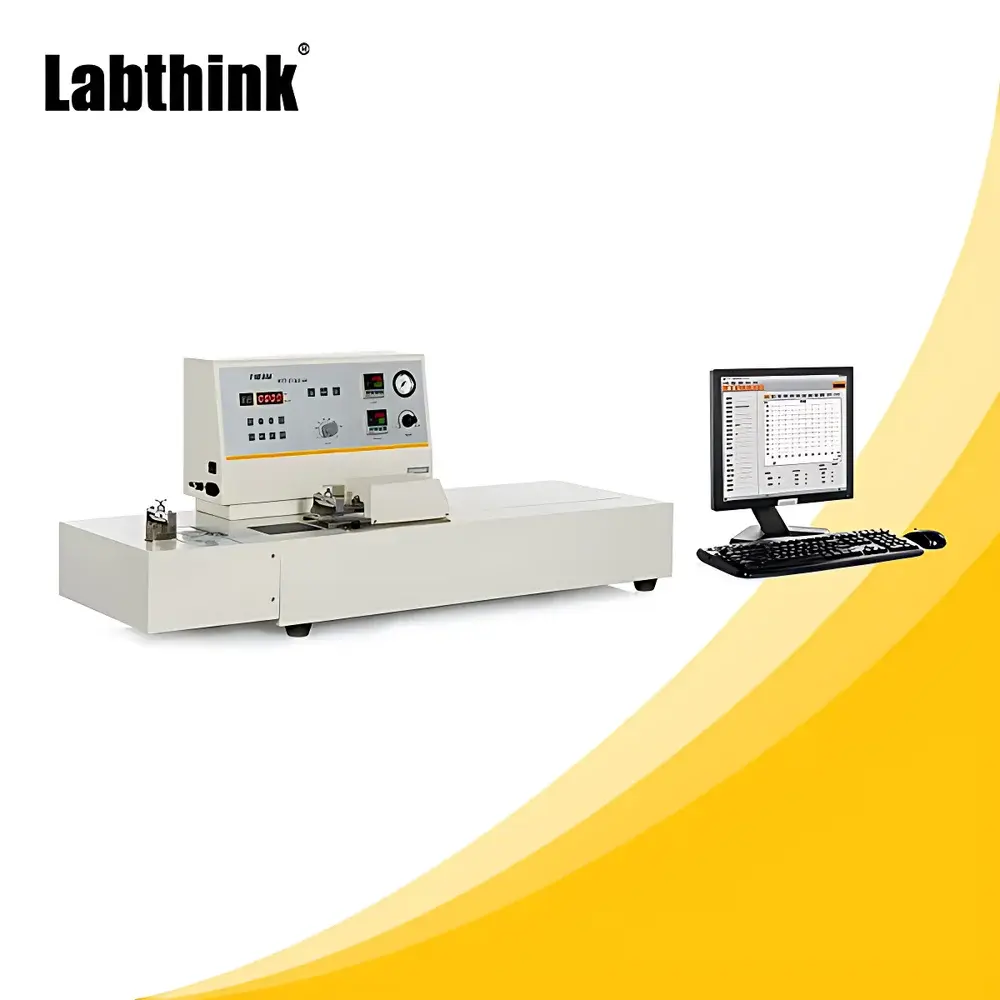

Labthink HTT-L1 Heat Sealing and Hot Tack Tester
| Brand | Labthink |
|---|---|
| Origin | Shandong, China |
| Manufacturer Type | Manufacturer |
| Country of Origin | China |
| Model | HTT-L1 |
| Price Range | USD 7,000 – 14,000 |
| Heat Seal Temperature Range | 20–250 °C |
| Temperature Control Accuracy | ±0.2 °C |
| Heat Seal Time | 0.1–999.9 s |
| Hot Tack Time | 0.1–999.9 s |
| Seal Pressure | 0.05–0.7 MPa |
| Seal Jaw Dimensions | 100 mm × 5 mm |
| Load Capacity Options | 30 N / 50 N / 100 N / 200 N |
| Force Resolution | 0.01 N |
| Force Accuracy | Class 1 |
| Test Speed Options | 100 / 150 / 200 / 300 / 500 mm/min (plus hot tack mode) |
| Specimen Width Options | 15 mm / 25 mm / 25.4 mm |
| Stroke | 500 mm |
| Power Supply | AC 220 V, 50 Hz |
| Net Weight | 45 kg |
| Dimensions (L×W×H) | 1170 mm × 360 mm × 460 mm |
| Pneumatic Interface | Φ6 mm polyurethane tubing |
| Air Supply Requirement | 0.5–0.7 MPa (user-provided) |
Overview
The Labthink HTT-L1 Heat Sealing and Hot Tack Tester is an integrated benchtop instrument engineered for precise evaluation of heat seal integrity and hot tack strength in flexible packaging materials. It operates on the principle of controlled thermal sealing followed by immediate tensile separation—enabling quantification of both sealed joint strength (heat seal strength) and transient cohesive resistance during cooling (hot tack). This dual-capability design supports critical quality assurance protocols across packaging R&D, production line validation, and regulatory compliance testing. The system employs a pneumatically actuated dual-jaw configuration with independent temperature, pressure, and dwell-time control—ensuring reproducible seal formation under defined ISO/ASTM-specified conditions. Its architecture aligns with fundamental packaging physics: seal strength depends on polymer chain interdiffusion at the interface, governed by temperature, contact time, and pressure; hot tack reflects viscoelastic resistance to deformation before full solidification. The HTT-L1 delivers traceable, repeatable data essential for optimizing sealing parameters in high-speed form-fill-seal (FFS) operations.
Key Features
- Four-in-one functional capability: simultaneous support for heat seal strength, hot tack, peel adhesion, and tensile break testing—eliminating need for multiple standalone instruments
- Digital PID temperature control with ±0.2 °C accuracy across 20–250 °C range, enabling rapid stabilization and minimal thermal overshoot during dynamic sealing cycles
- Adjustable pneumatic sealing pressure (0.05–0.7 MPa) with calibrated feedback, ensuring consistent force application regardless of ambient fluctuations
- Six selectable test speeds (100–500 mm/min) and five load cell options (30–200 N), accommodating diverse material stiffness and failure modes
- Modular jaw configuration: standard 100 mm × 5 mm sealing surface with optional single- or dual-heating configurations for asymmetric thermal profiles
- Integrated safety architecture: thermal insulation shielding, automatic jaw retraction upon completion, emergency stop, overload protection, and foot-switch/manual dual activation modes
- Microprocessor-based control with backlit LCD, intuitive PVC membrane keypad, and menu-driven navigation for rapid method setup and real-time parameter monitoring
Sample Compatibility & Compliance
The HTT-L1 accommodates a broad spectrum of soft packaging substrates including mono-layer polyolefins (LDPE, PP), coextruded films, aluminum-laminated structures, metallized PET, paper-plastic composites, and medical-grade barrier pouches. It is validated for use with ASTM F1921 (hot tack test method), ASTM F2029 (heat seal strength of thermoplastic polymers), QB/T 2358 (Chinese national standard for plastic film heat seal strength), and YBB 00122003 (Chinese pharmaceutical packaging standard). All mechanical and thermal calibrations are traceable to national metrology institutes. Data acquisition complies with GLP requirements through audit-trail-enabled software (optional), supporting FDA 21 CFR Part 11 readiness when paired with Labthink’s Lystem™ Laboratory Data Management System.
Software & Data Management
The HTT-L1 features RS232 serial communication for direct integration into laboratory networks. When equipped with optional PC-based software, it enables automated test sequence programming, real-time force–displacement curve visualization, statistical analysis (mean, SD, CV%), pass/fail thresholding, and PDF/Excel report generation. All raw data—including timestamped temperature, pressure, seal time, and load–extension profiles—are stored with immutable metadata (operator ID, sample ID, environmental conditions). Lystem™ compatibility allows centralized database synchronization across multiple HTT-L1 units and complementary Labthink instruments (e.g., VAC-V2, BLD-B2), facilitating cross-platform correlation studies and long-term stability trending per ICH Q5C guidelines.
Applications
- Optimizing FFS machine sealing parameters (temperature, dwell time, pressure) for detergent pouches, laundry pod wrappers, and agrochemical sachets
- Evaluating hot tack decay profiles of ethylene-vinyl acetate (EVA) and ionomer-based sealants used in medical device pouches
- Comparing seal integrity of recycled-content PE films versus virgin resins under identical thermal histories
- Validating shelf-life stability of peel-open seals on diagnostic test kits subjected to accelerated aging (40 °C/75% RH)
- Supporting root-cause analysis of seal failures in high-humidity environments through controlled humidity chamber coupling (external)
- Generating data packages for ISO 11607-1 submissions related to sterile barrier system qualification
FAQ
What standards does the HTT-L1 directly support?
ASTM F1921, ASTM F2029, QB/T 2358, and YBB 00122003.
Is compressed air supply included with the instrument?
No—the HTT-L1 requires an external clean, dry air source (0.5–0.7 MPa) connected via Φ6 mm polyurethane tubing.
Can the sealing jaw be customized for non-standard widths or geometries?
Yes—Labthink offers custom jaw designs, including stepped, contoured, or multi-zone heating configurations upon request.
How is force calibration maintained over time?
The system includes a certified calibration bracket and NIST-traceable weights; annual recalibration is recommended per ISO/IEC 17025.
Does the HTT-L1 meet regulatory requirements for pharmaceutical packaging validation?
When used with validated software and documented SOPs, it satisfies data integrity expectations for USP and EU Annex 11 compliance.
Related Products






