
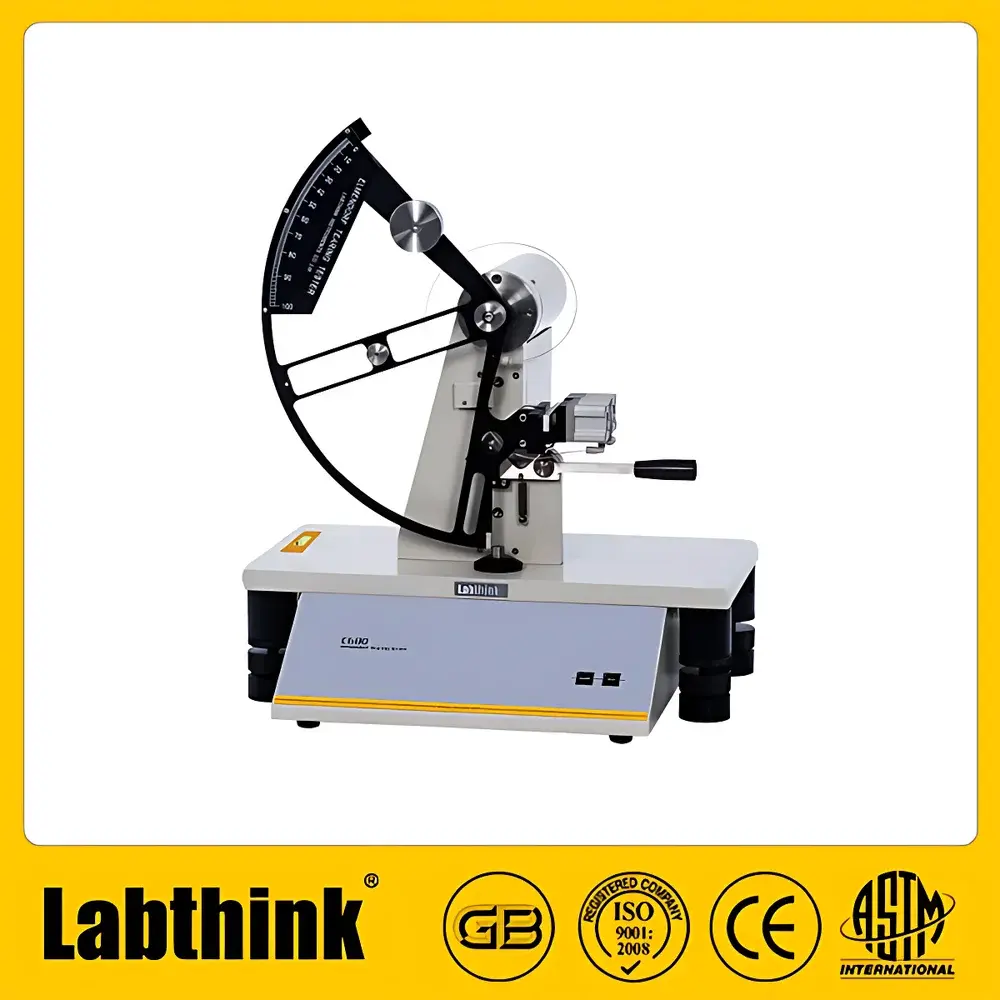
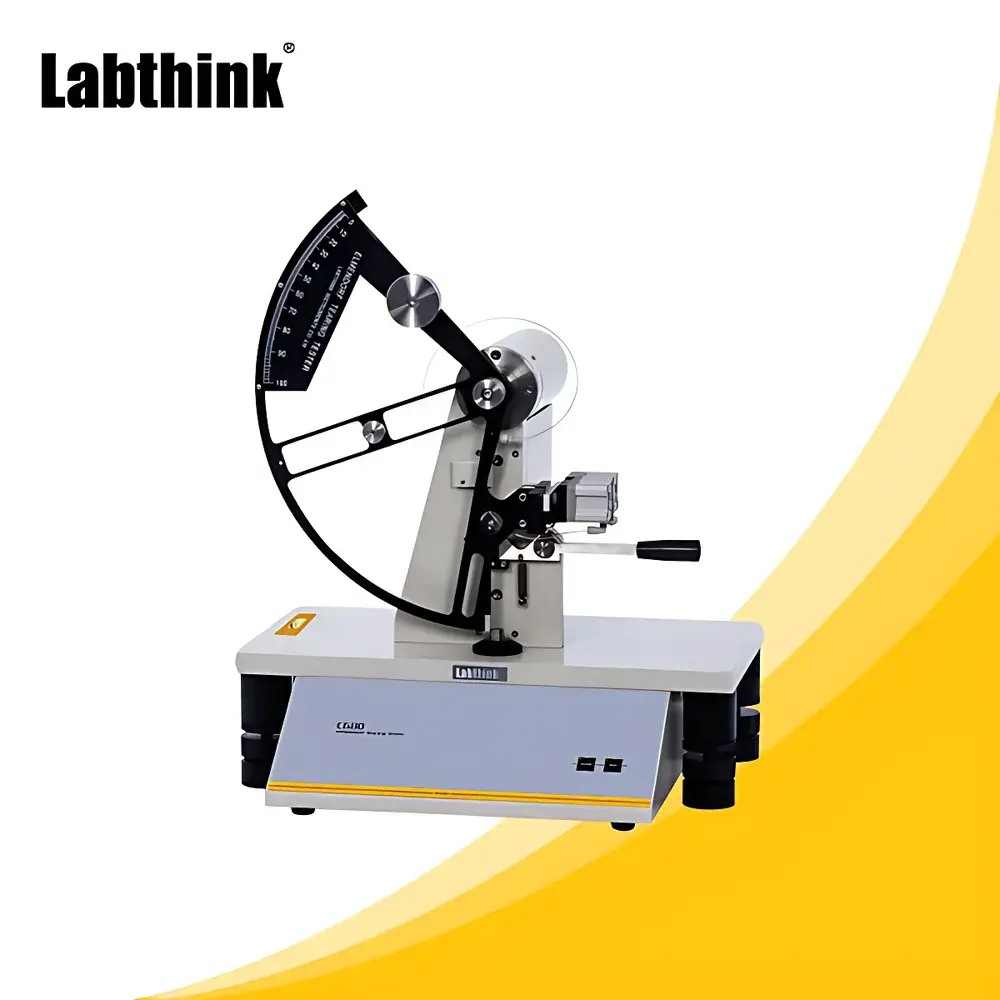
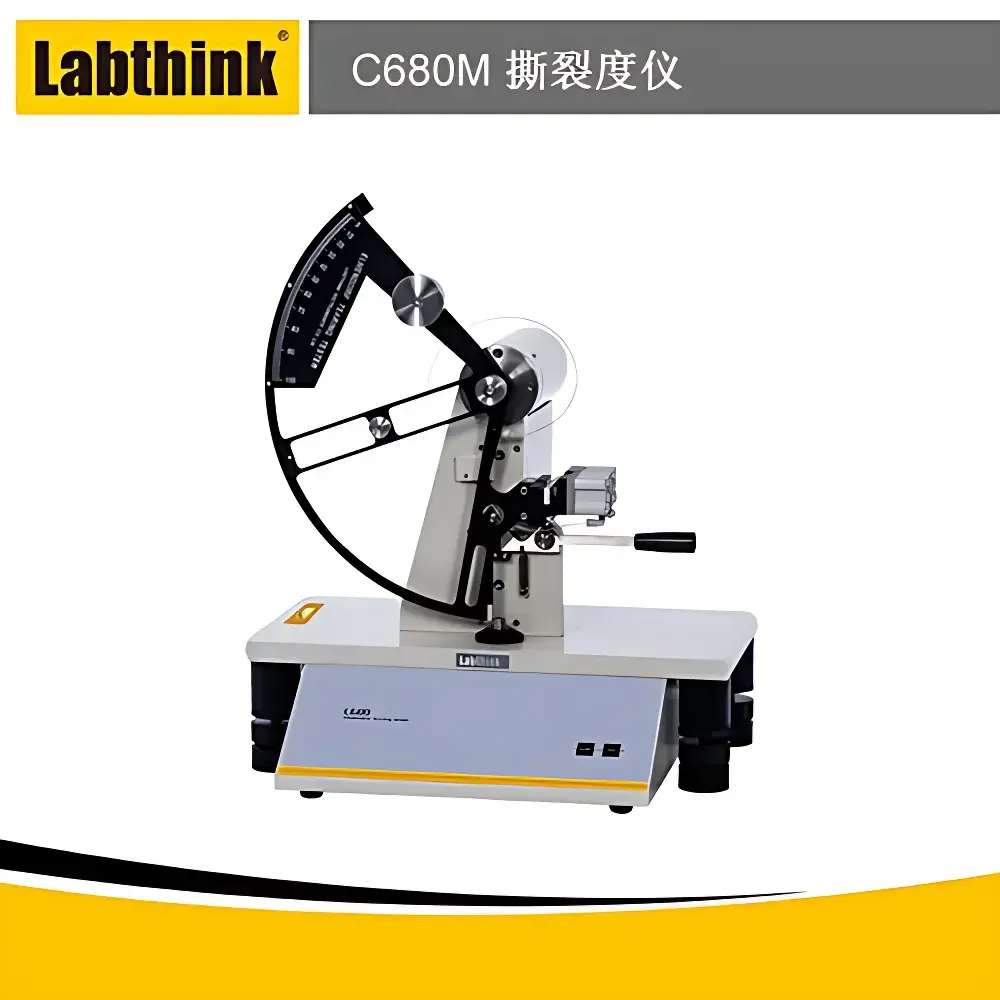
Labthink C680M Electronic Elmendorf Tear Tester
| Brand | Labthink |
|---|---|
| Model | C680M |
| Measurement Principle | Elmendorf tear method (pendulum-type energy absorption) |
| Test Range | 200–6400 gf (selectable pendulum capacities) |
| Pendulum Capacities | 200 gf, 400 gf, 800 gf, 1600 gf, 3200 gf, 6400 gf |
| Air Supply Requirement | 0.6 MPa (user-provided compressed air) |
| Air Inlet | Φ4 mm polyurethane tubing |
| Dimensions (L×W×H) | 480 × 380 × 560 mm |
| Weight | 23.5 kg (with 200 gf base pendulum) |
| Power Supply | 220 VAC 50 Hz / 120 VAC 60 Hz |
| Interface | RS232 serial port |
| Compliance Standards | ISO 6383-1:1983, ISO 6383-2:1983, ISO 1974, GB/T 16578.2–2009, GB/T 455, ASTM D1922, ASTM D1424, ASTM D689, TAPPI T414 |
Overview
The Labthink C680M Electronic Elmendorf Tear Tester is a precision-engineered instrument designed for quantitative assessment of tear resistance in flexible sheet materials using the standardized Elmendorf tear method. Based on pendulum dynamics, the system measures the energy required to propagate a pre-cut slit in a specimen under controlled gravitational acceleration. As the pendulum—loaded with a calibrated mass—swings freely from a fixed height, its kinetic energy at the point of impact initiates and propagates tearing across the notched sample. The instrument’s high-resolution optical encoder and real-time angular displacement tracking enable accurate calculation of energy loss, which is directly converted into tear force (expressed in gram-force or millinewtons). This physics-based, energy-integration approach ensures high reproducibility and alignment with internationally recognized mechanical testing paradigms for thin, anisotropic materials.
Key Features
- Computer-controlled operation with automated pendulum release and pneumatic specimen clamping—eliminating operator-induced variability and ensuring consistent jaw pressure and alignment.
- Integrated horizontal leveling assistance system with digital inclinometer feedback, enabling rapid, repeatable instrument calibration prior to each test series.
- Modular pendulum architecture supporting six interchangeable capacity configurations (200 gf to 6400 gf), allowing seamless adaptation to low-strength films or high-tensile packaging substrates without recalibration.
- Dual-unit output capability (gf, mN, cN) via embedded software; all results traceable to NIST-traceable reference weights included in standard configuration.
- RS232 serial interface compliant with industry-standard data acquisition protocols; supports direct integration with LIMS and QA/QC databases under GLP-compliant environments.
- Robust cast-aluminum frame with vibration-damped base plate, minimizing environmental interference during low-energy tear events (e.g., tissue paper or ultra-thin PVDC coatings).
Sample Compatibility & Compliance
The C680M accommodates specimens up to 75 mm wide × 63 mm long, with thicknesses ranging from 0.01 mm (e.g., metallized PET film) to 1.2 mm (e.g., corrugated board liners). Validated applications include plastic films (polyolefins, PET, BOPP), coated papers, nonwovens, woven and knitted textiles, rubber-latex gloves, and multi-layer laminates used in medical device packaging. All test procedures adhere strictly to the geometric and procedural requirements defined in ISO 1974 (paper and board), ASTM D1922 (plastic films), and TAPPI T414 (tissue and towel products). Instrument validation documentation—including as-found/as-left calibration reports, uncertainty budgets per GUM (JCGM 100:2008), and compliance matrices against ISO/IEC 17025:2017 clause 6.4—is provided upon request for regulatory audit readiness.
Software & Data Management
The proprietary TearTest v3.2 software provides full control over test execution, parameter configuration, and statistical analysis. It enforces mandatory entry of material type, lot number, and environmental conditions (temperature/humidity logged via optional external sensor input). Audit trails record every user action—including method edits, result overrides, and calibration events—with timestamps and operator IDs, satisfying FDA 21 CFR Part 11 electronic record requirements when deployed on validated Windows OS platforms. Raw angular displacement vs. time datasets are exportable in CSV and XML formats; summary reports include mean tear force, coefficient of variation (%CV), confidence intervals (95%), and pass/fail status against configurable specification limits.
Applications
Primary use cases span R&D formulation screening, incoming raw material verification, and final package integrity validation. In packaging development, the C680M quantifies directional tear anisotropy in biaxially oriented films—critical for optimizing opening performance in stand-up pouches. For paper mills, it supports ISO 455-compliant evaluation of folding endurance in banknote substrates and transit ticket stock. Regulatory submissions for pharmaceutical blister lidding (per USP ) and sterile barrier systems (ISO 11607-1) routinely cite Elmendorf tear data generated on this platform. Additional niche applications include tear propagation analysis in geotextiles (ASTM D4533), seam strength validation in protective apparel (EN 14325), and quality gate checks for lithium-ion battery separator films.
FAQ
What standards does the C680M support out-of-the-box?
Pre-configured test methods cover ISO 6383-1, ISO 1974, ASTM D1922, ASTM D1424, GB/T 455, and TAPPI T414. Custom method templates can be created for internal SOPs or emerging standards.
Is compressed air supply included with the instrument?
No—users must provide a clean, dry, oil-free air source delivering stable 0.6 MPa pressure via Φ4 mm polyurethane tubing. A desiccant-filter regulator is recommended for optimal clamp consistency.
Can the C680M measure tear resistance of multi-layer laminates?
Yes—provided the total thickness remains within the clamping gap (≤1.2 mm) and the notch geometry complies with ISO 1974 Annex A for heterogeneous structures.
How often does the pendulum require recalibration?
Annual verification against certified reference masses is recommended; however, daily verification using supplied calibration weights (200–6400 gf) satisfies ISO/IEC 17025 intermediate checks.
Does the software support multi-user role-based access control?
Yes—administrator, technician, and reviewer roles are enforced with password protection, session timeouts, and granular permission settings for method editing, result approval, and report generation.





