
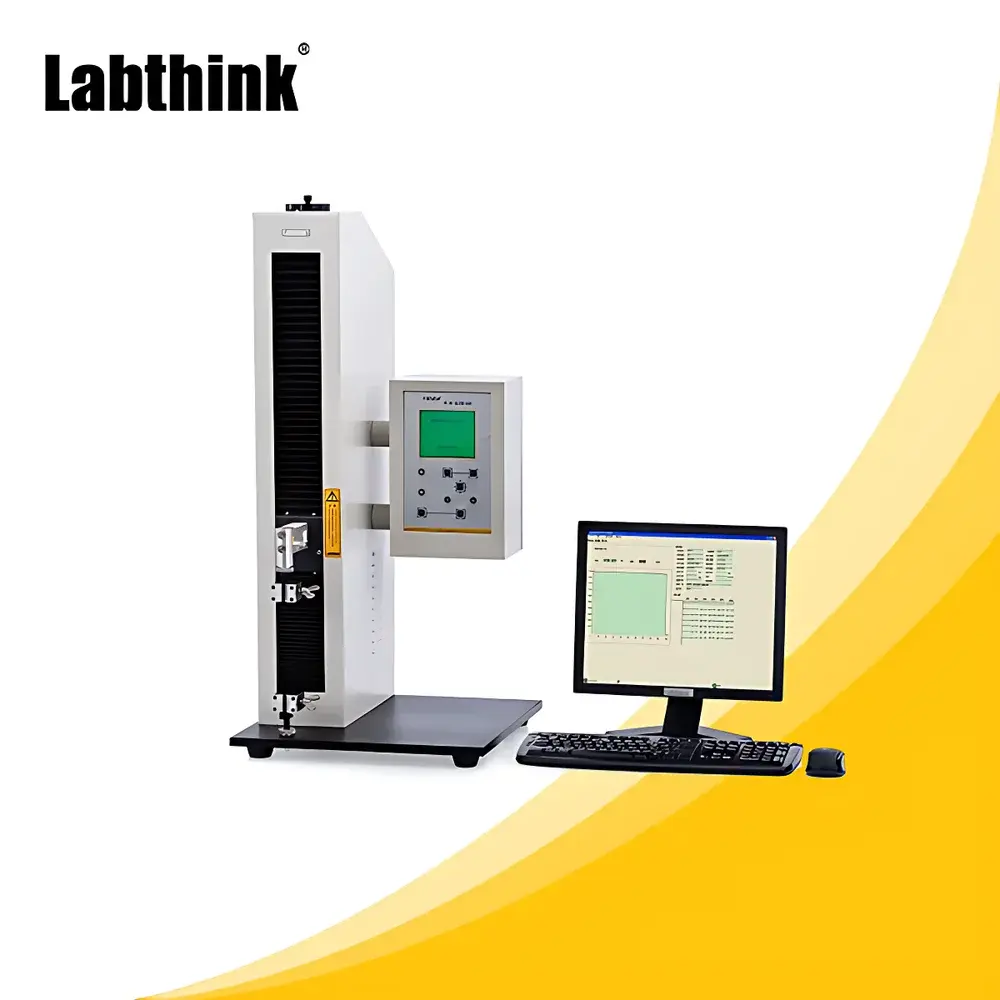
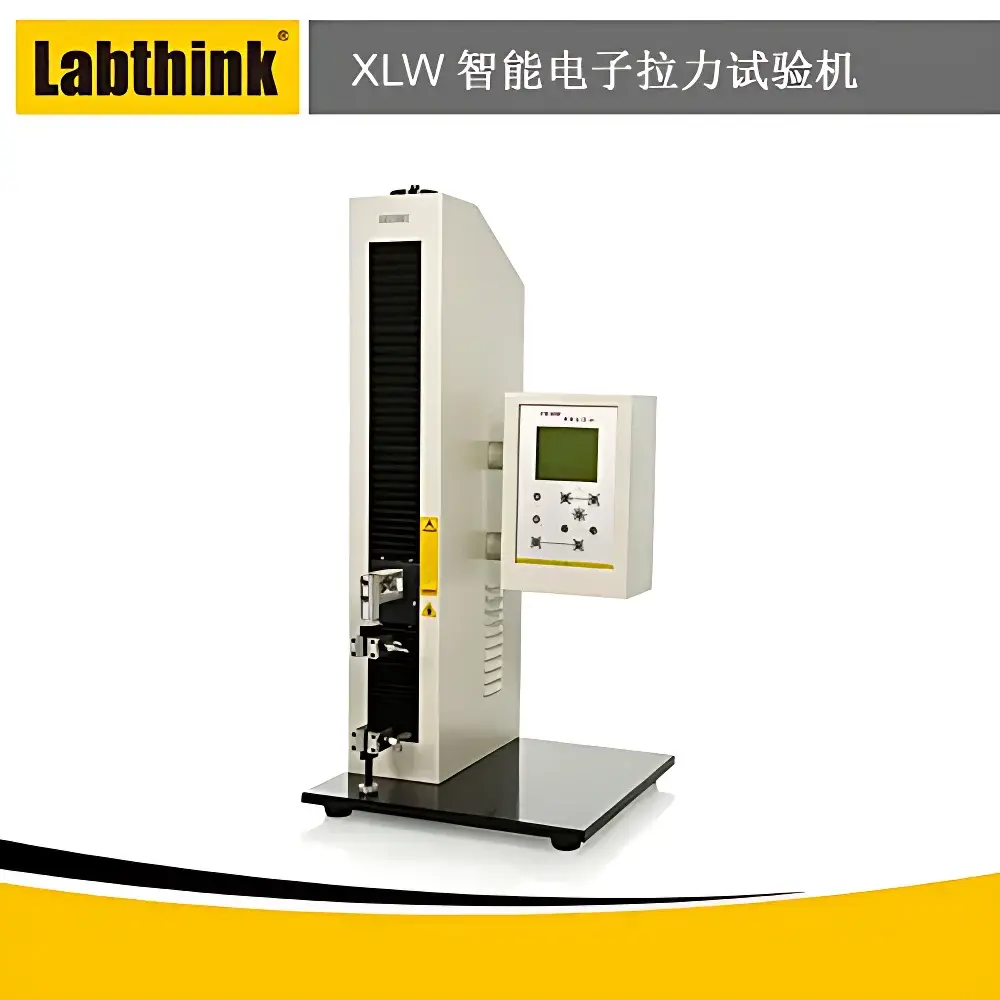
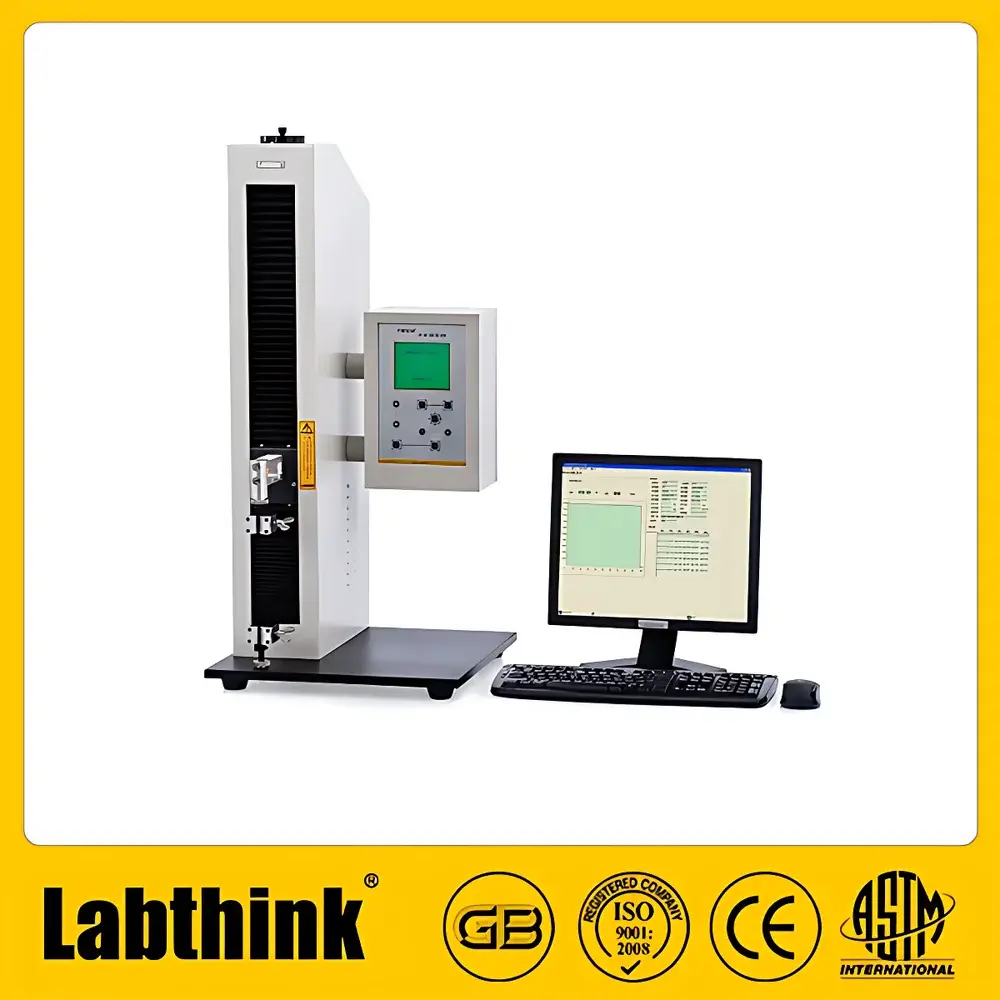
Labthink XLW Series Skin-Mimicking Puncture Resistance Tester
| Brand | Labthink |
|---|---|
| Model | XLW |
| Type | Universal Electronic Tensile & Puncture Testing Machine |
| Force Capacity | 100 N / 200 N / 500 N (selectable) |
| Accuracy Class | Class 1 per ISO 7500-1 |
| Test Speed | 50–500 mm/min (7 discrete settings) |
| Gauge Length | 30 mm (standard), 50 mm (optional) |
| Maximum Travel | 600 mm |
| Power Supply | AC 220 V, 50 Hz |
| Dimensions (L×W×H) | 450 × 450 × 980 mm |
| Net Weight | 65 kg |
Overview
The Labthink XLW Series Skin-Mimicking Puncture Resistance Tester is a precision-engineered universal testing system designed for quantitative mechanical evaluation of soft, flexible materials—particularly those requiring biomimetic performance validation in medical device, pharmaceutical packaging, and personal care applications. Operating on the fundamental principle of controlled uniaxial force application under defined displacement conditions, the instrument measures puncture resistance, tensile strength, tear propagation, peel adhesion, and deformation behavior using high-fidelity load cell transduction (±0.5% full-scale repeatability) and calibrated linear encoder-based displacement sensing. Its architecture conforms to the mechanical measurement framework specified in ISO 7500-1 (static calibration of force-measuring systems) and supports traceable test execution aligned with GLP and GMP documentation requirements. Unlike general-purpose tensile testers, the XLW series integrates dedicated fixtures and procedural logic specifically validated for skin-simulating substrate puncture—enabling reproducible assessment of needle penetration force, stopper coring resistance, and cap-seal integrity under physiologically relevant loading profiles.
Key Features
- Modular force sensor configuration: Selectable 100 N, 200 N, or 500 N load cells—each certified to ISO 7500-1 Class 1 accuracy for high-resolution low-force measurements critical in biomedical material characterization.
- Seven-step programmable crosshead speed control (50–500 mm/min), enabling compliance with dynamic test protocols such as ASTM D3330 (peel adhesion), ASTM F88 (seal strength), and ISO 11607-2 (sterile barrier system puncture).
- Dual-axis synchronized data acquisition: Simultaneous real-time capture of force (mN/N) and displacement (µm/mm) at ≥1 kHz sampling rate, ensuring fidelity in transient event detection (e.g., initial puncture breakthrough, seal delamination onset).
- Standardized fixture ecosystem: Includes 30 mm wide parallel jaw clamps (ISO 527-compliant), plus optional 50 mm jaws, angled peel fixtures (23°, 90°, 135°), floating roller assemblies, eccentric grips, and custom-designed puncture probes replicating 21G–25G hypodermic tip geometry.
- Rigid cast-iron frame with preloaded ball-screw drive ensures minimal deflection (<0.02 mm under max load) and long-term dimensional stability—essential for inter-laboratory method transfer and regulatory audit readiness.
Sample Compatibility & Compliance
The XLW platform accommodates diverse specimen geometries—from thin polymer films (≥12 µm) and elastomeric septa to laminated pouches, adhesive-coated patches, and pre-filled syringe components. It supports standardized test substrates including polyisoprene and silicone-based synthetic skin analogs (ASTM F2971-compliant), rubber stoppers (USP ), aluminum-plastic blister lidding, and child-resistant closures. All test methods implemented are directly referenced to internationally recognized standards: ISO 37 (rubber tensile properties), ISO 1421 (tear resistance), ASTM D882 (thin plastic film tensile), ASTM D1938 (trouser tear), ASTM F904 (peel strength of flexible barrier materials), and GB/T 17200 (general requirements for universal testing machines). The system’s mechanical design and software logic are fully compatible with FDA 21 CFR Part 11 electronic record and signature requirements when deployed with Labthink’s validated PC-based control suite.
Software & Data Management
Control and analysis are executed via Labthink’s proprietary WinTest™ software—a Windows-based application validated for analytical instrument qualification (AIQ) under ICH Q2(R2) guidelines. The interface provides role-based user access control, automated test method selection (with parameter locking per SOP), real-time curve overlay for comparative analysis, and customizable report generation (PDF/CSV/XLSX) containing raw data, statistical summaries (mean, SD, CV%), pass/fail flags against specification limits, and digital signatures. Audit trails log all user actions—including method edits, result deletions, and calibration events—with immutable timestamps. Data export complies with LIMS integration protocols (ODBC, HL7-ready), and raw binary files retain full sensor resolution for retrospective reprocessing.
Applications
- Medical packaging: Puncture resistance of vial stoppers, IV bag ports, and combination caps per USP and ISO 8536-4.
- Transdermal delivery systems: Quantification of microneedle insertion force into synthetic epidermis models (ASTM F2971).
- Pharmaceutical primary packaging: Seal integrity validation of cold-form blisters, heat-sealed pouches, and peel-open lids.
- Personal care devices: Brush bristle pull-out force (ISO 22867), applicator tip compression strength, and cosmetic patch adhesion durability.
- Food & beverage packaging: Yogurt cup membrane peel strength, juice pouch puncture resistance, and retort pouch seam integrity.
- Regulatory submission support: Generation of mechanically robust datasets for ISO 10993-1 biocompatibility assessments and MDR Annex I essential requirements.
FAQ
What standards does the XLW tester support for skin-mimicking puncture testing?
It supports ASTM F2971 (Standard Test Method for Measuring the Puncture Resistance of Synthetic Skin Materials) and ISO 10993-1 Annex A.2 guidance for mechanical evaluation of biomimetic substrates.
Can the system perform both tensile and puncture tests without hardware modification?
Yes—fixture interchangeability and software-defined test profiles allow seamless transition between tensile, peel, tear, and puncture modes using the same base unit.
Is the force sensor calibration traceable to national metrology institutes?
All load cells ship with NIST-traceable calibration certificates issued by CNAS-accredited laboratories, valid for 12 months under standard operating conditions.
Does the software meet FDA 21 CFR Part 11 requirements?
When configured with WinTest™ v3.2 or later and deployed on a validated Windows OS environment, the system satisfies electronic signature, audit trail, and data integrity provisions of 21 CFR Part 11.
What is the minimum resolvable force value at the 100 N range?
The system achieves ≤0.01 N resolution at full scale, enabling precise quantification of low-force interactions typical in soft-tissue mimicry and micro-device testing.



