
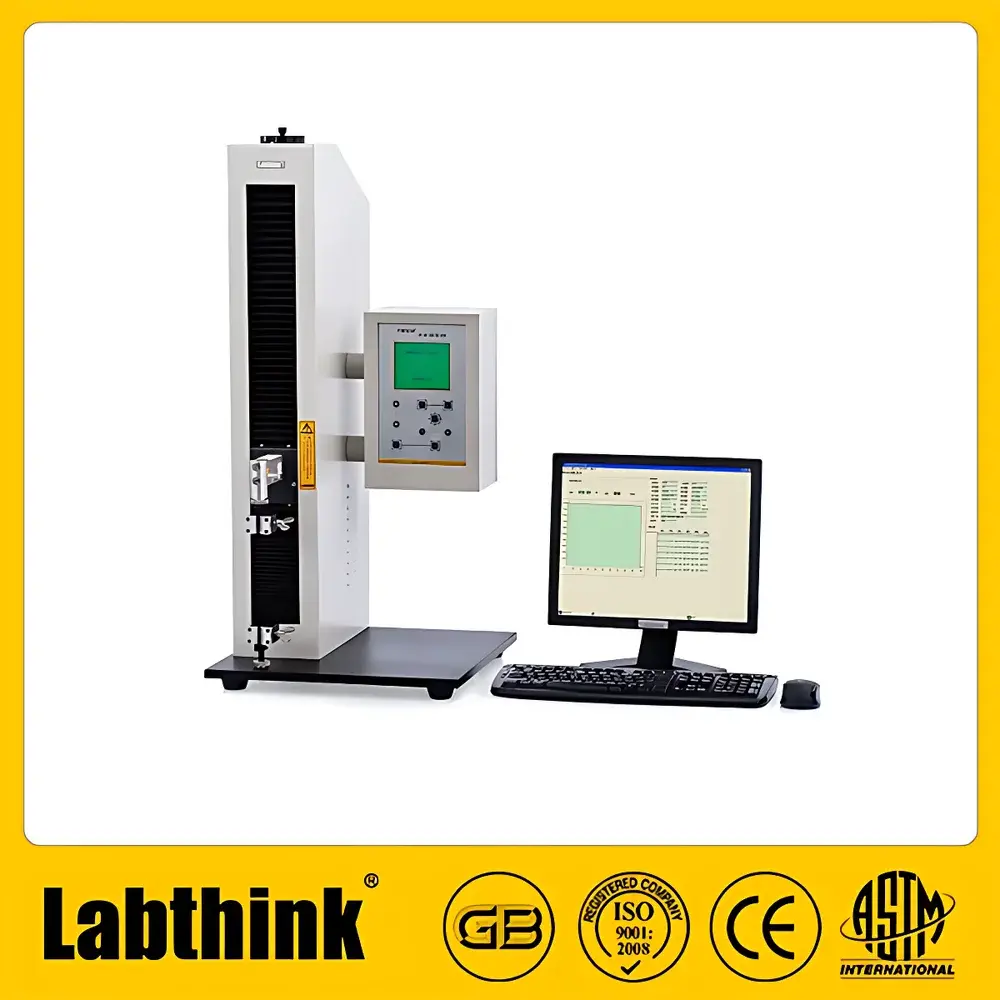
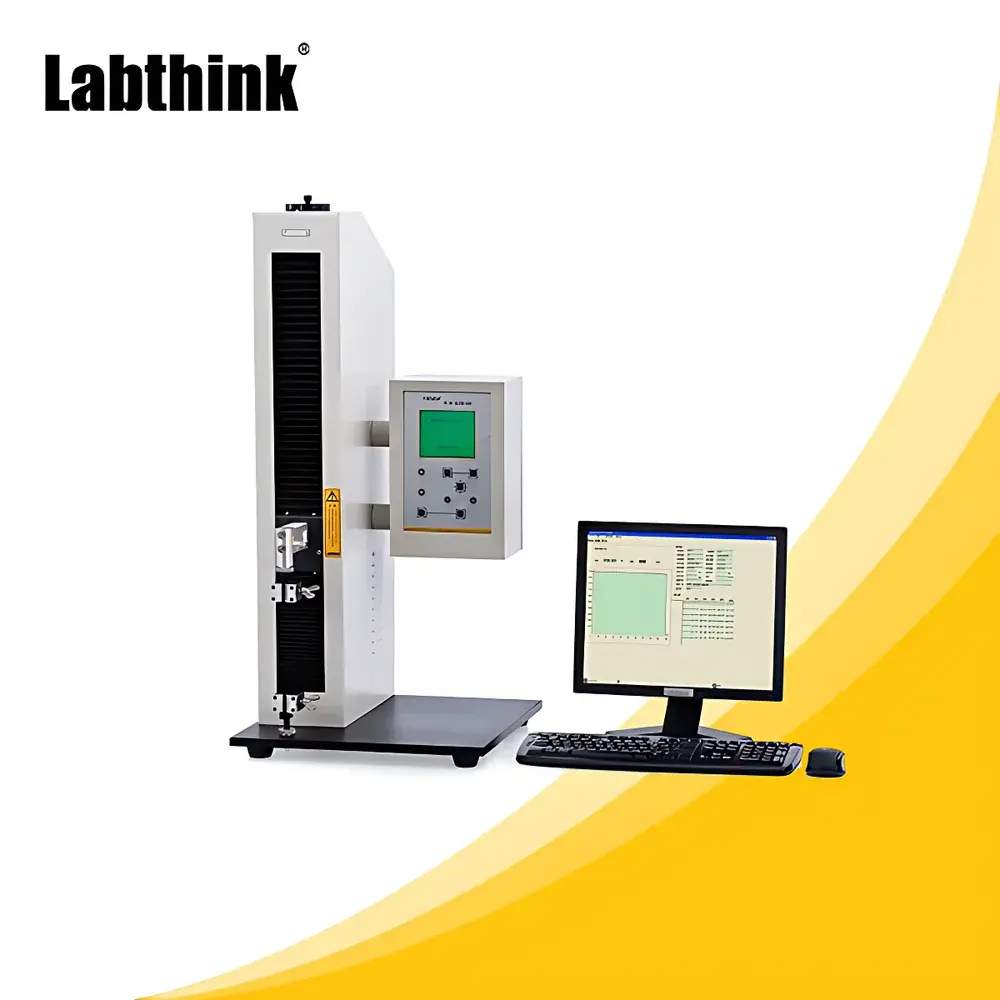
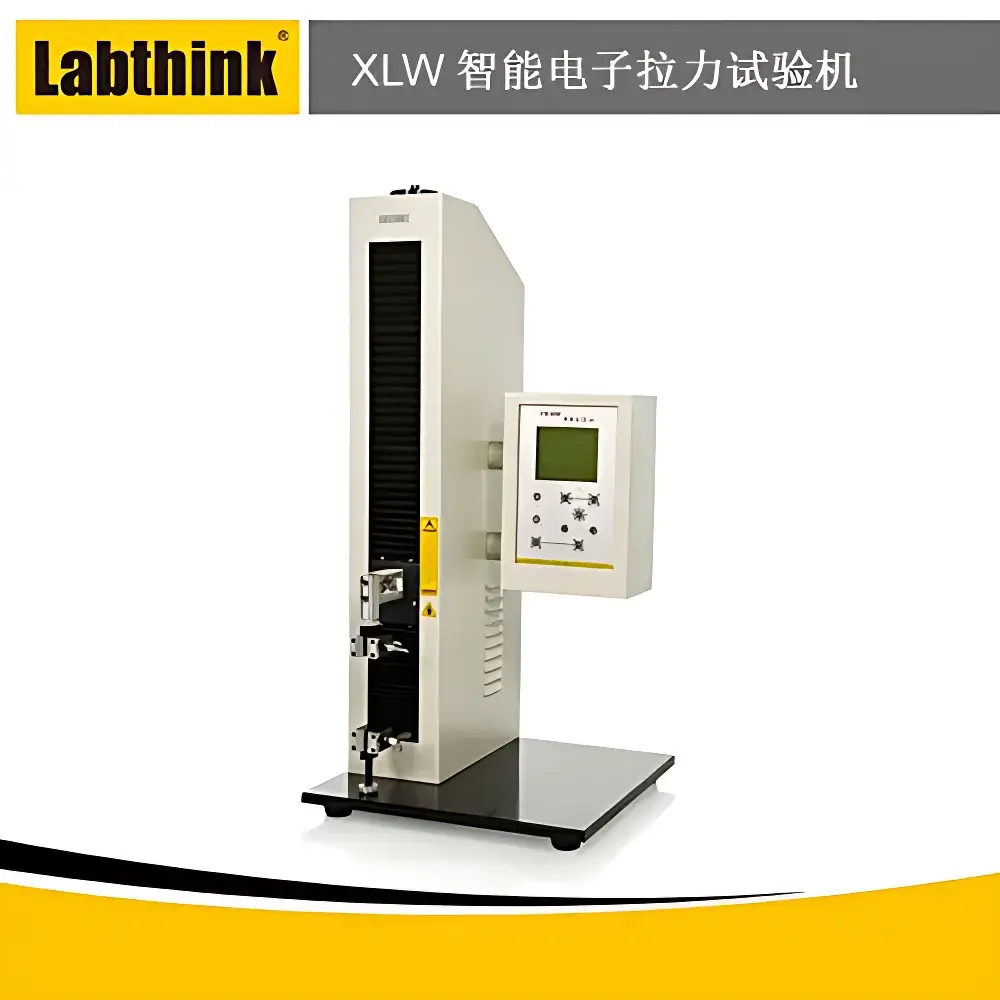
Labthink XLW Series Universal Tensile Testing Machine for Packaging and Soft Materials
| Brand | Labthink |
|---|---|
| Origin | Shandong, China |
| Manufacturer Type | Direct Manufacturer |
| Product Category | Domestic |
| Model | XLW |
| Instrument Type | Electronic Tensile Tester |
| Maximum Test Load | 1 kN |
| Force Measurement Range | Full Scale (FS) |
| Force Accuracy Class | Class 1 |
| Test Stroke | 600 mm |
| Displacement Resolution | 1 mm |
Overview
The Labthink XLW Series Universal Tensile Testing Machine is an electromechanical testing system engineered for precision mechanical property evaluation of flexible and semi-rigid materials commonly used in packaging, medical devices, consumer goods, and industrial components. Operating on the fundamental principle of uniaxial tensile loading—where a specimen is clamped between two opposing grips and subjected to controlled, linear displacement—the XLW captures real-time force and displacement data via a high-stability load cell mounted on the moving crosshead and an integrated linear displacement transducer. This architecture enables quantitative determination of tensile strength, elongation at break, yield point, modulus of elasticity (via post-processing), peel adhesion, tear resistance, heat seal strength, puncture force, opening force, and low-speed unwind torque—all compliant with standardized test methodologies defined by international and national regulatory frameworks.
Key Features
- Class 1 force accuracy per ISO 7500-1 and ASTM E4, ensuring traceable and reproducible mechanical measurements across laboratories.
- Seven pre-programmed test modes—including tensile, peel, tear, heat seal, shear, puncture, and opening force—configured via intuitive microprocessor-based control with PVC membrane keypad and large LCD display.
- Seven selectable test speeds (50–500 mm/min) and interchangeable load cells (100 N, 200 N, 500 N options) accommodate diverse material stiffness and deformation characteristics without hardware reconfiguration.
- Robust mechanical design featuring 600 mm travel stroke, manual wedge-action grips (standard 30 mm width; optional 50 mm), and fail-safe protection mechanisms including overload cutoff, mechanical limit switches, automatic return-to-start, and power-loss memory retention.
- Comprehensive safety architecture aligned with IEC 61000-6-2/6-4 electromagnetic compatibility requirements and CE-conformant mechanical safety principles.
Sample Compatibility & Compliance
The XLW system is validated for testing thin-film polymers, laminates, foils, nonwovens, elastomeric sheets, paperboard, adhesive tapes, medical pressure-sensitive adhesives (PSAs), blister lidding, pouch seals, and rubberized tubing—materials routinely encountered in ISO 13485-certified medical packaging lines and FDA-regulated pharmaceutical secondary packaging operations. It supports full compliance with over 25 standards, including ISO 37 (vulcanized rubber), ASTM D882 (thin plastic sheeting), ASTM F88 (heat seal strength), ASTM D1938 (tear propagation), GB/T 1040 series (plastic tensile properties), GB/T 2792 (peel adhesion), and QB/T 2358 (heat seal strength of plastic films). All test methods are implemented as executable protocols within the embedded firmware, enabling audit-ready execution under GLP and GMP environments.
Software & Data Management
The included professional control and analysis software provides full parameter configuration, real-time curve visualization (force vs. displacement), group statistical reporting (mean, SD, CV%), curve superposition for comparative analysis, elastic modulus derivation from linear region slope, and customizable report generation with digital signature support. Data export is supported via RS232 serial interface to external PCs or local thermal printers. When integrated with Labthink’s Lystem™ Laboratory Data Sharing System, the XLW enables automated metadata tagging (operator ID, sample ID, test standard, environmental conditions), time-stamped audit trails, role-based user access control, and centralized database archiving—fully compatible with 21 CFR Part 11 electronic record and signature requirements when deployed with appropriate validation documentation.
Applications
- Quality assurance of hot-water bottle bladders and elastomeric medical containers requiring burst resistance and cyclic fatigue evaluation.
- Validation of peel strength for sterile barrier packaging (e.g., Tyvek®-polyethylene pouches) per ISO 11607-2.
- Tensile characterization of lithium-ion battery separator films (e.g., polyolefin microporous membranes) under controlled humidity conditions.
- Heat seal integrity testing of flexible food packaging laminates exposed to retort or microwave sterilization cycles.
- Mechanical screening of wound dressings, transdermal patches, and surgical drapes for elongation and recovery behavior.
- Adhesion performance benchmarking of protective films applied to display panels and automotive interior trim.
FAQ
What standards does the XLW machine natively support?
The XLW firmware includes built-in test routines aligned with ISO 37, ASTM D882, ASTM F88, GB/T 1040.2, GB/T 2792, and 20+ additional national and industry-specific standards.
Can the system be calibrated in-house?
Yes—calibration is performed using certified reference load cells traceable to NIM (China) or NIST-equivalent national metrology institutes; calibration certificates and adjustment procedures are provided with each instrument.
Is the software compliant with FDA 21 CFR Part 11?
The Lystem™ integration module supports electronic signatures, audit trail logging, and user permission tiers required for Part 11 compliance—subject to site-specific validation protocol execution.
What is the maximum specimen thickness the standard grips can accommodate?
Standard manual wedge grips accept specimens up to 5 mm thick; custom pneumatic or hydraulic grips are available for thicker or high-force applications.
Does the XLW require external environmental conditioning?
No—ambient operation is specified from 10–35°C and 20–80% RH; for temperature- or humidity-dependent testing, integration with external climate chambers is supported via analog/digital I/O triggers.



