
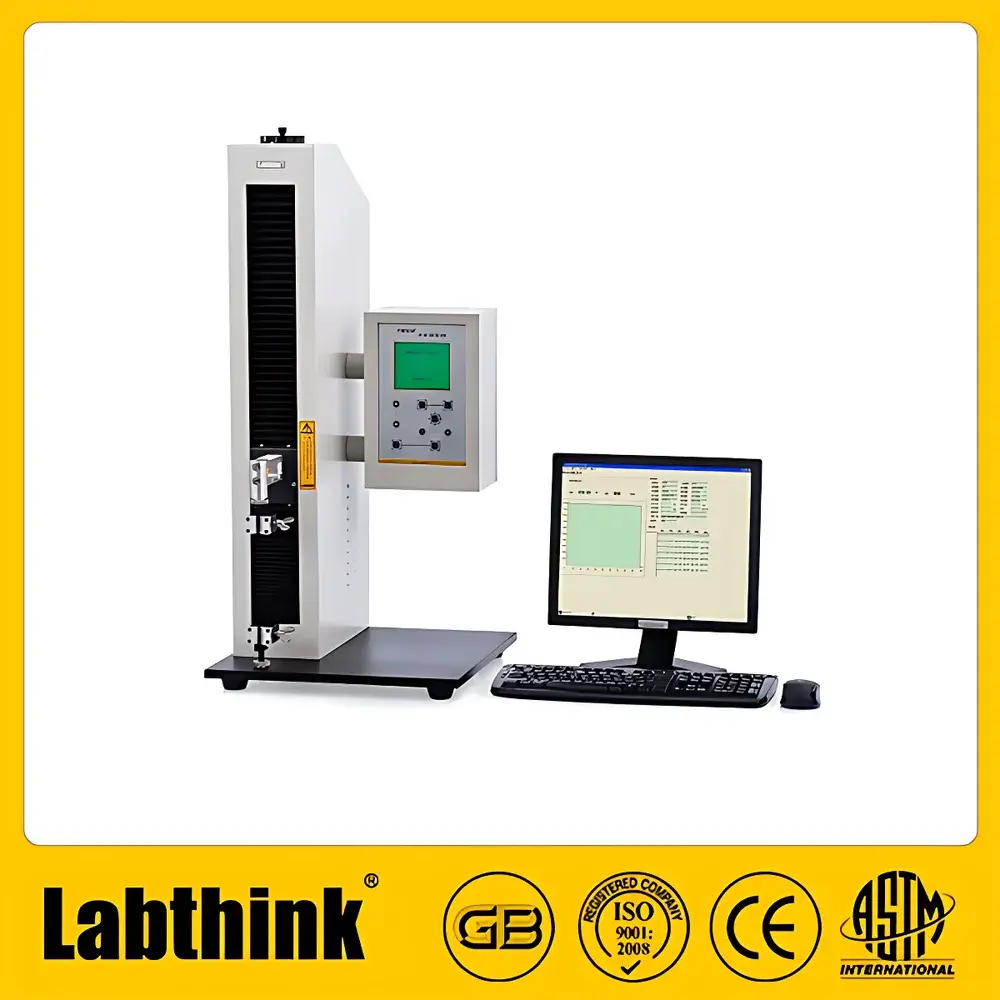
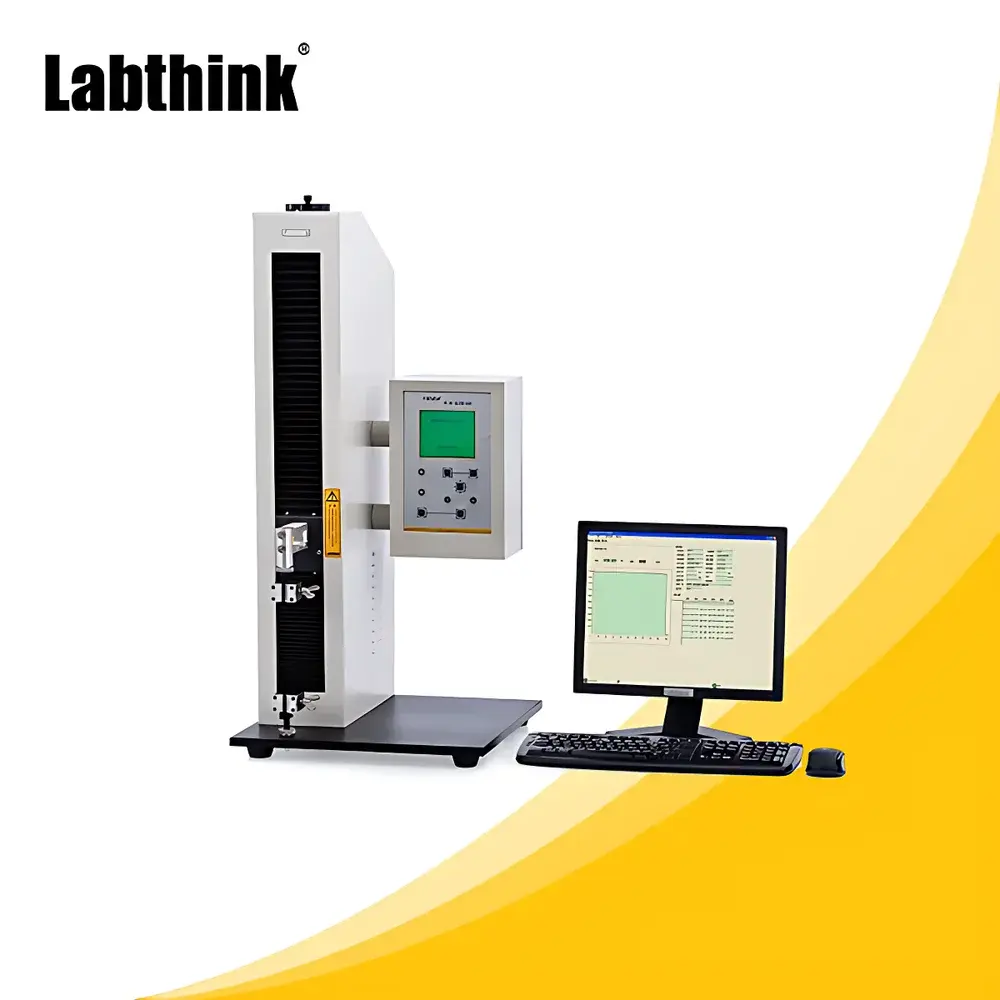
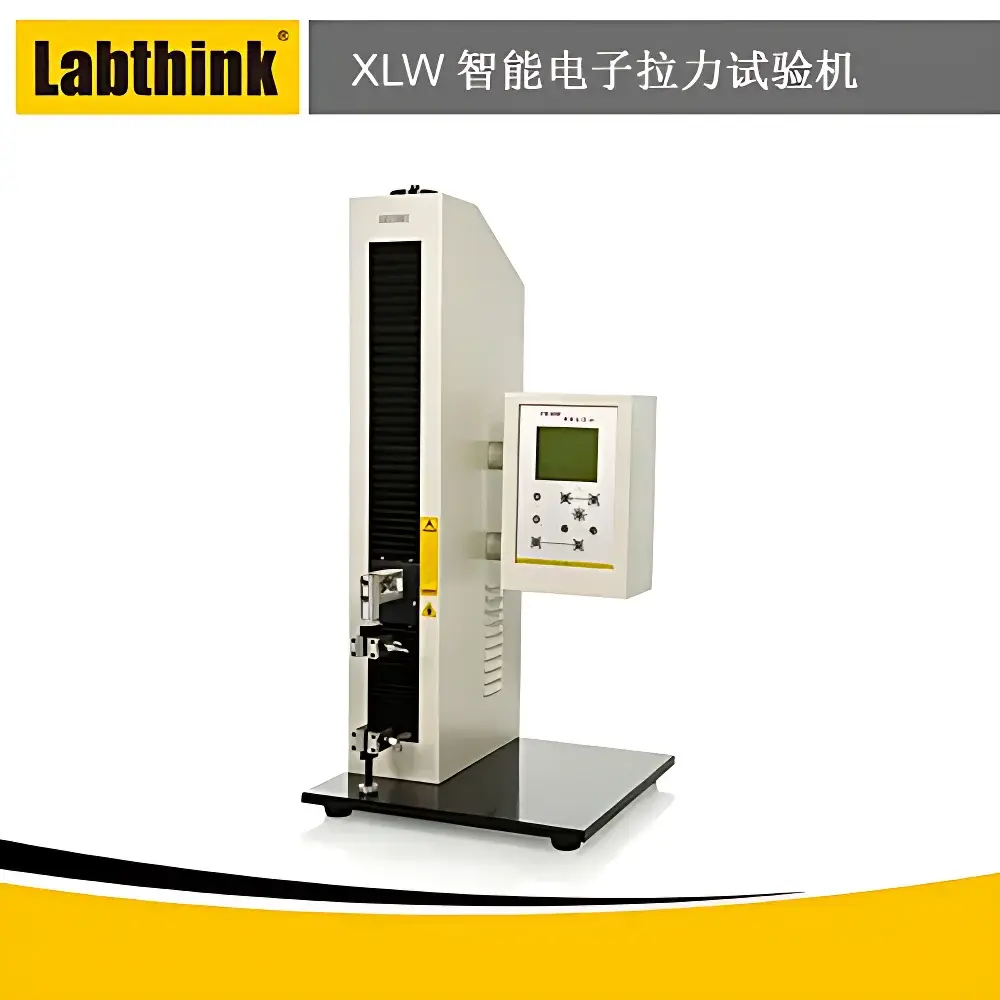
Labthink XLW Series Electronic Tensile Tester for Puncture Resistance Testing of Films and Flexible Packaging
| Brand | Labthink |
|---|---|
| Origin | Shandong, China |
| Manufacturer | Labthink Instruments Co., Ltd. |
| Model | XLW |
| Max Test Load | 1 kN |
| Force Accuracy Class | Class 1 |
| Test Stroke | 600 mm |
| Standard Load Cell | 500 N |
| Optional Load Cells | 30 N, 50 N, 100 N, 200 N, 750 N, 1000 N |
| Test Speeds | 50, 100, 150, 200, 250, 300, 500 mm/min |
| Sample Width | 30 mm (standard), 50 mm (optional) |
| Clamp Type | Manual |
| Dimensions (L×W×H) | 450 × 450 × 980 mm |
| Weight | 65 kg |
| Power Supply | 220 VAC 50 Hz / 120 VAC 60 Hz |
Overview
The Labthink XLW Series Electronic Tensile Tester is a precision-engineered universal testing instrument designed specifically for mechanical performance evaluation of thin-film and flexible packaging materials. It operates on the fundamental principle of uniaxial force-displacement measurement: a specimen is clamped between two opposing grips, one stationary and one motor-driven; as the moving grip traverses at a controlled rate, integrated high-stability load cells and linear displacement transducers continuously record real-time force (in Newtons) and extension (in millimeters). From this synchronized data stream, key mechanical parameters—including puncture resistance, tensile strength, elongation at break, peel adhesion, tear propagation, heat seal strength, and low-speed unwind force—are derived in accordance with standardized test protocols. The system is calibrated and validated to meet international metrological requirements for Class 1 force accuracy per ISO 7500-1 and ASTM E4, ensuring traceable, repeatable, and inter-laboratory comparable results across quality control, R&D, and regulatory submission environments.
Key Features
- Class 1 force accuracy certified per ISO 7500-1 and ASTM E4, supporting compliance-critical applications in pharmaceutical, food, and medical device packaging.
- Seven pre-programmed test modes—tensile, peel, tear, puncture, heat seal, shear, and low-speed unwind—configured via intuitive menu-driven interface on a large backlit LCD screen.
- Modular load cell architecture: standard 500 N sensor with optional ranges from 30 N to 1000 N, enabling optimal resolution for ultra-thin films (e.g., <12 µm PET) and high-strength laminates (e.g., aluminum foil–polymer composites).
- Seven discrete crosshead speeds (50–500 mm/min), adjustable without recalibration, accommodating both quasi-static characterization (per ISO 37) and dynamic process simulation (e.g., cap removal or pouch opening).
- Dual-safety architecture: hardware-based overload cutoff, mechanical end-stop limit switches, automatic return-to-initial-position post-test, and non-volatile memory retention of calibration and test parameters during power interruption.
- Microprocessor-controlled operation with PVC membrane keypad, eliminating reliance on external PCs for routine testing—ideal for production-floor deployment under ISO 13485 or BRCGS-certified environments.
Sample Compatibility & Compliance
The XLW platform accommodates a broad spectrum of planar soft materials up to 600 mm stroke length and 30/50 mm nominal width. Validated substrates include polyolefin and polyester films, metallized laminates, medical-grade pressure-sensitive adhesives, sterile barrier pouches, battery separator membranes, photovoltaic backsheet composites, and nonwoven hygiene materials. All test methods are implemented in strict alignment with globally recognized standards: ISO 37 (rubber tensile), ISO 11607-2 (sterile packaging), ASTM D882 (thin plastic sheeting), ASTM F88 (heat seal strength), ASTM D1938 (tear propagation), GB/T 1040 series (plastic tensile), GB/T 8808 (peel strength of composite films), and QB/T 2358 (heat seal strength of plastic films). Instrument qualification documentation supports GLP/GMP audit readiness, including full traceability of calibration certificates, uncertainty budgets, and preventive maintenance logs.
Software & Data Management
The embedded Lystem™ Laboratory Data Sharing System enables centralized management of test records, user permissions, and report templates across networked instruments. Raw force–displacement curves are stored in vendor-neutral CSV format with timestamp, operator ID, environmental conditions (if connected to optional hygrothermic sensor), and full metadata tagging. Software features include group statistical analysis (mean, SD, CV%), curve superposition for comparative material screening, elastic modulus calculation via initial linear slope, and automated pass/fail flagging against user-defined specification limits. Audit trail functionality complies with FDA 21 CFR Part 11 requirements—capturing all electronic signatures, parameter modifications, and data exports with immutable timestamps. RS232 serial interface supports integration with LIMS and ERP systems; optional thermal printer provides immediate hard-copy output with GLP-compliant header (test ID, date, operator, standard reference).
Applications
- Quantifying puncture resistance of pharmaceutical blister lidding foils to ensure child-resistant yet senior-friendly opening behavior.
- Evaluating peel strength consistency of cold-form aluminum/PVC blisters per USP and EP 3.2.1.
- Validating tear initiation and propagation resistance of stand-up pouch gussets under simulated distribution stresses.
- Measuring heat seal integrity of Tyvek®-based medical device packaging across sterilization cycles (EO, gamma, steam).
- Characterizing tensile modulus and yield point of lithium-ion battery separator films (e.g., PP/PE microporous membranes) per IEC 62660-1.
- Assessing adhesive bond durability of transdermal patch backing layers under accelerated aging per ISO 10993-10.
FAQ
What standards does the XLW tester support for puncture resistance testing?
It executes puncture tests per ASTM D5748, ISO 25537 (for medical packaging), and GB/T 10004 Annex F, using conical or flat-tipped probes mounted in the upper grip.
Can the instrument perform simultaneous multi-specimen testing?
No—it is configured for single-specimen evaluation per test cycle to maintain force transducer linearity and positional repeatability; however, batch processing is enabled via automated sequence programming.
Is third-party calibration certification available?
Yes—Labthink provides NIST-traceable calibration certificates issued by CNAS-accredited laboratories, valid for 12 months under normal operating conditions.
How is compliance with FDA 21 CFR Part 11 ensured?
Through role-based access control, electronic signature workflows, immutable audit trails, and encrypted data storage—all verified during IQ/OQ/PQ validation packages.
What maintenance intervals are recommended?
Biannual verification of load cell linearity and crosshead speed accuracy; annual full mechanical inspection including guide rail lubrication and belt tension adjustment—documented in the included maintenance logbook.



