
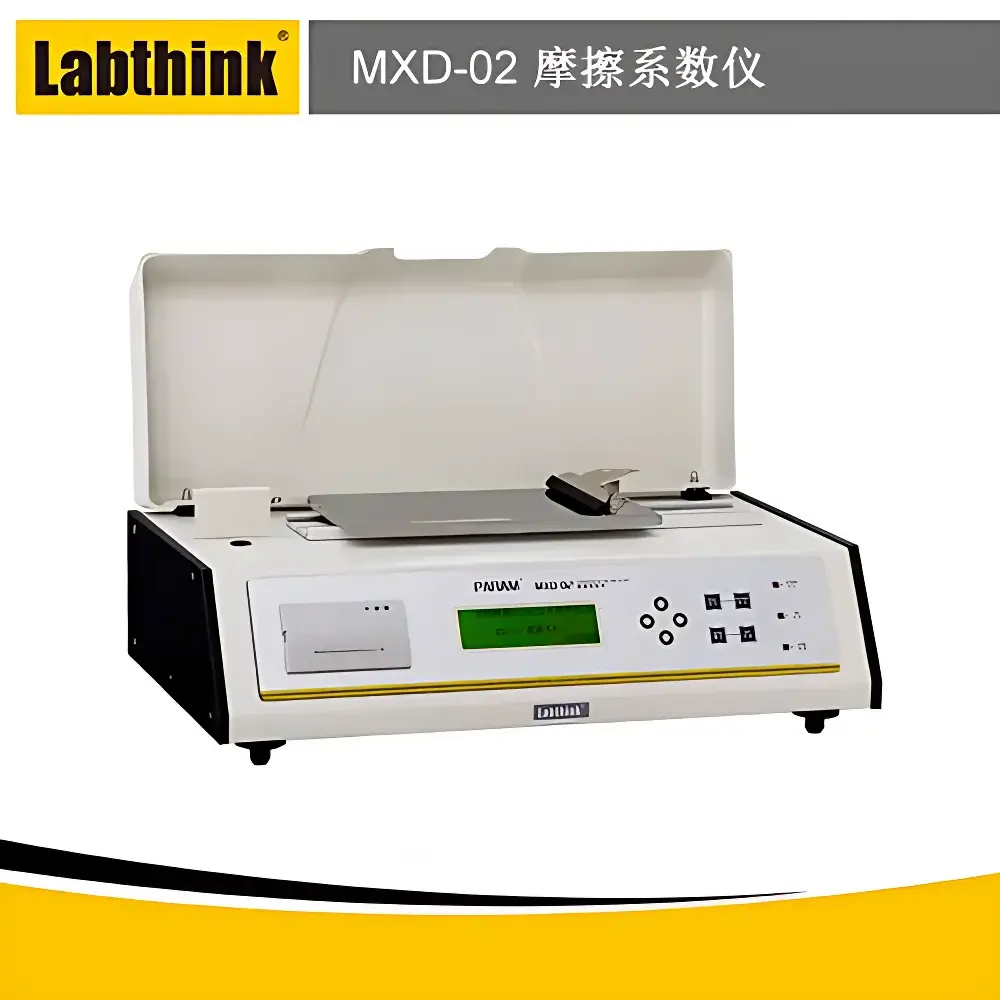
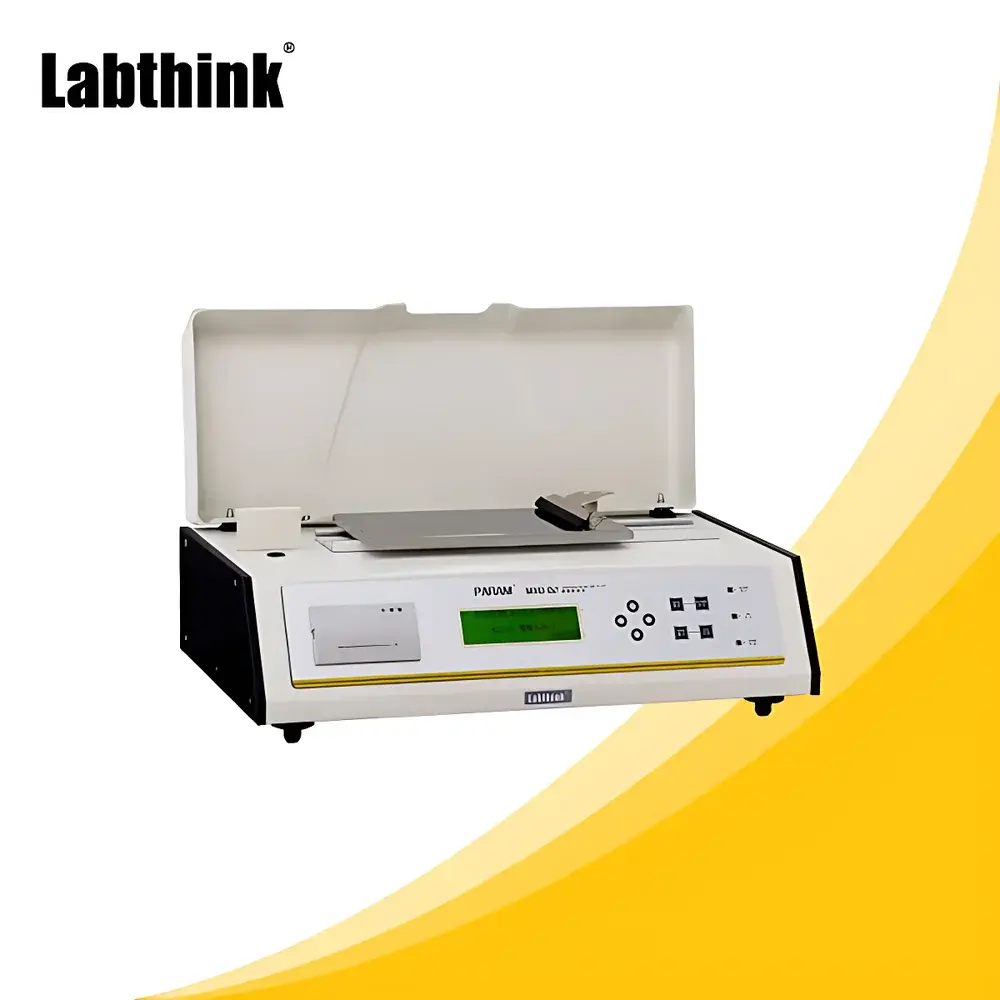
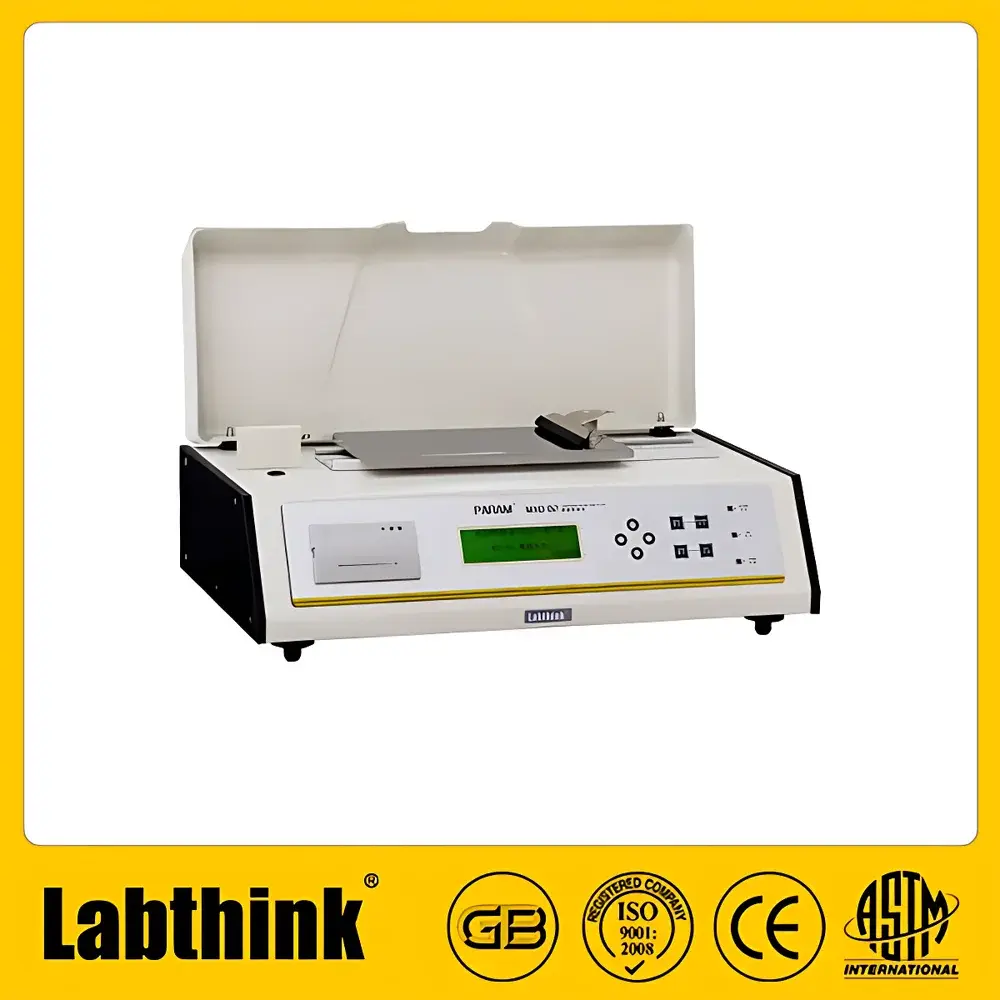
Labthink MXD-02 Coefficient of Friction Tester for Automotive Wiper Blade Rubber and Elastomeric Materials
| Brand | Labthink |
|---|---|
| Model | MXD-02 |
| Origin | Shandong, China |
| Manufacturer Type | Direct Manufacturer |
| Country of Origin | China |
| Load Range | 0–5 N |
| Accuracy Class | 0.5 |
| Traverse Distance | 70 mm / 150 mm |
| Standard Sled Mass | 200 g (custom sleds available) |
| Test Speeds | 100 mm/min, 150 mm/min (adjustable) |
| Operating Environment | 23 ± 2 °C, 20–70 %RH |
| Power Supply | 220 VAC 50 Hz / 120 VAC 60 Hz |
| Dimensions (L×W×H) | 630 × 360 × 230 mm |
| Net Weight | 33 kg |
| Compliance | GB 10006, ISO 8295, ASTM D1894, TAPPI T816 |
Overview
The Labthink MXD-02 Coefficient of Friction Tester is a precision-engineered instrument designed for quantitative measurement of static and kinetic coefficients of friction (COF) between elastomeric and polymeric surfaces—specifically optimized for automotive wiper blade rubber squeegee elements, silicone-based wiping films, thermoplastic elastomer (TPE) compounds, and packaging-grade polymer films. It operates on the fundamental principle of direct horizontal force measurement under controlled normal load: two flat test surfaces are brought into contact under a defined normal force (0–5 N), then driven relative to one another at a constant linear velocity. The system captures the peak tangential resistance at motion initiation (static friction force, Fs) and the sustained resistance during steady-state sliding (kinetic friction force, Fk). Static and kinetic COF values are calculated as μs = Fs/N and μk = Fk/N, respectively, where N is the applied normal force. This methodology conforms rigorously to the tribological framework established in ASTM D1894, ISO 8295, and GB 10006, ensuring metrological traceability and inter-laboratory comparability.
Key Features
- Simultaneous dual-mode measurement: single test cycle yields both static (μs) and kinetic (μk) COF values with high reproducibility (CV ≤ 2.5% per ASTM D1894 repeatability criteria)
- Programmable test speed: standard settings at 100 mm/min and 150 mm/min; full digital speed control enables user-defined velocities within mechanical limits
- Modular sled configuration: includes certified 200 g stainless-steel sled (ISO-compliant geometry); optional 500 g or custom-mass sleds available for application-specific normal force scaling
- Demagnetized test platform and sled: subjected to rigorous degaussing and residual magnetism verification (<0.1 mT) to eliminate electromagnetic interference with load cell signal integrity
- Microprocessor-based control architecture: embedded real-time OS with tactile PVC membrane keypad and 128×64 dot-matrix LCD display for local operation, parameter entry, and immediate result visualization
- High-stability transduction system: precision strain-gauge load cell (0.5-class accuracy per JJG 391) integrated with low-backlash timing belt drive and optical encoder position feedback
Sample Compatibility & Compliance
The MXD-02 accommodates flat, flexible specimens up to 150 mm wide × 300 mm long, including vulcanized rubber strips (e.g., EPDM, CR, silicone), coated wiper blade edges, laminated polymer films (PET, PP, PE), metallized foils, and coated paperboard substrates. All mechanical interfaces—including the stationary base plate and moving sled—are precision-ground and anodized for dimensional stability and wear resistance. The instrument satisfies mandatory requirements for GLP-compliant quality control laboratories: it supports audit-ready test logs with timestamped operator ID, test parameters, raw force-time traces, and final COF calculations. Full compliance is documented against GB 10006 (Chinese national standard), ISO 8295:1995 (plastics—film and sheeting—determination of coefficient of friction), ASTM D1894–22 (standard test method for static and kinetic coefficients of friction of plastic film and sheeting), and TAPPI T816 (horizontal plane static COF for corrugated and solid fiberboard).
Software & Data Management
Lystem™ Laboratory Data Management System (LDMS) integration enables centralized storage, version-controlled reporting, and cross-instrument data correlation. The optional professional software module provides automated statistical analysis (mean, SD, CV, min/max) across test groups; overlay plotting of multiple COF-time curves for comparative wear profiling; and customizable report generation compliant with ISO/IEC 17025 documentation requirements. Raw force vs. time datasets are exportable in CSV and XML formats. The RS232 serial interface supports bidirectional communication with LIMS environments, while the built-in thermal printer outputs calibrated hard-copy reports with instrument ID, calibration date, operator signature field, and ISO/ASTM reference clause citations. All electronic records maintain immutable audit trails meeting FDA 21 CFR Part 11 predicate rule requirements for electronic signatures and data integrity.
Applications
- Quality assurance of automotive wiper blade rubber compounds: validation of surface lubricity post-curing and post-silicone coating
- R&D screening of elastomer formulations for reduced stick-slip behavior under variable humidity and temperature
- Process validation of extrusion die lip treatments and calendering roll surface finishes
- Regulatory testing of medical device packaging films (e.g., peelable Tyvek®/foil laminates) per ISO 11607
- Frictional performance benchmarking of anti-static and hydrophobic polymer coatings used in optical lens cleaning wipes
- Supplier qualification testing for OEM Tier-1 automotive component suppliers requiring PPAP submission packages
FAQ
What standards does the MXD-02 officially support for friction testing?
The instrument is factory-validated against GB 10006, ISO 8295, ASTM D1894, and TAPPI T816. Calibration certificates include uncertainty budgets traceable to NIM (National Institute of Metrology, China).
Can the MXD-02 measure friction on curved or textured wiper blade surfaces?
No—it requires flat, parallel specimen surfaces per standardized test methods. Curved blades must be sectioned and mounted on rigid planar substrates prior to testing.
Is the 0.5-class load cell certified annually by an accredited body?
Yes—Labthink provides ISO/IEC 17025-accredited third-party calibration services with NIST-traceable reference standards; recommended recalibration interval is 12 months.
Does the system meet FDA 21 CFR Part 11 requirements for electronic records?
When operated with Lystem™ LDMS and enabled audit trail features, the MXD-02 satisfies Part 11 criteria for electronic signatures, record retention, and system validation documentation.
What environmental conditions must be maintained during testing?
Per ISO 291 and ASTM D618, tests shall be conducted in a conditioned room at 23 ± 2 °C and 50 ± 5 %RH unless otherwise specified in the material standard; ambient humidity range of 20–70 %RH is supported for operational flexibility.





