
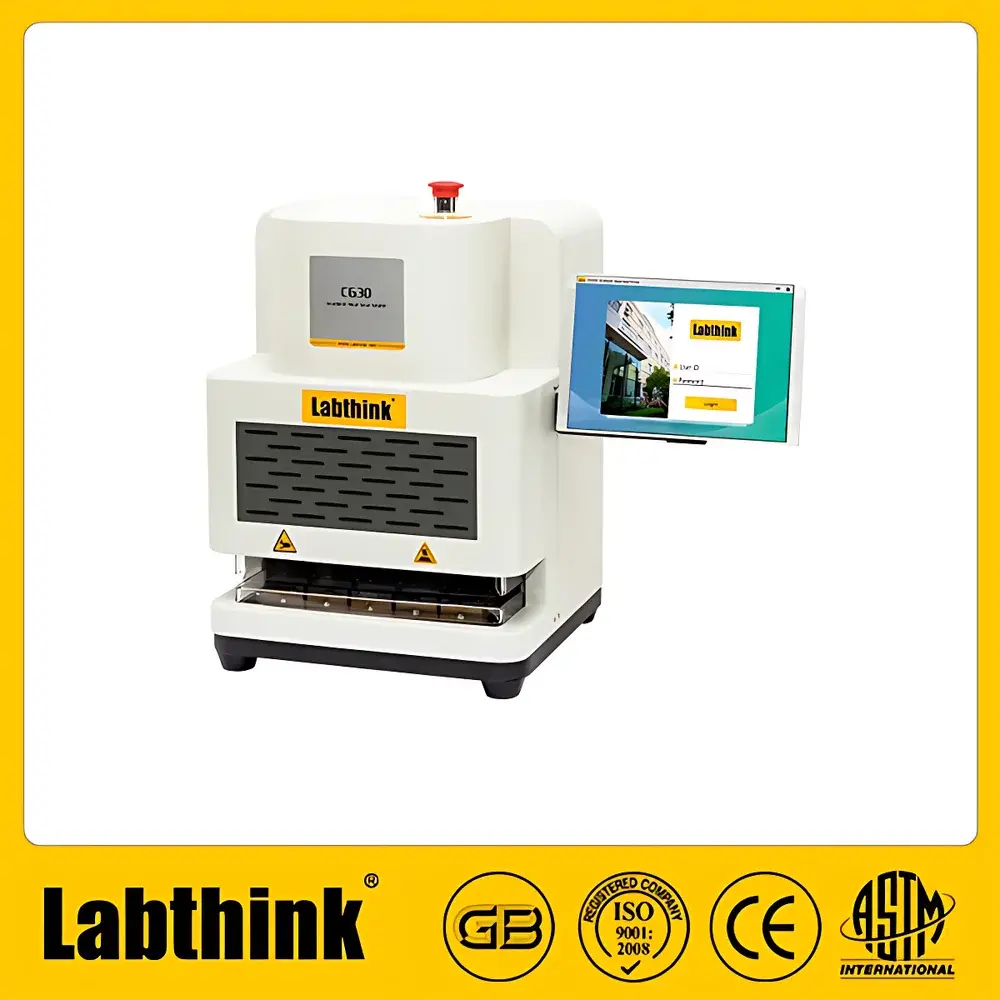
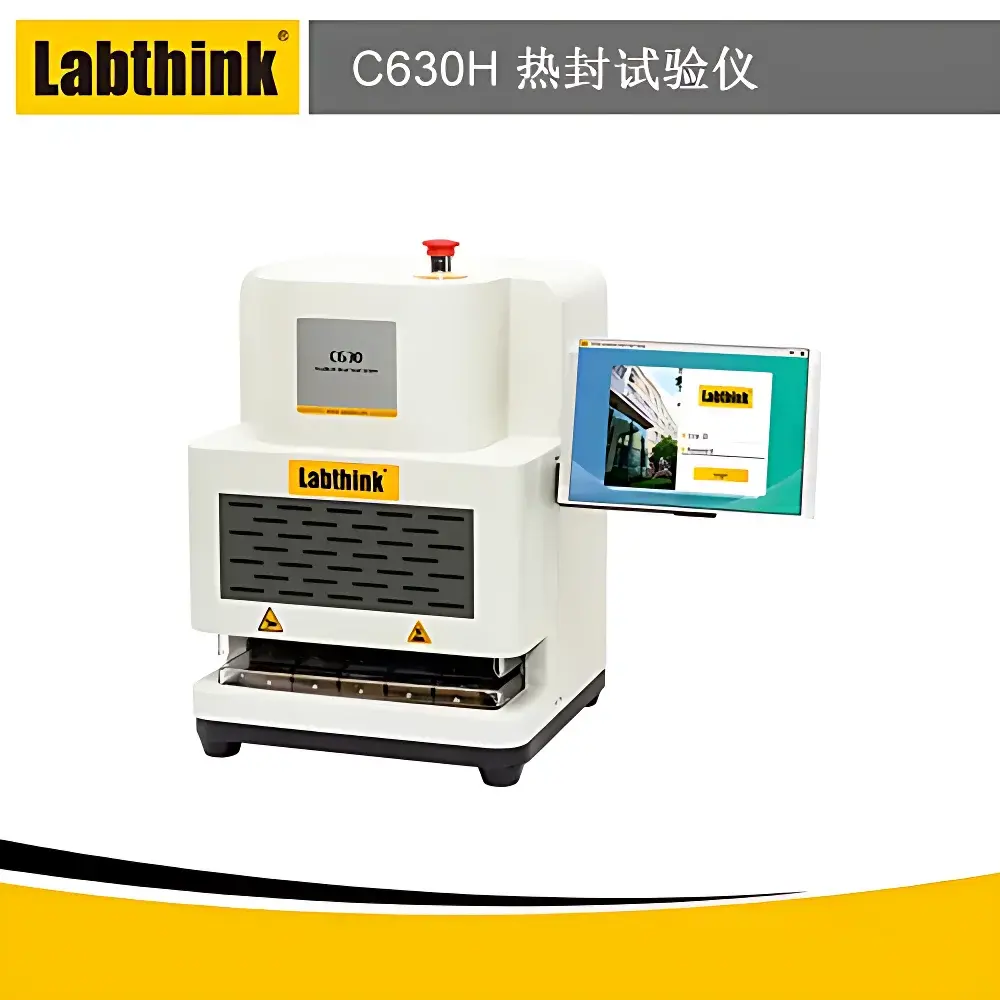
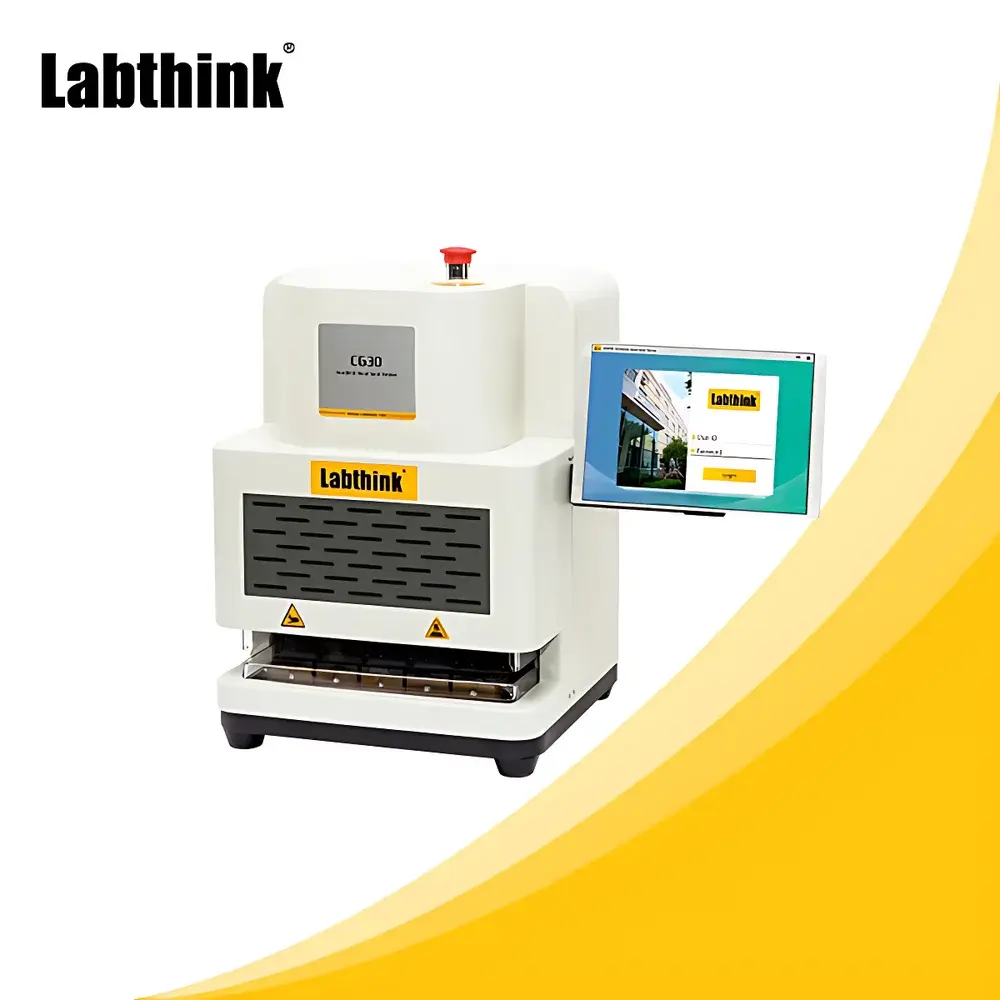
Labthink C630H Heat Sealing Tester for Pharmaceutical and Flexible Packaging Films
| Brand | Labthink |
|---|---|
| Origin | Shandong, China |
| Manufacturer | Jinan Labthink Electromechanical Technology Co., Ltd. |
| Model | C630H |
| Temperature Range | 25–300 °C |
| Sealing Pressure | 0.05–0.70 MPa (Resolution: 0.001 MPa) |
| Sealing Time | 0.10–999.99 s (Resolution: 0.01 s) |
| Temperature Accuracy | ±0.5 °C (single-point calibration) |
| Temperature Uniformity | ≤20 °C across 5 sealing bars |
| Sealing Surface | 40 mm × 10 mm per bar |
| Independent Dual-Zone Heating | 5 upper + 5 lower sealing heads |
| Power Supply | 220 VAC ±10%, 50 Hz or 120 VAC ±10%, 60 Hz |
| Dimensions | 375 × 360 × 518 mm (L×W×H) |
| Weight | 55 kg |
| Compressed Air Requirement | 0.7 MPa, Ø8 mm polyurethane tubing |
Overview
The Labthink C630H Heat Sealing Tester is a precision-engineered laboratory instrument designed to quantify the thermal seal integrity of flexible packaging materials under controlled, reproducible conditions. It operates on the principle of contact heat sealing—applying precisely regulated temperature, pressure, and dwell time to induce polymer chain mobility and interfacial fusion at the interface of thermoplastic layers. This method is foundational to evaluating seal initiation temperature (SIT), hot tack strength, and ultimate seal strength—critical quality attributes in pharmaceutical blister packaging, sterile barrier systems, and medical device pouches. The C630H meets the physical testing requirements defined in ASTM F2029 (Standard Test Method for Making Heat-Sealed Packages for Testing), QB/T 2358 (Chinese national standard for plastic film heat seal strength), and YBB 00122003 (Chinese Pharmacopoeia supplementary standard for pharmaceutical packaging materials). Its architecture supports both R&D optimization and QC release testing in GMP-regulated environments.
Key Features
- Five independent dual-zone sealing stations (10 total sealing heads), each with fully decoupled PID temperature control and auto-balanced pneumatic pressure actuation
- High-resolution parameter control: temperature resolution 0.1 °C (±0.5 °C accuracy), pressure resolution 0.001 MPa, time resolution 0.01 s
- Integrated automatic leveling mechanism ensures parallel alignment of all upper/lower sealing surfaces—eliminating edge lift and non-uniform heat transfer
- Dual activation modes: manual touchscreen command and foot-switch operation, both with hardware-enforced safety interlocks to prevent accidental actuation during maintenance
- Modular sealing head design allows rapid replacement of sealing surfaces—including smooth, embossed, or custom-profiled anvil plates—for application-specific validation
- Embedded industrial-grade computing platform with 10.1-inch capacitive touch display, real-time parameter visualization, and local data storage compliant with ALCOA+ principles
Sample Compatibility & Compliance
The C630H accommodates a broad spectrum of heat-sealable substrates used in regulated packaging: aluminum-plastic laminates (e.g., Al/PE, Al/PVC), cold-form foil, thermoformed PVC/PVDC blisters, peelable lidstocks (e.g., PET/PE, PP/PE), and multilayer coextrusions. It supports both flat-surface sealing (standard 40 mm × 10 mm bar) and patterned sealing (e.g., for fin seals or tube end closures). All operational parameters are traceable and auditable—data logs include timestamp, operator ID, environmental conditions (if external sensors integrated), and full parameter set per test cycle. Optional GMP-compliant software enables 21 CFR Part 11–aligned electronic signatures, audit trails, and role-based access control. Calibration certificates conform to ISO/IEC 17025 requirements when performed by accredited service providers.
Software & Data Management
The embedded operating system features a streamlined, workflow-driven interface optimized for routine QC execution. Users define multi-step test protocols—including ramp-and-hold temperature profiles, pressure ramping sequences, and sequential multi-temperature trials—without scripting. Raw data exports in CSV and PDF formats support LIMS integration. Optional DataShield™ software provides centralized database management, automated report generation (including statistical summaries and trend charts), and secure API-based synchronization with enterprise MES or QMS platforms. All measurement data reside locally on the instrument’s isolated SSD; the embedded OS prohibits network-initiated write operations to prevent contamination from external endpoints—a design aligned with ICH Q5C and EU Annex 11 risk mitigation guidance.
Applications
- Pharmaceutical primary packaging: validation of blister cavity seal integrity, strip pack peel strength, and child-resistant pouch closure performance
- Medical device packaging: qualification of Tyvek®/PET–PE pouch seals under accelerated aging conditions per ISO 11607-2
- Food and beverage: assessment of retort pouch seal durability after thermal processing and flex-crack resistance
- Material development: comparative evaluation of sealant layer formulations (e.g., ionomer vs. EVA vs. metallocene PE)
- Process window mapping: determination of optimal sealing parameter envelopes (temperature–pressure–time) using Design of Experiments (DoE) methodology
- Root cause analysis: correlation of seal defects (leakers, wrinkles, scorching) with deviations in thermal history or mechanical load distribution
FAQ
What standards does the C630H comply with?
ASTM F2029, QB/T 2358, YBB 00122003, and ISO 9001-aligned test procedure documentation.
Is compressed air supplied with the instrument?
No—the user must provide clean, dry, oil-free compressed air at ≥0.7 MPa via Ø8 mm polyurethane tubing.
Can the C630H perform hot tack testing?
Yes—by configuring short dwell times (<1.0 s) and initiating tensile separation immediately post-seal, it supports hot tack curve generation per ASTM F1921.
How is data integrity ensured during long-term deployment?
Through segregated firmware/data partitions, immutable log files, optional electronic signature modules, and compatibility with third-party calibration management systems.
What maintenance is required for sustained accuracy?
Annual verification of temperature uniformity and pressure transducer linearity using NIST-traceable references; periodic cleaning of sealing surfaces with isopropyl alcohol and lint-free wipes.






