
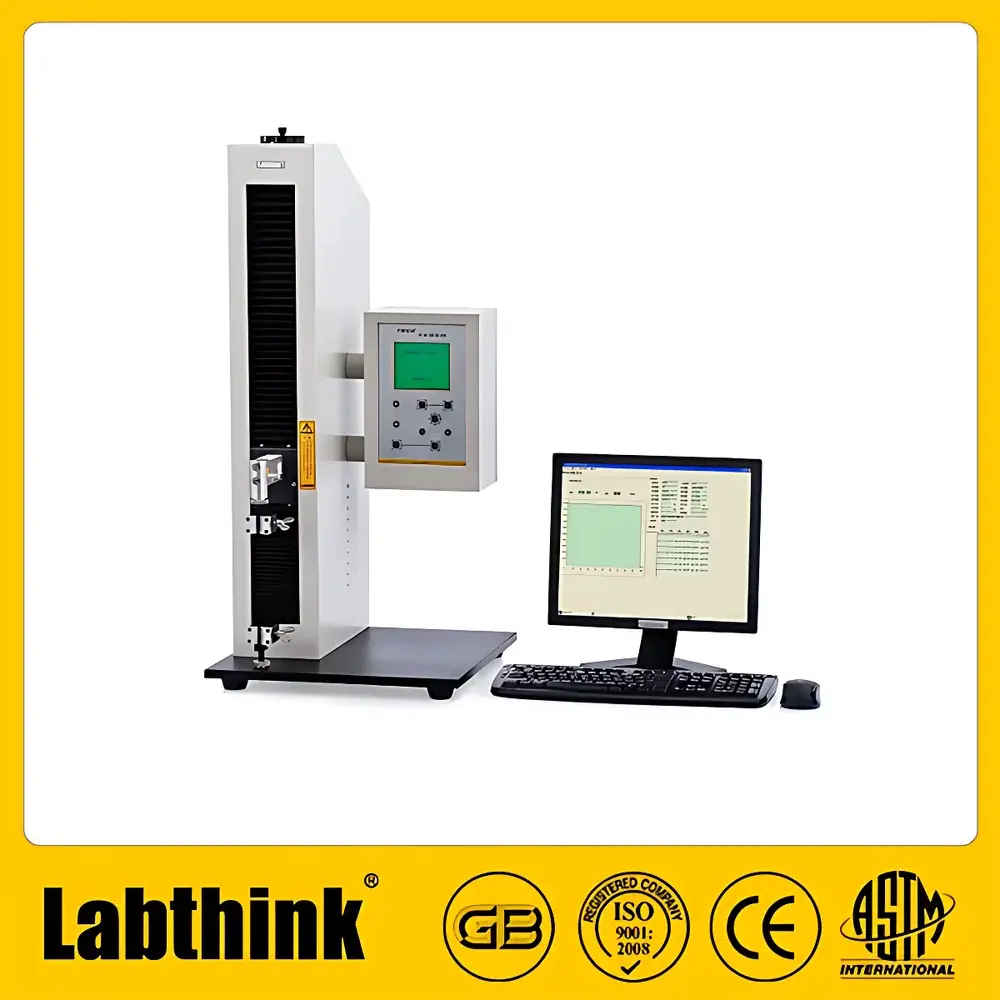
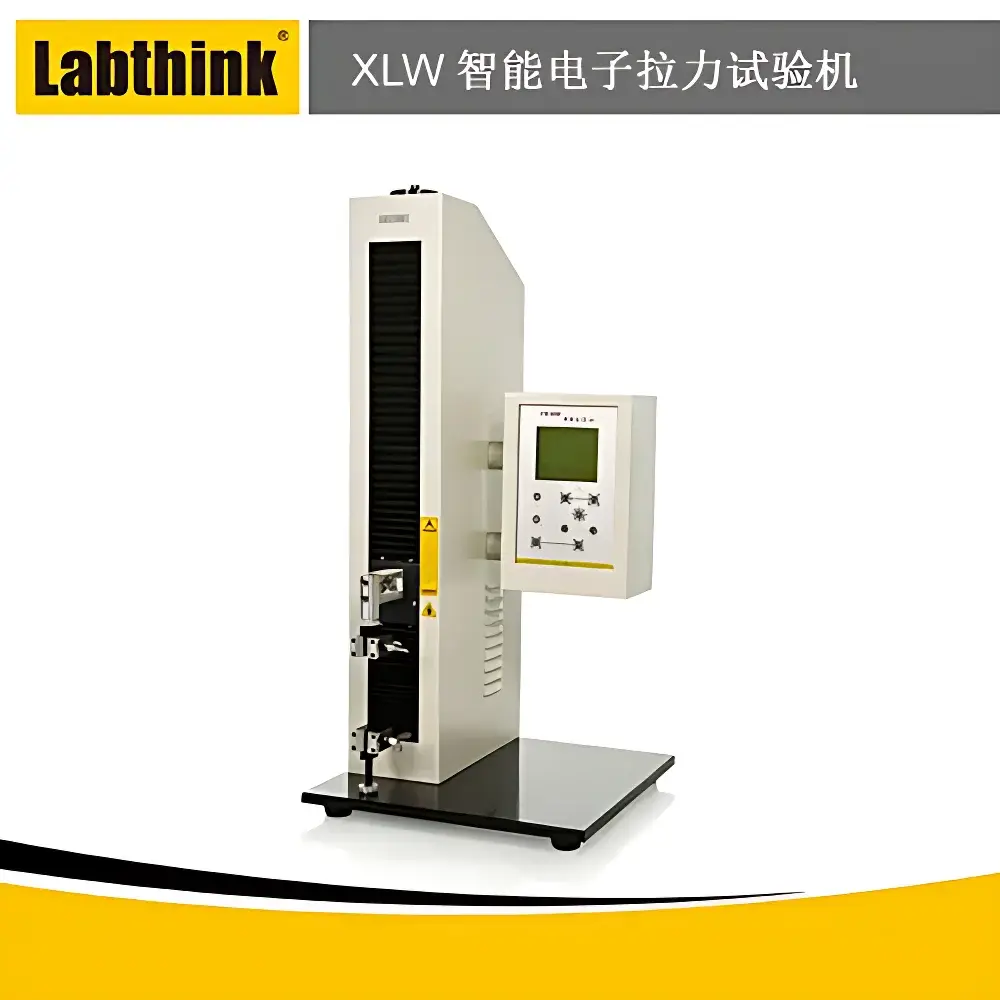
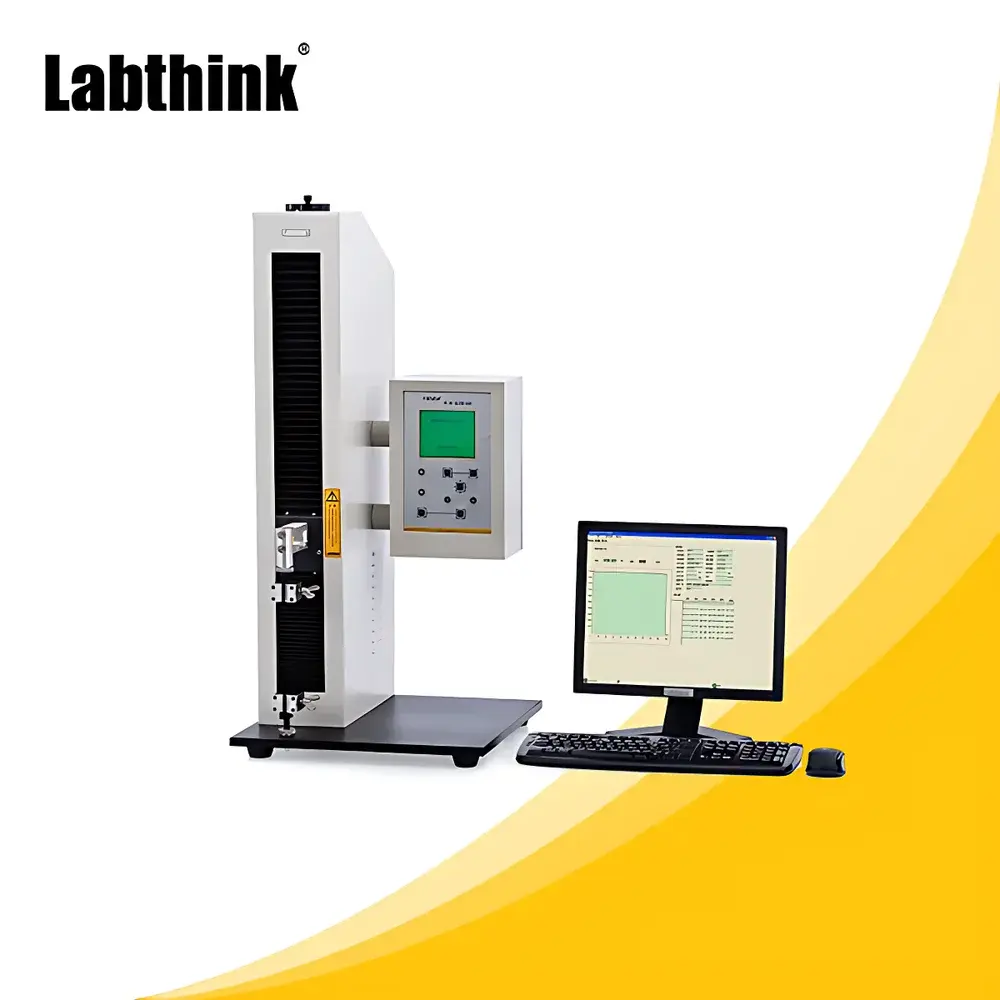
Labthink XLW Electronic Tensile Tester for Peel Strength Testing of Plastic Dairy Cup Lids and Packaging Films
| Brand | Labthink |
|---|---|
| Origin | Shandong, China |
| Manufacturer Type | Direct Manufacturer |
| Product Category | Domestic |
| Model | XLW |
| Price Range | USD 2,800 – 7,000 (FOB) |
| Instrument Type | Electronic Tensile Testing Machine |
| Maximum Load Capacity | 1 kN |
| Force Accuracy Class | Class 1 (per ISO 7500-1 / ASTM E4) |
| Test Stroke | 600 mm |
| Displacement Resolution | 1 mm |
| Standard Load Cell | 500 N |
| Optional Load Cells | 30 N, 50 N, 100 N, 200 N, 750 N, 1000 N |
| Test Speeds | 50, 100, 150, 200, 250, 300, 500 mm/min (7 fixed rates) |
| Specimen Width | 30 mm (standard fixture), 50 mm (optional) |
| Fixture Type | Manual Clamp |
| Dimensions (L×W×H) | 450 × 450 × 980 mm |
| Weight | 65 kg |
| Power Supply | 220 VAC 50 Hz / 120 VAC 60 Hz |
Overview
The Labthink XLW Electronic Tensile Tester is a precision-engineered universal testing system designed specifically for quantitative mechanical evaluation of flexible packaging materials and closure systems—particularly plastic dairy cup lids, laminated films, adhesive tapes, medical patches, protective membranes, and composite packaging structures. It operates on the fundamental principle of uniaxial tensile displacement: two opposing grips move at controlled relative velocity while a high-fidelity load cell (mounted on the moving crosshead) and integrated linear displacement transducer continuously record force and extension data in real time. The instrument conforms to internationally recognized static mechanical testing methodologies defined under ISO 7500-1 (verification of force-measuring systems) and ASTM E4 (calibration of verifying machines), ensuring traceable, repeatable, and auditable test outcomes essential for quality assurance laboratories operating under GLP, GMP, or ISO/IEC 17025 frameworks.
Key Features
- Class 1 force accuracy per ISO 7500-1 and ASTM E4, validated across the full operational range of standard and optional load cells (30 N to 1000 N)
- Seven pre-programmed test modes—including peel (90° and 180°), tensile, tear (Elmendorf & trouser), heat seal strength, puncture, opening force, and low-speed unwind—each with dedicated parameter presets and compliance logic
- Seven fixed test speeds (50–500 mm/min), optimized for regulatory alignment with ISO 37, ASTM D882, ASTM F88, GB/T 2790–2792, and QB/T 2358
- Microprocessor-based control with intuitive PVC membrane keypad, backlit LCD display (128×64), and menu-driven navigation—no PC required for routine operation
- Integrated safety architecture: mechanical limit switches, overload cut-off, automatic return-to-start, and power-loss memory retention
- Modular fixture system supporting standardized specimen widths (30 mm default; 50 mm optional) and manual clamping for rapid setup and minimal operator variability
Sample Compatibility & Compliance
The XLW accommodates a broad spectrum of thin-gauge polymeric and composite substrates used in food, pharmaceutical, and consumer product packaging. Validated applications include HDPE/LDPE lid seals on PET or PP dairy cups; aluminum foil/polymer laminates for pouches; acrylic- and silicone-based pressure-sensitive adhesives; nonwoven backing layers in transdermal patches; and metallized barrier films for snack packaging. All test protocols align with mandatory standards referenced in global regulatory submissions—including USP /, FDA 21 CFR Part 11 (when paired with Lystem™ software audit trail), ISO 11607-2 (packaging validation), and EU Regulation (EC) No 1935/2004 (food contact materials). Calibration certificates are provided with NIST-traceable force standards.
Software & Data Management
Bundled Lystem™ Laboratory Data Management Software enables comprehensive post-test analysis: group statistical reporting (mean, SD, CV%, min/max), overlay of up to eight stress–strain curves for comparative assessment, elastic modulus calculation via linear regression of initial slope, and customizable report templates compliant with internal QA documentation requirements. The software supports 21 CFR Part 11–compliant user access control, electronic signatures, and immutable audit trails. Data export is available in CSV, PDF, and XML formats. RS232 serial interface ensures seamless integration with LIMS environments; optional USB-to-RS232 adapters support modern workstation connectivity. Micro-printer output (via dedicated interface) provides immediate hardcopy of individual test records for shift logs or production floor use.
Applications
- Quantification of 90° peel adhesion strength between aluminum foil lidding and thermoformed PP cups (per ASTM F88 and GB/T 2790)
- Heat seal integrity verification of coextruded LDPE/PP films sealed under controlled dwell time, temperature, and pressure (per ASTM F2054 and GB/T 10004)
- Tensile property profiling (UTS, elongation at break, Young’s modulus) of biaxially oriented polypropylene (BOPP) and polyester (PET) films (per ISO 527-3 and GB/T 1040.3)
- Puncture resistance measurement of medical-grade silicone-coated release liners (per ISO 11607-2 Annex D)
- Opening force evaluation of child-resistant blister card seals (per ASTM D3475 and ISO 8503)
- Low-speed unwind torque characterization of liner-backed labels (per ASTM D3330)
FAQ
What standards does the XLW comply with for peel testing of dairy cup lids?
The XLW implements test methods aligned with ASTM F88 (Standard Test Method for Seal Strength of Flexible Barrier Materials), GB/T 2790 (Peel Adhesion of Pressure-Sensitive Tapes), and ISO 8510-2 (Adhesives — Peel Test), with hardware calibration certified to ISO 7500-1 Class 1.
Can the instrument perform both 90° and 180° peel configurations?
Yes—fixture geometry supports both angular orientations; 90° peel is standard for lid-to-container evaluation, while 180° is used for tape and film-to-film adhesion studies.
Is the software compliant with FDA 21 CFR Part 11 requirements?
Lystem™ software includes role-based authentication, electronic signature capture, and tamper-evident audit logging—fully configurable to meet Part 11 technical and procedural controls when deployed in regulated environments.
What is the maximum specimen thickness the standard grips can accommodate?
The manual wedge-action grips accept specimens up to 2.5 mm thick without modification; custom fixtures are available for thicker composites or rigid substrates.
Does the system support automated sample loading or high-throughput operation?
The XLW is a single-station, manually loaded platform optimized for R&D and QC labs performing ≤20 tests/day; it does not feature robotic auto-loaders but offers rapid fixture interchange and one-touch test initiation to minimize cycle time.



