
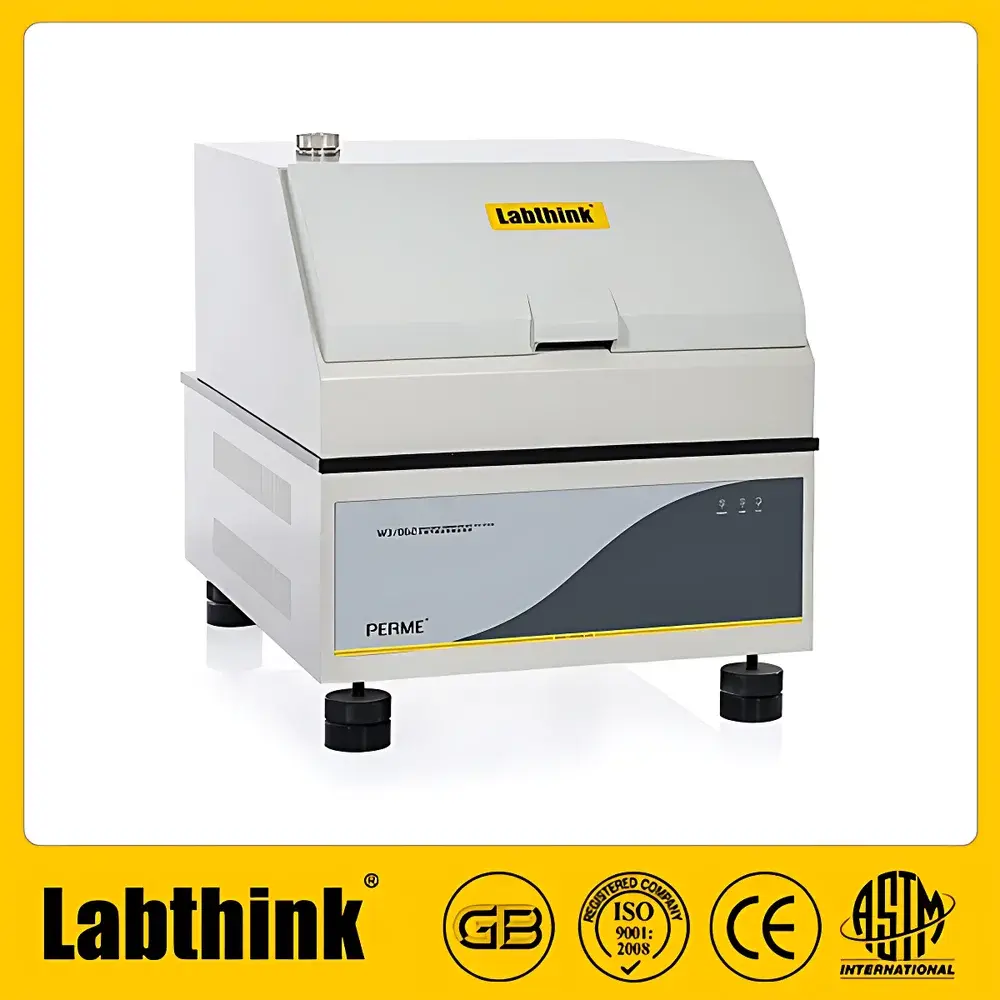
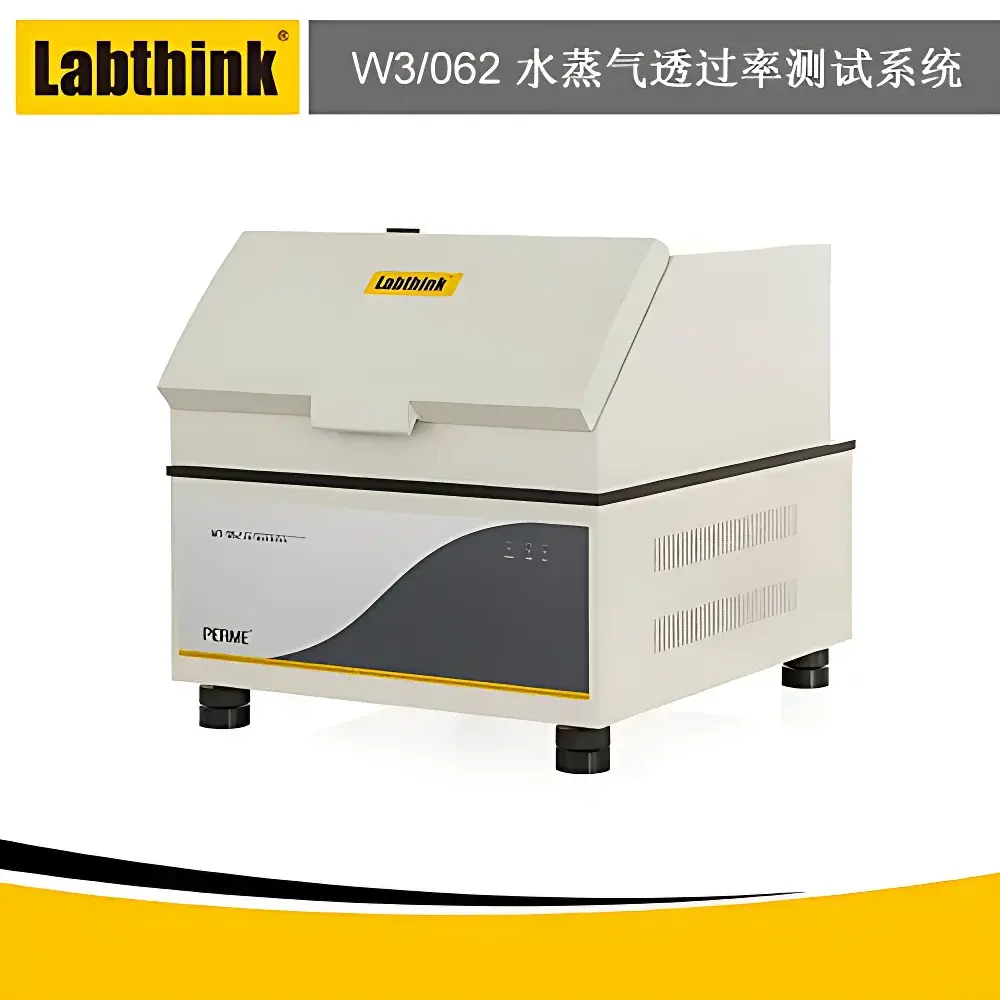
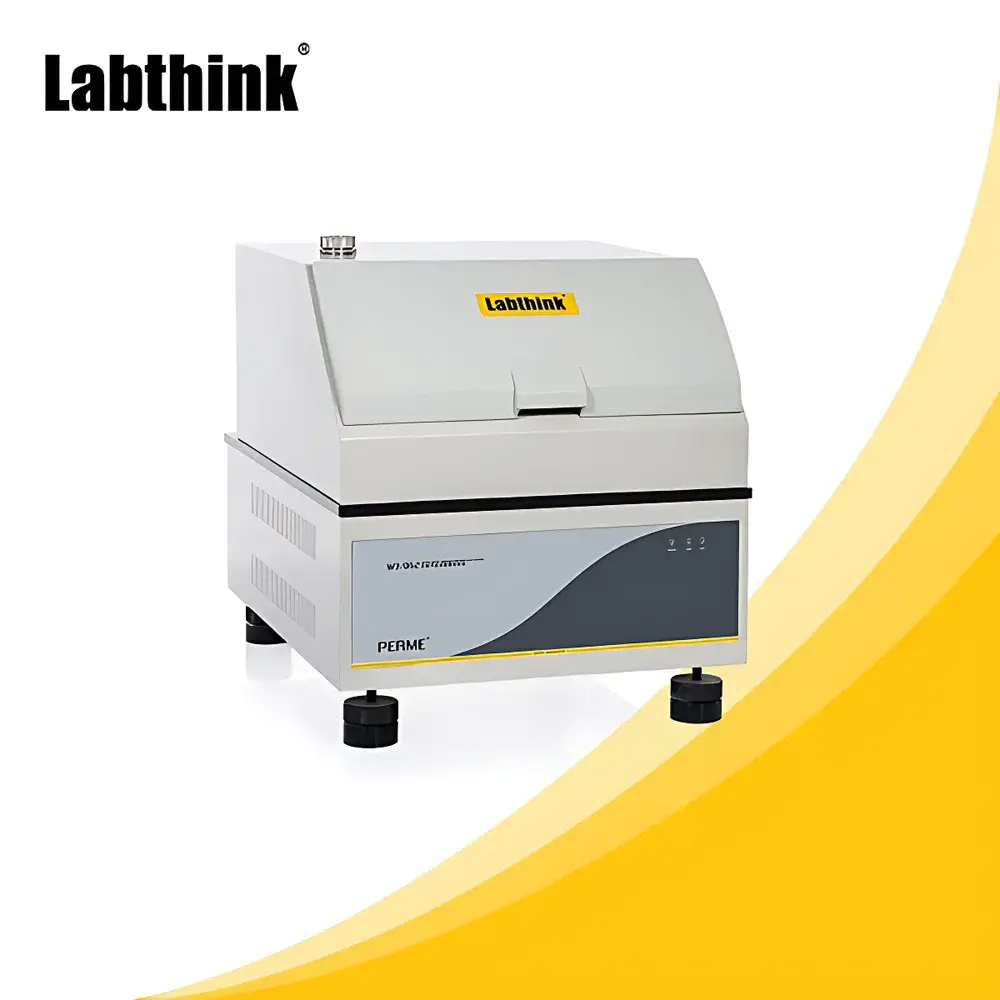
Labthink W3/062 Gravimetric Water Vapor Transmission Rate (WVTR) Tester
| Brand | Labthink |
|---|---|
| Origin | Shandong, China |
| Manufacturer | Labthink International Co., Ltd. |
| Model | W3/062 |
| Test Principle | Gravimetric Cup Method (ASTM E96, ISO 2528, GB 1037) |
| Measurement Range | 0.1–10,000 g/m²·24h (loss mode) |
| Sample Capacity | 1–6 independent specimens per test cycle |
| Temperature Control | 15–55 °C ±0.1 °C |
| Humidity Control | 10–98% RH ±1% RH |
| Test Area | 33 cm² |
| Specimen Thickness Limit | ≤3 mm |
| Weight Resolution | 0.001 g |
| Power Supply | 220 VAC 50 Hz / 120 VAC 60 Hz |
| Net Weight | 80 kg |
| Dimensions | 660 × 580 × 580 mm (L×W×H) |
Overview
The Labthink W3/062 Gravimetric Water Vapor Transmission Rate (WVTR) Tester is an engineered solution for precise, traceable, and repeatable measurement of water vapor permeation through flexible barrier materials. It operates on the gravimetric cup method—a primary reference technique standardized under ASTM E96, ISO 2528, GB 1037, and other internationally recognized protocols. In this method, a conditioned specimen is sealed over a test cup containing either desiccant (for weight-loss mode) or distilled water (for weight-gain mode), establishing a defined vapor pressure gradient across the film. The system continuously monitors mass change of the cup assembly via high-resolution electromagnetic force compensation balance (0.001 g resolution), enabling direct calculation of WVTR in g/m²·24h. Designed for R&D laboratories, QC departments, and regulatory-compliant packaging validation facilities, the W3/062 delivers metrological integrity without reliance on indirect sensors or calibration drift-prone humidity transducers.
Key Features
- High-precision dual-mode operation: supports both weight-loss and weight-gain configurations to accommodate diverse material behaviors—including hydrophobic films, hydrophilic coatings, and asymmetric laminates.
- Modular parallel testing architecture: single main unit accommodates up to six independently controlled test stations; scalable to 60 simultaneous tests via optional satellite modules (up to nine units per host).
- Thermo-hygrometric stability: PID-controlled environmental chamber maintains temperature within ±0.1 °C and relative humidity within ±1% RH across the full operational range (10–98% RH, 15–55 °C), ensuring compliance with stringent test condition repeatability requirements.
- Optimized cup geometry and airflow: circular specimen holder with 33 cm² active area and regulated sweep air (0.5–2.5 m/s) minimizes boundary layer effects and accelerates equilibration without inducing mechanical stress on thin films.
- Rugged mechanical design: stainless-steel test chamber (45 L volume), corrosion-resistant humidity generation/drying subsystems, and integrated gas regulation (0.6 MPa inlet pressure) support long-term unattended operation in GLP/GMP environments.
Sample Compatibility & Compliance
The W3/062 accepts flat, flexible specimens up to 3 mm thick and 74 mm in diameter—covering monolayer plastics (e.g., PET, PE, PP), metallized films, aluminum foil laminates, pharmaceutical blister foils, medical pouch materials, and construction membranes. Its configuration adheres to multiple global regulatory frameworks: ASTM E96 (desiccant and water methods), ISO 2528 (gravimetric determination), GB/T 16928 (Chinese national standard for packaging films), TAPPI T464 (paperboard moisture barrier), and YBB00092003 (Chinese pharmacopoeial standard for drug packaging). All hardware and software components are designed to support audit-ready documentation, including electronic signatures, user access control, and full data traceability—enabling alignment with FDA 21 CFR Part 11 and EU Annex 11 expectations where applicable.
Software & Data Management
The instrument is operated via Labthink’s proprietary Lystem™ v3.x software platform, compliant with IEC 62304 Class B software safety requirements. The interface provides real-time mass trend visualization, automatic endpoint detection based on slope convergence criteria, and built-in uncertainty propagation analysis per GUM (Guide to the Expression of Uncertainty in Measurement). Data export supports CSV, PDF, and XML formats with embedded metadata (operator ID, timestamp, environmental logs, calibration history). When deployed in networked laboratory environments, the system integrates natively with Labthink’s Lystem™ Laboratory Data Management System (LDMS), enabling centralized storage, cross-instrument comparison, statistical process control (SPC) charting, and automated report generation aligned with ISO/IEC 17025 documentation standards.
Applications
- Packaging development: quantifying moisture barrier performance of food, pharmaceutical, and electronics packaging to predict shelf-life and prevent degradation.
- Regulatory submission support: generating validated WVTR datasets for FDA IND/NDA dossiers, EMA CTD modules, and PMDA filings requiring physical stability evidence.
- Material qualification: screening incoming raw films against supplier specifications and internal quality thresholds (e.g., AQL-based acceptance sampling).
- Process optimization: correlating extrusion parameters, coating thickness, or lamination conditions with empirical WVTR outcomes.
- Accelerated aging studies: coupling WVTR measurements with thermal/humidity stress profiles to model long-term barrier decay kinetics.
FAQ
What is the difference between weight-loss and weight-gain modes?
Weight-loss mode uses desiccant in the test cup and measures moisture ingress into dry environment; weight-gain mode uses water and measures moisture egress into humid environment—each suited to different material hygroscopicity and diffusion mechanisms.
Can the W3/062 test non-planar or textured samples?
No—the system requires flat, sealable specimens; three-dimensional or porous structures must be mounted on rigid supports or evaluated using complementary techniques such as infrared sensor-based methods.
Is calibration traceable to national standards?
Yes—mass calibration employs NIST-traceable weights; temperature and RH sensors are certified against PTB- or NIM-calibrated references, with full calibration certificates provided upon request.
Does the system support 21 CFR Part 11 compliance?
Full electronic record and signature functionality—including audit trail, role-based access, and secure data archiving—is available when configured with Lystem™ LDMS and validated IQ/OQ protocols.
What maintenance is required for long-term accuracy?
Routine verification includes daily zero-balance checks, weekly humidity generator cleaning, quarterly sensor recalibration, and annual full-system performance qualification per ASTM D1653 Annex A1 guidelines.






