
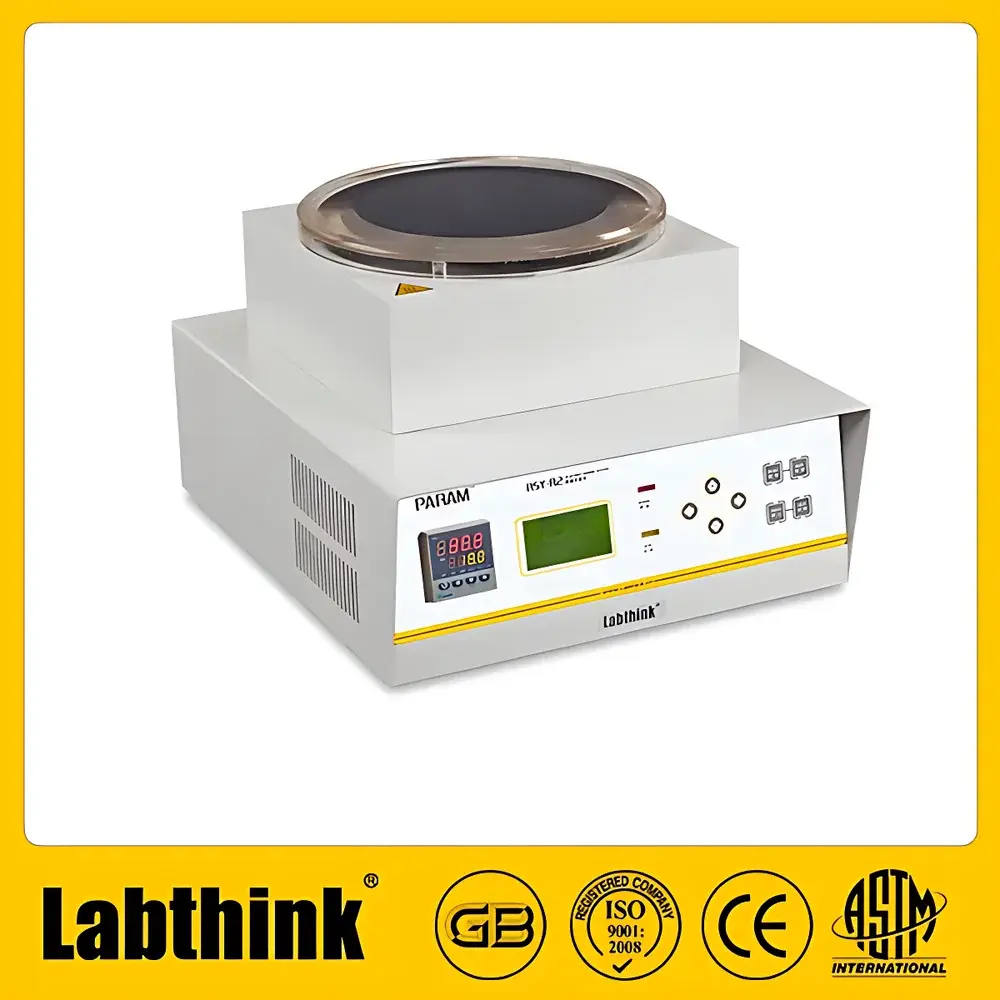
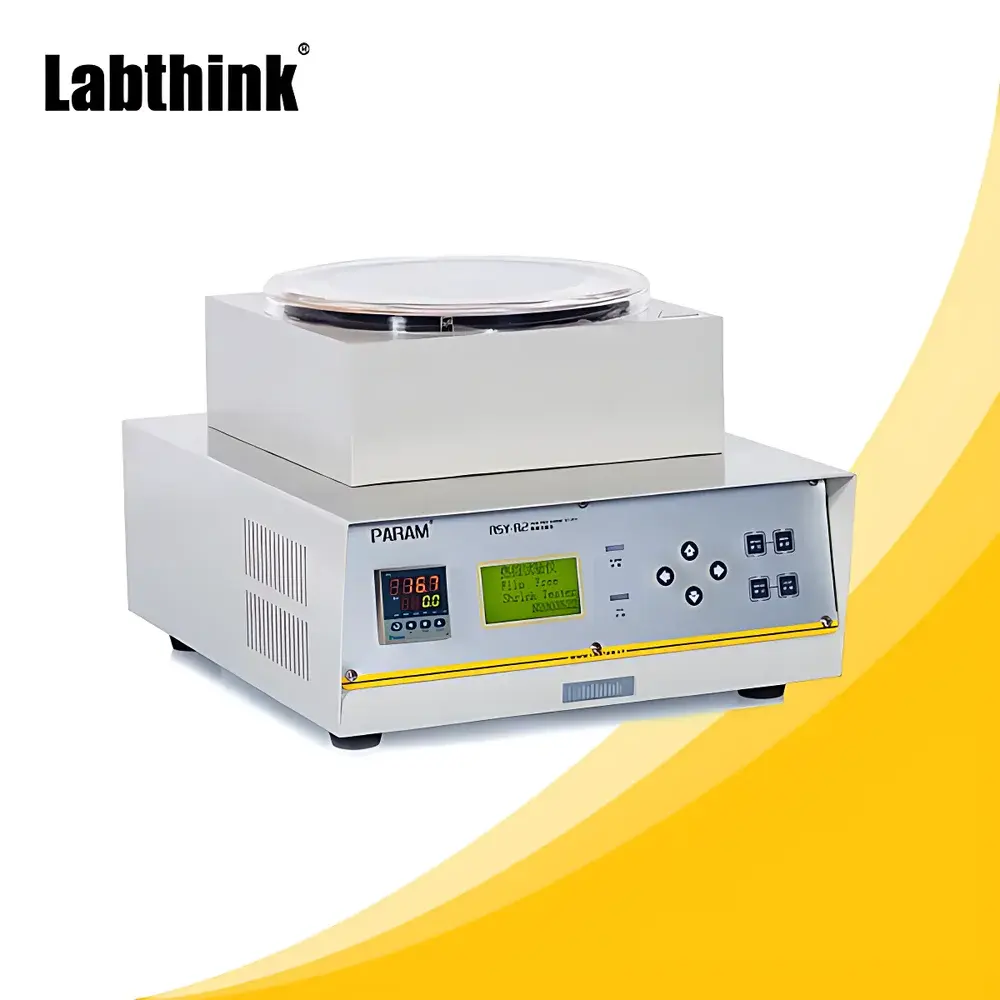
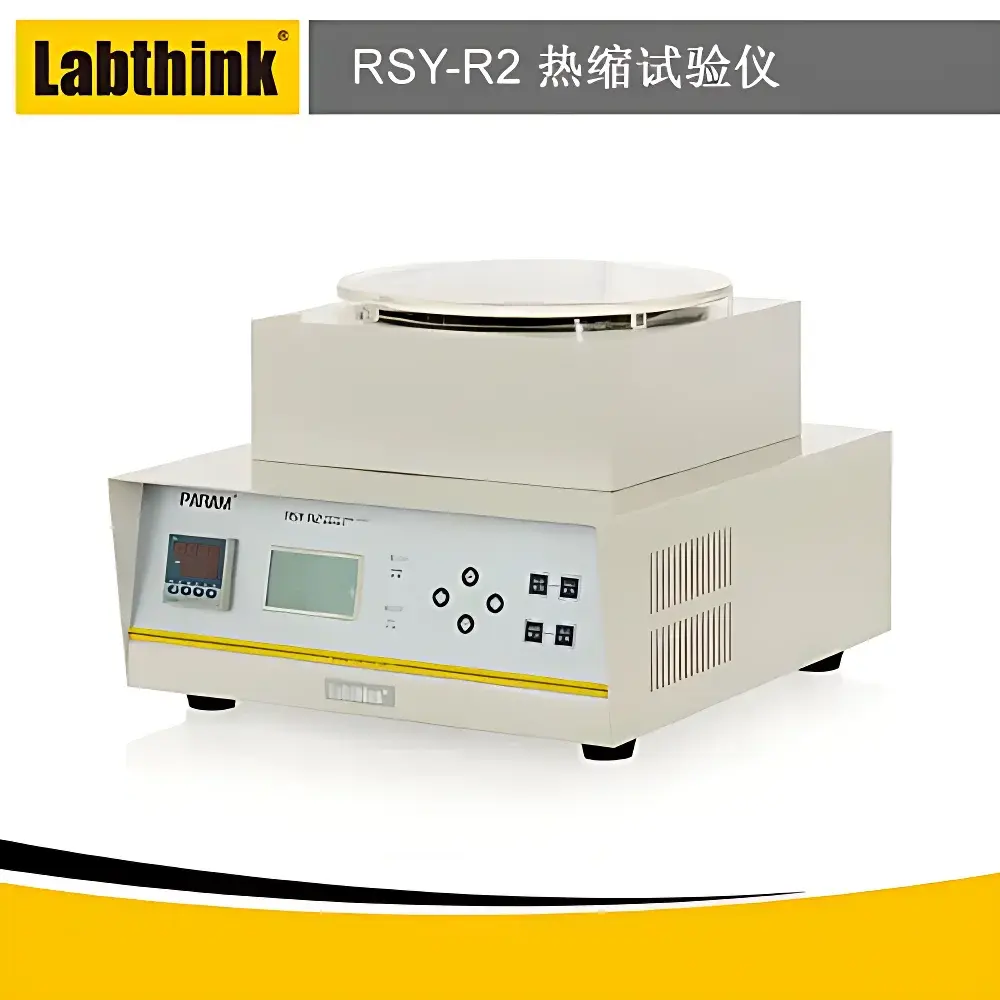
Labthink RSY-R2 Thermal Shrinkage Tester for Photovoltaic Backsheets and Polymeric Films
| Brand | Labthink |
|---|---|
| Origin | Jinan, Shandong, China |
| Manufacturer | Jinan Labthink Electromechanical Technology Co., Ltd. |
| Model | RSY-R2 |
| Temperature Range | Ambient to 200 °C |
| Temperature Control Accuracy | ±0.3 °C |
| Sample Size Limit | ≤140 mm × 140 mm |
| Heating Medium | Liquid bath (e.g., silicone oil or water) |
| Power Supply | AC 220 V, 50 Hz |
| Dimensions (L×W×H) | 440 × 370 × 310 mm |
| Net Weight | 24 kg |
| Compliance | ASTM D2732, GB/T 13519 |
Overview
The Labthink RSY-R2 Thermal Shrinkage Tester is a precision-engineered instrument designed to quantify the dimensional stability and free linear thermal shrinkage behavior of polymeric sheet materials under controlled thermal conditions. It operates on the principle of immersion-based thermal exposure: test specimens are suspended in a temperature-regulated liquid medium—typically silicone oil for high-temperature applications or deionized water for lower-range testing—and subjected to defined isothermal conditions for specified durations. The resulting dimensional changes (length and width) are measured before and after exposure using calibrated digital calipers or optical measurement systems (not included), enabling calculation of percentage shrinkage in both machine and transverse directions. This methodology aligns with fundamental polymer physics principles governing chain mobility, crystallinity relaxation, and residual stress release upon heating. The RSY-R2 is specifically optimized for photovoltaic (PV) backsheet substrates—including fluoropolymer-laminated PET, ETFE, and PVF-based composites—as well as packaging films (PVC, PE, PP), pharmaceutical blister lidding, and heat-shrink tubing used in cable insulation and medical device packaging.
Key Features
- Digital P.I.D. temperature control algorithm ensures rapid thermal equilibration and maintains bath stability within ±0.3 °C across the full operating range (ambient to 200 °C), minimizing drift-induced measurement uncertainty.
- Liquid-immersion heating architecture provides uniform thermal transfer and eliminates convective air-current artifacts common in oven-based systems, enhancing repeatability between replicate tests.
- Microprocessor-based controller with backlit LCD interface and intuitive PVC membrane keypad enables menu-driven operation, parameter setting, and real-time display of bath temperature and elapsed test time.
- Automated timing function initiates countdown upon reaching target temperature, eliminating operator-dependent start delays and ensuring consistent dwell periods per ASTM D2732 protocol.
- Standard fixture set includes five stainless-steel sample mesh frames and three supporting mesh holders, engineered to minimize edge constraint while maintaining planar specimen orientation during immersion.
- Compact benchtop footprint (440 × 370 × 310 mm) and 24 kg net weight facilitate integration into QC laboratories, R&D cleanrooms, and ISO 17025-accredited testing facilities without requiring dedicated floor space or structural reinforcement.
Sample Compatibility & Compliance
The RSY-R2 accommodates flat, non-porous polymeric specimens up to 140 mm × 140 mm, including multilayer laminates, coated foils, and co-extruded films. It supports standardized evaluation of PV backsheets per IEC 62788-5-2 (Measurement of dimensional stability of photovoltaic module backsheet materials) and aligns with critical regulatory expectations for material qualification under UL 1703 and IEC 61215-2 MQT 12. Test reports generated using this system satisfy traceability requirements for GLP and GMP environments when paired with validated calibration records and audit-ready documentation protocols. The instrument’s adherence to ASTM D2732 and GB/T 13519 ensures cross-laboratory comparability and facilitates third-party certification submissions.
Software & Data Management
While the RSY-R2 operates as a standalone hardware platform, its analog output signals (temperature, timer status) are compatible with external data acquisition systems supporting 4–20 mA or 0–10 V inputs. Users may integrate the device into LIMS or ELN workflows via RS232/RS485 serial communication (optional interface module available). All manual measurements—pre-test and post-test dimensions—are recorded in accordance with ALCOA+ principles (Attributable, Legible, Contemporaneous, Original, Accurate, Complete, Consistent, Enduring, Available) to support FDA 21 CFR Part 11-compliant electronic record retention when paired with qualified software platforms.
Applications
- Quantification of longitudinal and lateral shrinkage in fluoropolymer-coated PV backsheets after 150 °C/30 min thermal exposure—critical for assessing long-term module reliability under desert climatic stress.
- Quality control of heat-shrink tubing used in aerospace wire harnessing, where dimensional tolerance ≤±1.5% is mandated per SAE AS4373.
- Development-stage screening of biodegradable PLA and PHA films for food packaging, evaluating thermal stability during sterilization simulation cycles.
- Validation of thermoforming-grade APET sheets prior to roll-to-roll processing, verifying minimal distortion at pre-heating temperatures.
- Comparative analysis of annealing effects on oriented PET films, correlating shrinkage kinetics with DSC-measured cold-crystallization onset temperatures.
FAQ
What liquid media are compatible with the RSY-R2 bath system?
Silicone oil (up to 200 °C), mineral oil (up to 150 °C), and deionized water (up to 95 °C) are recommended. Viscosity and thermal stability must be verified per manufacturer specifications prior to use.
Is the RSY-R2 suitable for testing opaque or metallized films?
Yes—dimensional change is assessed via physical measurement of specimen edges; optical transparency is not required.
Does the instrument include measurement tools for post-test dimension analysis?
No. Calibrated digital calipers (resolution ≤0.01 mm) or optical profilometers must be provided separately per ASTM D2732 Section 7.2.
Can test parameters be exported for audit purposes?
Temperature setpoints, actual bath readings, and timer logs can be manually documented or captured via optional serial interface; full electronic audit trails require integration with validated external software.
What maintenance is required to ensure long-term accuracy?
Quarterly verification of temperature sensor calibration against NIST-traceable reference thermometers and annual inspection of heater element resistance are recommended per Labthink Maintenance Protocol MP-RSY-01.



