
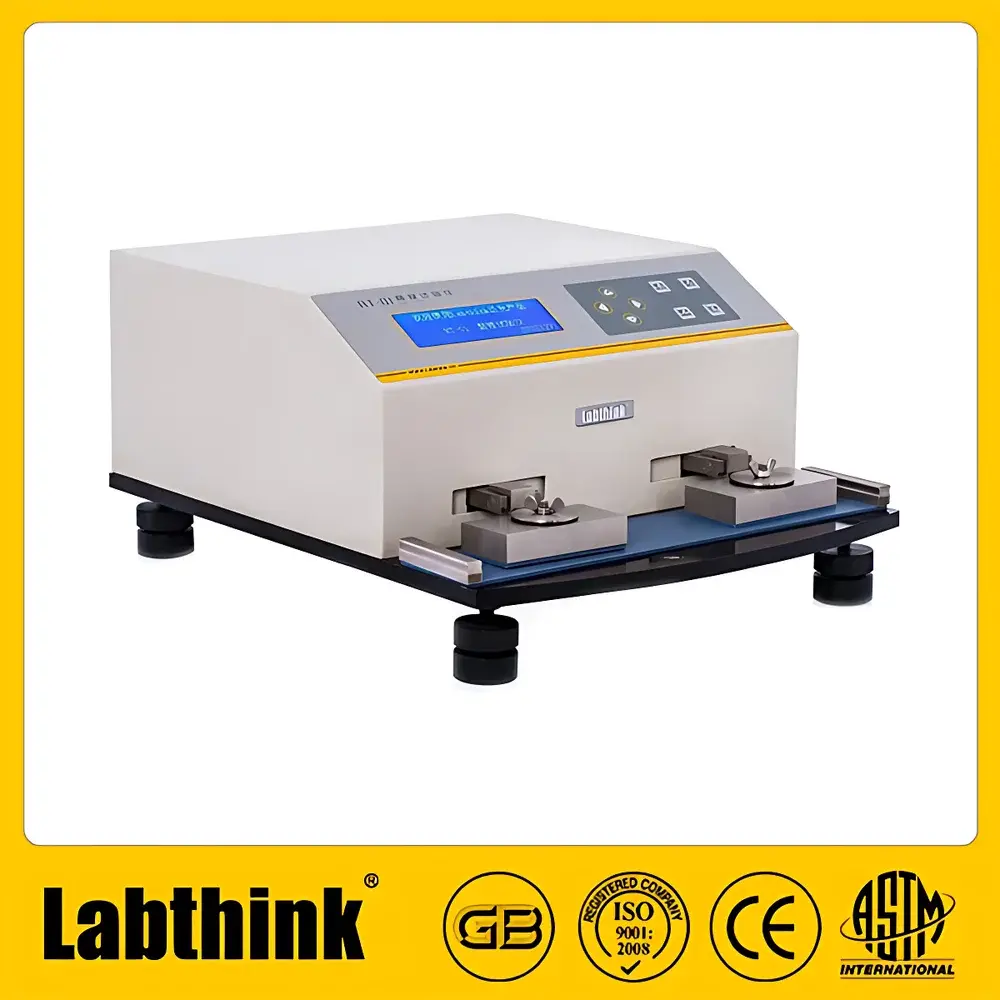
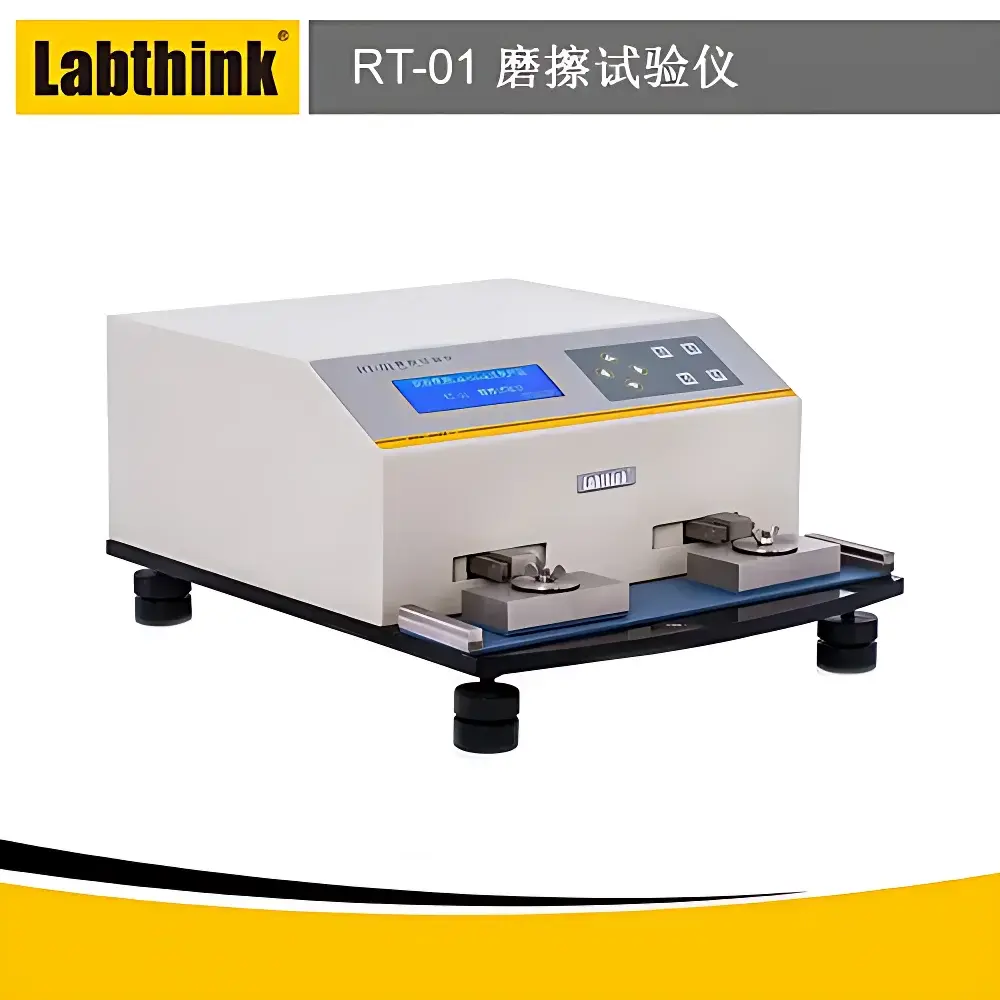
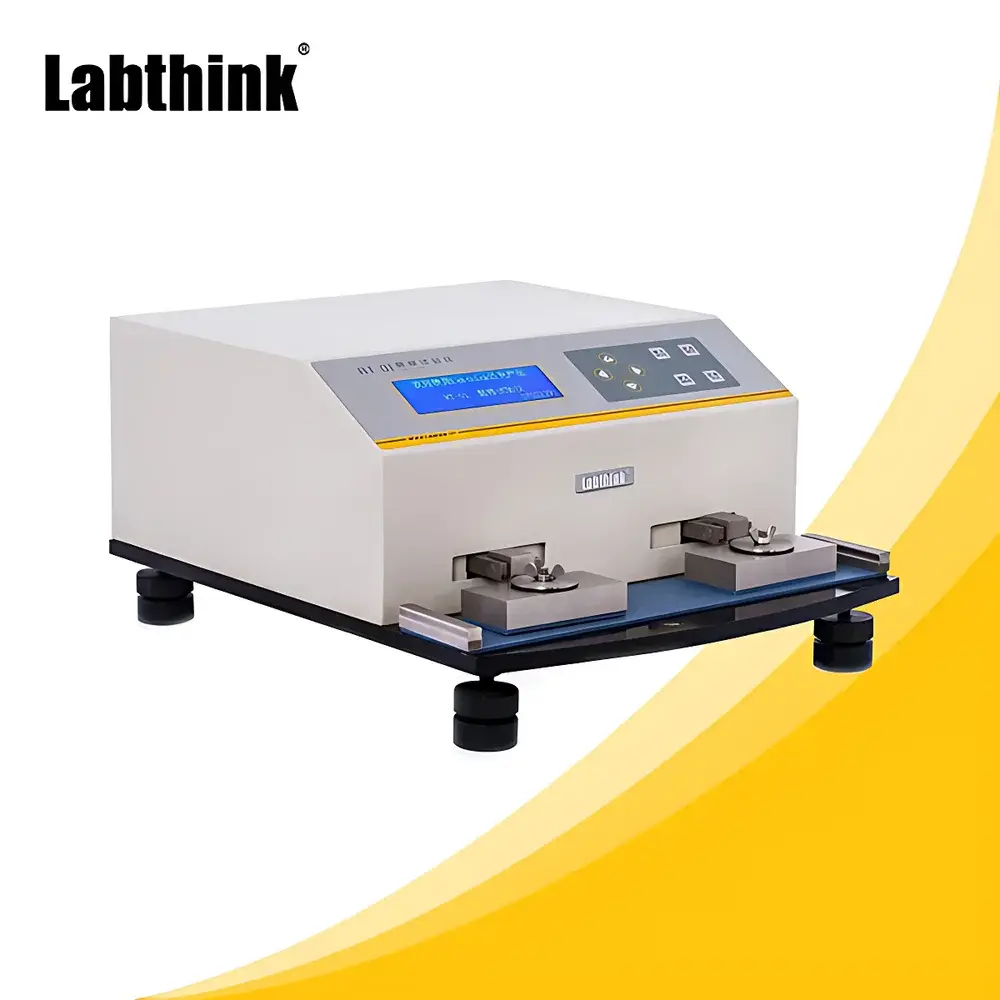
Labthink RT-01 Sutherland Rub Tester for Ink and Coating Abrasion Resistance
| Brand | Labthink |
|---|---|
| Model | RT-01 |
| Origin | Shandong, China |
| Manufacturer | Labthink Instruments Co., Ltd. |
| Application | Ink adhesion, coating abrasion resistance, print rub fastness testing |
| Compliance | ASTM D5264, TAPPI T830 |
| Load Options | 8.9 N (2 lb) and 17.8 N (4 lb) |
| Stroke Frequency | 21, 42, 85, 106 cycles per minute (cpm) |
| Motion Type | Arcuate reciprocating |
| Cycle Count Range | 0–999,999 |
| Sample Capacity | 1–2 specimens |
| Power Supply | AC 220 V, 50 Hz |
| Dimensions (L×W×H) | 485 × 390 × 230 mm |
| Net Weight | 40 kg |
| Control System | Microprocessor-based with PVC membrane keypad and LCD display |
| Test Modes | Dry rub, wet rub, migration, wet trace |
| Memory Function | Power-loss cycle retention |
| Audible Alert | Built-in buzzer for test completion |
Overview
The Labthink RT-01 Sutherland Rub Tester is an engineered solution for quantitative assessment of surface abrasion resistance in printed materials and coated substrates. Based on the standardized Sutherland rub principle—a controlled arcuate reciprocating motion applied under defined normal load—the instrument replicates real-world mechanical stress encountered during handling, packaging, transportation, and shelf exposure. It measures the degree of ink transfer, coating wear, or surface degradation after a predetermined number of cycles, providing objective data for quality control and material qualification. Designed specifically for packaging laboratories, print R&D centers, and regulatory compliance units, the RT-01 supports methodologically rigorous evaluation aligned with internationally recognized test protocols.
Key Features
- Four standardized test modes: dry rub, wet rub, migration, and wet trace—enabling differentiation between mechanical wear and solvent-induced ink transfer
- Dual-station configuration allows simultaneous testing of identical or dissimilar specimens under identical or independent parameter sets
- Four selectable stroke frequencies (21, 42, 85, and 106 cpm) to simulate varying degrees of mechanical aggressiveness across applications
- Precisely calibrated load application via interchangeable weights: 8.9 N (2 lb) and 17.8 N (4 lb), traceable to national metrological standards
- Microprocessor-controlled operation with non-volatile memory retains cycle count and settings after power interruption
- Intuitive PVC membrane keypad and backlit LCD interface support rapid setup, real-time monitoring, and post-test review without external software
- Robust aluminum alloy frame and precision-machined guide rails ensure long-term dimensional stability and motion repeatability
Sample Compatibility & Compliance
The RT-01 accommodates flat, rigid, or semi-rigid specimens up to standard Sutherland test card dimensions (typically 100 mm × 100 mm), including but not limited to: offset-printed paperboard, flexographic labels, gravure-films, laminated pouches, and UV-cured coatings. Specimen thickness is constrained only by the vertical clearance between the rubbing pad and platen (≥ 3 mm). The system complies fully with ASTM D5264 (“Standard Test Method for Determining the Rub Resistance of Printed Materials Using the Sutherland Rub Tester”) and TAPPI T830 (“Test Method for Rub Resistance of Ink on Paper and Paperboard”). Its operational parameters—including load tolerance (±0.5 N), frequency accuracy (±1 cpm), and cycle resolution (1 cycle)—meet the repeatability requirements stipulated in both standards for GLP-compliant environments.
Software & Data Management
While the RT-01 operates as a stand-alone instrument with embedded firmware, its test logs—including start time, total cycles, selected mode, applied load, and final status—are stored in internal memory and viewable directly on the LCD. For laboratories requiring electronic record retention, optional RS-232 or USB-to-serial interfaces enable integration with LIMS or custom QA databases. All stored data adhere to ALCOA+ principles (Attributable, Legible, Contemporaneous, Original, Accurate, Complete, Consistent, Enduring, Available) when exported. Audit trail functionality—including operator ID input and timestamped event logging—is available via firmware upgrade for FDA 21 CFR Part 11–aligned workflows.
Applications
- Quantifying rub fastness of ink systems on folding cartons and corrugated shipping containers
- Evaluating durability of functional barrier coatings (e.g., PVDC, EVOH, acrylic dispersions) against mechanical abrasion
- Validating shelf-life performance of pharmaceutical blister foil lidding under simulated distribution conditions
- Supporting ISO 15378 and ICH Q5C stability protocol development for printed primary packaging components
- Assessing cross-contamination risk in multi-product packaging lines via migration testing under wet rub conditions
- Correlating lab-scale rub resistance with field failure reports for root cause analysis in packaging quality investigations
FAQ
What is the maximum specimen thickness the RT-01 can accommodate?
The instrument accepts specimens up to 3 mm in thickness, determined by the vertical gap between the abrasive pad and test platen. Thicker samples may be evaluated using custom-height spacers, subject to mechanical stability verification.
Can non-standard loads be used beyond the supplied 2 lb and 4 lb weights?
Yes—custom-calibrated load blocks are available as optional accessories. Any non-standard load must be independently verified with certified force calibration equipment prior to use in regulated testing.
Is the RT-01 suitable for testing flexible films with low tensile modulus?
Yes, provided the film is mounted tautly on a rigid backing card (e.g., 300 gsm board) to prevent buckling or lateral slippage during reciprocation.
Does the device meet requirements for ISO/IEC 17025 accredited testing labs?
When operated within specified environmental conditions (23 ± 2°C, 50 ± 5% RH) and accompanied by documented calibration certificates for load and cycle counters, the RT-01 satisfies the technical competence criteria outlined in ISO/IEC 17025:2017 Clause 6.4 for mechanical testing equipment.
How frequently should the rubbing pad be replaced?
Pad replacement is determined empirically based on observed wear; typical service life ranges from 5,000 to 10,000 cycles depending on substrate hardness and test severity. Labthink recommends visual inspection after every 2,000 cycles and replacement upon visible fiber fraying or loss of uniform surface texture.
Related Products





