
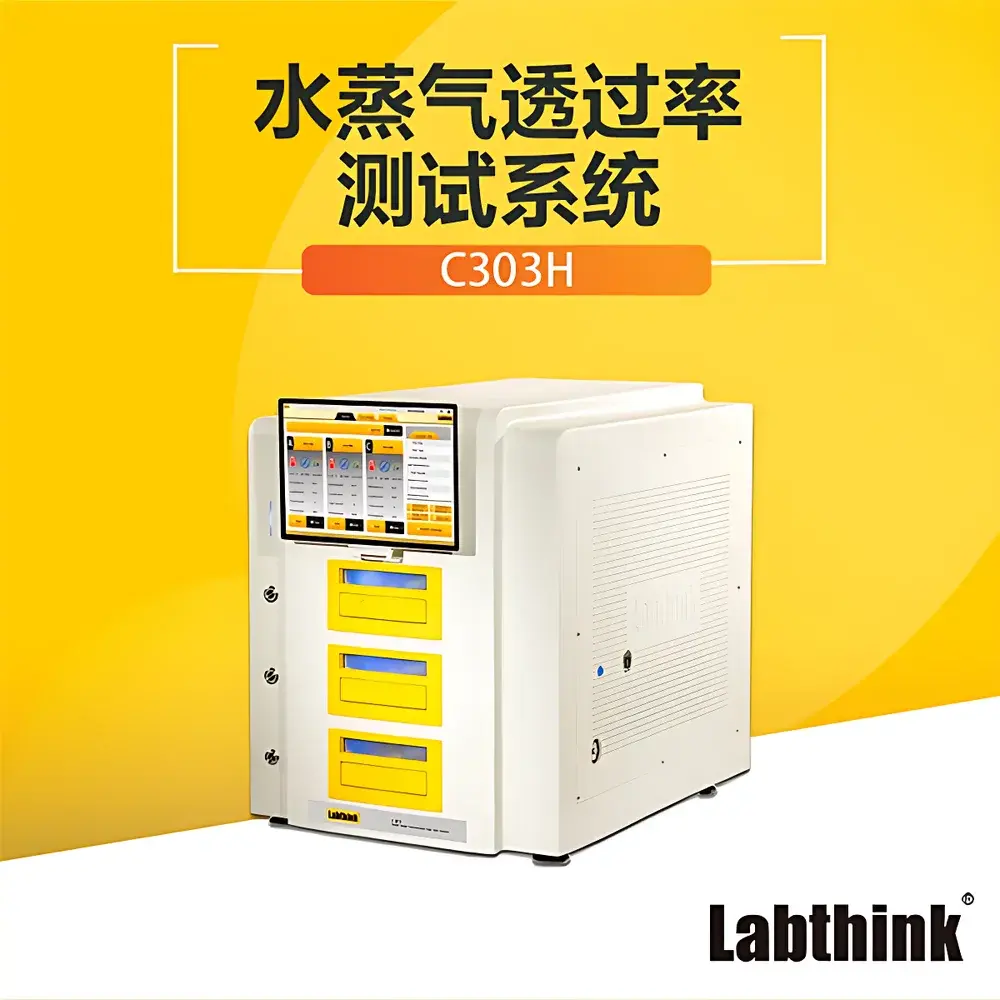
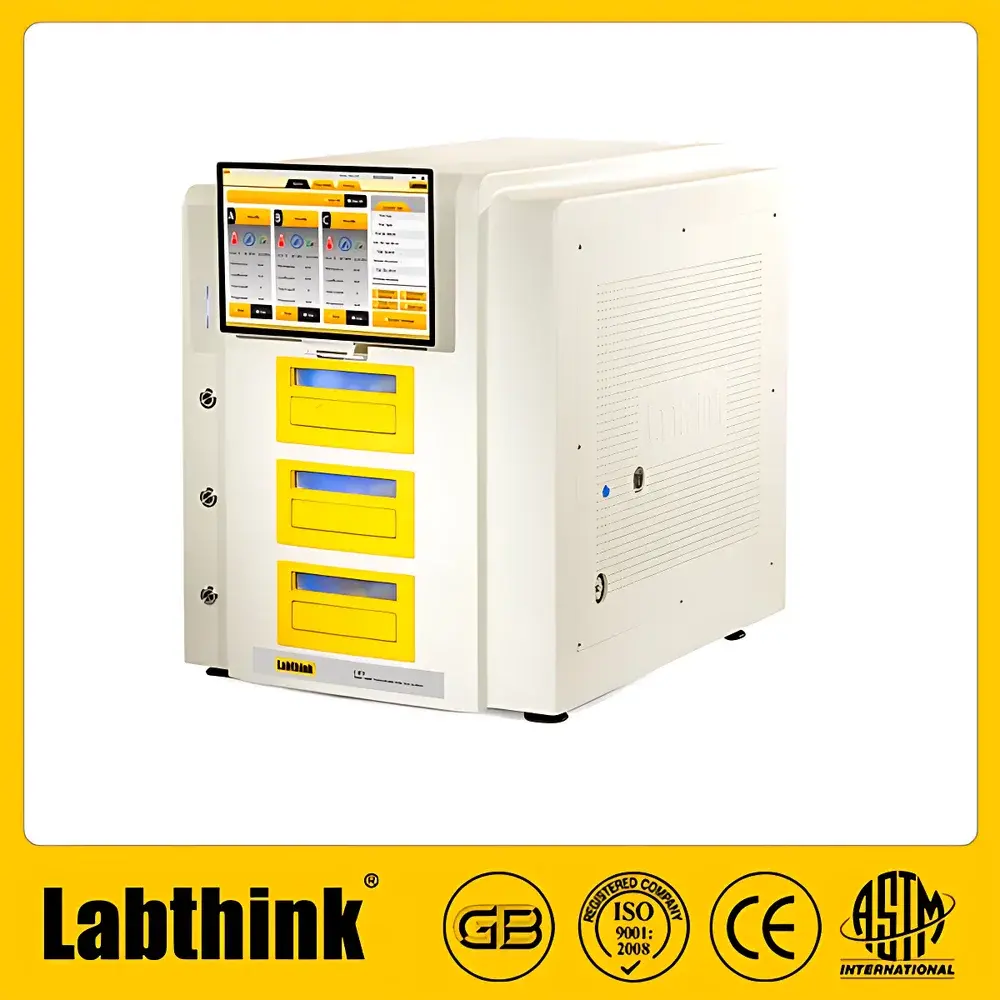
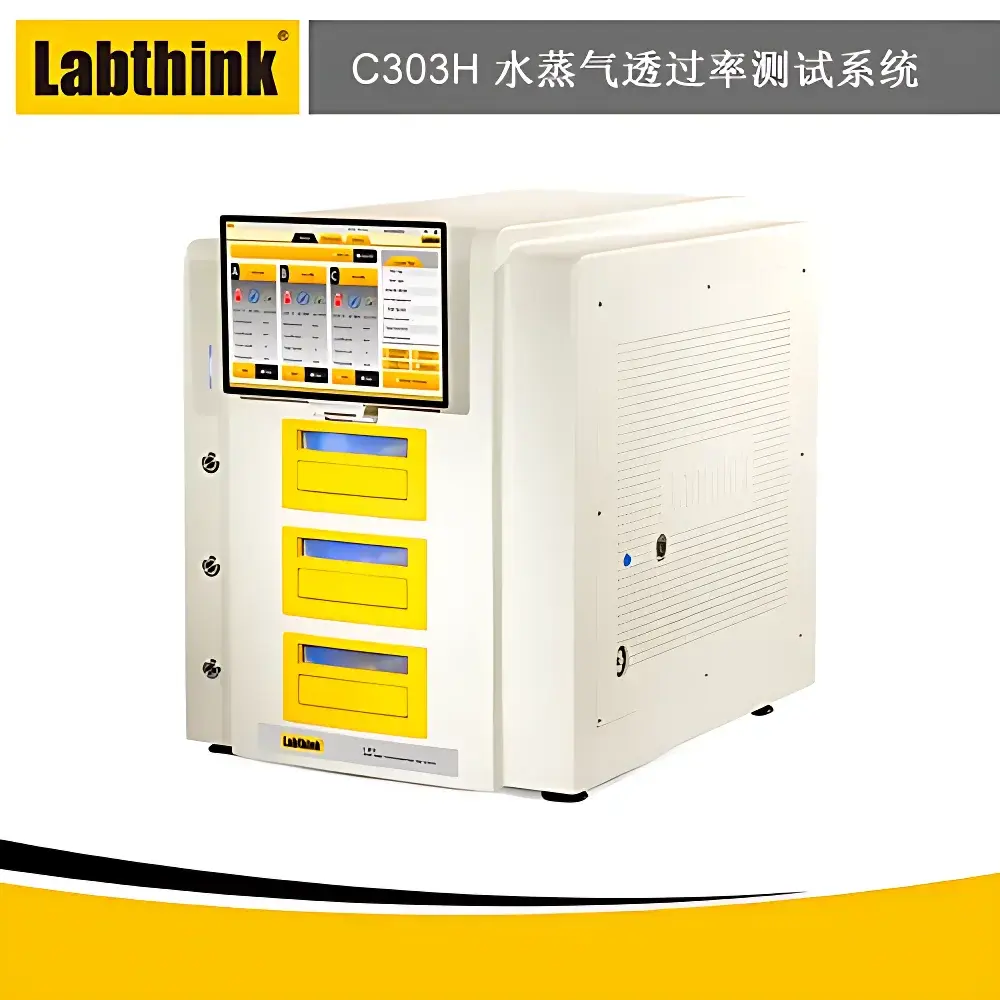
Labthink C303H Infrared Moisture Transmission Rate Tester (WVTR)
| Brand | Labthink |
|---|---|
| Model | C303H |
| Measurement Principle | Infrared Detection (ASTM F1249, ISO 15106-2 compliant) |
| Test Range | Standard WVTR range for high-to-medium barrier films |
| Sample Types | Flexible packaging films, laminates, coated papers, pharmaceutical blister foils, PV encapsulation films |
| Compliance | GB/T 26253, ASTM F1249, ISO 15106-2, ISO 2528 |
| Data Output | Real-time WVTR (g/m²·day), permeability coefficient, temperature & RH control logging |
| Environmental Control | Dual-zone temperature and relative humidity regulation |
| Sensor Type | High-stability infrared moisture sensor with auto-zero calibration |
| Throughput | Up to 3 simultaneous test stations (configurable) |
| Interface | Ethernet + USB |
| Software | Labthink TRS v4.2 with 21 CFR Part 11 compliance mode, audit trail, user permission levels |
Overview
The Labthink C303H Infrared Moisture Transmission Rate Tester is a precision-engineered instrument designed for the quantitative determination of water vapor transmission rate (WVTR) in flexible barrier materials. It operates on the principle of non-dispersive infrared (NDIR) detection, where water vapor molecules traversing a test specimen are quantified via selective absorption at characteristic infrared wavelengths (typically ~2.7 µm). This optical method eliminates consumables, drift-prone electrochemical cells, or desiccant-based gravimetric interference—delivering inherent long-term stability and measurement repeatability. The system conforms rigorously to international standards including ASTM F1249 (Standard Test Method for Water Vapor Transmission Rate Through Plastic Film and Sheeting Using a Modulated Infrared Sensor), ISO 15106-2 (Plastics — Film and sheeting — Determination of water vapour transmission rate — Part 2: Infrared detection method), and China’s national standard GB/T 26253. Its dual-climate chamber architecture enables independent, programmable control of temperature (15–40 °C ±0.1 °C) and relative humidity (10–90% RH ±1% RH) on both test and carrier sides—critical for simulating real-world storage conditions and evaluating material performance across environmental gradients.
Key Features
- Infrared moisture sensor with integrated auto-zero calibration and thermal drift compensation—ensuring measurement integrity over extended operational cycles
- Three independent test stations (standard configuration) with individual environmental control, enabling parallel testing of heterogeneous samples under identical or differentiated conditions
- Modular climate chamber design featuring PID-controlled heating/cooling and saturated salt/ultrasonic humidification systems for precise RH generation and stability
- Automated sample loading mechanism with pressure-sealed test cells and leak-tight sealing verification (integrated pressure decay test)
- Real-time data acquisition at 1-second intervals, with continuous calculation of WVTR, cumulative transmission, and diffusion coefficient trends
- Robust mechanical architecture with stainless-steel fluid pathways, corrosion-resistant internal surfaces, and ESD-safe housing for cleanroom-compatible operation
Sample Compatibility & Compliance
The C303H accommodates flat, flexible specimens up to 100 mm × 100 mm, including polymer films (PET, PE, PP, PA, EVOH), metallized laminates, AlOx/SiOx-coated substrates, pharmaceutical cold-form foil, photovoltaic backsheet films, and barrier-coated paperboard. Specimen thickness range spans 20 µm to 2 mm, with automatic thickness compensation applied during permeability calculations. All test methodologies adhere to regulatory expectations for quality-controlled environments: full traceability per ISO/IEC 17025, electronic records compliant with FDA 21 CFR Part 11 (including electronic signatures, audit trails, and role-based access control), and alignment with GMP/GLP documentation requirements. Validation documentation—including IQ/OQ/PQ protocols, uncertainty budgets, and metrological traceability to NIM (National Institute of Metrology, China) and NIST-traceable humidity standards—is provided with each instrument shipment.
Software & Data Management
Labthink TRS v4.2 software serves as the central interface for instrument control, data visualization, and regulatory reporting. It features a hierarchical user management system with configurable permissions (operator, supervisor, administrator), mandatory electronic signature workflows for critical actions (e.g., method validation, report approval), and immutable audit trails recording all parameter changes, test initiations, and data exports. Raw sensor output, environmental logs, and calculated WVTR values are stored in encrypted SQLite databases with optional synchronization to networked LIMS or ELN platforms via ASTM E1384-compliant HL7 or CSV/JSON APIs. Reporting templates comply with ISO 17025 clause 7.8.2, supporting customizable PDF reports with embedded metadata (tester ID, calibration date, operator ID, environmental setpoints, uncertainty statements).
Applications
The C303H is deployed extensively in R&D laboratories and QC/QA departments across regulated industries. In pharmaceutical packaging, it validates moisture barrier integrity of blister cavities and pouches to ensure drug stability per USP and ICH Q5C guidelines. Food packaging engineers use it to benchmark shelf-life predictions for snack bags, coffee pouches, and frozen meal trays under accelerated aging conditions. Photovoltaic manufacturers rely on its sensitivity to detect micro-defects in ethylene-vinyl acetate (EVA) encapsulants and fluoropolymer backsheets—where WVTR thresholds below 0.01 g/m²·day directly correlate with module delamination risk. Additionally, the system supports comparative studies of novel barrier coatings (e.g., ALD-deposited oxides, graphene oxide nanocomposites) and supports ASTM D3045-based thermal aging correlation protocols.
FAQ
What standards does the C303H validate against?
ASTM F1249, ISO 15106-2, ISO 2528, GB/T 26253, and ASTM E96 (for gravimetric comparison mode when configured).
Can the system be used for low-permeability materials (<0.05 g/m²·day)?
Yes—the infrared sensor’s noise floor and extended integration time algorithms enable reliable quantification down to 0.005 g/m²·day with appropriate test duration and environmental stabilization.
Is 21 CFR Part 11 compliance hardware- or software-enabled?
Compliance is fully implemented in TRS v4.2 software, including electronic signatures, audit trail encryption, and system-level access controls—no additional hardware modules required.
How is sensor calibration maintained over time?
The system performs automated zero-point calibration before each test cycle using dry nitrogen purge; annual verification with NIST-traceable humidity standards is recommended and supported by Labthink’s global service network.
Does the instrument support custom test profiles (e.g., cyclic RH/temperature ramps)?
Yes—TRS v4.2 allows definition of multi-step environmental profiles with up to 10 segments per test, including ramp rates, dwell times, and conditional triggers based on WVTR deviation thresholds.
Related Products





