
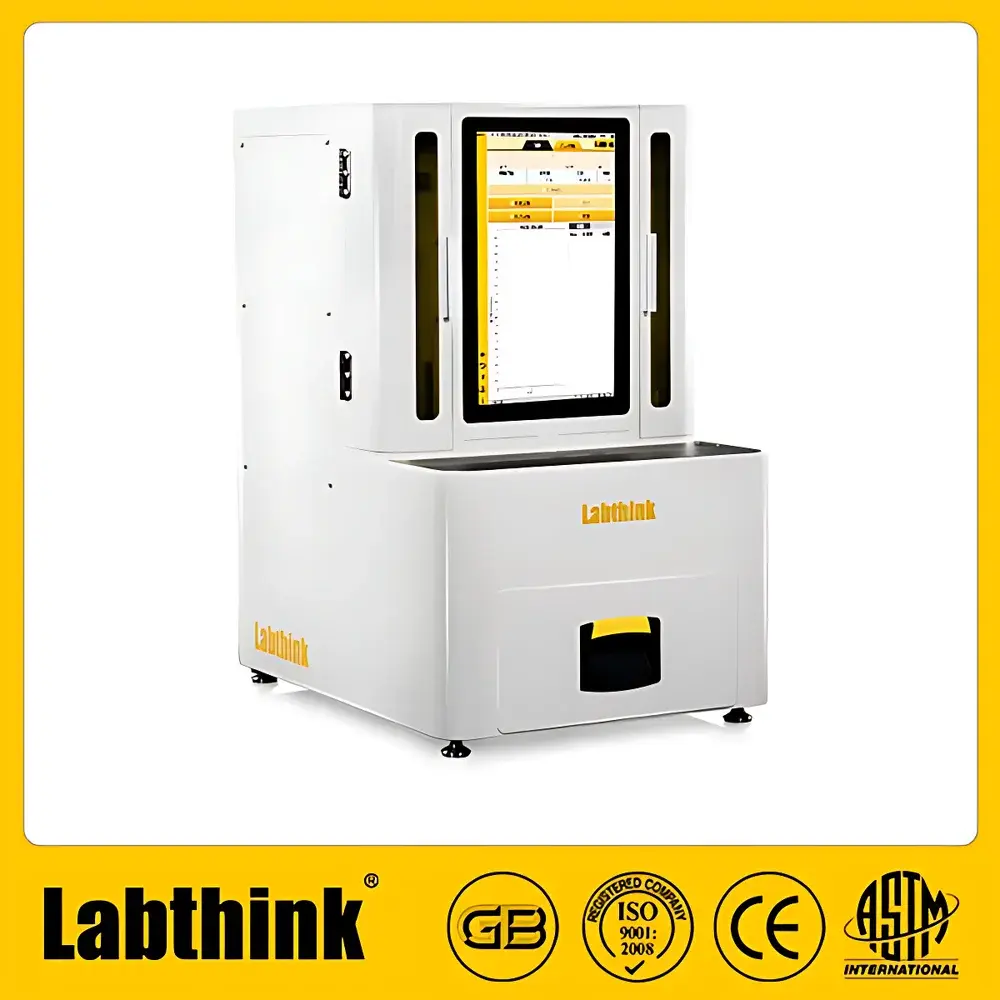
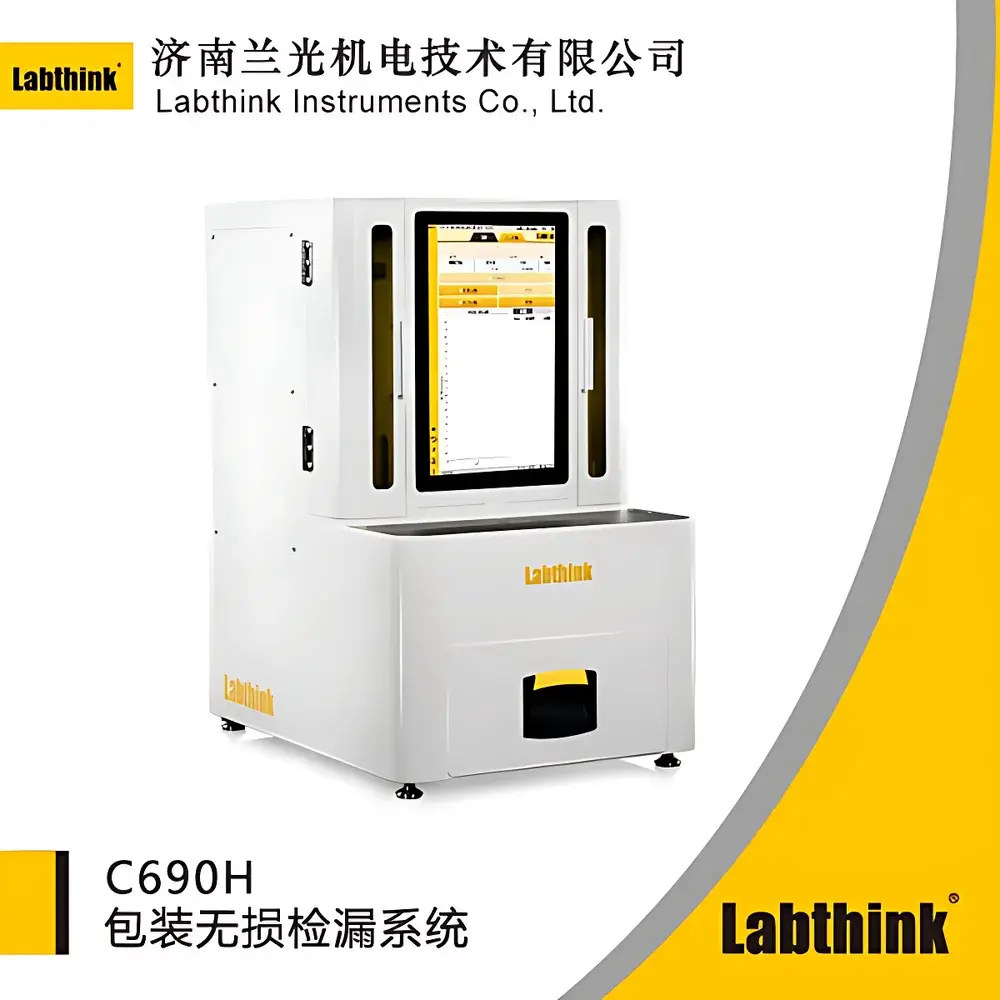
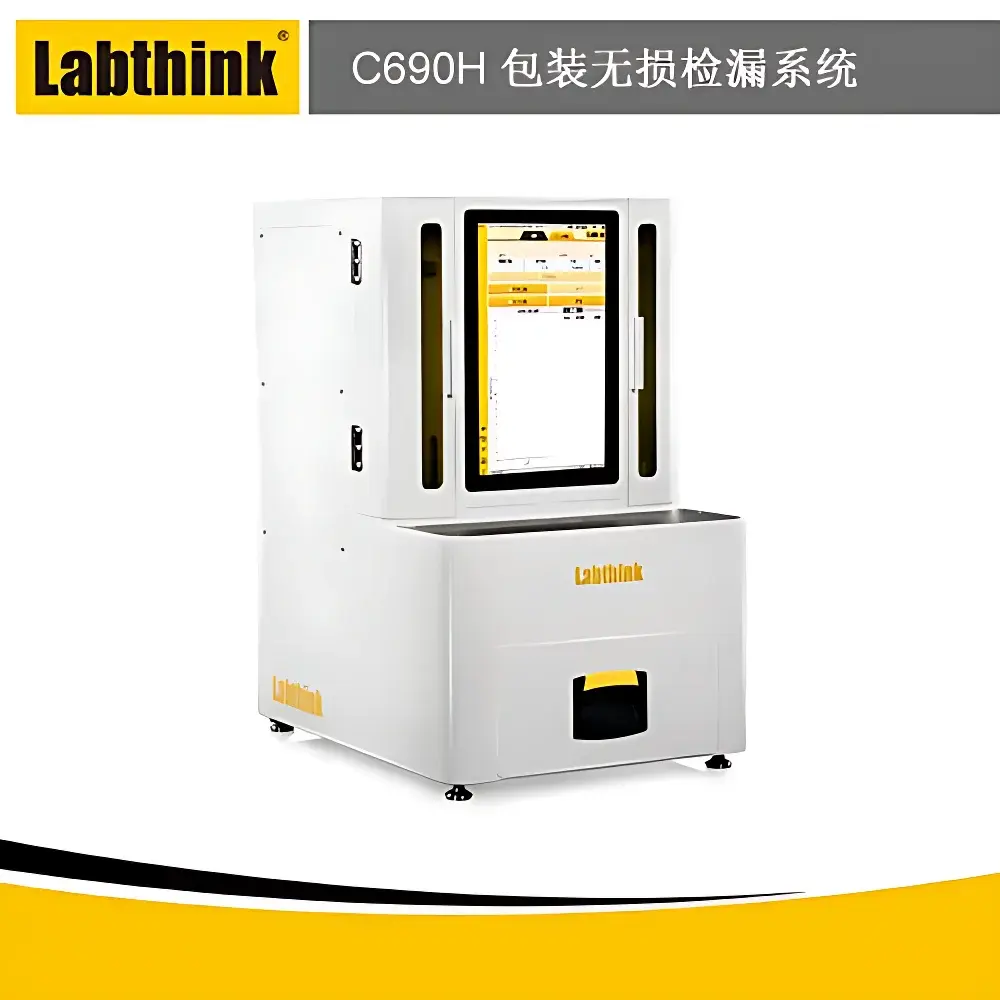
Labthink C690H Non-Destructive Package Leak Tester for Micro-Leak Detection
| Brand | Labthink |
|---|---|
| Model | C690H |
| Origin | Shandong, China |
| Manufacturer Type | Direct Manufacturer |
| Country of Origin | China |
| Test Principle | Vacuum Decay Method (ASTM F2338–21 compliant) |
| Test Range | 3–8–Large Leak (USP <1207> Reference Orifice Equivalent) |
| Detection Limit | ≤3 µm |
| Resolution | 0.1 µm |
| Repeatability | ±1 µm |
| Pressure Range | –100 to 0 to +100 kPa |
| Sample Capacity | 20–120 units per batch |
| Max Sample Dimensions | Ø45 mm × 80 mm |
| Interface | Ø6 mm Polyurethane Tubing |
| Dimensions | 850 × 500 × 730 mm |
| Weight | 95 kg |
| Power | 120 VAC ±10%, 60 Hz OR 220 VAC ±10%, 50 Hz (user-selectable) |
| Operating System | Embedded Windows on 15.6" Touchscreen |
| Data Compliance | 21 CFR Part 11–ready Electronic Signatures, Audit Trail, Role-Based User Access Control |
| Software Features | Real-time Pressure Curve Visualization, Automatic Pass/Fail Classification, Leakage Rate & Equivalent Orifice Diameter Calculation, Auto-Capture & Sorting of Non-Conforming Units, USB & Ethernet Connectivity, Remote Firmware Updates |
Overview
The Labthink C690H Non-Destructive Package Leak Tester is an engineered solution for quantitative micro-leak detection in pharmaceutical primary packaging—designed specifically to meet the rigorous demands of quality control laboratories operating under cGMP, ISO 13485, and FDA-regulated environments. It employs the vacuum decay method, a physically grounded, non-invasive technique standardized in ASTM F2338–21 and aligned with USP guidance on container closure integrity testing (CCIT). Unlike destructive dye ingress or microbial challenge methods, the C690H measures minute pressure differentials within a sealed test chamber to derive leakage rate and equivalent reference orifice diameter—enabling statistical evaluation of seal integrity without compromising product sterility or stability. Its dual-channel architecture supports concurrent validation and routine testing of heterogeneous packaging formats, ensuring throughput efficiency while maintaining metrological traceability to NIST-certified pressure and flow standards.
Key Features
- Dual independent test channels (A and B), each equipped with a dedicated vacuum chamber and automated drop-feed mechanism—enabling simultaneous evaluation of two distinct package types or sizes.
- Automated sample handling via Labthink’s proprietary gravity-fed feeder system, supporting batch sizes from 20 to 120 units with programmable positioning and alignment verification.
- Configurable vacuum setpoints and dual-mode operation (vacuum decay and positive pressure hold) to mitigate false negatives caused by transient occlusion of leak paths—a known limitation in single-mode systems.
- NIST-traceable differential pressure transducers and mass flow sensors, calibrated against certified reference standards; measurement uncertainty validated per ISO/IEC 17025 requirements.
- High-resolution data acquisition (0.1 µm equivalent orifice resolution) with repeatability of ±1 µm across repeated measurements under identical environmental conditions.
- Embedded 15.6-inch Windows-based touchscreen interface featuring vertically optimized UI, real-time pressure curve visualization, and auto-generated statistical summaries (mean, SD, CV%, pass/fail distribution).
- Integrated hardware-level safeguards: overpressure protection, temperature-compensated sensor drift correction, automatic leak-path verification prior to test initiation, and audible/visual alerts for out-of-spec conditions.
Sample Compatibility & Compliance
The C690H is validated for use with glass and polymer-based parenteral containers including vials (e.g., serum, lyophilized, and liquid-filled), ampoules (type I–III), cartridge systems (e.g., Luer-lock and integrated plunger designs), infusion bottles, and prefilled syringes. Each test chamber accommodates packages up to Ø45 mm × 80 mm. Chamber geometry and feeder tooling are customizable to match specific container footprints and orientation requirements. The system complies with ASTM F2338–21, YY/T 0681.18–2022, and USP Category 1 (deterministic, quantitative CCIT). All software functions—including electronic signatures, audit trail generation, user privilege assignment, and data export—meet 21 CFR Part 11 technical and procedural criteria. Full validation documentation (IQ/OQ/PQ protocols, risk assessments, and method suitability reports) is available upon request.
Software & Data Management
The embedded software platform provides end-to-end data governance: time-stamped raw pressure/flow datasets, configurable report templates (PDF/CSV/XLSX), and encrypted local storage with optional network backup. Audit trails record all user actions—including parameter changes, test starts/stops, result overrides, and logins—with immutable timestamps and operator identifiers. Role-based access control supports up to five hierarchical permission levels (e.g., Operator, Supervisor, QA Reviewer, Administrator, Auditor), each with granular configuration options (e.g., “view-only”, “edit-test-parameters”, “approve-reports”). Data export interfaces support HL7, ASTM E1384, and SQL-compatible databases. Firmware updates are delivered remotely via secure HTTPS, with version rollback capability and SHA-256 signature verification.
Applications
- Batch release testing of lyophilized and liquid-filled vials prior to sterilization or final packaging.
- Comparative evaluation of stopper-crimp combinations during formulation development or container closure system qualification.
- Stability study monitoring: periodic CCIT assessment at accelerated and real-time storage conditions.
- Root cause analysis of seal failure modes—correlating leakage magnitude with manufacturing variables (e.g., crimp torque, stopper compression force, autoclave cycle parameters).
- Qualification of alternative packaging materials (e.g., cyclic olefin copolymer vials vs. borosilicate glass) under identical test conditions.
- Supporting regulatory submissions: providing deterministic, instrument-based evidence for CCIT strategy justification per ICH Q5C and Q9 guidelines.
FAQ
What regulatory standards does the C690H directly support?
ASTM F2338–21, USP , YY/T 0681.18–2022, ISO 11607–2, and 21 CFR Part 11 for electronic records and signatures.
Can the system validate both glass and polymer containers simultaneously?
Yes—via independent A/B channel configuration, allowing side-by-side comparison of dissimilar materials or geometries without cross-contamination or recalibration delays.
Is external compressed air required, and what are the specifications?
Yes—clean, oil-free compressed air at ≥500 kPa (72.5 psi) is mandatory; supply must be regulated and filtered to ISO 8573–1 Class 2:2:2.
How is measurement traceability ensured?
All pressure and flow sensors are factory-calibrated against NIST-traceable references; calibration certificates include uncertainty budgets and are updated annually per ISO/IEC 17025.
Does the system support method transfer between sites?
Yes—software configuration files, test protocols, and calibration profiles are exportable/importable; IQ/OQ templates include site-specific installation and operational checks.
Related Products





