
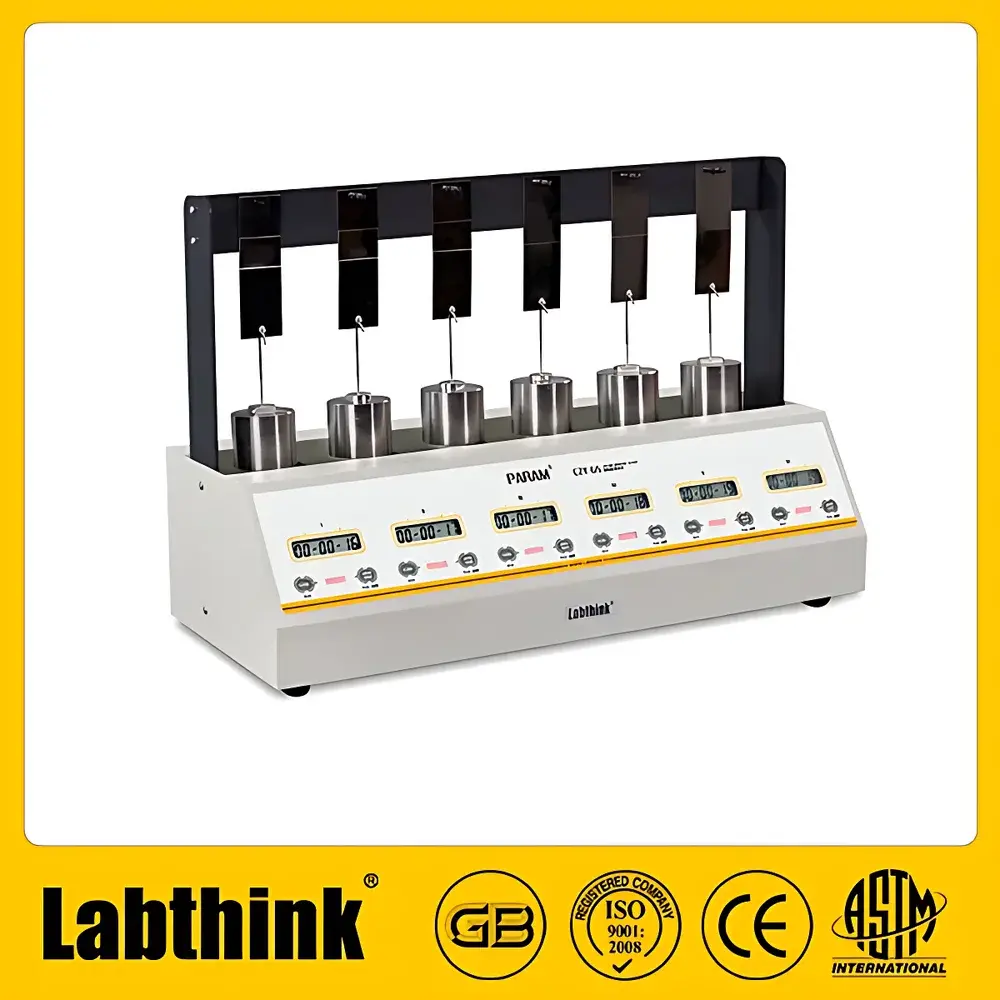
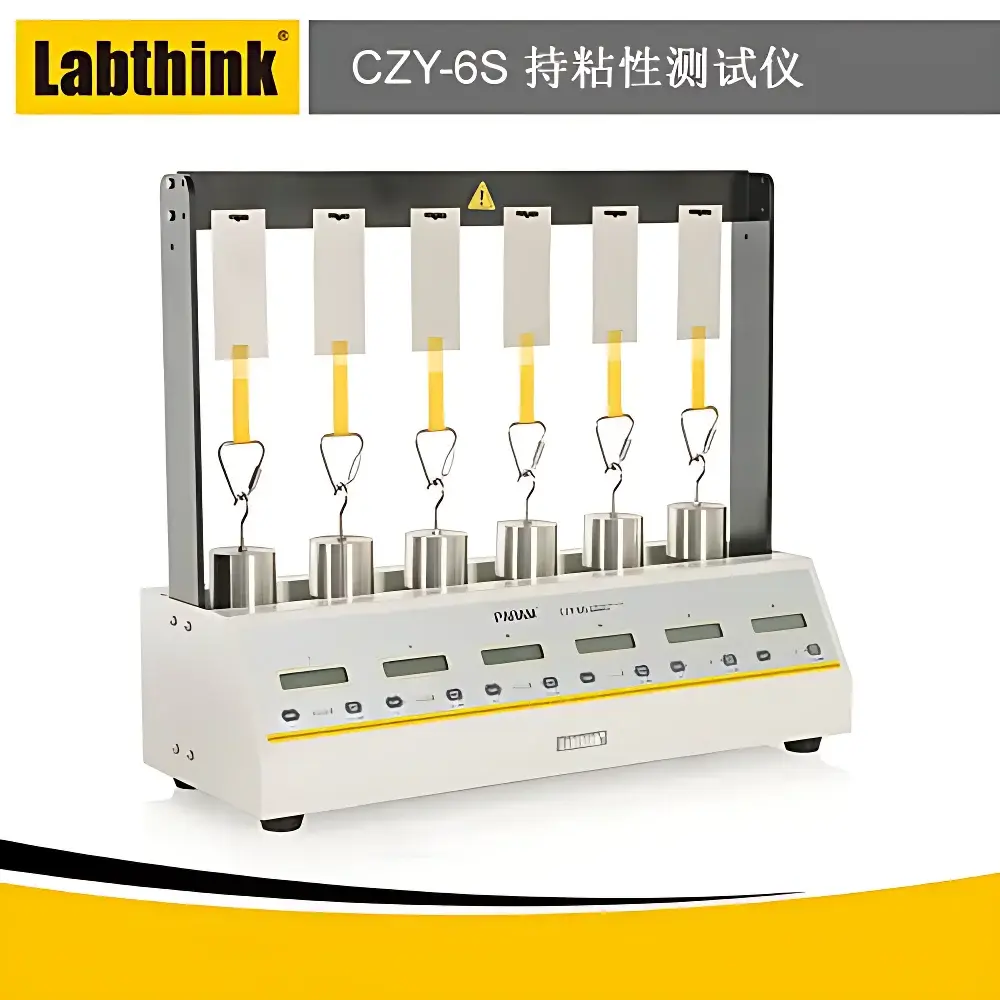
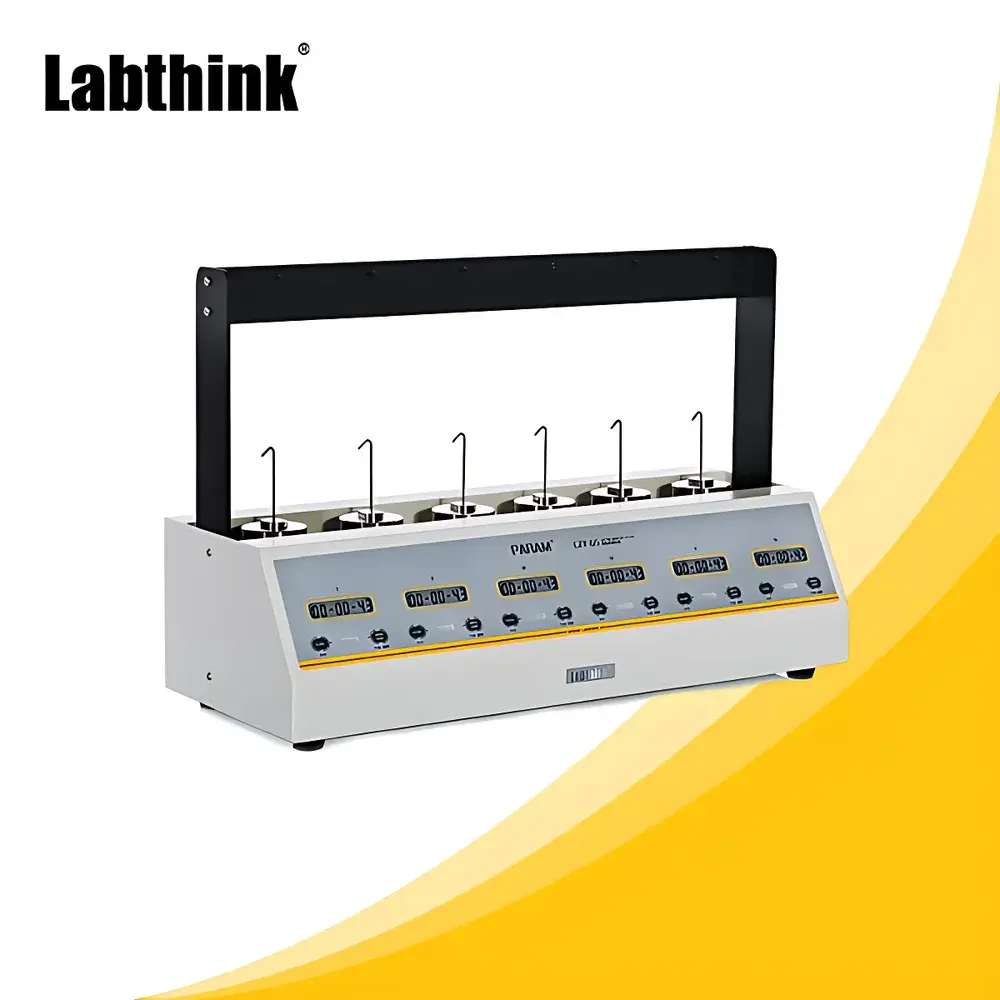
Labthink CZY-6S Constant-Load Adhesion Tester for Pressure-Sensitive Tapes and Medical Adhesives
| Brand | Labthink |
|---|---|
| Model | CZY-6S |
| Origin | Shandong, China |
| Manufacturer | Labthink Co., Ltd. |
| Application | ASTM D3654, GB/T 4851, JIS Z0237 |
| Test Principle | Vertical constant-load shear adhesion measurement under ambient conditions |
| Test Stations | 6 |
| Standard Weight Load | 1000 g ± 10 g (including loading plate) |
| Standard Roller | 2000 g ± 50 g |
| Test Plate Dimensions | 60 mm × 40 mm × 1.5 mm |
| Timing Range | 0–99 h (standard), up to 9999 h (optional) |
| Power Supply | 220 VAC 50 Hz / 120 VAC 60 Hz |
| Net Weight | 20 kg |
| Dimensions | 600 mm × 240 mm × 400 mm (L×W×H) |
Overview
The Labthink CZY-6S Constant-Load Adhesion Tester is an engineered solution for quantifying the shear resistance of pressure-sensitive adhesive (PSA) materials under sustained vertical loading at ambient temperature. It operates on the principle of standardized constant-load shear testing—where a specimen, mounted on a vertically oriented stainless steel test plate, is subjected to a precisely defined gravitational load via calibrated weights. The instrument measures either the displacement of the specimen after a specified duration or the time-to-failure (complete detachment) under constant stress. This method directly reflects the viscoelastic creep behavior of the adhesive layer under static shear stress, making it critical for quality control in medical transdermal patches, labeling systems, protective films, and industrial tapes. Designed in strict conformance with ISO/IEC 17025-aligned laboratory practices, the CZY-6S delivers reproducible data essential for regulatory submissions and internal specification compliance.
Key Features
- Six independent test stations enable parallel evaluation of multiple specimens—significantly improving throughput while maintaining inter-station consistency.
- Microprocessor-based control system with PVC membrane keypad and backlit LCD display ensures intuitive operation, real-time monitoring, and unambiguous status feedback.
- Pre-calibrated test plates (60 mm × 40 mm × 1.5 mm) and loading assemblies meet dimensional tolerances specified in GB/T 4851 and ASTM D3654, minimizing geometric variability.
- Standardized 2000 g ± 50 g rubber-covered roller ensures uniform contact pressure during specimen application—critical for eliminating air entrapment and ensuring consistent wetting.
- Automatic timing function with programmable duration (0–99 h standard; optional extension to 9999 h) supports both short-term validation and long-term stability studies.
- Fail-safe mechanical design includes anti-slip base mounting, rigid aluminum frame construction, and gravity-locked weight suspension—ensuring zero drift during extended tests.
Sample Compatibility & Compliance
The CZY-6S accommodates a broad spectrum of PSA-based products including acrylic and rubber-based pressure-sensitive tapes, silicone-coated medical adhesives (e.g., hydrocolloid wound dressings and transdermal drug delivery patches), self-adhesive labels, surface protection films, and laminated packaging substrates. All test configurations comply with internationally recognized standards: GB/T 4851 (China), ASTM D3654 (USA), and JIS Z0237 (Japan). For pharmaceutical applications, the system supports documentation protocols aligned with ICH Q5E stability guidelines and facilitates traceability required under GLP and GMP environments. While not a 21 CFR Part 11-compliant system out-of-the-box, audit-ready test logs—including operator ID, start/stop timestamps, load verification, and pass/fail status—can be exported in CSV format for integration into validated LIMS or ELN platforms.
Software & Data Management
The CZY-6S operates as a standalone hardware platform without embedded PC software. However, its digital interface provides timestamped event logging for each station: initiation, load application, and detachment detection (manual or auto-confirmed). Users record results manually or integrate with external spreadsheet templates pre-formatted for statistical process control (SPC) analysis. Optional RS-232 or USB-to-serial adapters allow connection to host PCs for automated data capture using custom scripts or third-party acquisition tools. Calibration records—including roller mass verification, weight certification, and plate flatness checks—are maintained per ISO/IEC 17025 requirements and recommended annually by an accredited metrology provider.
Applications
- Quality assurance of medical adhesive performance across shelf life and accelerated aging conditions.
- Comparative evaluation of formulation changes (e.g., tackifier concentration, polymer MW distribution) on long-term bond integrity.
- Validation of label adhesion to diverse substrates (PET, HDPE, glass, corrugated board) under warehouse storage conditions.
- Regulatory submission support for FDA 510(k), CE Marking (MDR Annex I), and NMPA Class II device dossiers requiring shear adhesion data.
- Root cause analysis of delamination failures in multi-layer flexible packaging structures.
- Supplier qualification testing against contractual hold-time specifications (e.g., “≥72 h retention at 23 °C/50% RH”).
FAQ
What is the difference between ‘hold time’ and ‘creep displacement’ in this test method?
Hold time refers to the elapsed duration until complete separation occurs under constant load; creep displacement measures lateral movement (mm) after a fixed time interval—both are valid endpoints per GB/T 4851 Section 6.2.
Can the CZY-6S be used for elevated temperature testing?
No—the CZY-6S is designed exclusively for ambient-temperature (23 ± 2 °C) testing. For thermal variants, Labthink offers the HT series with integrated environmental chambers.
Is calibration certificate included with shipment?
A factory-issued calibration report covering test plate dimensions, weight set accuracy, and roller mass is provided. Full ISO/IEC 17025 calibration requires third-party service.
How often should the test plates be replaced?
Stainless steel plates show no measurable wear under routine use; however, visual inspection for scratches or corrosion is recommended before each test batch.
Does the instrument meet any electrical safety standards?
Yes—it complies with IEC 61010-1:2010 for laboratory electrical equipment, including overcurrent protection, grounding continuity, and dielectric strength testing.



