
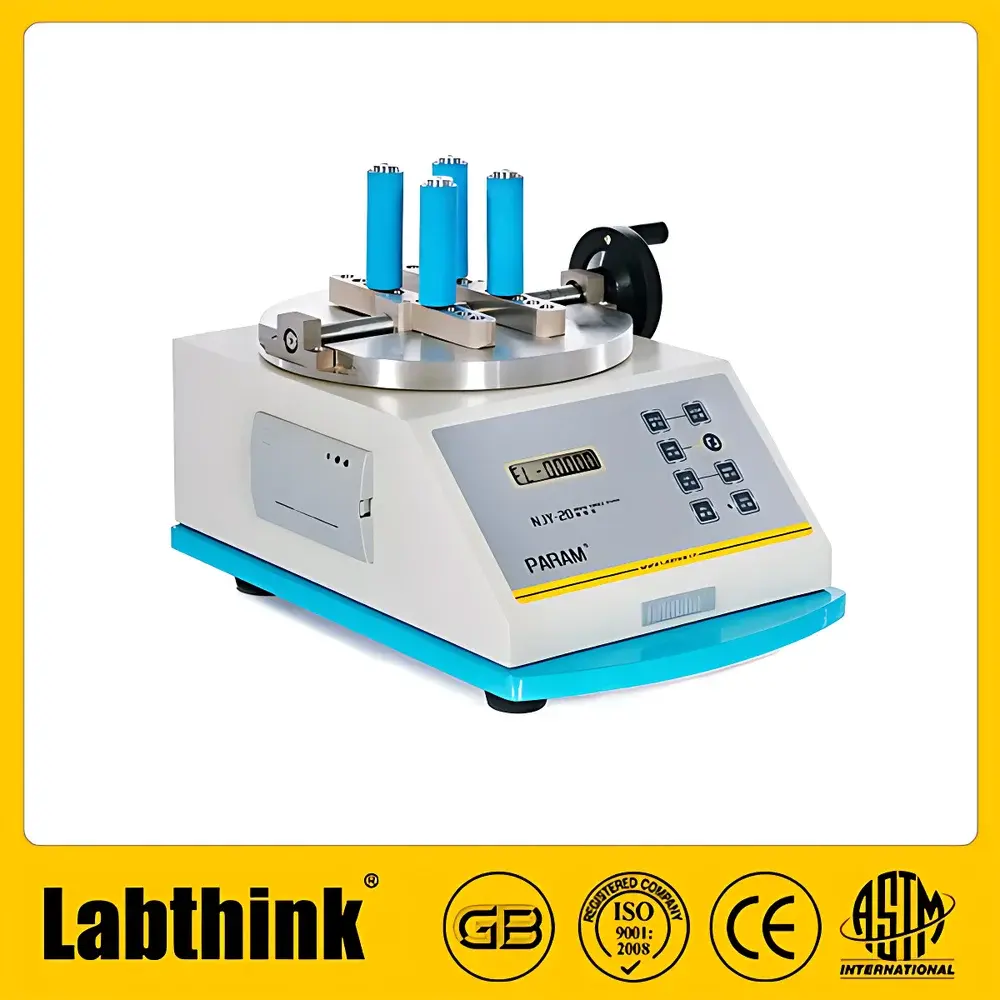
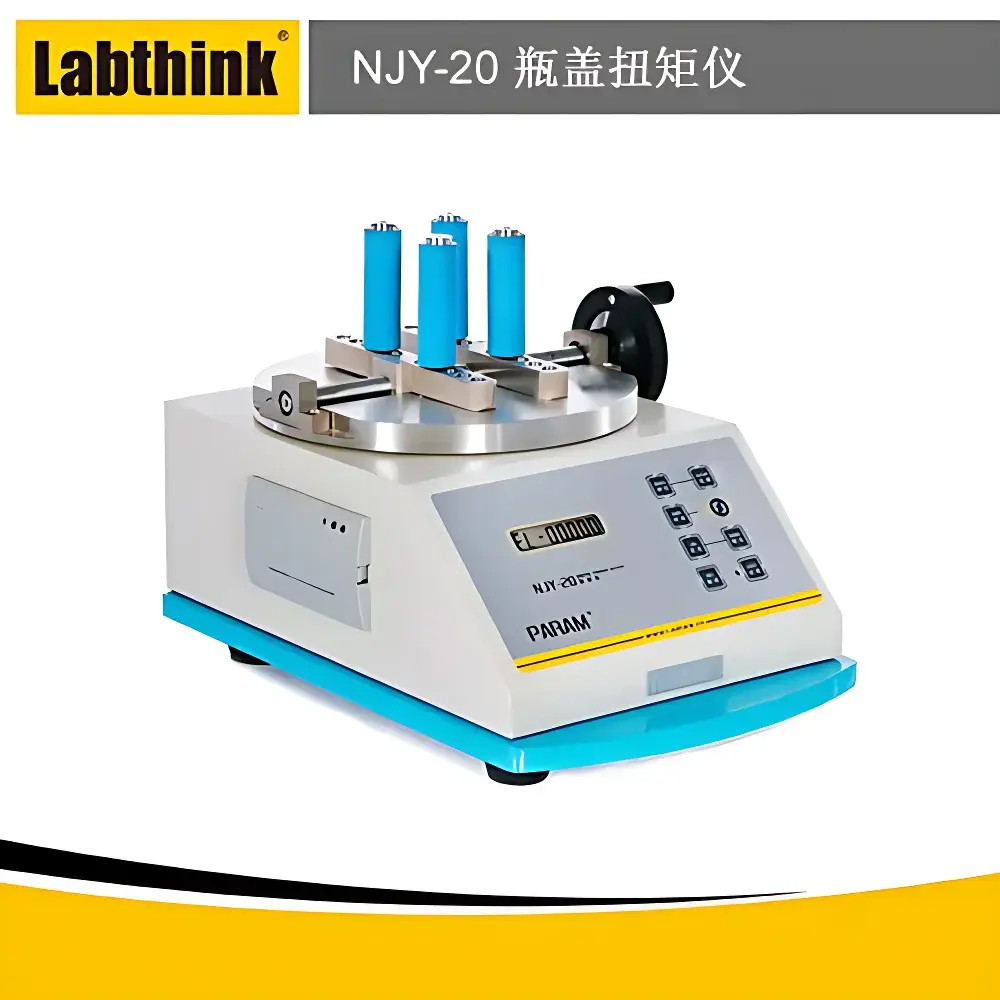
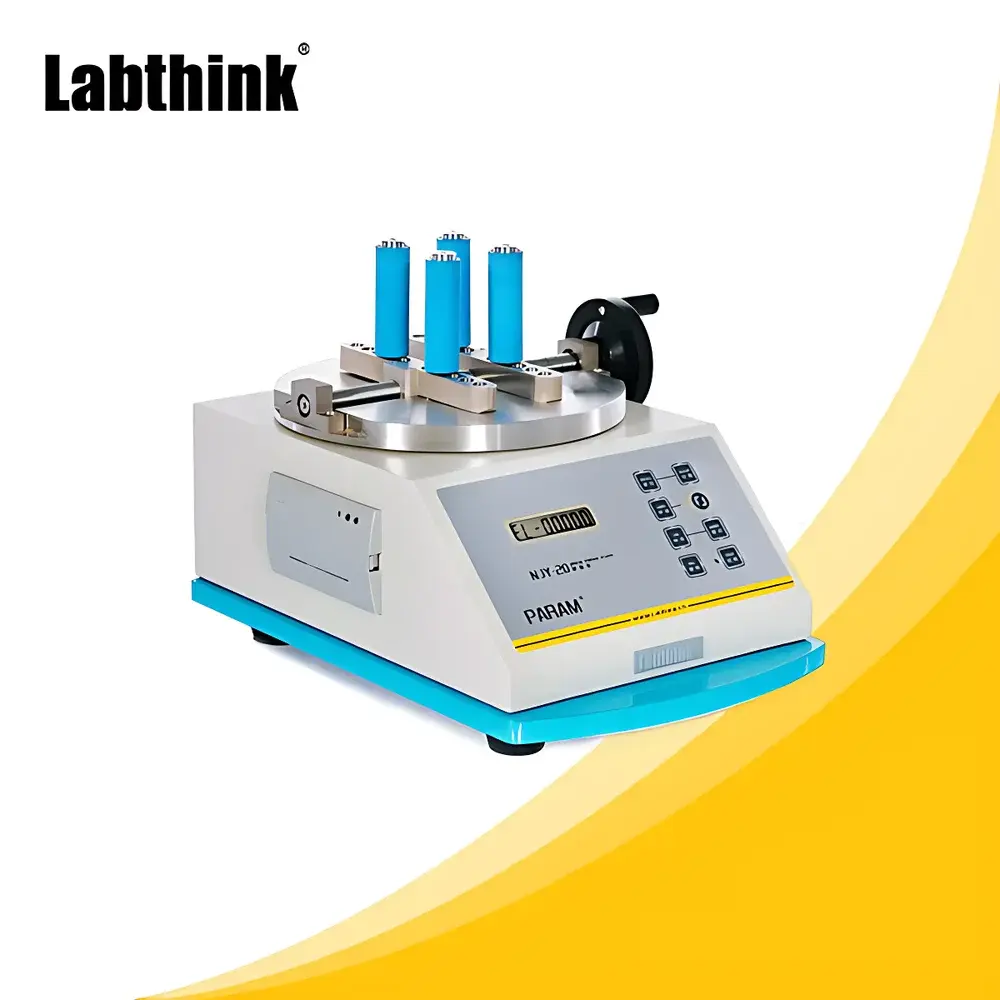
Labthink NJY-20 Cap Torque Tester for Tamper-Evident & Plastic Closures
| Brand | Labthink |
|---|---|
| Origin | Shandong, China |
| Manufacturer Type | Direct Manufacturer |
| Product Category | Domestic |
| Model | NJY-20 |
| Quotation | Upon Request |
| Torque Range | 20 N·m (Standard), 40 N·m / 50 N·m (Optional) |
| Accuracy Class | Class 1 |
| Resolution | 0.001 N·m |
| Clamp Diameter Range | Ø5–Ø170 mm |
| Test Count Storage | 1–9 Samples (Extended via Lystem™ Software) |
| Compliance Standards | BB/T 0025, BB/T 0034 (equivalent to GB/T 14803), GB/T 17876, ASTM D2063, ASTM D3198, ASTM D3474 |
Overview
The Labthink NJY-20 Cap Torque Tester is an electromechanical rotational force measurement instrument engineered for precise quantification of closure torque—specifically the opening and sealing torque values of tamper-evident caps, plastic screw closures, press-on lids, and dispensing actuators used in rigid and semi-rigid packaging systems. It operates on the principle of controlled angular displacement under load, measuring the peak rotational moment (in newton-meters) required to initiate rotation of a cap relative to its container neck. This parameter is critical in packaging integrity validation: insufficient torque may lead to leakage or contamination during distribution; excessive torque compromises consumer usability and may damage closure threads or liner compression. Designed for routine QC/QA laboratories in pharmaceutical, nutraceutical, food & beverage, and personal care manufacturing, the NJY-20 delivers repeatable, traceable torque data aligned with internationally recognized mechanical testing protocols.
Key Features
- Microprocessor-controlled torque sensing system with real-time LCD display and tactile PVC membrane keypad for intuitive operation and immediate result visualization
- Dual-mode testing capability: independent selection of “Opening Torque” (counterclockwise release) and “Sealing Torque” (clockwise application) modes, each capturing and holding the true peak value
- High-resolution transduction: 0.001 N·m system resolution across the standard 20 N·m range, with optional extended ranges (40 N·m and 50 N·m) for heavy-duty industrial closures
- Universal jaw mechanism accommodating containers from Ø5 mm to Ø170 mm in diameter—compatible with vials, PET bottles, HDPE jars, laminated tubes, and pouch spouts
- Integrated safety logic including overload protection, automatic zero calibration prior to each test cycle, and on-screen fault diagnostics (e.g., sensor saturation, motor stall)
- RS232 serial interface compliant with standard PC communication protocols and built-in thermal line printer for immediate hard-copy documentation
Sample Compatibility & Compliance
The NJY-20 supports standardized torque evaluation for closures installed on glass, plastic (PET, HDPE, PP), aluminum, and composite containers. Its mechanical design ensures consistent axial alignment and minimal slippage during torque application, meeting the geometric and kinematic requirements specified in BB/T 0025 (“Technical Specification for Cap Torque Testing Instruments”) and BB/T 0034 (“Testing Methods for Closure Torque of Plastic Bottles”). The instrument’s metrological performance conforms to Class 1 accuracy per JJG 539–2016 (Chinese verification regulation for torque meters), and its test methodology is directly referenced in ASTM D2063 (Standard Test Method for Measuring Opening Torque of Screw Caps), ASTM D3198 (Standard Practice for Determining Torque-Tension Relationships in Threaded Fasteners), and ASTM D3474 (Standard Test Method for Calibration of Torque Measuring Devices). For regulated environments, raw torque data—including timestamps, operator ID, and test sequence—is exportable for integration into GLP/GMP-compliant audit trails.
Software & Data Management
The NJY-20 is natively compatible with Labthink’s Lystem™ Laboratory Data Sharing System—a secure, server-based platform supporting multi-user access, role-based permissions, and centralized database management. Lystem™ enables automated statistical analysis (mean, SD, CV%, min/max, histogram generation), customizable report templates (PDF/Excel), and long-term trend monitoring across production batches. All exported datasets retain full metadata: test date/time, sample ID, operator code, torque mode, clamp diameter setting, and environmental notes. The RS232 interface supports direct import into third-party LIMS or MES platforms without proprietary drivers, ensuring interoperability in enterprise-scale quality infrastructure.
Applications
- Verification of torque specifications during packaging line setup and changeover (e.g., validating torque settings for capping machines)
- Stability assessment of closure integrity under accelerated aging conditions (e.g., post-sterilization or high-humidity storage)
- Comparative evaluation of liner material compression behavior across closure designs
- Root-cause analysis of customer complaints related to difficult-to-open or leaking packages
- Supporting regulatory submissions requiring documented torque validation (e.g., FDA 21 CFR Part 211 for pharmaceuticals, ISO 22000 for food safety)
- Calibration verification of in-line torque sensors using reference standards traceable to NIM (National Institute of Metrology, China)
FAQ
What torque units does the NJY-20 support?
The instrument reports results exclusively in newton-meters (N·m) by default, with software-enabled conversion to inch-pounds (lbf·in) and kilogram-force centimeters (kgf·cm) via Lystem™.
Can the NJY-20 test child-resistant closures?
Yes—its programmable dual-torque threshold mode allows sequential measurement of both initial breakaway torque and sustained rotation torque, satisfying ASTM D3474 requirements for pediatric-resistant packaging validation.
Is the device compliant with FDA 21 CFR Part 11?
While the standalone hardware does not include electronic signature or audit trail features, Lystem™ software—when deployed on validated IT infrastructure—supports Part 11 compliance through user authentication, immutable data logging, and electronic record retention.
How is calibration maintained?
The NJY-20 accepts certified torque calibration standards (traceable to national metrology institutes) and supports internal calibration verification routines. Annual recalibration by an accredited lab is recommended per ISO/IEC 17025 guidelines.
Does it accommodate irregularly shaped containers?
The adjustable clamping jaws and vertical sample stage allow stable positioning of non-cylindrical packages (e.g., oval jars, square bottles) as long as the cap axis remains coaxial with the torque sensor’s rotational centerline.



