
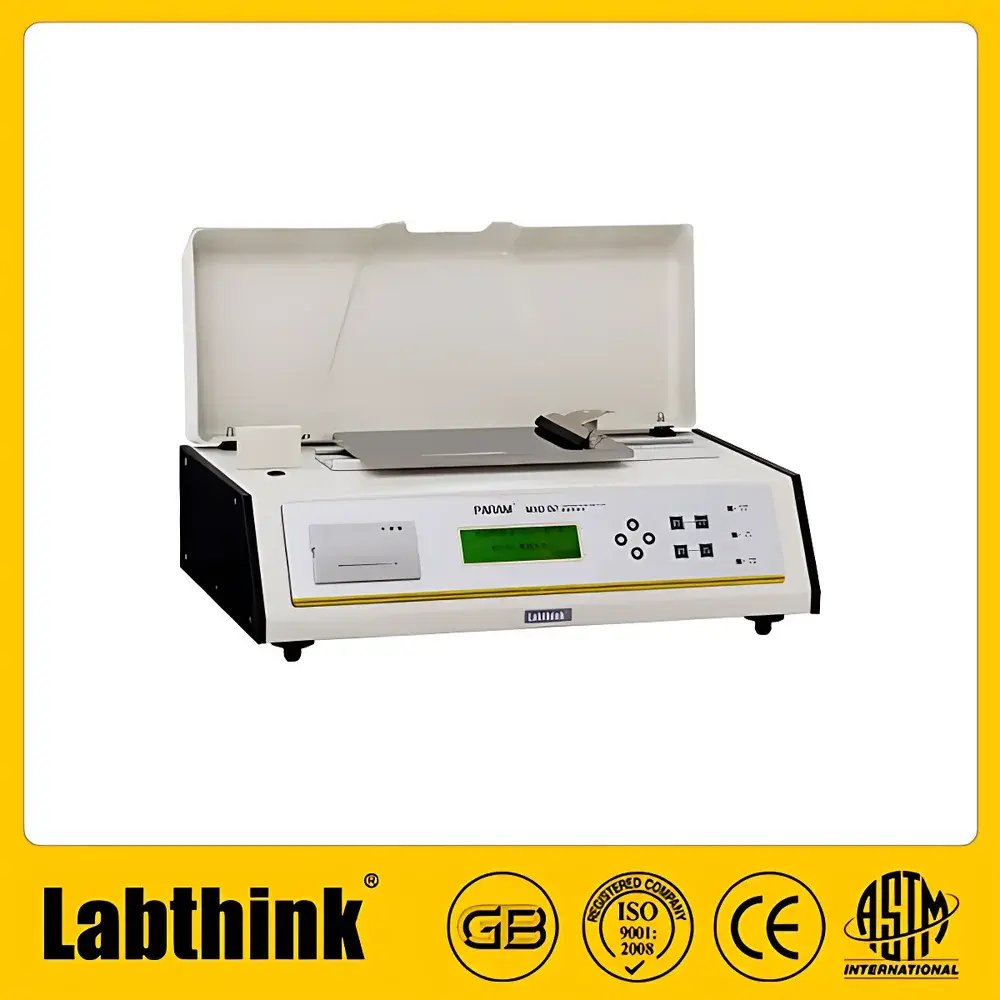
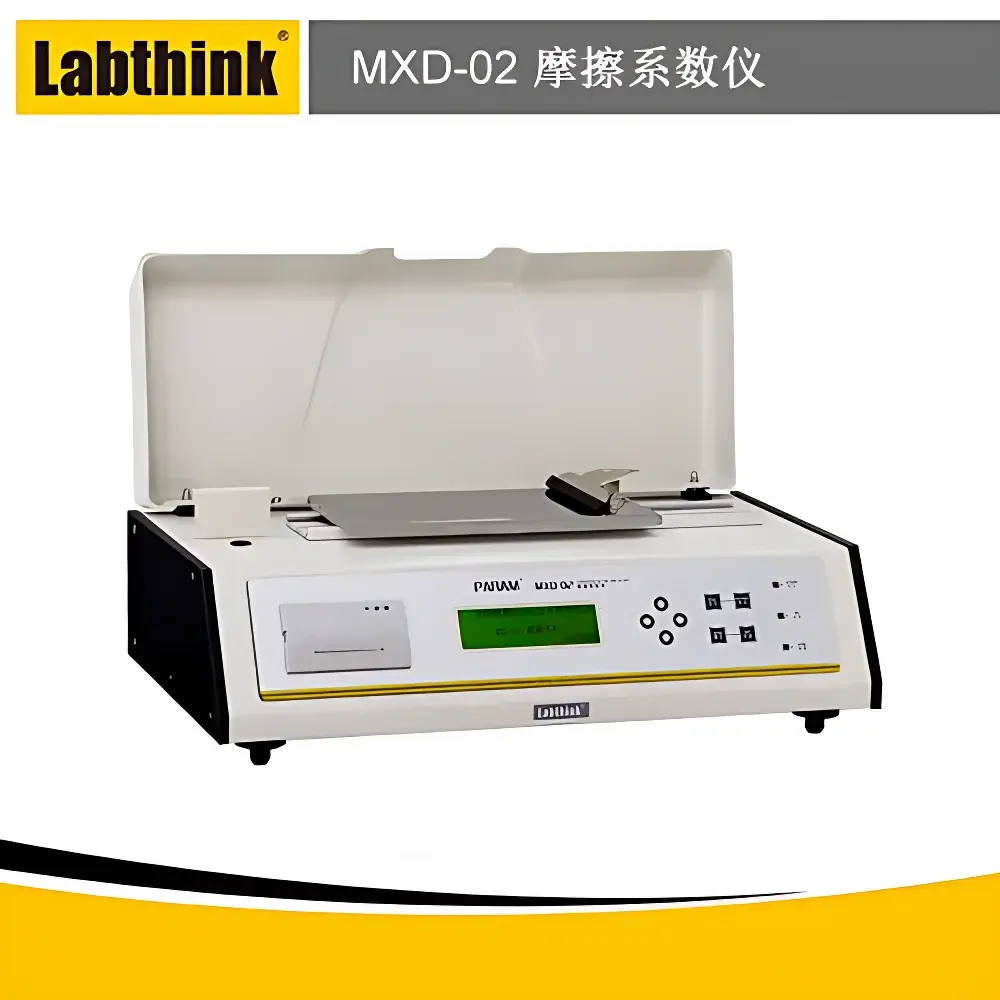
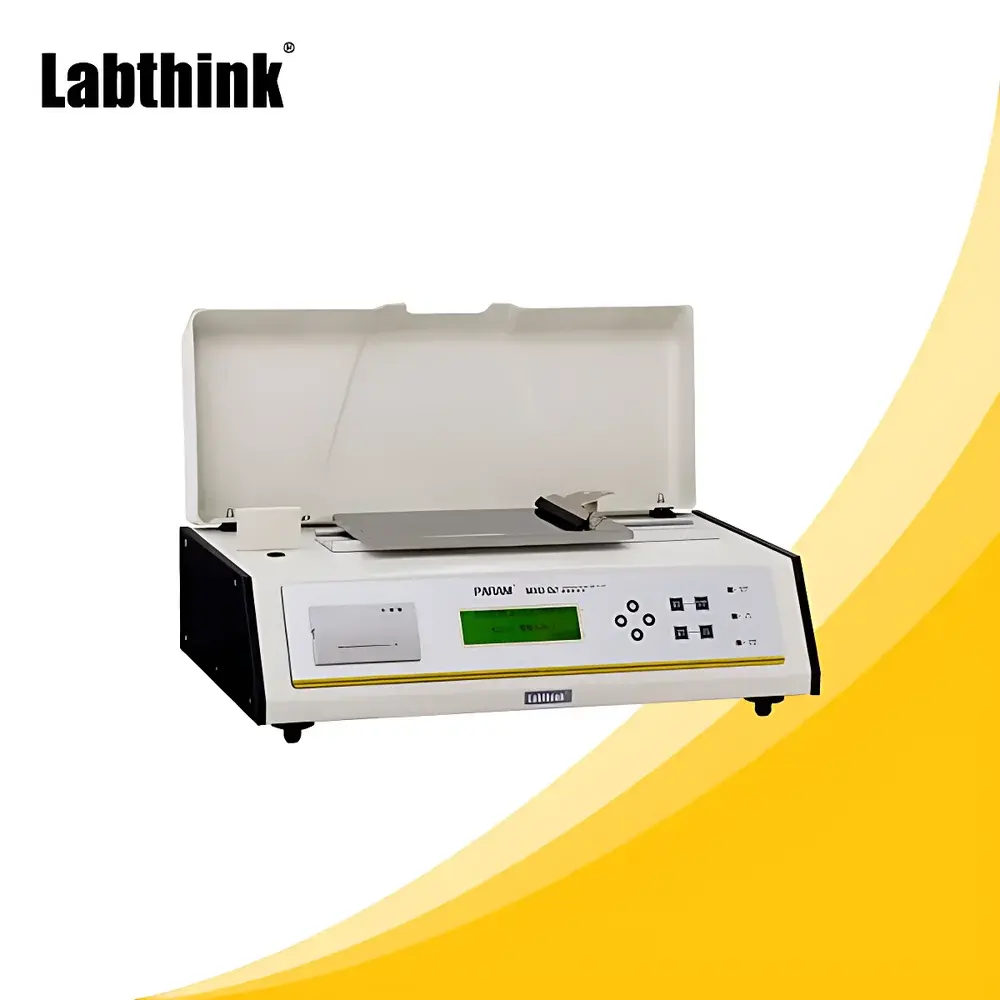
Labthink MXD-02 Coefficient of Friction Tester for Aluminum-Coated Composite Films
| Brand | Labthink |
|---|---|
| Origin | Shandong, China |
| Manufacturer | Yes |
| Country of Origin | China |
| Model | MXD-02 |
| Load Range | 0–5 N |
| Accuracy Class | 0.5 |
| Stroke | 70 mm / 150 mm |
| Standard Sled Mass | 200 g (customizable) |
| Test Speeds | 100 mm/min, 150 mm/min (adjustable) |
| Environmental Conditions | 23 ± 2 °C, 20–70 %RH |
| Power Supply | 220 VAC 50 Hz / 120 VAC 60 Hz |
| Dimensions (L×W×H) | 630 × 360 × 230 mm |
| Net Weight | 33 kg |
| Compliance | ISO 8295, GB 10006, ASTM D1894, TAPPI T816 |
Overview
The Labthink MXD-02 Coefficient of Friction Tester is a precision-engineered instrument designed to quantify the static and kinetic coefficients of friction (COF) for flexible packaging materials—including aluminum-coated composite films—as well as a broad spectrum of industrial substrates such as plastic films, thin sheets, rubber, paperboard, coated metals, conveyor belts, and polymer-based automotive components. Operating on the fundamental principle of horizontal sliding resistance measurement, the MXD-02 applies controlled normal force via calibrated sled mass and measures the tangential force required to initiate (static COF) and sustain (kinetic COF) relative motion between two contacting surfaces. This dual-phase measurement capability enables rigorous assessment of surface slipperiness—commonly referred to as “slip” or “slipperiness”—a critical quality attribute directly influencing high-speed packaging line performance, film unwinding stability, stacking integrity, and end-user tactile experience. The instrument’s mechanical architecture integrates a low-magnetic stainless steel test bed and demagnetized sled to minimize electromagnetic interference with force transduction, ensuring metrological traceability and repeatability under GLP-aligned laboratory conditions.
Key Features
- Simultaneous static and kinetic COF determination in a single test cycle, eliminating manual repositioning and reducing inter-test variability
- Programmable test speed (100 mm/min and 150 mm/min standard; extended range available upon configuration) with closed-loop motor control for velocity stability ±1 %
- Interchangeable sled masses (200 g standard; optional 500 g and custom masses) to accommodate material-specific pressure requirements per ISO 8295 and ASTM D1894 protocols
- Microprocessor-based control system featuring an intuitive PVC membrane keypad and backlit LCD display for real-time parameter monitoring and local data review
- High-precision load cell (0–5 N range, 0.5-class accuracy per JJG 391) with temperature-compensated signal conditioning and digital filtering
- Full magnetic shielding: both test platform and sled undergo certified demagnetization and residual magnetism verification (<0.2 mT), mitigating spurious force artifacts
- Modular hardware design compliant with IEC 61000-4 electromagnetic compatibility standards for integration into regulated manufacturing environments
Sample Compatibility & Compliance
The MXD-02 supports standardized testing of planar, non-porous, and semi-rigid sheet materials up to 150 mm wide and 2 mm thick. Validated applications include metallized polyester (PET-Al), polypropylene (PP), polyethylene (PE), biaxially oriented polypropylene (BOPP), laminated foil composites, and functional barrier coatings used in food, pharmaceutical, and medical device packaging. Regulatory alignment includes full conformance with ISO 8295 (Plastics — Film and sheeting — Determination of coefficient of friction), GB/T 10006 (Chinese national standard equivalent), ASTM D1894 (Standard Test Method for Static and Kinetic Coefficients of Friction of Plastic Film and Sheeting), and TAPPI T816 (Coefficient of Friction of Paper and Paperboard). Instrument qualification documentation supports IQ/OQ protocols for GMP-regulated facilities, and raw data files meet ALCOA+ principles for audit readiness.
Software & Data Management
Optional Lystem™ Laboratory Data Management System (LDMS) provides secure, role-based access to instrument control, automated pass/fail evaluation against user-defined specification limits, statistical process control (SPC) charting (X̄-R, Cp/Cpk), and multi-batch curve superposition. All test records include embedded metadata: operator ID, timestamp, environmental log (temperature/humidity), calibration certificate ID, and electronic signature per FDA 21 CFR Part 11 requirements. Raw force–displacement datasets are exportable in CSV and XML formats; report templates comply with ISO/IEC 17025 clause 7.8.2 for accredited testing laboratories. RS232 serial interface ensures seamless connectivity with LIMS platforms and enterprise MES systems.
Applications
- Optimization of silicone or wax-based slip additive concentrations in extrusion-grade polymers
- Verification of corona or plasma treatment efficacy on metallized film surfaces
- Comparative evaluation of anti-blocking agent performance across resin batches
- Stability testing of COF under accelerated aging (e.g., 40 °C/75 %RH for 14 days)
- Release liner characterization for adhesive tapes and transdermal patches
- Frictional behavior assessment of biodegradable films (PLA, PHA) versus conventional PE
- Slip property benchmarking for cosmetic tube laminate structures (Al/PET/PE)
FAQ
Does the MXD-02 comply with FDA 21 CFR Part 11 for electronic records?
Yes—when configured with Lystem™ LDMS, the system implements audit trails, electronic signatures, and data integrity controls aligned with Part 11 Subpart B requirements.
Can the instrument measure COF on curved or textured surfaces?
No—the MXD-02 is validated exclusively for flat, macroscopically uniform specimens per referenced standards; curvature or micro-roughness exceeding Ra < 0.8 µm introduces systematic deviation.
Is third-party calibration certification available?
Yes—NIST-traceable calibration certificates (ISO/IEC 17025 accredited) are provided upon request, covering load cell, position encoder, and environmental sensor subsystems.
What maintenance intervals are recommended for long-term accuracy?
Biannual verification of sled mass tolerance (±0.1 g), annual load cell recalibration, and quarterly cleaning of linear guide rails with isopropyl alcohol are specified in the operation manual.
Related Products





