
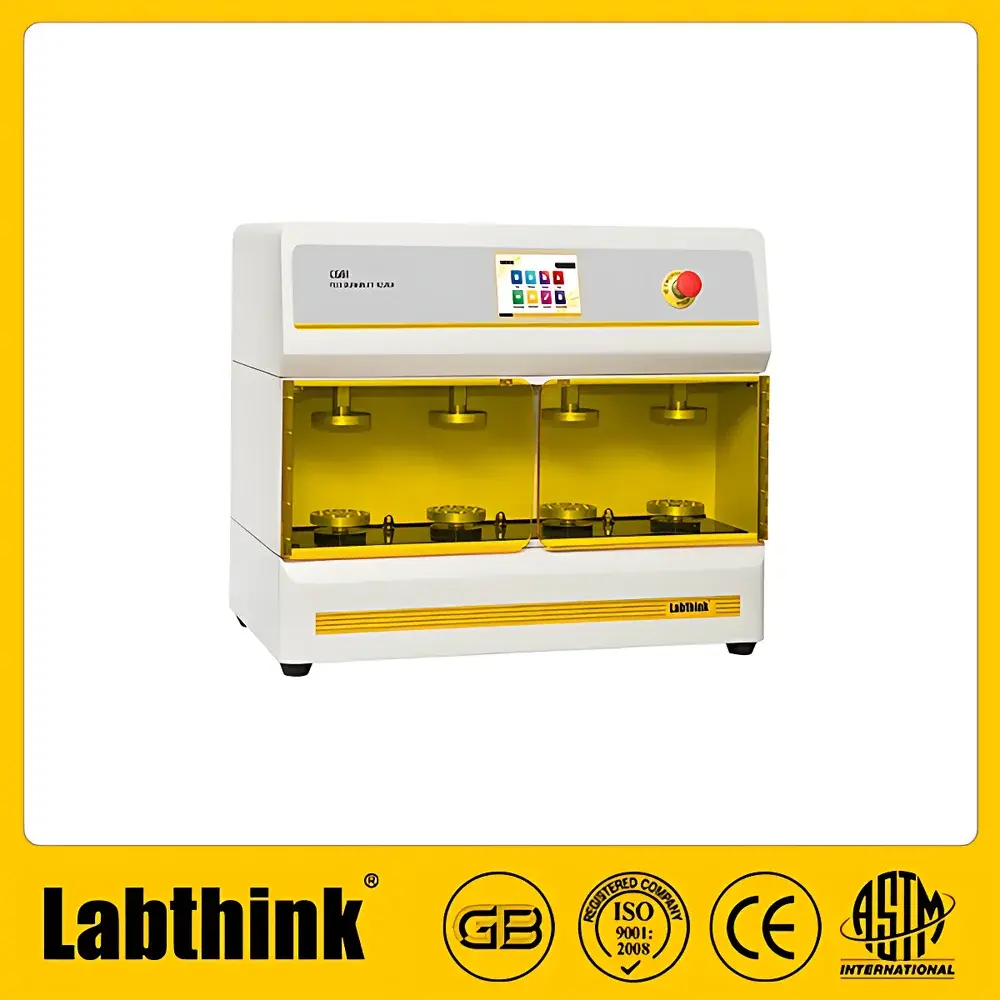
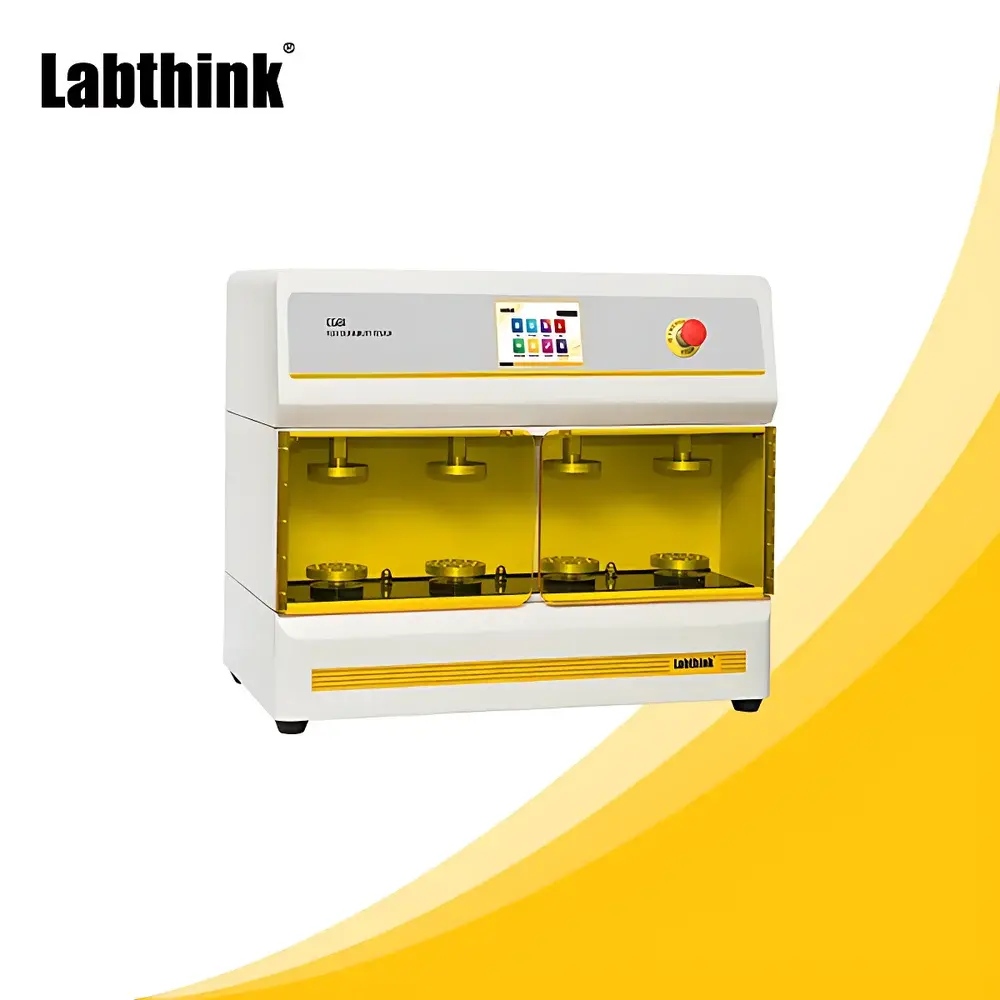
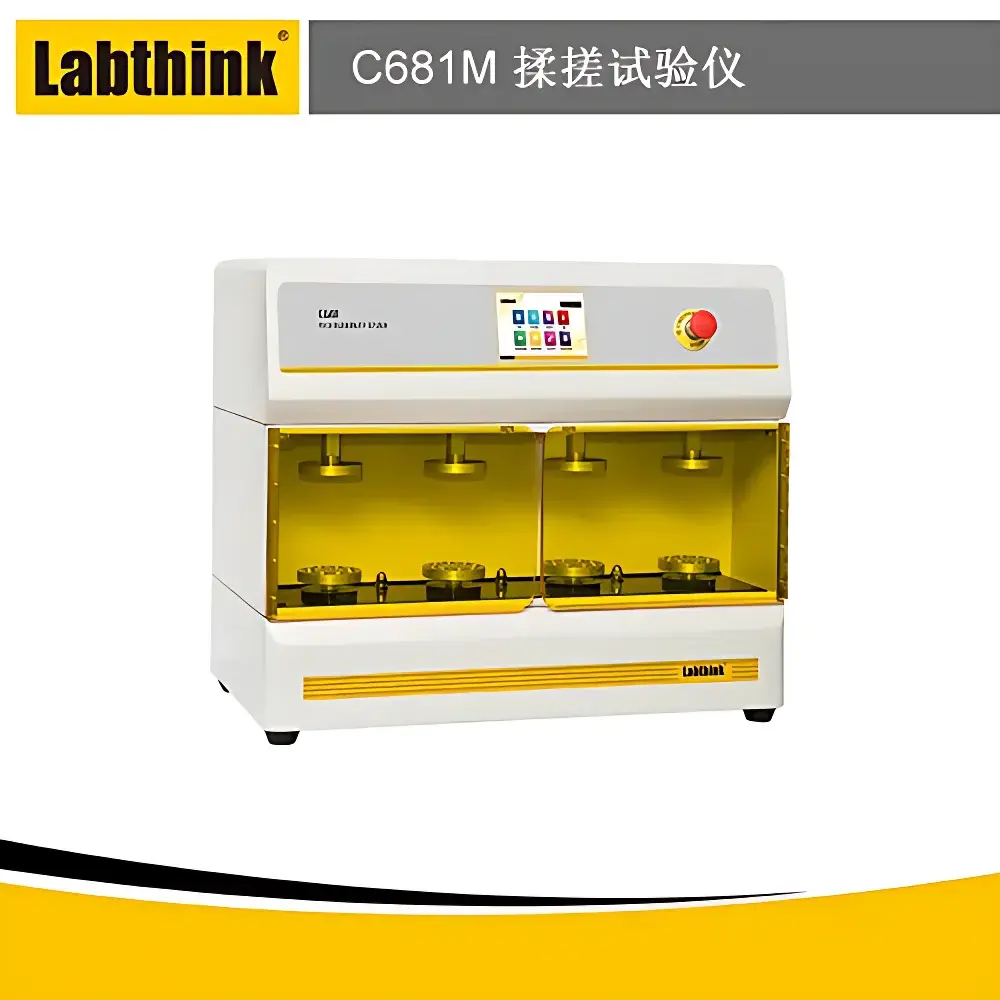
Labthink C681M Flex Resistance Tester for Flexible Packaging Films (ASTM F392 / GB/T 41347 Compliant)
| Brand | Labthink |
|---|---|
| Origin | Shandong, China |
| Manufacturer Type | Direct Manufacturer |
| Model | C681M |
| Frequency | 45 cycles/min |
| Test Modes | Mode A (2700 cycles), Mode B (900 cycles), Mode C (270 cycles), Mode D (20 cycles), Mode E (20 cycles, short stroke), Mode F (0–20,000 cycles, user-defined) |
| Applied Force | 300 N |
| Rotational Torque | 2 N·m |
| Specimen Thickness | ≤2.5 mm (custom fixtures available for thicker samples) |
| Oscillation Angle | 440° or 400° |
| Horizontal Stroke | 155 mm or 80 mm |
| Stations | 4 independent test stations |
| Sample Capacity | 1–4 specimens per run |
| Sample Size | 280 mm × 200 mm |
| Dimensions (L×W×H) | 760 mm × 410 mm × 650 mm |
| Power Supply | 220 VAC ±10%, 50 Hz OR 120 VAC ±10%, 60 Hz (dual-voltage configurable) |
| Net Weight | 85 kg |
Overview
The Labthink C681M Flex Resistance Tester is an electromechanical instrumentation platform engineered to quantify the mechanical durability of flexible packaging materials under repeated flexing, folding, and torsional stress—conditions routinely encountered during manufacturing, filling, distribution, and end-user handling. Based on the principle of controlled cyclic deformation, the instrument replicates real-world mechanical abuse by subjecting planar specimens to programmable oscillatory motion in both horizontal translation and rotational torque, simulating the cumulative effects of creasing, crumpling, and edge compression. Its design conforms rigorously to ASTM F392-93(2004) “Standard Test Method for Flexing Endurance of Flexible Barrier Materials” and GB/T 41347-2022 “Test Method for Flex Resistance of Flexible Packaging Materials”, enabling standardized evaluation of microstructural integrity loss—typically assessed via post-test quantification of pinhole formation (per ASTM F2338 or ISO 15142), oxygen transmission rate (OTR) degradation (per ASTM D3985), or water vapor transmission rate (WVTR) increase (per ASTM F1249). This tester serves as a critical validation tool for QC/QA laboratories in food, pharmaceutical, medical device, and consumer goods packaging supply chains where barrier integrity directly correlates with shelf life and regulatory compliance.
Key Features
- Four independently operated test stations enable parallel evaluation of up to four specimens under identical or divergent protocols—significantly improving throughput without compromising repeatability.
- Five pre-programmed standard modes (A–E) and one fully customizable mode (F) support rapid method adoption across global R&D and production environments; stroke length (80 mm or 155 mm) and oscillation angle (400° or 440°) are mechanically switchable within seconds.
- Industrial-grade servo motor system delivers precise cycle control (±0.5% frequency accuracy at 45 cycles/min), high-torque actuation (2 N·m), and consistent 300 N clamping force—ensuring mechanical fidelity across thousands of cycles.
- Full-touch HMI interface with industrial-grade capacitive screen supports bilingual (English/Chinese) operation, multi-level user authentication, automatic data logging with timestamped environmental monitoring (temperature & RH), and built-in non-volatile memory storing ≥1200 test records.
- Dual hardware/software safety architecture includes emergency stop circuitry, position-limit sensors, auto-reset functionality after power interruption, and real-time fault diagnostics—meeting IEC 61000-6-2 EMC and IEC 61000-6-4 emission standards.
- Modular fixture system accommodates specimens up to 2.5 mm thick; optional accessories include stainless steel hose clamps (64 mm–114 mm), precision sampling dies, and thermal-printed report output (via optional integrated mini-printer).
Sample Compatibility & Compliance
The C681M accepts flat, flexible sheet materials including polymer films (e.g., PET, OPP, PE, CPP), metallized laminates (AlOx, SiOx, vacuum-deposited Al), coextruded structures, foil-laminates (aluminum-plastic, aluminum-paper), coated substrates (PVDC-, acrylic-, or EVOH-coated), and paper-based composites. Specimens must be dimensionally stable within the 280 mm × 200 mm format and exhibit sufficient tensile integrity to remain clamped without slippage during 440° oscillation. The system complies with ASTM F392-93(2004) and GB/T 41347-2022 for method equivalence; it further supports alignment with ISO 22068 (flex fatigue of packaging films), FDA 21 CFR Part 11 requirements when paired with Labthink’s compliant software suite (audit trail, electronic signatures, role-based access), and GLP/GMP documentation workflows through CSV export and LIMS integration capability.
Software & Data Management
The embedded operating system logs all test parameters—including cycle count, applied load, stroke, angle, ambient temperature, relative humidity, and operator ID—with millisecond timestamp resolution. Data are stored locally in encrypted binary format and exportable via USB to CSV or PDF. Optional Labthink SmartLink™ software provides remote configuration, firmware OTA updates, centralized fleet management, and automated report generation compliant with 21 CFR Part 11 Annex 11 requirements—including full audit trail, electronic signature support, and change control history. All raw datasets retain traceability to calibration certificates (traceable to NIST or CNAS-accredited labs) and instrument serial numbers.
Applications
- Quantifying flex-induced barrier failure in retort pouches, stand-up pouches, and sachets used for sterile pharmaceuticals or ambient-stable foods.
- Evaluating delamination resistance in multilayer laminates subjected to roll-to-roll processing or high-speed form-fill-seal operations.
- Validating structural robustness of child-resistant packaging under simulated tamper attempts involving twisting and bending.
- Supporting material selection for medical packaging (e.g., Tyvek®-based sterile barriers) where flex endurance directly impacts sterility maintenance per ISO 11607-1.
- Correlating laboratory flex data with field performance metrics such as seal integrity loss, leak initiation, or microbial ingress probability.
FAQ
What standards does the C681M explicitly support?
ASTM F392-93(2004), GB/T 41347-2022, and ISO 22068 (under verification protocol); method equivalence to ISO 15142 and ASTM D3985 is achievable via post-test analytical correlation.
Can the instrument accommodate specimens thicker than 2.5 mm?
Yes—custom-designed high-clearance clamping fixtures are available upon request for specimens up to 5 mm thick.
Is remote diagnostics or software update capability included?
Yes—the touchscreen OS supports over-the-air firmware updates and remote troubleshooting via secure TLS-encrypted connection when enabled with SmartLink™ license.
How is data integrity ensured during power failure?
Non-volatile flash memory retains all active test progress and environmental logs; the system resumes from last valid cycle upon reboot without data loss.
Does the C681M meet electrical safety requirements for international deployment?
Yes—it carries CE marking per EN 61010-1:2010, UL 61010-1 certification for North America, and complies with RoHS 2011/65/EU and REACH (EC 1907/2006) material restrictions.



