
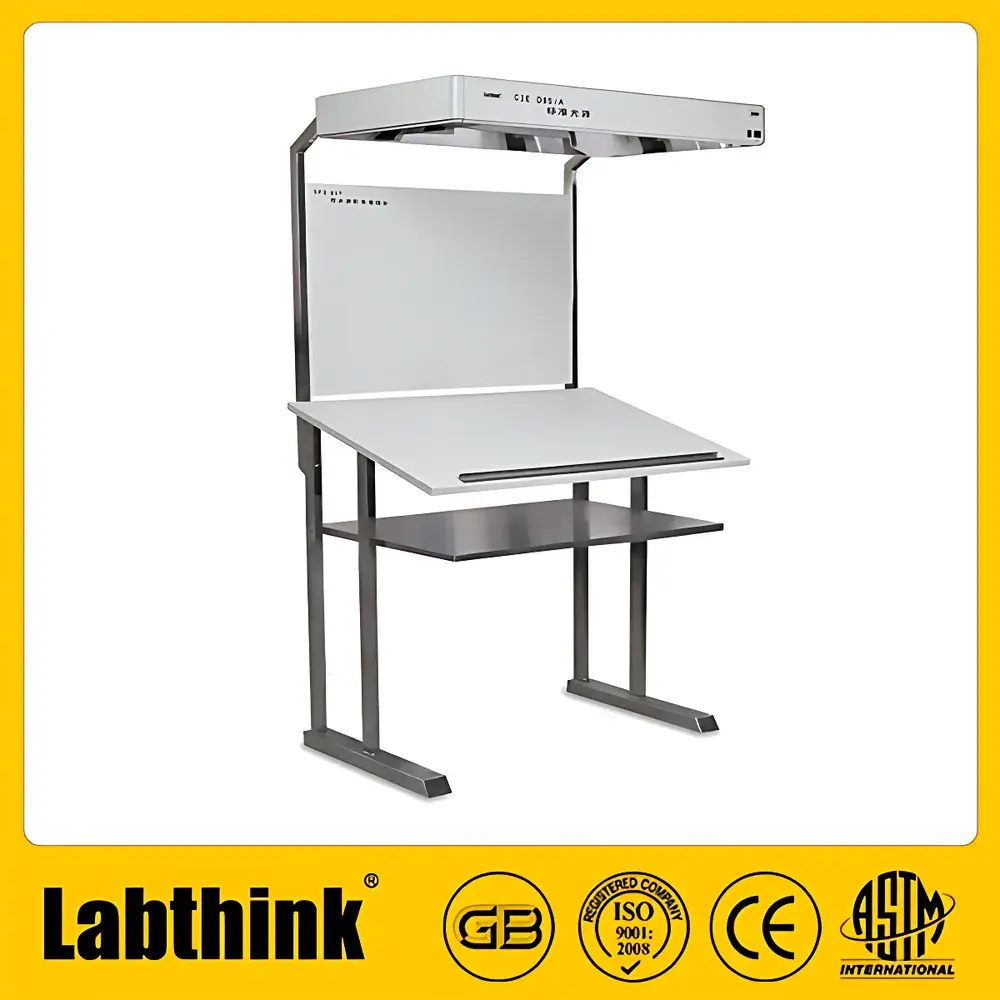
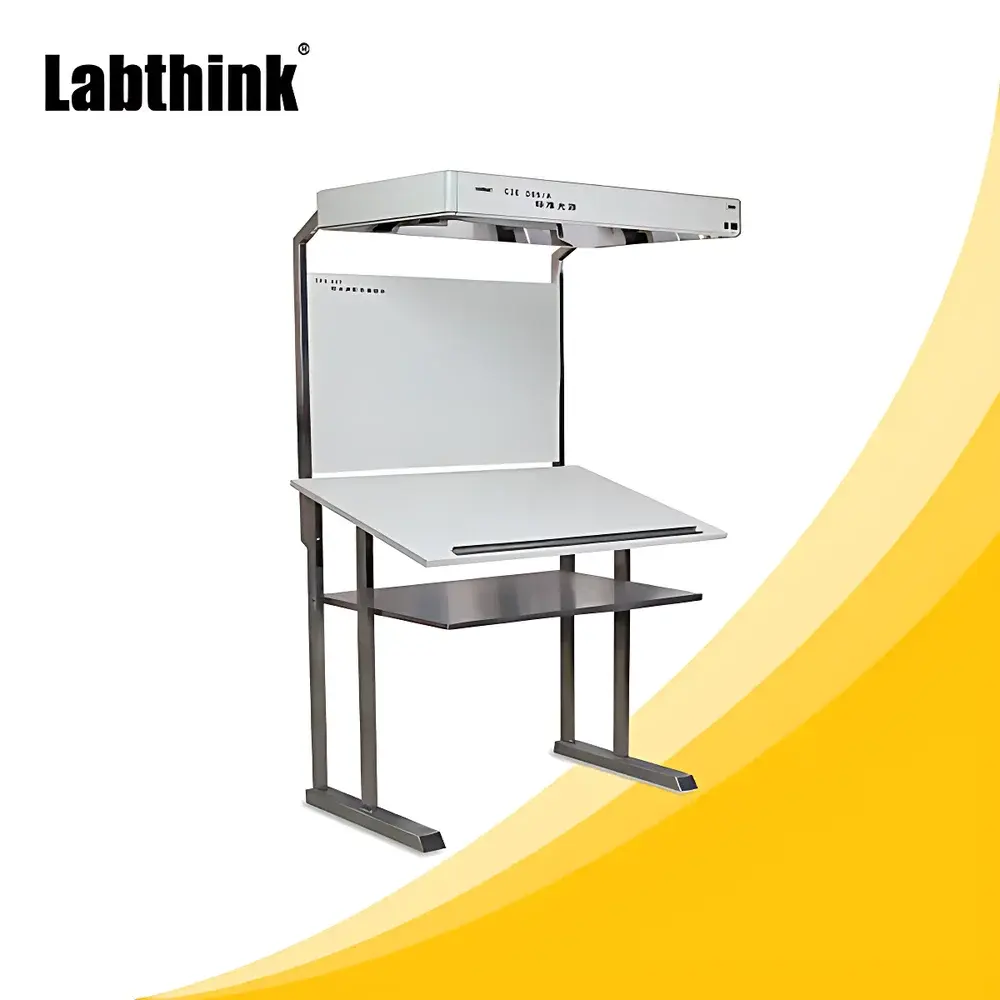
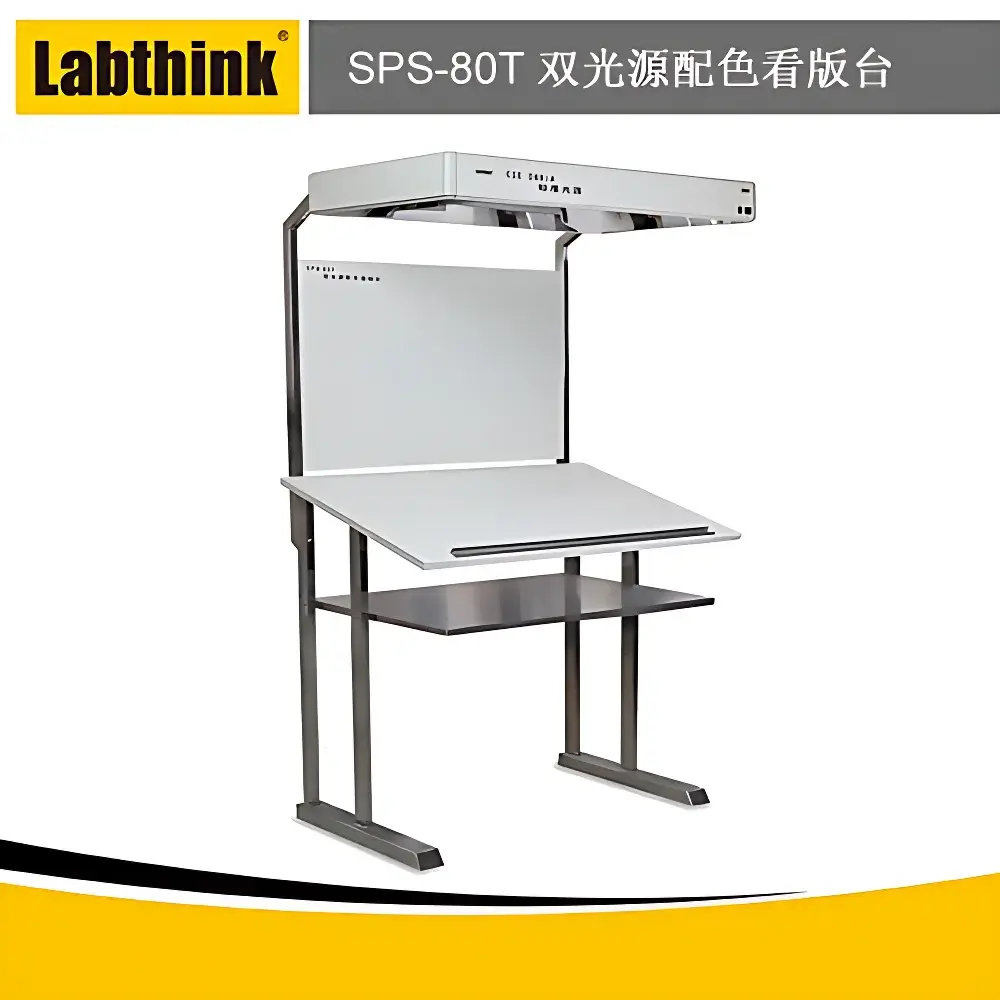
Labthink SPS-80T Dual-Source Color Matching Booth with CIE D65 and Illuminant A Lighting
| Brand | Labthink |
|---|---|
| Model | SPS-80T |
| Light Sources | CIE D65 (6500 K, Ra >96) & Illuminant A (2900 K, Ra = 100) |
| Viewing Surface | 1050 mm × 700 mm |
| Overall Dimensions | 1050 mm (L) × 800 mm (W) × 2100 mm (H) |
| Net Weight | 40 kg |
| Power Supply | AC 220 V, 50 Hz |
| Illumination Method | External top-down projection |
| Compliance | CIE No. 51, ISO 3664:2009, CY/T 3–91 |
| Features | Spectrally stable dual-lamp system, built-in lamp hour counter, tilt-adjustable diffuser hood, neutral gray interior (Munsell N5), standardized sample mounting board and hanging panel |
Overview
The Labthink SPS-80T Dual-Source Color Matching Booth is an engineered optical evaluation station designed for precise, repeatable color assessment under standardized illumination conditions. It implements the fundamental principle of metamerism control in industrial color management: visual color matching must be conducted under spectrally defined light sources to ensure consistency across production, quality control, and customer delivery stages. The booth integrates two photometrically certified light sources—CIE Standard Illuminant D65 (6500 K, color rendering index Ra >96) and Illuminant A (2900 K, Ra = 100)—within a rigid, neutral-gray (Munsell N5) viewing chamber. This dual-source architecture enables simultaneous or sequential evaluation of color appearance and spectral mismatch, directly addressing the critical challenge of illuminant-dependent color shift. Its optical design conforms to ISO 3664:2009 for graphic technology and photography, CIE Publication No. 51 for colorimetric observers, and China’s CY/T 3–91 standard for printing color evaluation—ensuring metrological traceability and inter-laboratory comparability.
Key Features
- Optically calibrated dual-lamp system: High-CRI D65 fluorescent tube (D6500 super-high-color-rendering phosphor blend) and tungsten-halogen A-source lamp, both independently stabilized for spectral integrity over time
- Neutral gray interior surface (Munsell N5) minimizing chromatic contamination during visual assessment
- Tilt-adjustable external projection hood with uniform diffuser optics, ensuring ≥85% irradiance uniformity across the full 1050 mm × 700 mm viewing surface per ISO 3664 Annex B
- Built-in digital lamp-hour counter for each light source, supporting preventive maintenance scheduling and GLP-compliant usage logging
- Modular accessory set including standardized sample mounting board, vertical hanging panel, and dedicated storage tray—all constructed from non-reflective, UV-stable materials
- Rigid steel frame with vibration-damped base, engineered for long-term dimensional stability in QC laboratory environments
Sample Compatibility & Compliance
The SPS-80T accommodates flat, rigid, and semi-flexible substrates up to 10 mm thickness—including printed sheets, coated films, painted panels, textile swatches, plastic injection-molded parts, and ink-jet proof prints. Its viewing geometry follows the 0°/45° observation convention specified in ISO 3664 for graphic arts applications, with optional adaptation for 45°/0° configurations via repositioning of the hanging panel. All optical components comply with IEC 62471 photobiological safety requirements for lamps and lamp systems. The booth supports audit-ready documentation for ISO/IEC 17025-accredited laboratories and satisfies lighting validation criteria required under FDA 21 CFR Part 11 for electronic records in regulated manufacturing (e.g., pharmaceutical packaging, medical device labeling). Calibration certificates for spectral power distribution (SPD) and illuminance uniformity are available upon request.
Software & Data Management
While the SPS-80T operates as a standalone optical reference instrument, it is fully compatible with third-party color measurement workflows. Its standardized illumination enables direct integration with spectrophotometers (e.g., X-Rite Ci7800, Konica Minolta CM-3700A) and color management software platforms (e.g., X-Rite Color iMatch, Datacolor Match Pigment). Users may record lamp usage hours, inspection dates, observer IDs, and sample IDs manually in logbooks or export timestamped data via optional RS-232 interface (available as add-on module). The booth’s design facilitates implementation of documented change control procedures and supports 21 CFR Part 11-compliant audit trails when paired with validated LIMS or ELN systems.
Applications
- Pre-press and pressroom color proof verification against contract standards (ISO 12647-2)
- Batch-to-batch color consistency checks in paint, ink, and pigment manufacturing
- Metamerism screening for automotive OEM trim parts and interior components
- Final inspection of packaging materials subject to retailer-specific color tolerances (e.g., Walmart, Target, Amazon FBA)
- Academic and industrial research on spectral reflectance behavior of novel pigments and effect coatings
- Training programs for color technicians requiring standardized visual assessment protocols
FAQ
What is the purpose of including Illuminant A alongside D65?
Illuminant A simulates incandescent lighting conditions and is essential for detecting metamerism—the phenomenon where two samples match under D65 but diverge under warm white light. This verification step prevents field failures due to lighting-dependent color mismatch.
Does the SPS-80T meet ISO 3664:2009 requirements for graphic technology?
Yes. Its D65 spectral output, illuminance level (≥2000 lx at viewing plane), uniformity (±15% across surface), and surround reflectance (N5 neutral gray) fully satisfy Clause 5.2 and Annex B of ISO 3664:2009.
Can the booth be used for evaluating textured or three-dimensional samples?
It is optimized for planar samples. For relief surfaces or curved objects, supplementary directional lighting modules or goniophotometric setups are recommended.
Is lamp replacement a user-serviceable procedure?
Yes. Both D65 and A lamps are industry-standard types (F30T8/D65 and PHILIPS 300W/A, respectively) with tool-free access; full replacement instructions and alignment templates are included in the operator manual.
How often should spectral validation be performed?
Annual verification using a NIST-traceable spectroradiometer is recommended for ISO/IEC 17025 compliance; Labthink provides certified recalibration services upon request.




