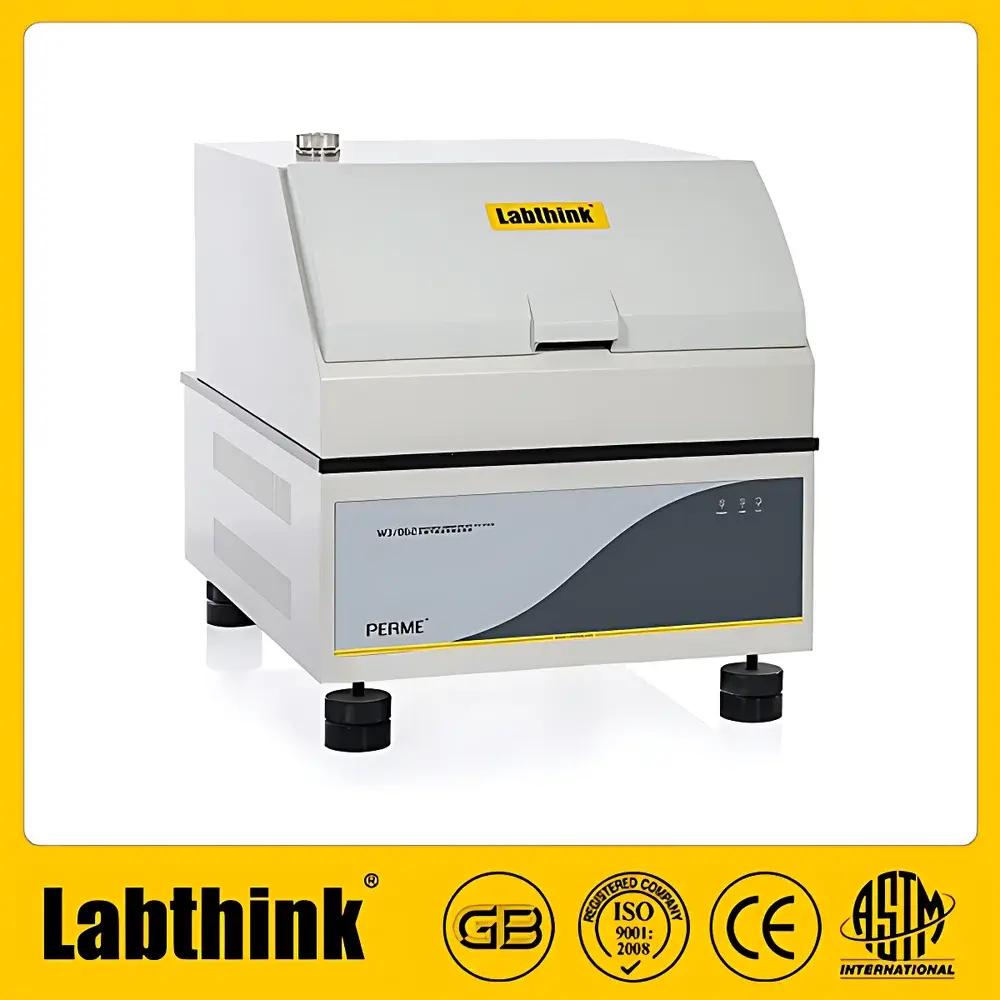
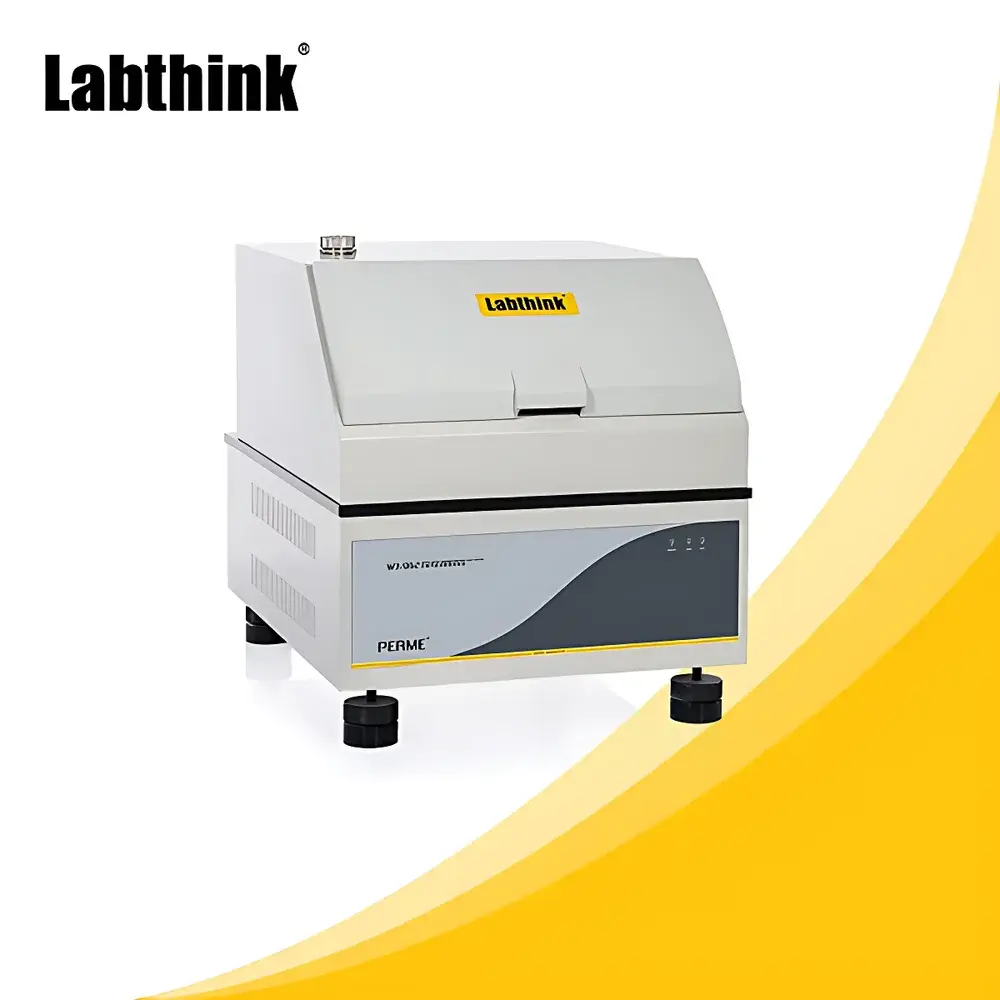
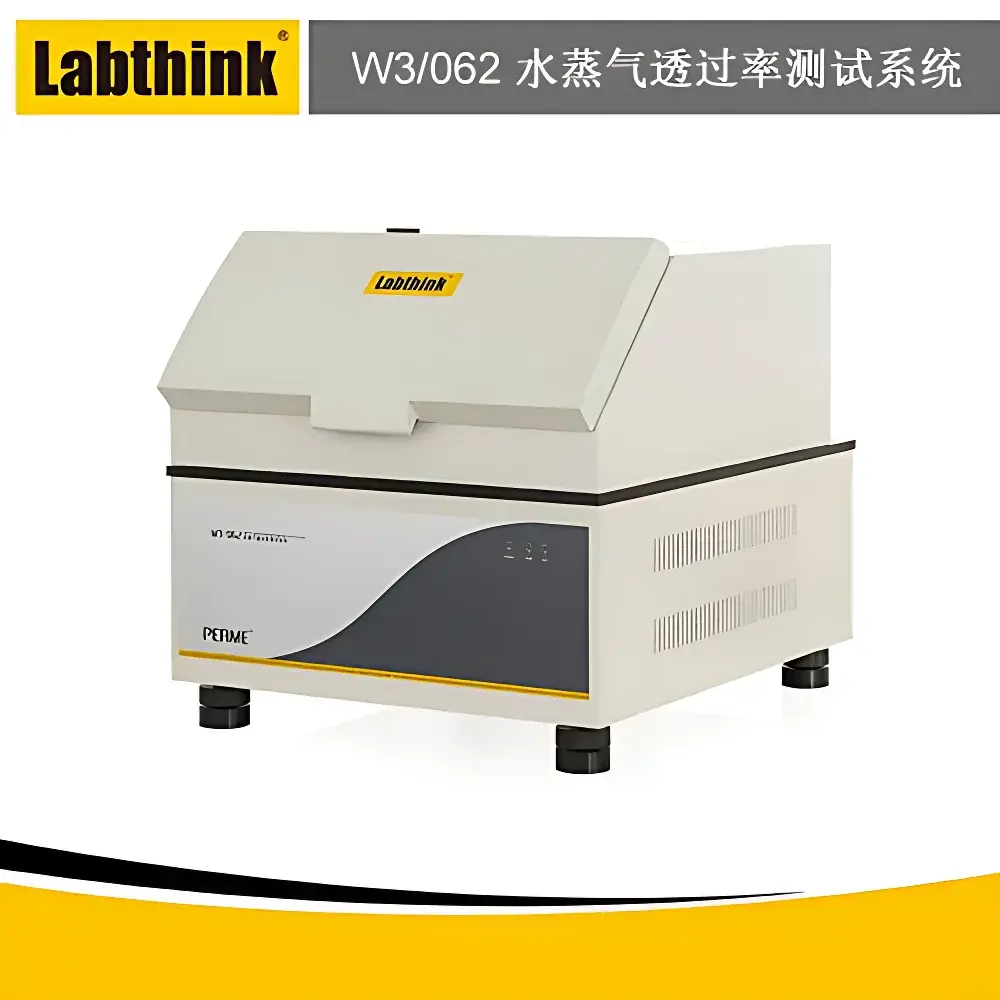
Labthink W3/062 Gravimetric Water Vapor Transmission Rate (WVTR) Tester for Medical Protective Apparel and Packaging Materials
| Brand | Labthink |
|---|---|
| Model | W3/062 |
| Measurement Principle | Gravimetric Cup Method (ASTM E96 / ISO 2528) |
| Test Range | 0.1–10,000 g/m²·24h (loss mode) |
| Sample Capacity | 1–6 independent specimens |
| Temperature Control | 15–55 °C (±0.1 °C) |
| Humidity Control | 10–98% RH (±1% RH) |
| Test Area | 33 cm² |
| Specimen Thickness | ≤3 mm |
| Weight Resolution | 0.001 g |
| Power Supply | 220 VAC 50 Hz / 120 VAC 60 Hz |
| Net Weight | 80 kg |
| Dimensions | 660 × 580 × 580 mm (L×W×H) |
Overview
The Labthink W3/062 Gravimetric Water Vapor Transmission Rate (WVTR) Tester is an engineered solution for precise, reproducible quantification of moisture permeation through medical protective apparel materials—including surgical gowns, isolation gowns, and disposable coveralls—as well as flexible packaging films, laminates, and barrier-coated substrates. It operates on the gravimetric cup method (also known as the desiccant or water method), compliant with ISO 2528, ASTM E96 (Procedure A & B), GB/T 1037, and YY/T 1498-2016. In this principle, a conditioned specimen seals a test cup containing either desiccant (for weight-loss mode) or distilled water (for weight-gain mode), establishing a defined vapor pressure gradient across the material. The system continuously monitors mass change of each cup via high-resolution electromagnetic force compensation sensors (0.001 g resolution), enabling calculation of WVTR in g/m²·24h with traceable uncertainty. This method remains the reference standard for regulatory evaluation of breathability in personal protective equipment (PPE), directly supporting compliance with GB 19082-2009—where minimum WVTR ≥2500 g/m²·24h is mandated for clinical-grade disposable protective clothing.
Key Features
- Multi-station parallel testing: Six independent test cups mounted on a precision rotary carousel enable simultaneous evaluation of up to six heterogeneous specimens under identical environmental conditions—reducing inter-test variability and accelerating throughput.
- Modular scalability: A single W3/062 host controller can integrate up to nine satellite units (totaling 60 test positions), facilitating high-volume quality control in centralized laboratories without sacrificing per-channel accuracy or audit readiness.
- Dual-mode humidity control: Programmable RH generation (10–98% RH, ±1% RH) and temperature regulation (15–55 °C, ±0.1 °C) support both gain and loss configurations per ASTM E96, ensuring method flexibility for hydrophilic, hydrophobic, and asymmetric barrier structures.
- High-fidelity mass metrology: Electromagnetic force compensation transducers deliver 0.001 g resolution and long-term drift stability—critical for detecting low-magnitude WVTR shifts in high-barrier materials such as metallized PET or SiOx-coated films.
- Controlled boundary airflow: Adjustable laminar purge (0.5–2.5 m/s) minimizes edge effects and boundary layer resistance, improving repeatability—especially for low-permeability specimens where convective transport dominates diffusive flux.
Sample Compatibility & Compliance
The W3/062 accommodates flat, non-porous, and semi-crystalline sheet materials up to 3 mm thick, with standardized circular specimens (Ø74 mm, effective test area 33 cm²). It is validated for use with woven/nonwoven textiles (e.g., SMS polypropylene, spunbond-meltblown composites), microporous membranes (PTFE, PU), coated papers, aluminum-laminated foils, and pharmaceutical blister lidding. All operational parameters align with Good Laboratory Practice (GLP) and GMP documentation requirements: full electronic audit trails, user-access controls, and 21 CFR Part 11–compliant data integrity features are embedded within the Lystem™ software architecture. Test reports include raw mass-time datasets, environmental logs, calibration certificates, and statistical summaries—all exportable in PDF, CSV, or XML formats for regulatory submission.
Software & Data Management
The instrument is operated via Labthink’s Lystem™ Laboratory Data Management System—a validated, network-deployable platform supporting multi-user workflows, role-based permissions, and automated report generation. Real-time visualization includes dynamic mass-vs.-time curves, deviation heatmaps across cup positions, and automatic outlier detection based on ICH Q5A criteria. Data archiving complies with ALCOA+ principles (Attributable, Legible, Contemporaneous, Original, Accurate, Complete, Consistent, Enduring, Available). Integration with enterprise LIMS environments is supported via HL7 and ASTM E1461-compliant APIs. Software validation packages (IQ/OQ/PQ protocols) and electronic signature modules are available upon request.
Applications
- Medical device manufacturers: Verification of breathability performance for ISO 13485-certified PPE production lines.
- Pharmaceutical packaging developers: WVTR qualification of cold-form blisters, sachets, and child-resistant pouches per USP and EP 3.2.1.
- Textile R&D labs: Comparative analysis of hydrophilic finishes, plasma-treated surfaces, and nanofiber architectures for enhanced moisture management.
- Regulatory testing laboratories: Third-party certification against GB 19082-2009, ASTM F1671 (viral penetration), and EN 14126 (protective clothing against infectious agents).
- Academic research: Fundamental studies on Fickian vs. anomalous diffusion mechanisms in polymer matrices under controlled T/RH gradients.
FAQ
What standards does the W3/062 comply with for medical protective apparel testing?
It fully supports GB 19082-2009, YY/T 1498-2016, ASTM E96 (Procedures A & B), ISO 2528, and EN 13726-1 for WVTR assessment of nonwoven and laminated barrier materials.
Can the system validate low-permeability materials used in sterile barrier systems?
Yes—the 0.1 g/m²·24h lower detection limit and ultra-stable thermal/hygrometric control make it suitable for evaluating high-integrity packaging per ISO 11607-1 Annex D.
Is remote monitoring and data export supported for FDA audit preparation?
All measurement data, environmental logs, and user actions are time-stamped, digitally signed, and exportable in 21 CFR Part 11–compliant formats including encrypted PDF and tamper-evident CSV.
How is calibration traceability maintained?
Each unit ships with NIST-traceable stainless-steel calibration weights; optional annual verification services include sensor linearity checks, temperature/humidity chamber validation, and cup seal integrity testing.
What maintenance is required for long-term operational reliability?
Routine tasks include desiccant replacement (for loss-mode tests), distilled water replenishment (for gain-mode), periodic cleaning of cup sealing surfaces, and annual sensor recalibration—documented in the integrated maintenance log module.