
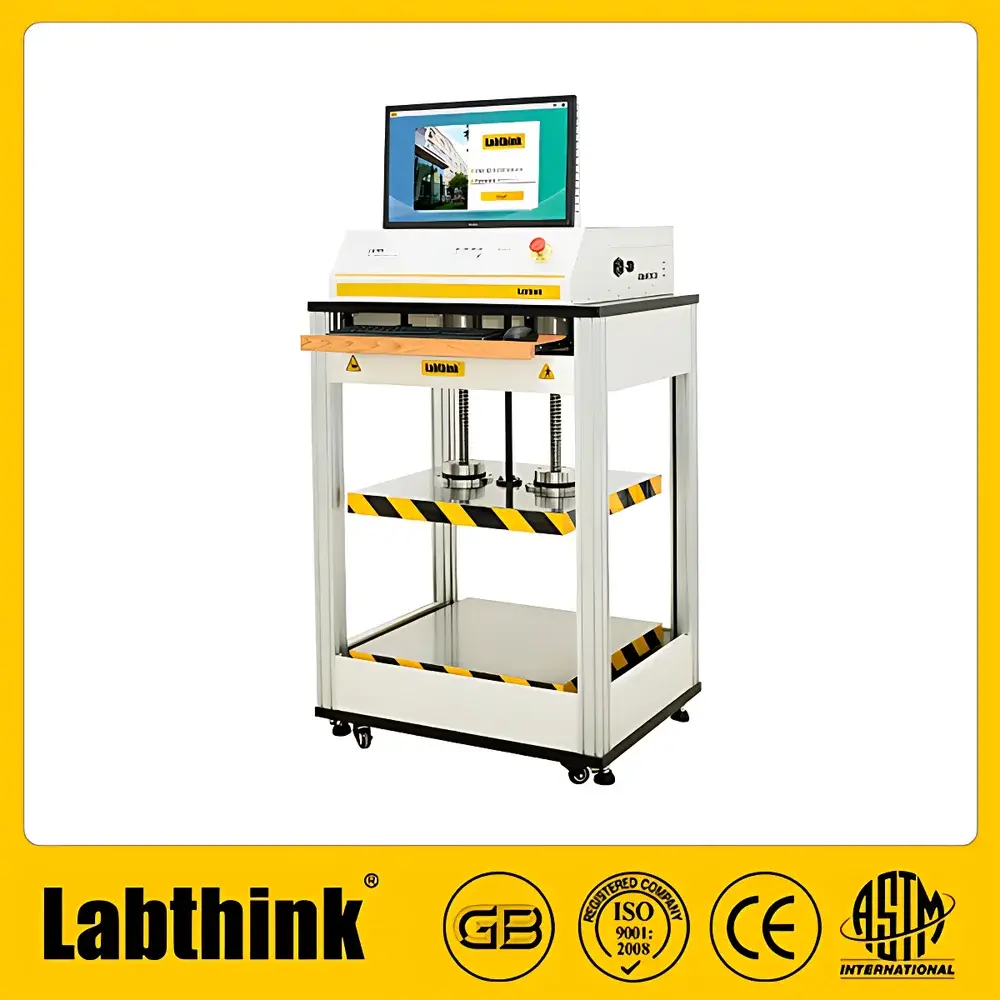
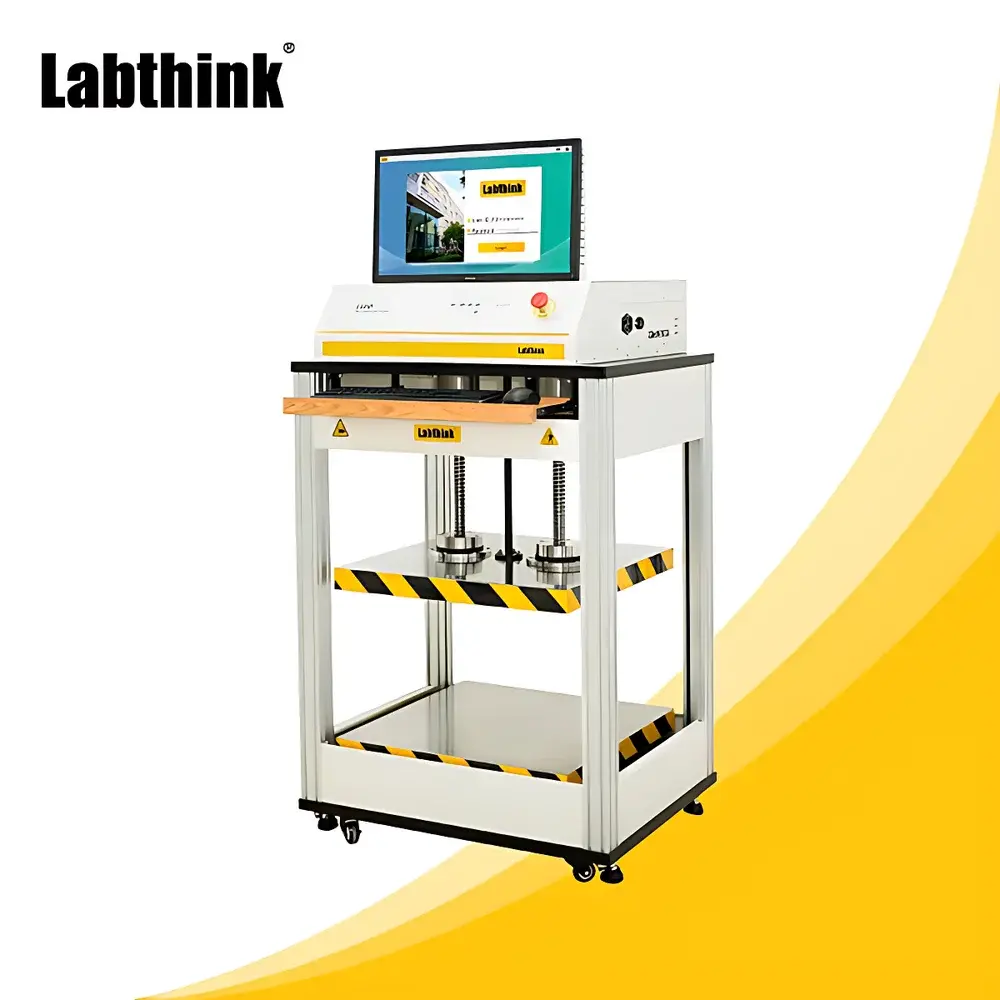
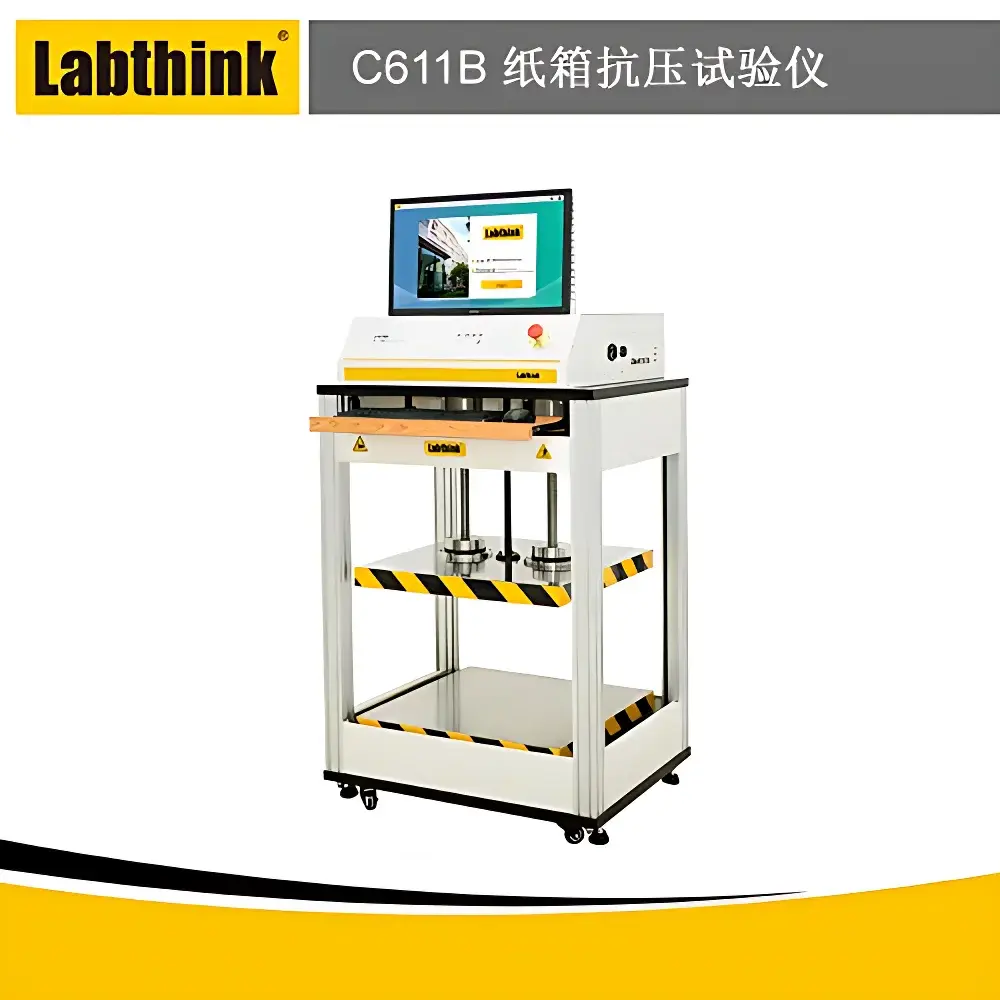
Labthink Labthink PC-01 Compression Tester for Corrugated Boxes and Hollow Containers
| Brand | Labthink |
|---|---|
| Origin | Shandong, China |
| Manufacturer Type | Direct Manufacturer |
| Model | Labthink PC-01 |
| Compliance Standards | ASTM D642, ASTM D4169, TAPPI T804, ISO 12048, JIS Z0212, GB/T 16491, GB/T 4857.4, QB/T 1048-2004 |
| Load Cell Capacity | 3 × 9 kN |
| Force Accuracy | ±1% of reading (10–100% FS), ±0.1% FS (0–10% FS) |
| Force Resolution | 1 N |
| Deformation Resolution | 0.1 mm |
| Test Speed Range | 0–200 mm/min (integer setting) |
| Speed Accuracy | ±2% of set value |
| Stroke | 450 mm |
| Specimen Height Range | 0–600 mm |
| Test Chamber Dimensions | 600 mm (L) × 600 mm (W) × 610 mm (H) |
| Overall Dimensions | 650 mm (L) × 810 mm (W) × 1620 mm (H) |
| Power Supply | AC 220 V ±10%, 50 Hz OR AC 120 V ±10%, 60 Hz |
| Net Weight | 180 kg |
| Standard Accessories | Host unit, integrated embedded display, optical mouse, keyboard, inkjet printer, one 150 mm compression plate |
Overview
The Labthink PC-01 Compression Tester is an electromechanical universal testing system engineered for precise static compressive strength evaluation of corrugated fiberboard containers, honeycomb packaging, and hollow rigid containers—including plastic drums, paper cans, composite pails, and intermediate bulk containers (IBCs). It operates on the principle of controlled axial loading under displacement or force control, delivering reproducible measurements of crush resistance, deformation behavior, and stack-load performance in accordance with internationally recognized packaging test standards. Designed for laboratory and quality control environments, the instrument employs a dual high-precision ball-screw actuation system driven by a servo motor to ensure smooth, low-noise, and repeatable motion across its full speed range. Its structural rigidity and calibrated load train—comprising three synchronized 9 kN load cells—enable high-fidelity capture of peak compressive force, yield point, and creep-related deformation under sustained load.
Key Features
- Integrated embedded computing platform running a Windows-style GUI; no external PC required for operation or data acquisition
- Three parallel 9 kN load cells with dual-range accuracy: ±0.1% full scale (FS) at low loads (0–10% FS), ±1% of reading at operational loads (10–100% FS)
- Adjustable test speed from 0 to 200 mm/min (integer steps), with speed accuracy maintained within ±2% of setpoint
- Real-time dynamic display of applied force (N), specimen deformation (mm), and time-stamped test curves on the built-in LCD interface
- Comprehensive safety architecture including overload protection, end-of-travel limit switches, automatic fault detection, and audible/visual alarm signaling
- Dual communication interfaces: USB 2.0 port for local data export and Ethernet port for networked lab integration and remote monitoring
- Optional DataShield™ software module for centralized data governance, role-based access control, and audit-ready electronic records compliant with FDA 21 CFR Part 11 requirements
- Modular test method library supporting standardized protocols: Crush Test (ASTM D642), Stack Load Test A (deformation under constant load), Stack Load Test B (time-dependent deformation at fixed load), and container-specific variants per ISO 12048 and GB/T 4857.4
Sample Compatibility & Compliance
The PC-01 accommodates specimens up to 600 mm in height and 600 mm × 600 mm in footprint, enabling evaluation of standard RSC, HSC, and die-cut corrugated boxes as well as cylindrical and rectangular hollow containers. Its open-frame design allows rapid fixture changes for flat compression plates (standard 150 mm diameter), custom platens, or specialized fixtures for irregular geometries. The system conforms to regulatory expectations for pharmaceutical and medical device packaging validation, including alignment with Chinese GMP Annex 11 and general principles of ALCOA+ (Attributable, Legible, Contemporaneous, Original, Accurate, Complete, Consistent, Enduring, Available). All test methods are traceable to primary national and international standards, including ASTM D642 (determining compressive resistance of shipping containers), ASTM D4169 (performance testing of distribution systems), TAPPI T804 (flat crush resistance of corrugated board), and ISO 12048 (compression testing of transport packages).
Software & Data Management
The embedded operating system provides intuitive keyboard-and-mouse navigation with context-sensitive menus, real-time graph overlays, and automated pass/fail decision logic based on user-defined acceptance criteria. Test reports include raw force–deformation data, statistical summaries (mean, SD, CV%), annotated curve images, and metadata such as operator ID, environmental conditions (optional sensor input), and calibration status. For regulated industries, optional DataShield™ adds electronic signature capability, change history logging, and secure database synchronization with LIMS or ERP systems. Audit trails record all user actions—including method edits, result modifications, and report generation—with immutable timestamps and identity attribution. Data export supports CSV, PDF, and XML formats compatible with statistical process control (SPC) platforms and enterprise analytics tools.
Applications
Primary applications include compressive strength verification of single-wall and double-wall corrugated boxes used in e-commerce fulfillment, cold-chain logistics, and pharmaceutical secondary packaging. The instrument also supports qualification of reusable plastic totes, fiber drums, and laminated paper cans subjected to warehouse stacking or palletized transport. In R&D settings, it enables comparative analysis of board grade substitutions, adhesive formulations, and moisture-conditioning effects on structural integrity. Stack Load Test B is frequently employed to simulate long-duration warehouse storage under defined load profiles, while Crush Test results inform carton design optimization and ISTA-compliant distribution cycle modeling. Additional use cases span food packaging compliance (e.g., shelf-life stability under vertical load), hazardous materials packaging certification (UN 4G/4H1), and sustainability initiatives evaluating recycled content impact on mechanical performance.
FAQ
What standards does the PC-01 support out of the box?
The instrument includes preconfigured test methods aligned with ASTM D642, ASTM D4169, ISO 12048, GB/T 4857.4, and TAPPI T804. Custom method creation is supported via editable parameter templates.
Can the system be validated for GxP environments?
Yes—when equipped with DataShield™ and configured with IQ/OQ documentation packages, the PC-01 meets core requirements for computerized system validation under FDA 21 CFR Part 11 and EU Annex 11.
Is calibration traceability provided?
Labthink supplies NIST-traceable calibration certificates for load cells and displacement sensors, with annual recalibration intervals recommended per ISO/IEC 17025 guidelines.
How is specimen alignment ensured during testing?
The dual-ball-screw drive ensures parallel platen movement within ±0.05 mm deviation over full stroke; optional laser alignment aids verify centering prior to test initiation.
Does the system support multi-specimen batch testing?
Yes—the software permits sequential test queuing, automatic report generation per specimen, and aggregated summary statistics across batches with configurable grouping logic (e.g., by material lot, production shift, or supplier).




