
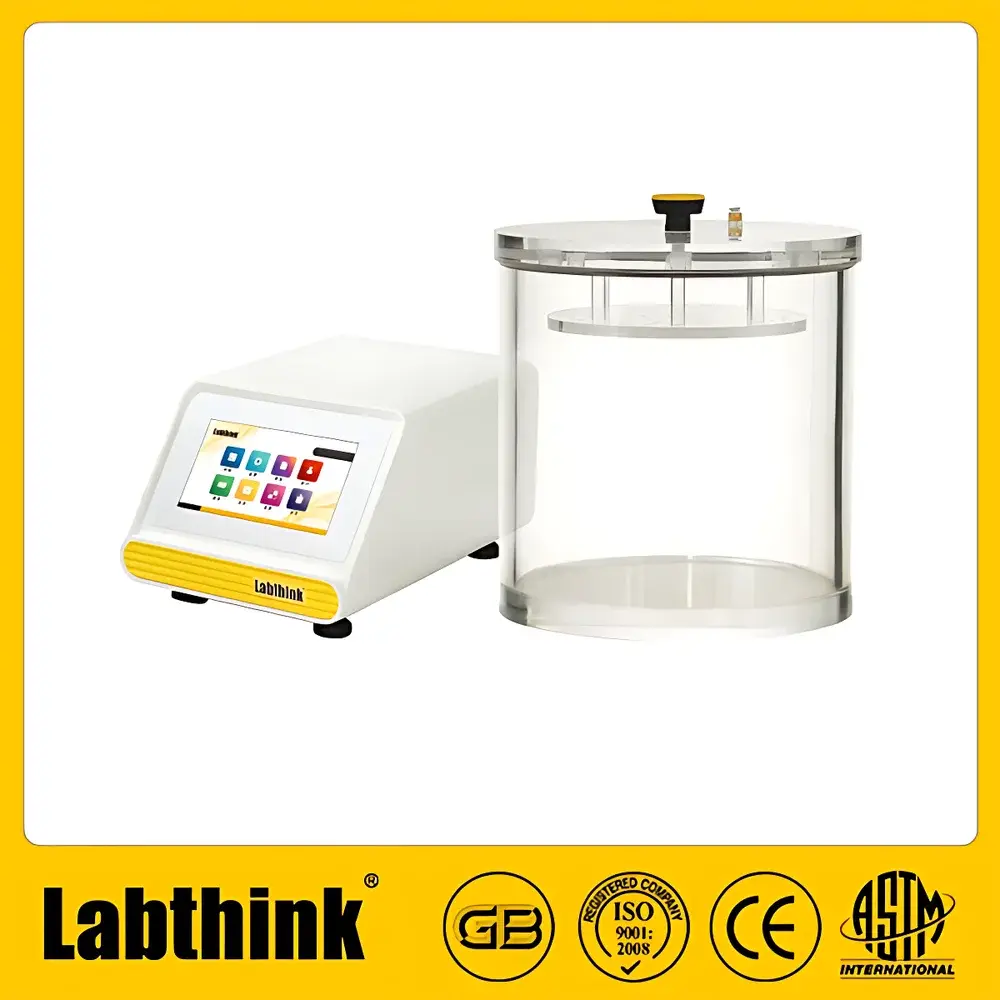
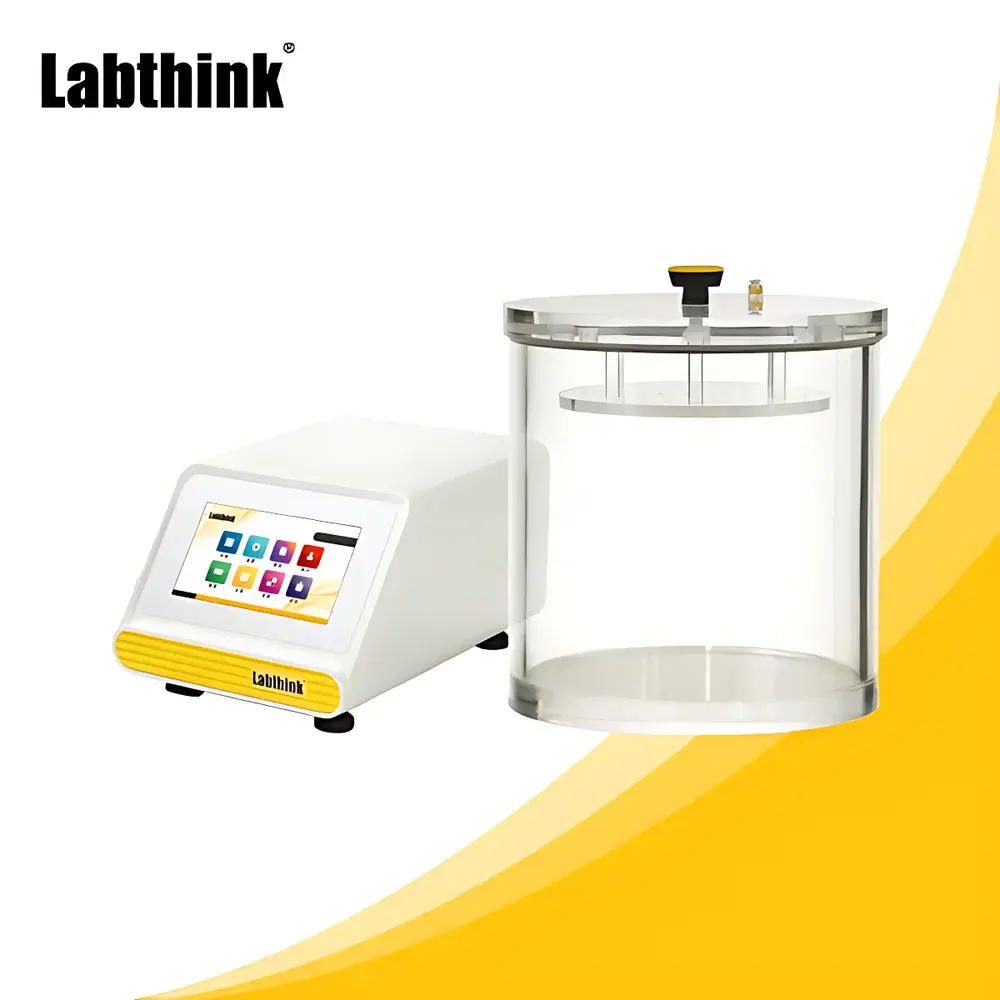
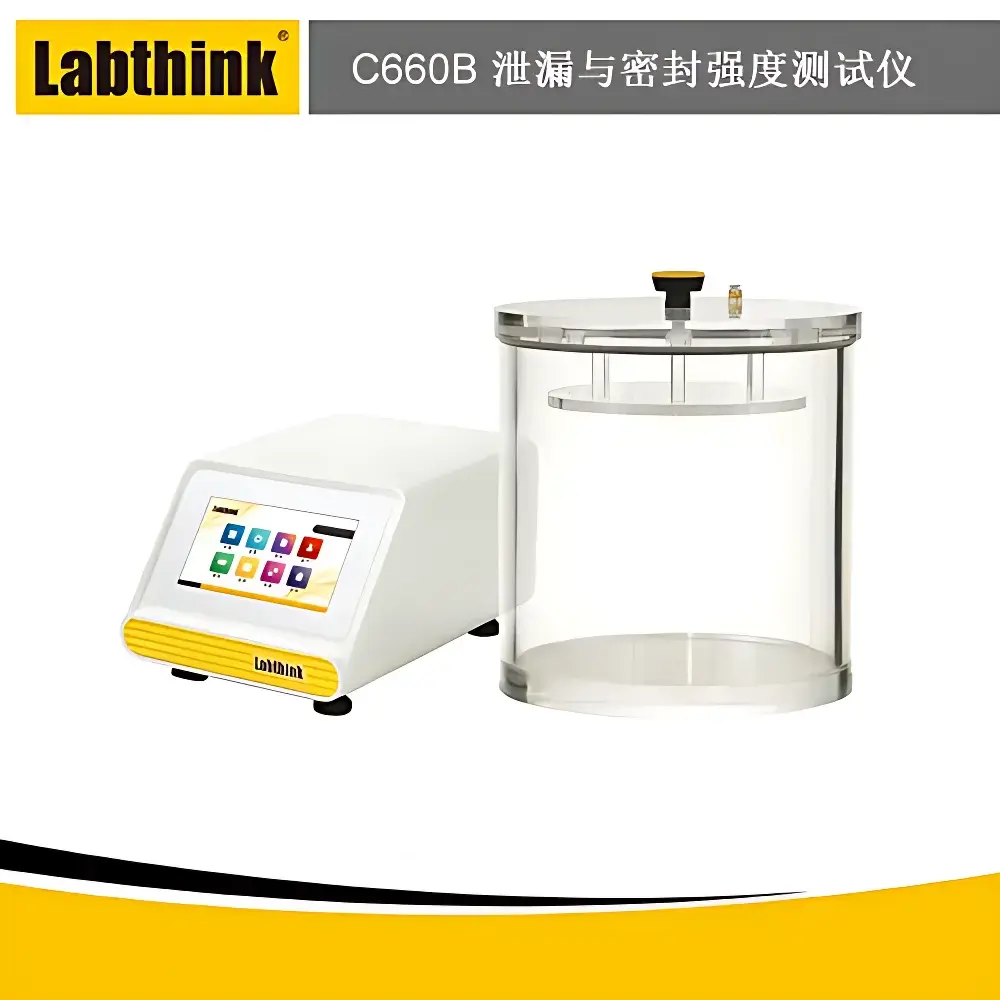
Labthink C660B Vacuum Seal Integrity Tester
| Brand | Labthink |
|---|---|
| Model | C660B |
| Origin | Shandong, China |
| Manufacturer Type | OEM/ODM Manufacturer |
| Product Category | Domestic Instrument |
| Price Range | USD 1,400 – 4,200 |
| Vacuum Range | 0 to −90 kPa (0 to −13 psi) |
| Vacuum Accuracy | ±0.25% FS |
| Vacuum Resolution | 0.1 kPa / 0.01 psi |
| Vacuum Hold Time | 0–9999 min 59 sec |
| Standard Vacuum Chamber Dimensions | Φ270 mm × 210 mm (H) |
| Power Supply | 220 VAC ±10%, 50 Hz or 120 VAC ±10%, 60 Hz |
| Net Weight | 6.5 kg (host), 9 kg (standard chamber) |
| Compliance Standards | GB/T 15171, ASTM D3078 |
Overview
The Labthink C660B Vacuum Seal Integrity Tester is an engineered solution for non-destructive, quantitative evaluation of package seal integrity using the vacuum decay principle—also known as the bubble emission method per ASTM D3078 and the water immersion vacuum test per GB/T 15171. It operates by subjecting a sealed sample submerged in water to controlled negative pressure within a calibrated vacuum chamber. The resulting differential pressure induces gas leakage at defect sites, manifested as visible bubbles; alternatively, for flexible or semi-rigid packages, deformation under vacuum and subsequent shape recovery upon pressure release are assessed as indicators of structural integrity and seal continuity. Designed for routine QC/QA laboratories and R&D environments, the C660B delivers repeatable, operator-independent results across diverse packaging formats—including blister packs, pouches, bottles, tubes, trays, and sterile barrier systems—without requiring tracer gases, dyes, or destructive sectioning.
Key Features
- Multi-mode vacuum testing: Standard vacuum hold, multi-stage vacuum ramping, and dye-assisted (methylene blue) automation mode with programmable vacuum level, dwell time, and observation duration
- Precision vacuum control: Digital proportional solenoid valves enable auto-compensation for minor leakage during hold phase, maintaining setpoint vacuum within ±0.25% full-scale accuracy
- Real-time graphical monitoring: On-screen vacuum curve display with timestamped event markers (e.g., start, target pressure reached, hold initiated, end)
- Intelligent pass/fail classification: Automatic count and logging of compliant vs. non-compliant units based on user-defined acceptance criteria (e.g., zero bubbles within specified timeframe)
- Industrial-grade 7-inch capacitive touchscreen interface: Full touch navigation with dual-language support (English/Chinese), configurable unit system (kPa/psi), and firmware-upgradable architecture via Ethernet or USB
- Data integrity architecture: Built-in non-volatile memory stores up to 1,200 standard test records with full metadata (date/time, operator ID, vacuum parameters, result status); optional DataShield™ module enables centralized database integration and audit-trail compliance per FDA 21 CFR Part 11 and EU Annex 11
- Modular hardware design: Interchangeable vacuum chambers (Φ270 × 210 mm standard; optional Φ360 × 585 mm and Φ460 × 330 mm configurations); compatible with external compressed air sources (0.5–0.7 MPa)
Sample Compatibility & Compliance
The C660B accommodates rigid, semi-rigid, and flexible primary and secondary packaging across regulated and non-regulated sectors. Validated use cases include glass, plastic (PET, HDPE, PP), aluminum, and laminated pouches used in pharmaceutical blister cards, IV bags, diagnostic kits, and sterile medical device trays. It supports post-stress validation—samples subjected to drop testing (ISTA 2A/3A), compression, or thermal cycling may be evaluated without modification to test protocol. The instrument meets essential requirements of ISO 11607-2 for packaging validation, aligns with USP guidance on container closure integrity testing (CCIT), and satisfies GMP data traceability mandates when equipped with optional computer system validation (CSV) package and electronic signature capability. All vacuum calibration procedures follow ISO/IEC 17025–accredited traceability paths.
Software & Data Management
Embedded firmware provides local data management with password-protected multi-tier user roles (Operator, Supervisor, Administrator). Test records include vacuum profile snapshots, operator ID, environmental timestamps, and digital pass/fail flags. Optional Labthink “SealCheck Pro” software enables advanced statistical process control (SPC), trend analysis, PDF report generation with digital signatures, and automated export to LIMS or ERP systems. DataShield™ ensures encrypted transmission, role-based access control, and immutable audit logs—including all parameter changes, login attempts, and result modifications—meeting GLP/GMP documentation rigor. USB host port supports flash drive export; RS-232 and Ethernet interfaces facilitate networked deployment.
Applications
- Pharmaceutical: Sterile vial stopper integrity, pre-filled syringe plunger seal verification, peel strength validation of foil-lidded trays
- Medical Devices: Hermeticity screening of implant packaging, oxygen-barrier pouches for electrosurgical tools, and RFID-tagged surgical kits
- Food & Beverage: Evaluation of retort pouch seals, modified atmosphere packaging (MAP) integrity, and child-resistant closures
- Electronics: Moisture barrier validation for MEMS sensor housings and conformally coated PCB modules
- Automotive: Leak detection in fuel cap assemblies, brake fluid reservoirs, and EV battery module enclosures
- Consumer Goods: Quality assurance for cosmetic tube crimps, pen cartridge seals, and resealable snack packaging
FAQ
What standards does the C660B comply with?
The instrument implements test methodologies aligned with GB/T 15171–1994, ASTM D3078–2022, and ISO 11607–2:2019. Optional validation packages support IQ/OQ/PQ execution per GMP Annex 15.
Can the C660B test dry, non-submerged packages?
No—the core methodology requires aqueous immersion to visualize bubble emission. For dry-package CCIT, consider Labthink’s LSSD series laser-based headspace analyzers or helium leak testers.
Is compressed air supply included?
No. Users must provide clean, oil-free compressed air at 0.5–0.7 MPa via standard Φ6 mm polyurethane tubing. An optional integrated air compressor kit is available.
How is calibration verified?
Vacuum sensor calibration is traceable to NIST-certified pressure standards. Internal self-diagnostic routines verify valve response, pressure transducer linearity, and timer accuracy prior to each test sequence.
Does the system support 21 CFR Part 11 compliance?
Yes—when configured with the CSV-ready software bundle, DataShield™, and biometric or smart-card authentication hardware, it fulfills electronic record and signature requirements including audit trails, role-based permissions, and data encryption.






