
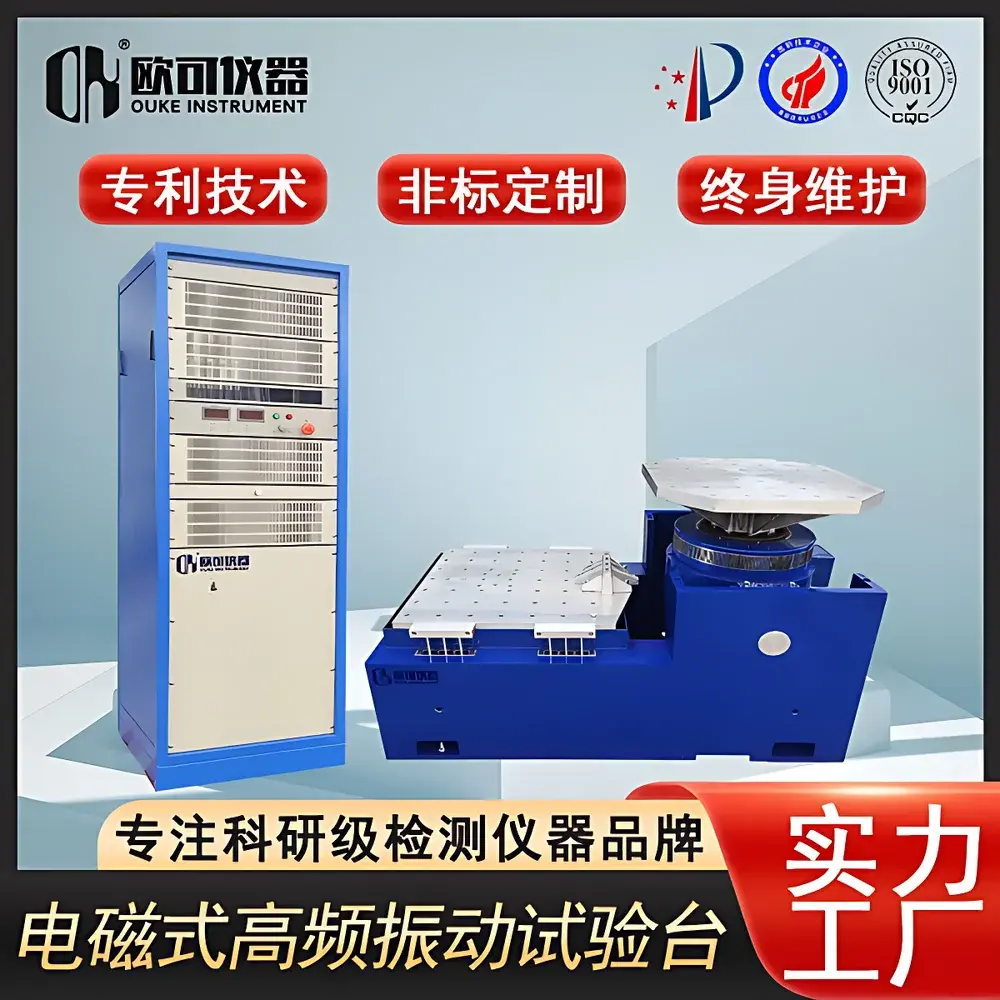
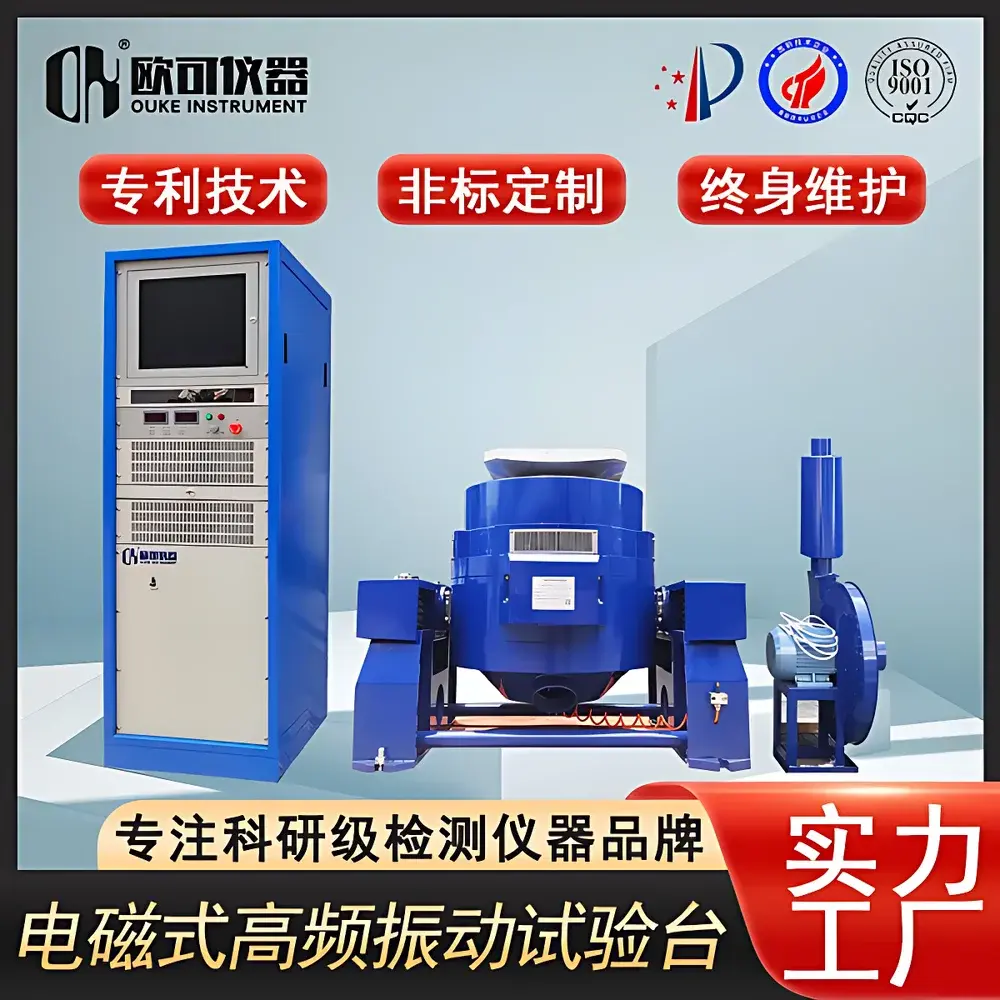
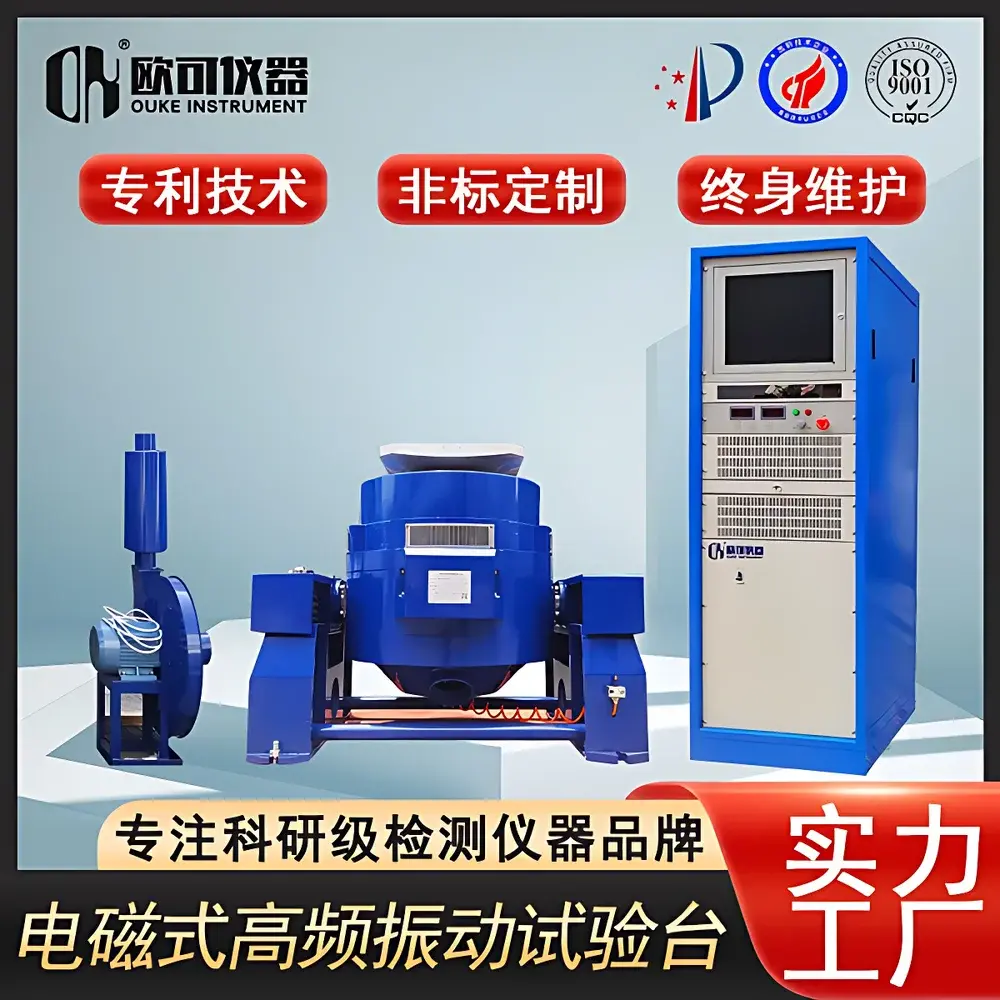
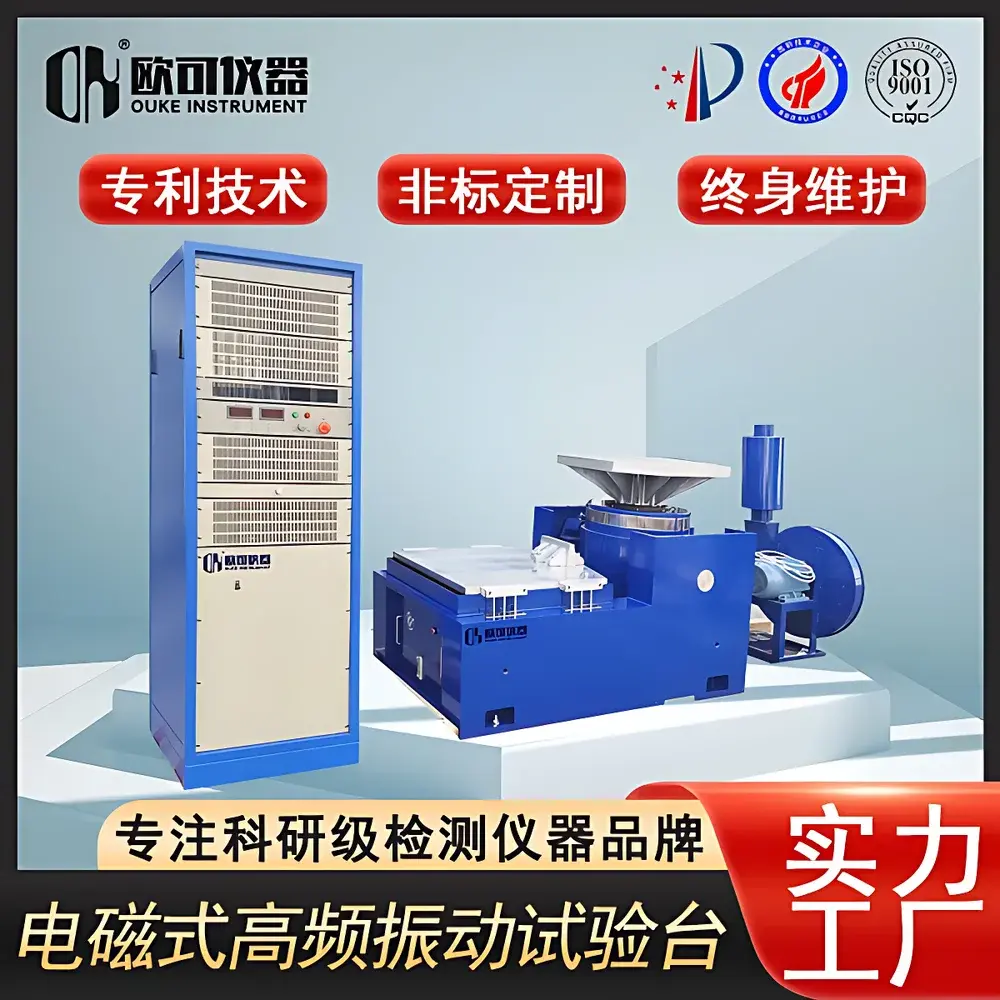
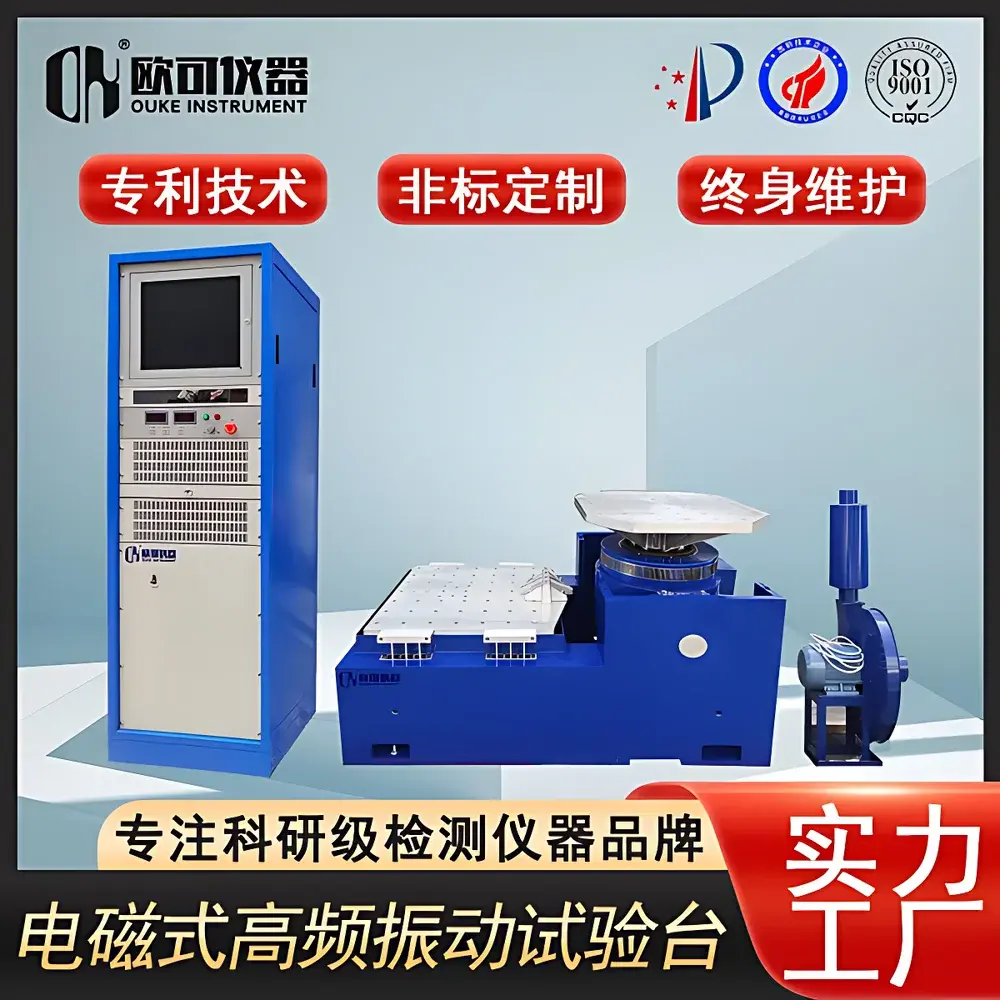
OK-ES Series Electromagnetic Vibration Testing System
| Brand | OK Instruments |
|---|---|
| Origin | Guangdong, China |
| Manufacturer Type | Direct Manufacturer |
| Model | OK-ES Series |
| Frequency Range | 5–4000 Hz |
| Displacement (Peak-to-Peak) | 25 mm |
| Vibration Modes | Sinusoidal & Random |
| Drive Principle | Electromagnetic Shaker |
| Orientation Flexibility | Vertical / Horizontal (90° Rotatable) |
| Mounting | Floor-Standing with Anti-Vibration Rubber Pads |
| Control Interface | Digital Frequency Display |
| Timing Function | Integrated Programmable Timer |
| Compliance | Meets ISTA, ASTM D999, ISO 8568, and EN 60068-2-64 for Transport Simulation |
Overview
The OK-ES Series Electromagnetic Vibration Testing System is a high-frequency, dual-mode (sinusoidal and random) shaker engineered for rigorous transport simulation and mechanical durability assessment of packaged goods, electronic assemblies, automotive components, and industrial subassemblies. Based on electromagnetic excitation principles, the system generates controlled acceleration profiles by passing time-varying current through a voice-coil-type drive unit suspended within a high-flux permanent magnet circuit. This architecture ensures rapid dynamic response, low harmonic distortion, and high waveform fidelity across its full operational bandwidth of 5–4000 Hz — enabling accurate replication of real-world road, rail, and air transport vibration spectra. Unlike hydraulic or electrodynamic shakers with mechanical linkages, the OK-ES employs a direct-drive electromagnetic actuator with minimal moving mass, resulting in superior phase linearity and reduced thermal drift during extended test cycles. Its design targets laboratories and QA/QC departments requiring repeatable, standards-compliant vibration exposure without reliance on foundation anchoring or complex facility modifications.
Key Features
- Electromagnetic drive system with integrated cooling and overload protection, delivering stable force output up to rated displacement (25 mm p-p) under full load conditions.
- Three-axis capable configuration with rotatable magnetic cylinder mounted on precision ear-axis suspension — enabling seamless switching between vertical and horizontal (±90°) vibration orientations without hardware reconfiguration.
- Patented rocker-arm guidance mechanism combined with axial air-spring suspension, minimizing cross-axis coupling and maintaining transverse stiffness >12 kN/mm — critical for high-fidelity waveform reproduction during multi-degree-of-freedom testing.
- Digital frequency display with ±0.1 Hz resolution and real-time amplitude monitoring; calibrated per ISO 10816-3 traceable procedures.
- Integrated programmable timer with 0.1–999.9 minute range and automatic shutdown, supporting unattended operation for standardized drop-and-vibration sequences per ISTA 3A/3E protocols.
- Heavy-duty structural base fabricated from reinforced C-channel steel, decoupled from floor via high-damping rubber isolators — eliminating need for anchor bolts or concrete foundations.
- Linear rail-mounted sample fixture platform with quick-lock clamping and adjustable center-of-gravity alignment, ensuring safe handling of asymmetrical or oversized specimens (up to 100 kg).
Sample Compatibility & Compliance
The OK-ES Series accommodates a wide range of specimen geometries and mass distributions through modular fixture interfaces, including flat-table, pallet-mount, and custom bracket options. It supports test specimens weighing from 1 kg to 100 kg, with mounting surface dimensions up to 600 × 600 mm. The system complies with international transport simulation standards including ISTA 3A, ISTA 3E, ASTM D999 (Package Vibration Testing), ISO 8568 (Vibration Testing of Packaged Products), and EN 60068-2-64 (Random Vibration Testing). While not certified for FDA 21 CFR Part 11 or GLP/GMP audit trails out-of-the-box, its digital control interface supports external data logging via RS-232/USB and can be integrated into validated test environments with third-party software validation packages.
Software & Data Management
The OK-ES operates via an embedded microcontroller-based controller with front-panel digital interface — no PC dependency required for basic sine sweep, fixed-frequency, or timed random vibration tests. Optional PC-based control software (sold separately) provides expanded functionality including PSD profile editing, real-time FFT analysis, test report generation (PDF/CSV), and automated compliance checking against predefined spectral masks. All test parameters — frequency, acceleration, duration, and direction — are stored with timestamp and operator ID in non-volatile memory. Data export conforms to IEEE 1584-compliant CSV formatting for post-processing in MATLAB, LabVIEW, or commercial CAE tools such as ANSYS Mechanical.
Applications
- Transportation simulation of consumer electronics packaging to assess cushioning performance and identify resonance-induced failure modes.
- Pre-shipment qualification of medical device enclosures per ISO 11607-1 requirements for sterile barrier integrity under vibratory stress.
- Mechanical fatigue screening of printed circuit board assemblies (PCBAs) prior to automotive AEC-Q200 qualification.
- Validation of aerospace component mounting brackets using synthesized power spectral density (PSD) profiles derived from flight data telemetry.
- Research-grade modal analysis support for academic labs studying structural damping characteristics of composite materials.
FAQ
Does the OK-ES Series support closed-loop acceleration control?
Yes — optional accelerometer feedback integration enables closed-loop amplitude regulation with ±1.5% RMS accuracy across the 5–2000 Hz range.
Can the system perform shock testing?
No — it is designed exclusively for sinusoidal and Gaussian random vibration; dedicated electrodynamic shock machines are recommended for half-sine or trapezoidal pulse profiles.
Is calibration certification included with shipment?
A factory calibration certificate (traceable to NIM, China) is provided; ISO/IEC 17025-accredited calibration services are available upon request.
What maintenance intervals are recommended?
Annual inspection of suspension bearings, coil insulation resistance, and air-spring pressure is advised; no routine lubrication is required due to sealed electromagnetic actuator design.
How is thermal management handled during extended random vibration tests?
The drive coil incorporates forced-air cooling with thermostatically regulated fans; continuous operation at 80% of maximum force rating is supported for ≥4 hours without derating.



