
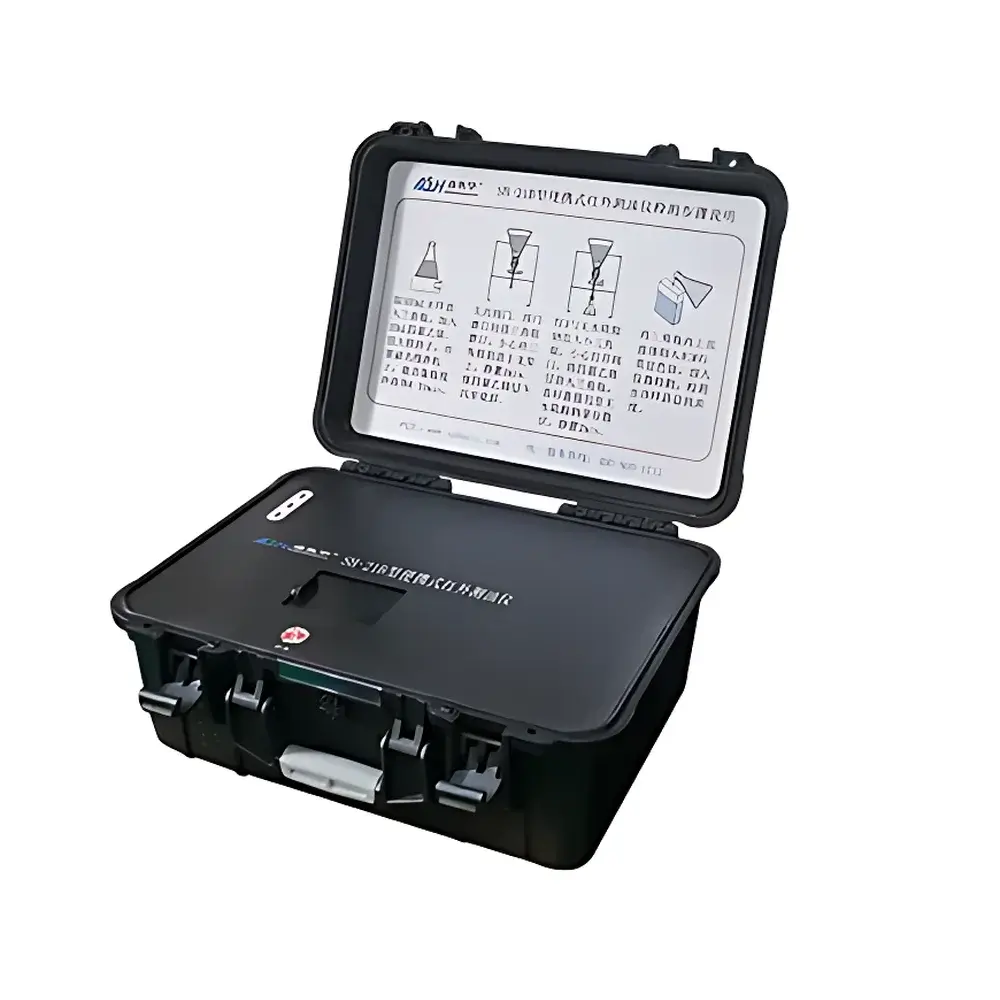
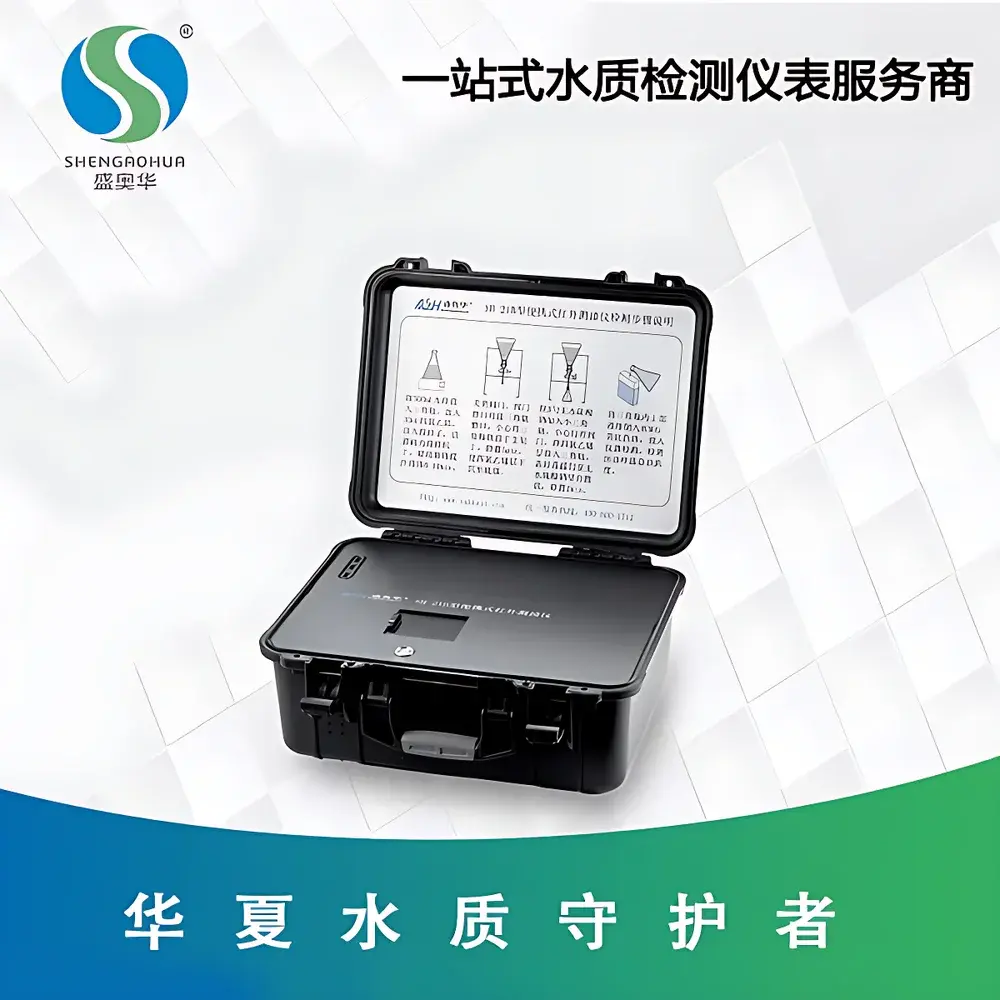
Shengaohua SH-21B(V11) Portable Infrared Oil-in-Water Analyzer
| Brand | Shengaohua |
|---|---|
| Origin | Jiangsu, China |
| Manufacturer Type | Direct Manufacturer |
| Country of Origin | China |
| Model | SH-21B(V11) |
| Instrument Type | Portable |
| Measurement Principle | Infrared Spectrophotometry (Fourier-transform-free dispersive IR) |
| Measurement Range | 0–120 mg/L (for C₂Cl₄ extract, 4 cm cell) |
| Detection Limit | 0.002 mg/L (in water) |
| Upper Quantitation Limit | 640,000 mg/L (in water) |
| Accuracy | RSD < 0.8% (for standard oil reference at 20–80 mg/L) |
| Resolution | 0.1 mg/L |
| Scan Time | ~30 s (full spectral scan, 3400–2400 cm⁻¹) |
| Wavenumber Accuracy | ±1 cm⁻¹ |
| Wavenumber Repeatability | ±1 cm⁻¹ |
| Absorbance Range | 0.0000–3.0000 AU (100–1% T) |
| Baseline Drift | Zero drift (mechanical chopper stabilization) |
| Display | 10.1″ Windows 10 tablet PC (backward-compatible with Win7/Win8) |
| Battery Life | Up to 8 h |
| Weight | 12 kg (main unit) |
| Dimensions | 470 × 360 × 230 mm (L×W×H) |
| Enclosure Rating | IP65 |
| Compatible Solvent | Tetrachloroethylene (C₂Cl₄) |
| Data Storage | Local spectral files, measurement parameters, and results exportable to PC |
| Power Supply | Integrated portable rechargeable power module |
Overview
The Shengaohua SH-21B(V11) Portable Infrared Oil-in-Water Analyzer is an engineered field-deployable instrument designed for quantitative determination of total petroleum hydrocarbons (TPH), petroleum hydrocarbons (PHC), and animal/vegetable oils in environmental matrices using standardized infrared absorption spectroscopy. It operates on the principle of differential absorbance at three characteristic wavenumbers—2930 cm⁻¹ (CH₂ asymmetric stretch), 2960 cm⁻¹ (CH₃ asymmetric stretch), and 3030 cm⁻¹ (aromatic C–H stretch)—as defined in HJ 637–2018, HJ 1051–2019, and HJ 1077–2019. Unlike dispersive or filter-based systems, the SH-21B(V11) employs a stable optical path with mechanical chopper modulation to eliminate baseline drift, ensuring long-term photometric stability without recalibration during extended field campaigns. Its design conforms to the core physical measurement paradigm of EPA Method 1664 and ISO 9377-2, adapted for portable use under variable ambient conditions (0–50 °C, ≤80% RH). The analyzer delivers trace-level sensitivity (LOD = 0.002 mg/L in water) while maintaining linearity (R > 0.999) across five orders of magnitude—from sub-ppb to hyper-concentrated industrial effluents.
Key Features
- Zero-baseline-drift architecture via precision mechanical chopper, eliminating thermal and electronic drift common in unmodulated IR systems
- Full-spectrum acquisition from 3400–2400 cm⁻¹ (2940–4167 nm) in ~30 seconds; rapid non-dispersive mode (<2 s) and targeted multi-point scanning (~10 s) available
- Integrated 10.1″ Windows 10 tablet PC with embedded analytical software—no external computer required for operation or data review
- IP65-rated ruggedized housing and ABS transit case compliant with MIL-STD-810G shock/vibration specifications
- Pre-calibrated optical path optimized for 4 cm pathlength cells, supporting both direct aqueous sample measurement (0–10,000 mg/L) and extract analysis (0–120 mg/L)
- Native compatibility with tetrachloroethylene (C₂Cl₄) as extraction solvent; optional CCl₄ support per legacy method requirements
- On-device auto-zeroing against blank solvent and automatic full-scale adjustment—no manual alignment or gain tuning needed
Sample Compatibility & Compliance
The SH-21B(V11) supports analysis of water (surface, groundwater, wastewater), soil extracts, solid-phase leachates, welding fume condensates, cooking oil vapors, and fixed-source stack emissions—validated per HJ 637–2018 (water), HJ 1051–2019 (soil), and HJ 1077–2019 (stack oil mist). It enables dual quantification: total extractable material (TEM) and petroleum hydrocarbons (PHC) after silica-magnesium adsorption. All calculations follow the three-band algorithm (A2930, A2960, A3030) with built-in correction for C–H bond absorbance interferences. The system meets GLP documentation requirements: audit-trail-enabled data logging, user-access-controlled method files, timestamped spectra, and immutable result records compliant with 21 CFR Part 11 when paired with validated networked storage.
Software & Data Management
The embedded Windows-based application provides real-time spectral visualization, peak integration, calibration curve management (up to 12-point linear/nonlinear fits), and automated report generation (PDF/CSV). Spectra, measurement metadata (date/time, operator ID, cell pathlength, solvent lot), and final concentrations are stored locally with SHA-256 hash integrity verification. Export formats include ASTM E131-compliant .spa files and ISO/IEC 17025-ready audit packages. Firmware updates are delivered via encrypted USB key; no internet connectivity is required for routine operation—critical for secure government or utility lab deployments.
Applications
- Regulatory compliance monitoring for municipal wastewater discharge permits (e.g., NPDES, EU WFD)
- Leak detection and remediation assessment at UST sites and refinery perimeters
- Oil-in-water monitoring in cooling tower circuits and boiler feedwater systems
- Soil screening at brownfield redevelopment projects (ASTM D7678 alignment)
- Stack emission testing for food processing facilities and metal fabrication plants
- Field validation of online oil-in-water analyzers in drinking water treatment plants
- Teaching laboratories for environmental chemistry and instrumental analysis courses
FAQ
Does the SH-21B(V11) require annual factory recalibration?
No. The mechanical chopper and thermally stabilized source/detector assembly maintain wavenumber accuracy (±1 cm⁻¹) and photometric linearity over 24 months under normal field use. Annual verification using NIST-traceable polystyrene film is recommended.
Can it quantify diesel, lubricating oil, and crude separately?
No. It reports total petroleum hydrocarbons (TPH) and animal/vegetable oil content as defined in HJ 637–2018. Speciation requires GC-MS or FTIR library matching, which is outside its scope.
Is the instrument compatible with LIMS integration?
Yes. CSV exports and configurable ODBC drivers enable seamless ingestion into LabVantage, Thermo Fisher SampleManager, and LabWare LIMS platforms.
What is the expected lifetime of the IR source and detector?
The silicon carbide globar source and DTGS detector are rated for ≥10,000 hours of operational life under typical intermittent field use.
Does it meet ISO/IEC 17025 method validation requirements?
Yes. Full validation documentation—including specificity, linearity, LOD/LOQ, precision (repeatability & intermediate precision), and robustness—is provided per ISO/IEC 17025:2017 Clause 7.2.2.
Related Products







