
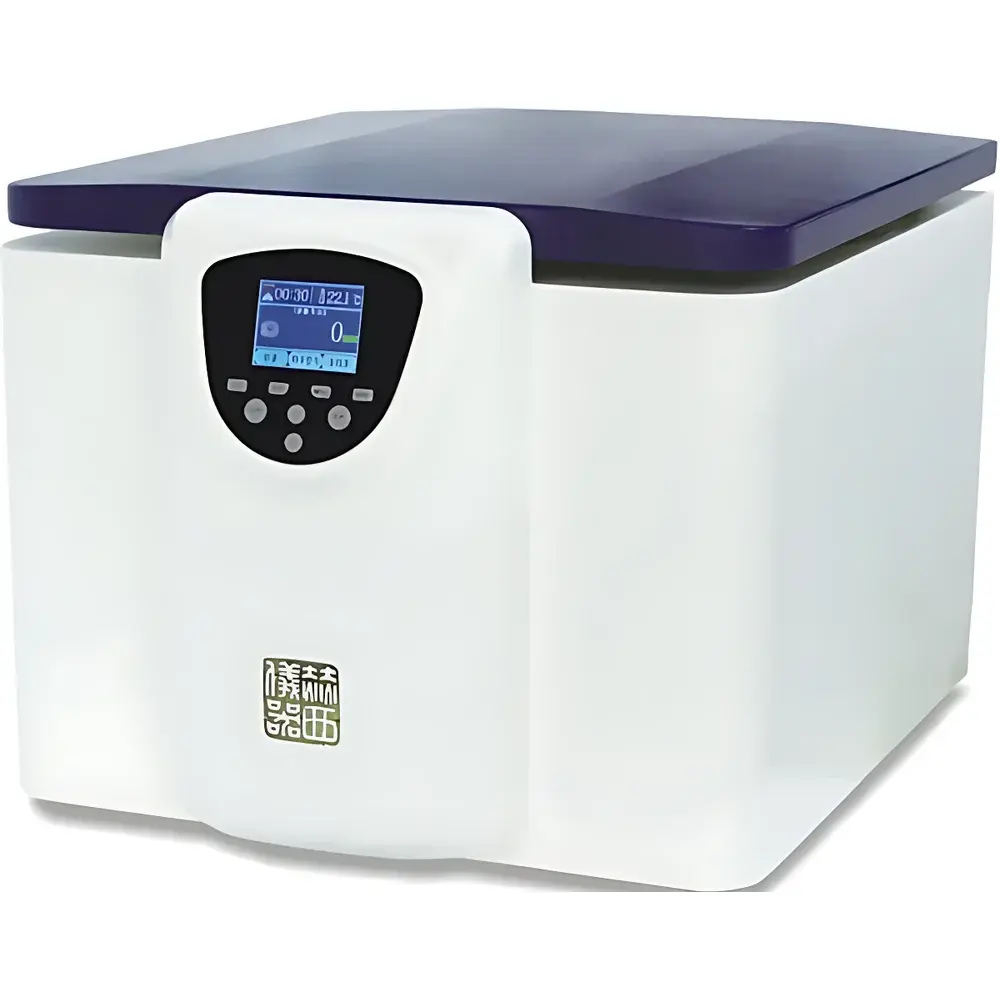
Hesley DD5 Portable Vehicle-Mounted Benchtop Centrifuge for Field-Based Total Phosphorus and Total Nitrogen Sample Preparation
| Brand | Hesley |
|---|---|
| Model | DD5 |
| Type | Low-Speed Benchtop Centrifuge |
| Max Speed | 4000 rpm |
| Max RCF | 2780 ×g |
| Max Capacity | 4 × 250 mL (conical-bottom tubes) |
| Timer Range | 1 min – 99 h 59 min, continuous & short-spin modes |
| Power Supply | 220 V AC or 12/24 V DC (vehicle-compatible) |
| Noise Level | ≤60 dB(A) |
| Dimensions (W×D×H) | 630 × 500 × 420 mm |
| Weight | 65 kg |
| Compliance | ISO 9001:2015, ISO 13485:2016, CFDA registered |
| Safety | RoHS-compliant silicone gasket, 304 stainless steel rotor chamber, triple-damping suspension, electronic lid lock, multi-parameter real-time monitoring (overspeed, overtemperature, imbalance, under/over-voltage) |
Overview
The Hesley DD5 is an engineered field-deployable benchtop centrifuge designed specifically for on-site pretreatment of surface water samples in compliance with China’s Ministry of Ecology and Environment (MEE) Technical Specification for On-Site Pretreatment of Total Phosphorus in Surface Water (HJ 91.2–2022). It operates on the principle of sedimentation-based separation under controlled centrifugal force, enabling rapid phase separation of suspended particulates, precipitated phosphomolybdate complexes, and nitrogen-bound particulate matter from large-volume aqueous matrices (≥1 L per run). Its vehicle-mountable architecture, dual-power capability (AC mains or DC vehicle battery), and ruggedized mechanical design meet stringent requirements for mobile environmental monitoring laboratories—particularly those deployed in riverine, lacustrine, and reservoir sampling campaigns where immediate sample stabilization is critical to prevent analyte degradation or re-suspension.
Key Features
- High-capacity low-speed separation: Supports four 250 mL conical-bottom centrifuge tubes (ISO 10715 compliant), optimized for settling of coarse and fine particulates in turbid surface waters.
- Intelligent motor control: Equipped with a high-torque brushless DC motor driven by Infineon power modules and EnMicro single-chip microcontroller, ensuring stable rotational performance across variable voltage inputs (100–230 V AC or 12/24 V DC).
- Real-time operational transparency: 5.7-inch TFT-LCD touchscreen with bilingual interface (English/Chinese preloaded; optional Russian/Portuguese firmware), displaying simultaneous setpoints and actual values—including RCF, speed, time remaining, and temperature (if equipped with optional cooling module).
- Multi-layer safety architecture: Integrated electronic lid interlock with silent electromechanical actuation; triple-stage damping system (rubber mounts + spring isolation + dynamic counterbalance); RoHS 2015/863-certified silicone gasket for aerosol containment in biosafety-critical applications.
- Regulatory-ready operation: Preconfigured protocols aligned with MEE HJ 91.2–2022 minimum specifications—2000 rpm for ≥2 minutes, ≥1000 mL batch volume—and compatible with GLP-aligned data integrity workflows.
- Configurable deceleration: 10-step programmable braking profiles to minimize resuspension of dense sediments, especially critical for total phosphorus analysis where orthophosphate recovery depends on intact pellet integrity.
Sample Compatibility & Compliance
The DD5 accommodates standard polypropylene or polycarbonate conical-bottom centrifuge tubes (15–250 mL), with validated performance for surface water samples containing suspended solids up to 500 mg/L. It complies with national technical guidelines for field-based total phosphorus analysis (HJ 91.2–2022), as well as broader quality system standards including ISO 9001:2015 (quality management) and ISO 13485:2016 (medical device–grade manufacturing controls). While not refrigerated, its thermally insulated 304 stainless steel chamber maintains ambient-temperature stability during extended field use. All rotor assemblies are CE-marked and certified for Class II biosafety containment when used with sealed tube carriers.
Software & Data Management
The DD5 supports audit-trail-capable operation through its embedded firmware, logging timestamped records of all parameter changes, run completions, and alarm events (e.g., imbalance detection, power fluctuation). Though it does not feature network connectivity or cloud integration, its 20-user-program memory enables reproducible method recall without external software—critical for field technicians operating under limited IT infrastructure. Exportable runtime logs (via USB flash drive) facilitate traceability in regulatory submissions and internal QA/QC reviews. Optional firmware upgrades maintain alignment with evolving MEE and CNAS documentation requirements.
Applications
- On-site pretreatment of surface water for EPA Method 365.4 / HJ 670–2013 total phosphorus determination via ascorbic acid–molybdate blue spectrophotometry.
- Field stabilization of nitrogen-rich samples prior to TN analysis (e.g., alkaline persulfate digestion per HJ 636–2012).
- Mobile laboratory deployment in emergency response scenarios involving agricultural runoff or wastewater discharge incidents.
- Quality assurance for automated water quality monitoring stations requiring periodic manual verification of sensor drift using reference centrifugation protocols.
- Academic and municipal environmental labs conducting spatially distributed watershed assessments requiring consistent sample conditioning across multiple field sites.
FAQ
Does the DD5 meet MEE HJ 91.2–2022 requirements for total phosphorus field processing?
Yes—it exceeds the minimum 2000 rpm and 2-minute runtime threshold, supports ≥1 L sample batches, and delivers validated pellet integrity under field-vibration conditions.
Can the DD5 operate directly from a vehicle’s 12 V or 24 V DC system?
Yes—its wide-input power module accepts both AC mains and DC vehicle sources without external inverters.
Is rotor balancing required before each run?
No—automatic imbalance detection and real-time compensation eliminate manual balancing; however, symmetrical tube loading remains essential for optimal RCF delivery.
What safety certifications apply to the DD5’s aerosol containment system?
The rotor lid seal uses EU RoHS 2015/863-compliant silicone elastomer, tested per EN 61010-2-020 for aerosol retention during high-speed operation.
How is method reproducibility ensured across multiple operators and field sites?
Via stored user programs with locked parameter sets, tactile feedback on lid engagement, and on-screen RCF confirmation—reducing operator-dependent variability in centrifugation outcomes.



