
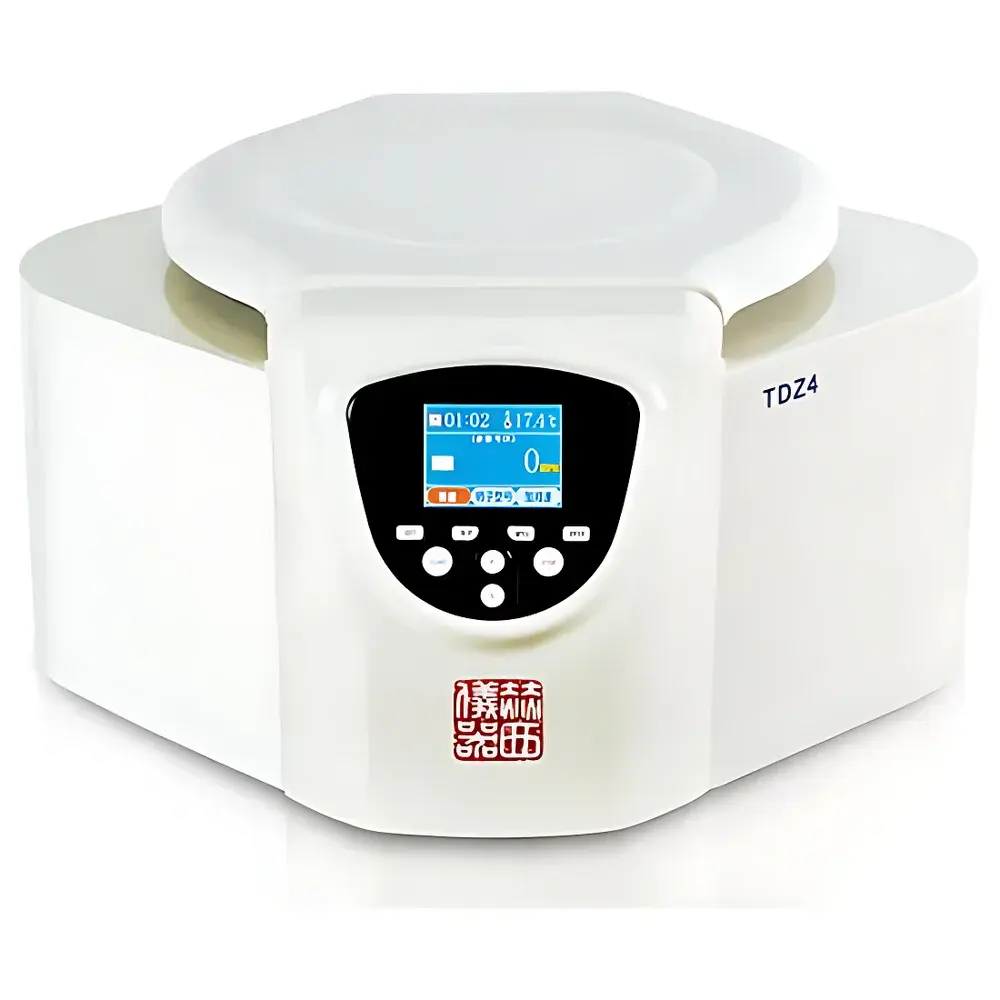
Herx TDZ4 Liquid-Based Cytology Centrifuge
| Brand | Herx |
|---|---|
| Origin | Hunan, China |
| Manufacturer Type | General Distributor |
| Product Category | Domestic |
| Model | TDZ4 |
| Instrument Type | Benchtop Centrifuge |
| Speed Class | Low-Speed Centrifuge (≤4000 rpm) |
| Function | Standard Centrifuge |
| Configuration | Fixed-Angle Rotor |
| Application Grade | Cell/Bacterial Separation |
| Maximum Capacity | 12 Slides |
| Max. Speed | 4000 rpm |
| Max. RCF | 2600 × g |
| Dimensions | 500 × 450 × 280 mm |
| Weight | 20 kg |
| Power Supply | AC 220 V, 50 Hz |
| Power Consumption | 120 W |
| Noise Level | ≤60 dB(A) |
| Timer Range | 0–99 h 59 min |
| Speed Accuracy | ±50 rpm |
| Rotor Type | 12-Position Slide Carrier Rotor |
| Display | 4.3″ TFT True-Color Touchscreen |
| Control System | Microprocessor-Based Dual-Mode (Touch + Keypad) |
| Motor | Brushless Frequency-Controlled DC Motor |
| Chamber Material | AISI 304 Stainless Steel |
| Safety Features | Electronic Lid Lock, Imbalance Detection, Overspeed Protection, Automatic Rotor Recognition, Real-Time Fault Alert |
| Language Support | English, Chinese, Russian, Portuguese |
| Program Storage | 20 User-Defined Protocols |
Overview
The Herx TDZ4 Liquid-Based Cytology Centrifuge is a purpose-engineered benchtop centrifuge designed specifically for standardized preparation of monolayer cytological specimens in clinical and research laboratories. It operates on the principle of controlled low-speed sedimentation and centrifugal deposition—enabling uniform, ultra-thin, non-overlapping cell monolayers on glass slides from diverse biological fluids including pleural effusions, ascites, cerebrospinal fluid (CSF), bronchial lavage, urine, synovial fluid, and fine-needle aspiration (FNA) samples. Unlike general-purpose centrifuges, the TDZ4 integrates a dedicated 12-position slide carrier rotor and optimized acceleration/deceleration profiles to minimize shear-induced cell distortion while maximizing recovery of diagnostically relevant epithelial and inflammatory cells. Its brushless frequency-controlled motor eliminates carbon dust contamination—a critical requirement for cleanroom-compliant cytology workflows—and ensures long-term operational stability under repeated daily use in high-throughput diagnostic settings.
Key Features
- Brushless DC motor with variable-frequency drive: Ensures silent operation (<60 dB[A]), zero particulate emission, and extended service life without commutator wear.
- 4.3-inch TFT true-color touchscreen with dual-control interface (touch + physical keypad): Displays real-time setpoints and actual values (speed, time, RCF); allows parameter modification during active runs without stopping the rotor.
- AISI 304 stainless steel centrifuge chamber and reinforced triple-layer steel housing: Provides corrosion resistance, structural integrity, and compliance with IEC 61010-1 safety standards for laboratory equipment.
- Intelligent imbalance compensation system: Automatically detects and compensates for minor load asymmetries; prevents vibration amplification and extends bearing lifetime.
- 20 programmable protocols with auto-recall: Stores user-defined speed/time/acceleration/deceleration profiles; resumes last-used program at power-on.
- Comprehensive safety architecture: Includes electronic lid interlock, overspeed cutoff, real-time rotor identification, automatic fault diagnostics, and audible/visual alarm signaling.
- Ergonomic front-loading design with integrated slide tray alignment guides: Reduces operator fatigue and minimizes handling errors during batch processing of 8–12 specimens per run.
Sample Compatibility & Compliance
The TDZ4 accommodates standard 75 × 25 mm glass slides mounted in reusable polypropylene or aluminum slide carriers (12-position fixed-angle rotor). It supports all common liquid-based cytology (LBC) specimen types—cervical, urinary, respiratory, and serous fluids—without requiring reagent-specific adapters. The device meets essential regulatory prerequisites for in vitro diagnostic (IVD) support equipment: its construction adheres to ISO 13485-aligned manufacturing controls, electrical safety conforms to IEC 61010-1:2010, and mechanical design satisfies EN 61000-6-2/6-3 for electromagnetic compatibility. While not an IVD device itself, the TDZ4 is routinely validated as part of LBC workflows compliant with CAP (College of American Pathologists) checklist requirements and aligned with CLSI EP17-A2 guidelines for analytical sensitivity in cytological specimen preparation.
Software & Data Management
The embedded microcontroller firmware supports full audit-trail functionality for GLP/GMP environments: each run logs timestamp, rotor ID, user-selected protocol, actual RCF, duration, and any triggered safety events. Data export is available via USB 2.0 port in CSV format for integration into LIS (Laboratory Information Systems) or digital pathology platforms. The multilingual UI—including English, Chinese, Russian, and Portuguese—facilitates deployment across multinational clinical networks and training environments. No external software installation is required; all configuration and diagnostics are performed locally through the onboard interface, minimizing cybersecurity exposure and IT infrastructure dependencies.
Applications
- Cervical cytology: ThinPrep®- and SurePath®-compatible monolayer preparation from cervical swabs and brushes.
- Body fluid analysis: Standardized CSF, pleural, peritoneal, and synovial fluid cytology for malignancy screening and inflammatory profiling.
- Respiratory diagnostics: Uniform deposition of bronchoalveolar lavage (BAL) and sputum-derived cells for Papanicolaou staining and immunocytochemistry.
- Fine-needle aspiration (FNA) processing: High-yield recovery of intact clusters and single cells from thyroid, lymph node, and breast aspirates.
- Urinary cytology: Enhanced detection of urothelial carcinoma cells in voided or catheterized urine specimens.
- Research cytology: Reproducible cell monolayer generation for downstream molecular assays (e.g., FISH, RNA-seq library prep) where morphological integrity and low background debris are critical.
FAQ
What types of biological fluids are compatible with the TDZ4?
The TDZ4 is validated for ascites, pleural effusion, cerebrospinal fluid, bronchial lavage, urine, synovial fluid, and fine-needle aspiration samples.
Does the TDZ4 require special reagents or consumables?
No—only standard glass slides and manufacturer-recommended slide carriers are needed; no proprietary chemistry or disposable rotors are required.
Can the TDZ4 be integrated into a LIS or hospital network?
Yes—run data can be exported via USB in CSV format for manual import; optional RS-232 or Ethernet modules may be added for automated LIS interfacing.
Is rotor balancing necessary before each run?
No—the built-in dynamic imbalance detection and compensation system eliminates the need for manual balancing when using the 12-position slide carrier rotor.
What safety certifications does the TDZ4 hold?
It complies with IEC 61010-1:2010 (Safety Requirements for Electrical Equipment for Measurement, Control, and Laboratory Use) and meets CE marking requirements for the European Economic Area.



