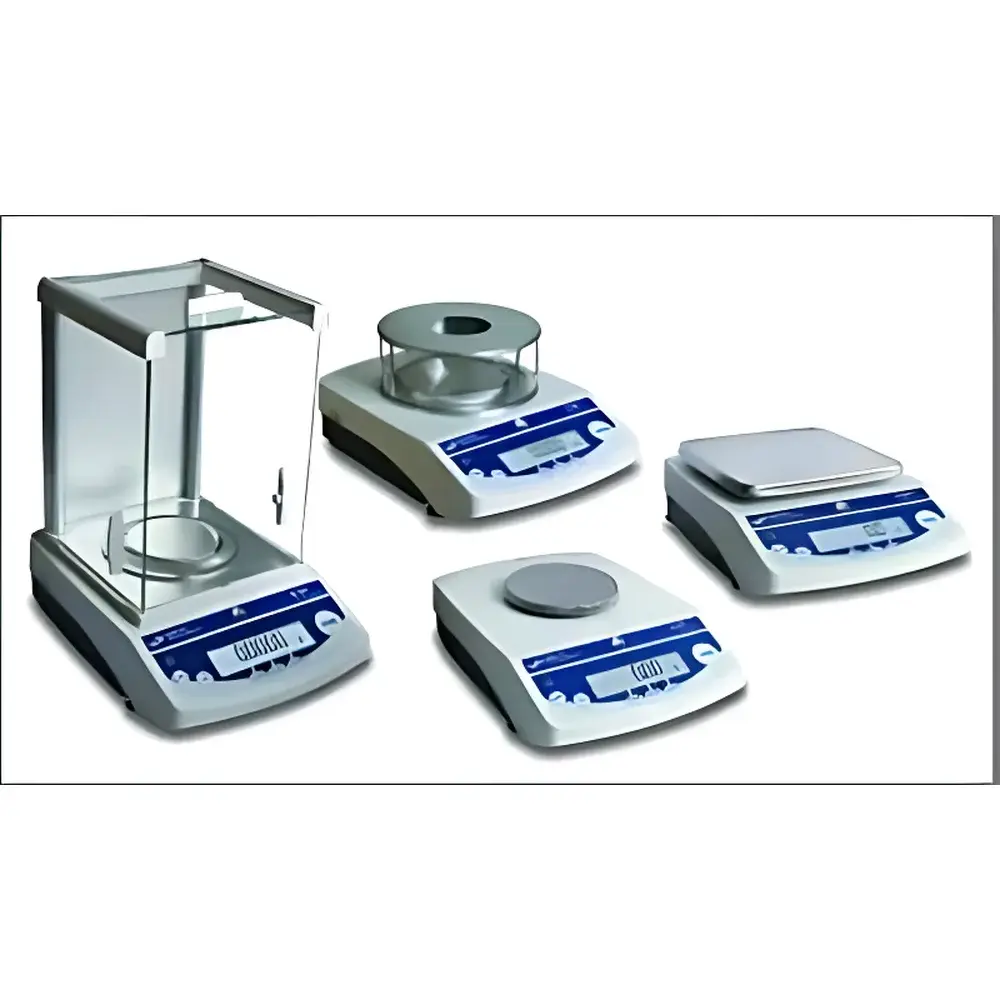
Denver SUMMIT S-Series Precision and Analytical Balances
| Brand | Denver |
|---|---|
| Origin | USA |
| Model | SUMMIT S-Series Electronic Balances |
| Capacity Range | 110–8000 g |
| Readability | 0.1 mg to 100 mg |
| Pan Size | Ø90 mm to 178×178 mm |
| Repeatability | ±0.1 mg to ±100 mg |
| Linearity | ±0.2 mg to ±200 mg |
| Stabilization Time | 1–2 s (analytical) / 1 s (precision) |
| Calibration | Fully Automatic External Calibration |
| Temperature Compensation | Full-Range Intelligent Compensation |
| Processor | Renesas H8S 80 MHz Microcontroller |
| Display | Backlit LCD with Adjustable Contrast |
| Interface | RS-232 Serial Port |
| Operating Modes | Density, Counting, Animal Weighing, Percentage, Formulation, Unit Conversion |
| Leveling | Front-Mounted Bubble Level |
| Clock | Built-in Real-Time Clock (RTC) with Operator ID & Date/Time Logging |
| Construction | Anodized Aluminum Draft Shield Backplate for Enhanced Electrostatic Shielding |
| Underhook | Yes |
| Compliance | ISO/IEC 17025-compatible operation, GLP/GMP-ready audit trail support via optional software |
Overview
The Denver SUMMIT S-Series Precision and Analytical Balances represent a rigorously engineered class of laboratory weighing instruments designed for high-throughput environments requiring both speed and metrological integrity. Built upon a dual-stage integrated transducer architecture and four-stage adaptive digital filtering, the S-Series delivers exceptional stability in dynamic lab conditions—minimizing drift from air currents, vibration, or thermal fluctuation. Each model operates on the fundamental principle of electromagnetic force restoration (EMFR), where load-induced displacement of the weighing pan is counteracted by a precisely regulated current through a coil within a permanent magnetic field; the resulting current is linearly proportional to mass and digitally resolved at up to 100,000 internal counts per measurement cycle. The inclusion of full-range intelligent temperature compensation ensures consistent accuracy across ambient shifts from 10 °C to 40 °C without manual recalibration. With stabilization times as low as 1.0 second for precision models and 2.0 seconds for analytical variants—and repeatability down to ±0.1 mg—the S-Series meets stringent performance criteria defined in ASTM E898, USP , and ISO 17025 Annex A.3 for balance verification and routine testing.
Key Features
- Dual-stage integrated sensor system with active mechanical damping for rapid settling and high resistance to transient disturbances
- Four-stage adaptive digital filtering algorithm dynamically adjusts response profile based on sample volatility and environmental noise
- Full-range intelligent temperature compensation (ITC) with real-time thermal mapping across critical transducer zones
- Automated external calibration routine triggered manually or scheduled via built-in RTC; supports multi-point linearity verification (up to 5 points)
- Renesas H8S 80 MHz microcontroller enabling concurrent execution of weighing, diagnostics, and communication protocols with zero task contention
- Backlit monochrome LCD with user-selectable interface language (English menu or numeric code navigation) and adjustable contrast for optimal readability under varied lighting
- Anodized aluminum draft shield backplate engineered to dissipate static charge—critical for low-mass powders, polymers, and hygroscopic materials
- Front-mounted bubble level with precision vial geometry for rapid, unambiguous leveling verification prior to calibration or critical measurement
- Integrated real-time clock (RTC) with non-volatile memory storing operator ID, date/time stamps, and session metadata—enabling GLP-compliant record linkage
Sample Compatibility & Compliance
The S-Series accommodates diverse sample types—from microgram pharmaceutical actives (S-114, 0.1 mg readability) to bulk industrial components (S-8001, 100 mg readability). Its underhook capability enables below-balance density determination of solids and liquids per ISO 1183-1 and ASTM D792. All models feature IP42-rated enclosure protection against dust ingress and incidental splashes. While not intrinsically certified for hazardous locations, the design conforms to IEC 61010-1 safety requirements for laboratory electrical equipment. Data integrity functions—including timestamped weight logs, operator authentication fields, and RS-232 output with configurable delimiter formats—support alignment with FDA 21 CFR Part 11 when paired with validated third-party data acquisition software. Routine verification protocols follow OIML R 76-1 and EURAMET cg-18 guidelines.
Software & Data Management
RS-232 serial interface provides deterministic, low-latency data streaming to LIMS, ELN, or custom SCADA systems. ASCII-based output format includes configurable prefixes (e.g., “WGT:”), units, timestamps, and checksums. Optional Denver BalanceLink™ software (v3.2+) enables automated calibration logging, trend analysis of repeatability over time, and generation of IQ/OQ documentation packages compliant with ISO/IEC 17025 clause 6.5. Audit trails retain immutable records of all configuration changes, calibration events, and error codes—including overload detection, instability alerts, and temperature deviation flags—with retention configurable up to 12 months.
Applications
- Pharmaceutical QC: Active ingredient dispensing (USP ), tablet weight variation testing, and excipient blending verification
- Materials Science: Density profiling of composites, metal alloys, and ceramics using sink-float and hydrostatic methods
- Academic Research: Gravimetric preparation of standard solutions, stoichiometric reaction monitoring, and nanoparticle yield quantification
- Food & Beverage: Batch formulation consistency checks, moisture loss tracking during drying cycles, and portion control validation
- Chemical Manufacturing: Catalyst dosing, reagent inventory reconciliation, and drum-filling verification with tare memory
FAQ
Does the S-Series support internal calibration?
No—calibration is fully external and automated using certified weights traceable to NIST or equivalent national metrology institutes.
Can the balance store multiple user profiles with individual permissions?
Operator ID is stored per weighing event but role-based access control requires integration with external LIMS or ELN platforms.
Is the RS-232 interface compatible with modern USB-to-serial adapters?
Yes—standard TTL-level RS-232 output is interoperable with FTDI- or CP210x-based adapters; baud rate configurable from 300 to 115200 bps.
What is the recommended verification frequency for ISO/IEC 17025 compliance?
Initial verification before first use, daily checks with calibrated check weights, and full recalibration every 3–6 months—or after relocation, impact, or environmental shift exceeding ±5 °C.
How does the four-stage digital filter differ from conventional moving-average filters?
It applies cascaded IIR and FIR stages optimized for step-response overshoot suppression, noise floor reduction below 0.5 µg RMS, and phase-linear signal reconstruction—preserving true mass dynamics during fast-loading scenarios.