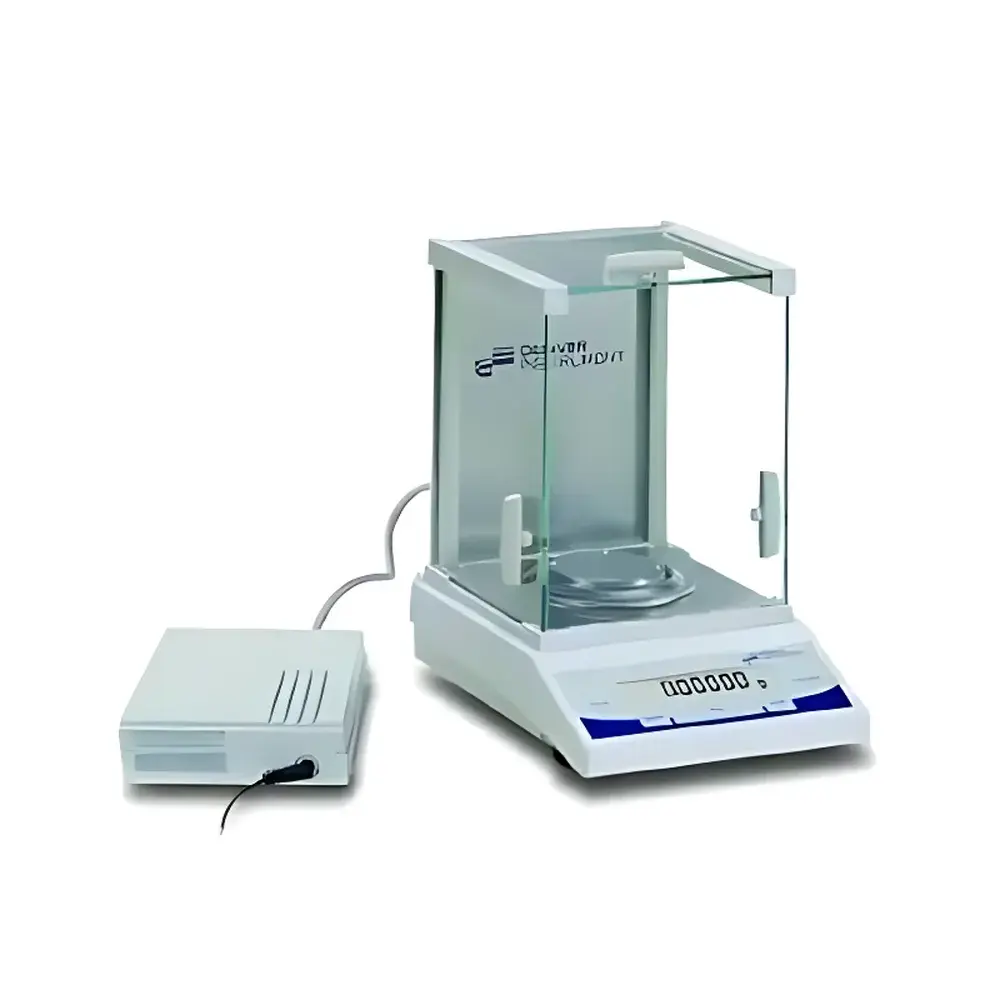
Denver TB-215D & TB-25 Ultra-Micro Analytical Balances
| Brand | Denver |
|---|---|
| Origin | USA |
| Distributor Type | Authorized General Distributor |
| Origin Category | Imported |
| Model | TB-215D / TB-25 Ultra-Micro Analytical Balances |
| Capacity (g) | TB-215D — 40 / 60 / 210 g (triple-range) |
| Readability | TB-215D — 0.01 / 0.01 / 0.1 mg |
| Pan Size | φ80 mm |
| Repeatability (≤ ±mg) | TB-215D — 0.02 / 0.05 / 0.1 mg |
| Linearity (≤ ±mg) | TB-215D — 0.03 / 0.1 / 0.2 mg |
| Temperature Compensation | Full-range automatic |
| Calibration | Internal motor-driven auto-calibration |
| Connectivity | RS232 interface (GLP-compliant) |
| Draft Shield | Aluminum rear panel with enhanced electrostatic dissipation |
| Power Options | AC adapter, DC input, or rechargeable battery |
| Built-in Applications | Counting, animal weighing, percentage weighing, net weight summation, unit conversion |
Overview
The Denver TB-215D and TB-25 Ultra-Micro Analytical Balances are precision mass measurement instruments engineered for laboratories requiring sub-milligram resolution, high repeatability, and metrological traceability. Based on electromagnetic force restoration (EMFR) transduction, these balances deliver stable, drift-compensated readings across variable ambient conditions. The TB-215D features a unique triple-range capacity architecture—40 g / 60 g / 210 g—with corresponding readability modes (0.01 mg / 0.01 mg / 0.1 mg), enabling flexible method adaptation without hardware change. The TB-25 provides fixed 21 g capacity at consistent 0.01 mg resolution, optimized for routine ultra-micro applications where range stability and speed are prioritized over multi-range versatility. Both models integrate full-range temperature compensation via embedded thermal sensors and proprietary algorithmic correction, minimizing thermal drift effects typical in high-sensitivity weighing environments.
Key Features
- Super-integrated EMFR sensor architecture with patented monolithic load cell design, delivering long-term stability and reduced mechanical hysteresis
- Quadruple-stage digital filtering—adaptive, real-time noise suppression across low-frequency vibrations, air currents, and electrical interference
- Touch-responsive keypad with tri-point tare activation (left/middle/right) for ergonomic operation under gloves or static-sensitive conditions
- Electrostatic-dissipative aluminum draft shield backplate—certified surface resistivity <10⁹ Ω/sq—reducing charge accumulation during powder or polymer handling
- Automatic internal calibration driven by motorized mass actuation; fully traceable to NIST-traceable standards and compliant with ISO/IEC 17025 calibration interval recommendations
- Self-diagnostic firmware performing continuous integrity checks of sensor output, amplifier gain, zero tracking, and environmental parameter thresholds
- Overload protection up to 500% of maximum capacity, safeguarding the transducer against accidental mechanical shock or misloading
Sample Compatibility & Compliance
Designed for use with standard analytical crucibles, vials, filter papers, and microcentrifuge tubes, the φ80 mm stainless-steel weighing pan accommodates both small-volume samples and extended geometry containers. The integrated lower hook enables below-pan suspension weighing for density determination (via Archimedes’ principle) or magnetic susceptibility measurements. All models comply with GLP requirements per FDA 21 CFR Part 11 when connected to validated data acquisition systems; audit trail generation, user authentication, and electronic signature support are enabled via optional software integration. Mechanical design conforms to ISO 9001 manufacturing controls and meets EN 45501 accuracy class I specifications for analytical balances. Electromagnetic compatibility (EMC) is certified to IEC 61326-1:2013, ensuring reliable operation in shared laboratory instrument racks.
Software & Data Management
The built-in RS232 serial interface supports ASCII-based bidirectional communication with LIMS, ELN, or custom lab automation platforms. Data export includes timestamp, operator ID (when paired with external RFID reader), balance status flags (e.g., draft shield open, calibration due), and raw measurement values with uncertainty metadata. Firmware supports GLP-compliant data formatting: each record contains sequence number, date/time (ISO 8601), gross/net/tare weights, application mode identifier, and checksum validation. Optional Denver BalanceLink™ software provides automated report generation aligned with ISO/IEC 17025 documentation templates, including calibration history logs, daily verification records, and uncertainty budget worksheets per GUM (JCGM 100:2008).
Applications
- Pharmaceutical R&D: Active pharmaceutical ingredient (API) formulation, reference standard preparation, and dissolution testing sample dosing
- Materials science: Catalyst loading quantification, nanomaterial dispersion mass verification, and thin-film deposition yield analysis
- Environmental testing: Trace contaminant extraction recovery studies, filter mass differential before/after particulate collection (PM₂.₅/PM₁₀)
- Academic research: Isotope ratio sample preparation, single-crystal growth stoichiometry validation, and enzymatic reaction substrate mass normalization
- Quality control labs: Certificate of Analysis (CoA) weight verification for certified reference materials (CRMs) and inter-laboratory comparison exercises
FAQ
What calibration standards are required for internal calibration?
Internal calibration uses factory-installed, NIST-traceable reference masses; no external weights are needed. Annual verification with Class E2 or better weights is recommended per ISO/IEC 17025.
Can the TB-215D switch between ranges during active weighing?
Yes—the range changes dynamically based on load detection and user-selected mode; no manual reset or stabilization delay is required between ranges.
Is the RS232 interface compatible with modern Windows/macOS systems?
Yes—via USB-to-RS232 adapters compliant with FTDI or Silicon Labs chipsets; drivers and communication protocols are documented in the Denver Technical Interface Manual (Rev. 4.2).
How does the electrostatic-dissipative shield differ from standard acrylic enclosures?
Unlike insulative acrylic, the aluminum-reinforced backplate provides controlled surface resistivity (10⁶–10⁹ Ω/sq), preventing static charge buildup that causes drifting readings during low-mass powder weighing.
Does the balance support 21 CFR Part 11 compliance out-of-the-box?
The hardware and firmware provide foundational controls (audit trail, user roles, electronic signatures); full compliance requires configuration within a validated software environment meeting ALCOA+ principles.