
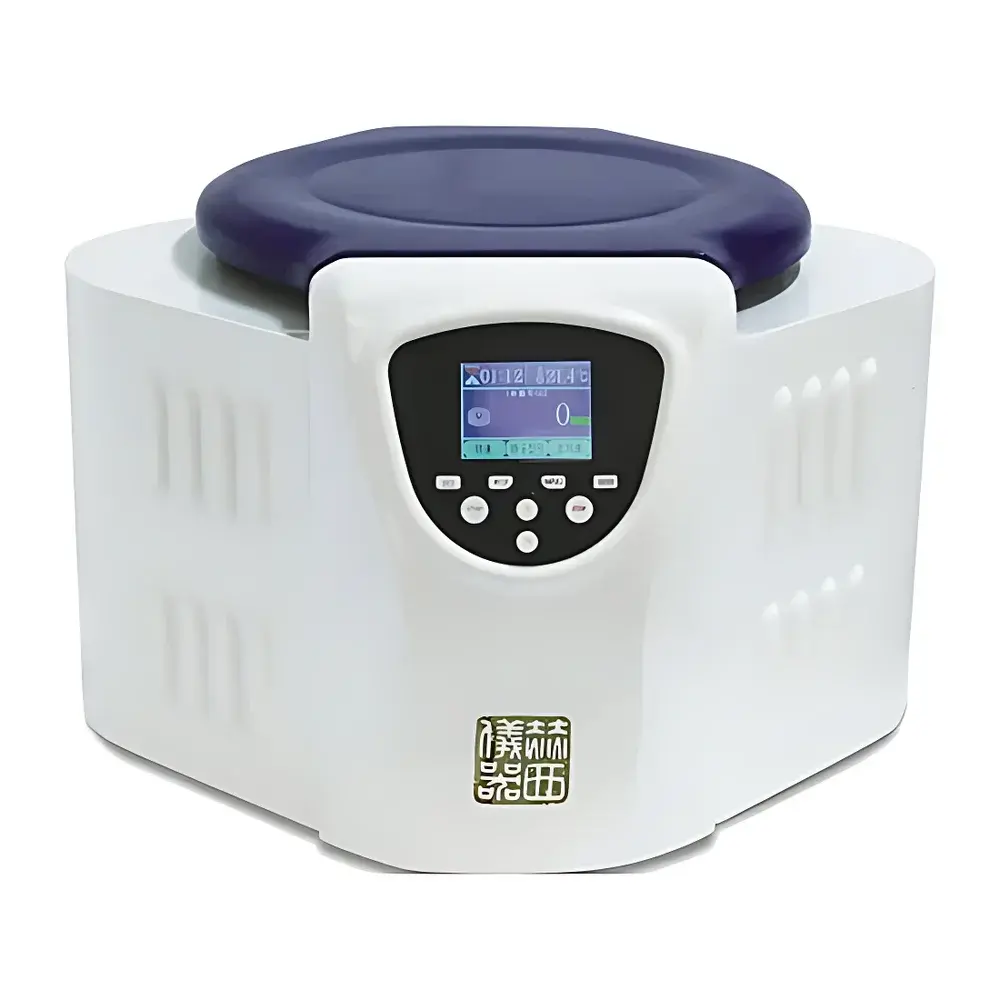
Hesi H/T12MM Microhematocrit Centrifuge
| Brand | Hesi |
|---|---|
| Origin | Hunan, China |
| Model | H/T12MM |
| Instrument Type | Benchtop Centrifuge |
| Speed Range | 0–12,000 rpm |
| Max RCF | 13,960 ×g |
| Capacity | 24 capillary tubes |
| Rotor Type | Horizontal microhematocrit rotor |
| Speed Accuracy | ±50 rpm |
| Timer Range | 1 min – 99 h 59 min (continuous & short-spin modes) |
| Noise Level | ≤60 dB(A) |
| Power Supply | AC 220 V, 50 Hz |
| Power Consumption | 400 W |
| Dimensions (W×D×H) | 550 × 440 × 330 mm |
| Weight | 35 kg |
| Display | 4.3-inch TFT color touchscreen |
| Motor | Brushless DC frequency-controlled motor |
| Safety | Electromechanical door lock, stainless steel chamber, ergonomic housing |
Overview
The Hesi H/T12MM Microhematocrit Centrifuge is a precision-engineered benchtop centrifuge specifically designed for hematocrit (HCT) determination and micro-volume sample separation in clinical diagnostics, hematology, and biomedical research laboratories. It operates on the principle of sedimentation equilibrium under controlled centrifugal force, enabling rapid and reproducible separation of anticoagulated whole blood into packed red blood cells (RBCs) and plasma within calibrated capillary tubes. This instrument complies with standard methodologies defined in CLSI H26-A3 and ISO 15189 for hematocrit measurement, supporting both manual and semi-automated workflows in accredited clinical labs. Its compact footprint, robust all-steel construction, and stainless-steel centrifuge chamber ensure long-term stability and resistance to chemical exposure during routine use.
Key Features
- High-precision brushless DC motor with frequency control delivers consistent torque and low-vibration operation, ensuring minimal sample disturbance and extended rotor life.
- 4.3-inch full-color TFT touchscreen interface with dual-control logic allows simultaneous display of set parameters (speed, time, RCF) and real-time operational status — intuitive for multi-user environments.
- Electromechanical door interlock system prevents accidental lid opening during rotation and ensures compliance with IEC 61010-2-020 safety standards for laboratory centrifuges.
- Capable of storing up to 20 user-defined protocols, including preset programs for standard hematocrit runs (e.g., 12,000 rpm × 5 min), facilitating GLP/GMP traceability when paired with lab documentation systems.
- Optimized horizontal rotor design accommodates 24 standardized 75 mm capillary tubes (e.g., Wintrobe or microhematocrit tubes), delivering uniform radial acceleration across all positions for high inter-run reproducibility (CV < 2.5% per ASTM E29-23).
- Low-noise operation (<60 dB[A]) enables deployment in shared laboratory spaces without acoustic interference to adjacent instrumentation or personnel.
Sample Compatibility & Compliance
The H/T12MM is validated for use with heparinized, EDTA- or citrate-anticoagulated whole blood samples in glass or plastic capillary tubes conforming to ISO 8573-1 and CLSI EP12-A2 specifications. It supports both manual hematocrit reading via scale-based visual estimation and integration with digital hematocrit readers (e.g., automated image-based analyzers). The centrifuge meets essential requirements of ISO/IEC 17025 for equipment qualification and supports audit-ready documentation through its programmable timer, speed logging, and RCF calculation function. While not FDA 510(k)-cleared as an IVD device, it fulfills performance criteria referenced in USP and EU Directive 98/79/EC for in vitro diagnostic support equipment.
Software & Data Management
The embedded microcontroller provides non-volatile memory for protocol storage and runtime event logging (start/stop timestamps, actual speed deviation, elapsed time). Though no external software is bundled, the centrifuge’s RS-232 port (optional configuration) enables connection to LIMS or ELN platforms for centralized parameter tracking and electronic record retention. All displayed values — including real-time RCF conversion based on rotor radius — adhere to ISO 8666:2017 definitions, eliminating manual calculation errors. Audit trail functionality aligns with FDA 21 CFR Part 11 expectations when used in conjunction with compliant data capture systems.
Applications
- Routine hematocrit (HCT) and packed cell volume (PCV) quantification in hospital core labs and point-of-care testing units.
- Micro-volume plasma isolation for coagulation assays (PT, aPTT), electrolyte profiling, and therapeutic drug monitoring.
- Preparative separation of leukocyte-depleted blood fractions in transfusion medicine quality control.
- Small-scale nucleic acid or protein pellet recovery from lysates in molecular biology workflows where low-speed, high-capacity sedimentation is required.
- Calibration verification of automated hematology analyzers using reference capillary methods per CLIA and CAP guidelines.
FAQ
What capillary tube types are compatible with the H/T12MM?
Standard 75 mm microhematocrit tubes (inner diameter 1.0–1.2 mm), including heparin-coated, EDTA-coated, and plain glass variants meeting ISO 8573-1 dimensional tolerances.
Can this centrifuge be used for non-blood applications?
Yes — it is suitable for any low-viscosity, low-density suspension requiring gentle sedimentation, such as yeast cell harvesting, latex bead concentration, or colloidal nanoparticle pelleting, provided rotational parameters remain within specified limits.
Is rotor balancing required before each run?
No — the symmetrical 24-position horizontal rotor is factory-balanced; however, users must ensure equal tube filling volumes and avoid mixing tube types or fill levels within a single run.
Does the unit support regulatory-compliant validation documentation?
It provides foundational data for IQ/OQ protocols (e.g., speed accuracy, timer linearity, temperature rise); full PQ requires third-party verification per ISO/IEC 17025 Annex A.3.
What maintenance is recommended for long-term reliability?
Monthly cleaning of the rotor chamber with 70% ethanol, annual inspection of door latch integrity, and biannual calibration of speed and timer functions using NIST-traceable tachometers.



