
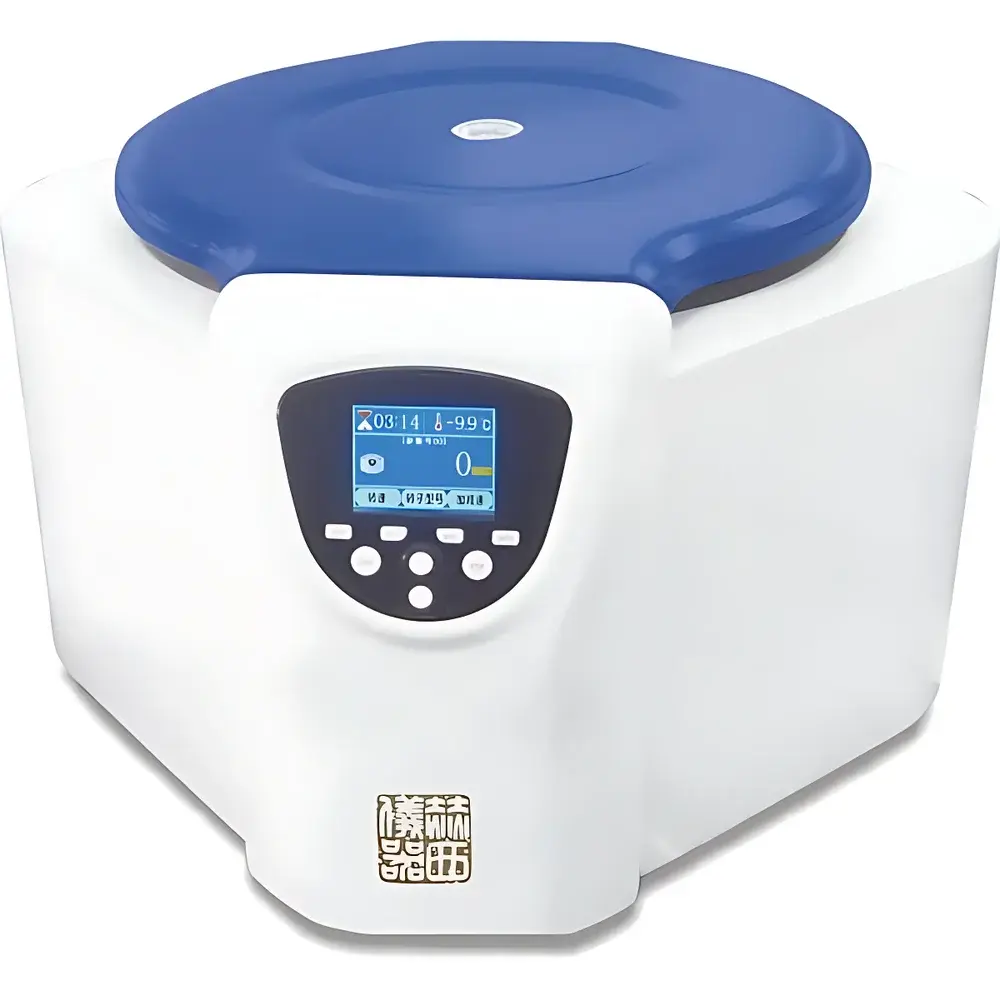
Hershey TD5A Benchtop Low-Speed Centrifuge
| Brand | Hershey |
|---|---|
| Origin | Hunan, China |
| Model | TD5A |
| Instrument Type | Benchtop Centrifuge |
| Speed Range | Up to 5500 rpm |
| Max RCF | 4800 ×g |
| Max Capacity | 4 × 250 mL |
| Dimensions (L×W×H) | 600 × 540 × 360 mm |
| Weight | 35 kg |
| Power Supply | AC 220 V, 50 Hz |
| Motor | Brushless AC Frequency-Controlled Motor |
| Control System | Microprocessor-Based with TFT Touchscreen Interface |
| Timer Range | 0–99 h 59 min / Continuous / Short-Term Mode |
| Programmable Methods | 20 User-Defined Protocols |
| Acceleration/Deceleration Profiles | 10 Adjustable Ramp Rates |
| Noise Level | ≤65 dB(A) |
| Chamber Material | Stainless Steel |
| Safety Features | Mechanical & Electronic Door Lock, Automatic Rotor Imbalance Detection, Multi-Stage Vibration Damping System |
| Compliance | Designed for GLP-compliant laboratories |
Overview
The Hershey TD5A Benchtop Low-Speed Centrifuge is an engineered solution for routine separation tasks in clinical diagnostics, life science research, and industrial quality control laboratories. It operates on the principle of sedimentation under centrifugal force—accelerating particle settling based on density, size, and shape differences in suspension media. With a maximum rotational speed of 5500 rpm and a peak relative centrifugal force (RCF) of 4800 ×g, the TD5A delivers consistent, reproducible separations across a broad range of biological and chemical samples—including whole blood, cell suspensions, precipitated proteins, and particulate-laden solutions. Its benchtop footprint (600 × 540 × 360 mm) and 35 kg mass ensure stability during operation while maintaining compatibility with standard laboratory workspaces. The device is optimized for low-speed applications where high g-force is unnecessary but precision, repeatability, and operational safety are critical.
Key Features
- Brushless AC frequency-controlled motor: Eliminates carbon brush wear, reduces electromagnetic interference, and ensures maintenance-free long-term operation with minimal thermal drift.
- TFT true-color touchscreen interface: Displays real-time setpoints and actual values (speed, RCF, time, temperature if equipped), supports multi-language UI, and enables intuitive parameter entry and protocol recall.
- Structural integrity: Fully welded steel frame with 304 stainless-steel centrifuge chamber resists corrosion from common reagents and facilitates decontamination.
- Intelligent rotor recognition: On-screen display of selected rotor geometry during setup improves method traceability and minimizes user error.
- Programmable deceleration profiles: Ten selectable acceleration/deceleration ramp rates allow optimization for shear-sensitive samples such as intact cells or fragile organelles.
- Dual-locking door mechanism: Combines electromagnetic engagement with mechanical interlock to prevent lid opening during rotation—certified to IEC 61010-2-020 safety standards.
- Vibration suppression system: Integrated passive damping mounts and dynamic balancing algorithms reduce operational noise to ≤65 dB(A) and eliminate perceptible resonance at all speeds.
Sample Compatibility & Compliance
The TD5A accommodates a wide variety of sample containers via interchangeable rotors—including conical tubes (5–250 mL), microtiter plates (96-well), vacuum blood collection tubes (2 mL and 5 mL), and custom adapters for specialized formats. Horizontal and fixed-angle rotors support both differential and rate-zonal centrifugation protocols. All rotors are balanced to ISO 1585 Class G2.5 and validated for use within specified speed and load limits. The instrument complies with essential electrical safety and electromagnetic compatibility directives (IEC 61010-1, IEC 61326-1) and is suitable for environments requiring adherence to ISO/IEC 17025 documentation practices. While not inherently 21 CFR Part 11 compliant, its programmable memory (20 stored methods), timestamped run logs, and non-volatile parameter retention support manual audit trails in regulated workflows.
Software & Data Management
The TD5A operates independently without external PC dependency. Its embedded firmware stores up to 20 user-defined centrifugation programs, each retaining speed, RCF, time, ramp profiles, and rotor ID. Upon power-up, the unit defaults to the last executed method—a feature that enhances procedural consistency in high-throughput labs. Run history includes start/stop timestamps and error codes (e.g., imbalance detection, overtemperature). Data export is not supported via USB or network interface; however, printed records can be generated using optional external thermal printers connected via RS-232. For integration into LIMS or ELN platforms, users may employ third-party serial-to-HTTP gateways to capture ASCII-formatted status updates.
Applications
- Clinical laboratories: Separation of serum/plasma from whole blood using vacuum tube rotors; preparation of PBMCs via Ficoll density gradients.
- Pharmaceutical QA/QC: Clarification of suspensions prior to HPLC analysis; recovery of microbial biomass after fermentation.
- Agricultural testing: Extraction of soil colloids or plant tissue homogenates; isolation of starch granules from tuber extracts.
- Environmental labs: Sedimentation of suspended solids in wastewater effluents; concentration of microplastics from aqueous filtrates.
- Educational institutions: Teaching core principles of sedimentation velocity, Stoke’s law, and rotor dynamics in undergraduate biophysics courses.
FAQ
What is the maximum RCF achievable with the 4 × 250 mL horizontal rotor?
The 4 × 250 mL bucket rotor achieves a maximum RCF of 3290 ×g at 4000 rpm.
Does the TD5A support refrigeration?
No—the TD5A is a non-refrigerated model. For temperature-sensitive applications, ambient lab conditioning and pre-chilled rotors are recommended.
Can rotor imbalance errors be overridden manually?
No. The system halts automatically upon detecting >0.5 mm radial displacement and requires physical re-balancing before restart.
Is rotor calibration required by the user?
Rotors are factory-calibrated and labeled with certified k-factor and Rmax values. No field recalibration is necessary unless physically damaged.
How often should the centrifuge undergo preventive maintenance?
Annual inspection of drive coupling, door latch integrity, and vibration dampers is advised per manufacturer guidelines; brushless motor eliminates scheduled commutator servicing.



