
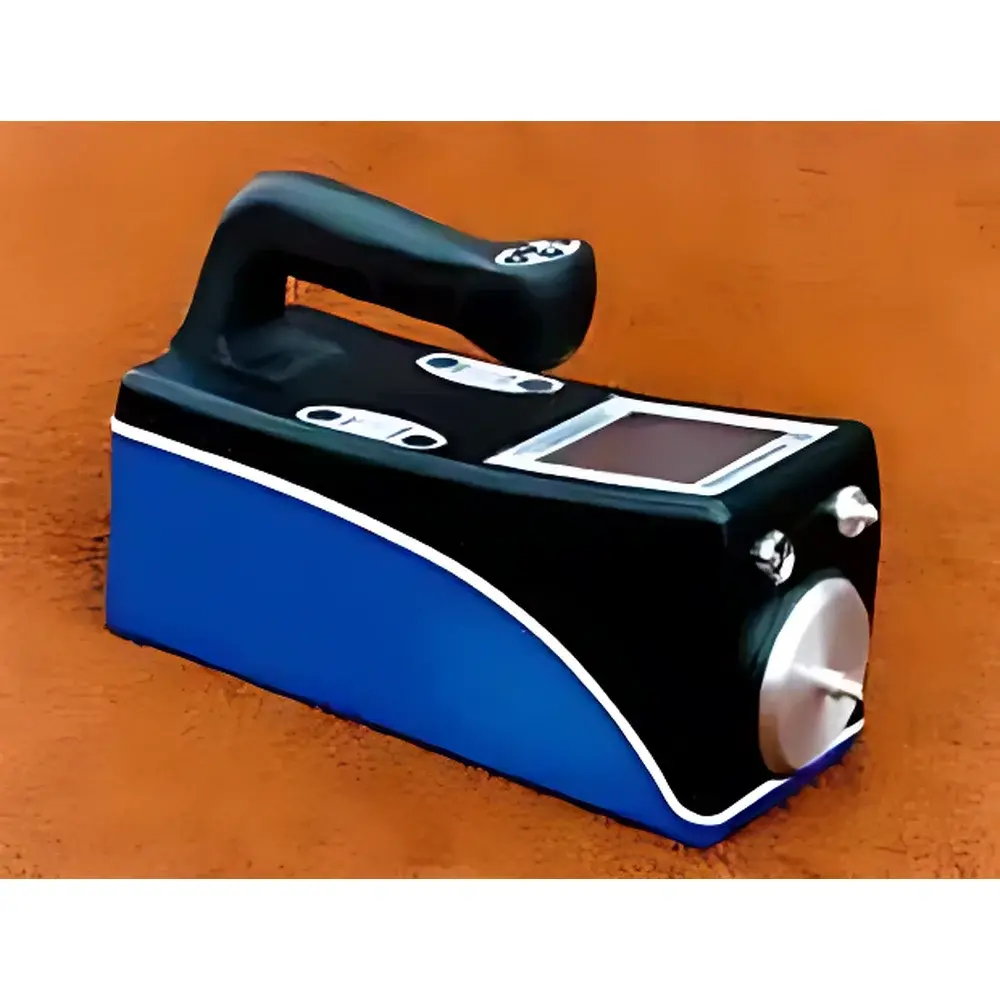
EcoProbe5 Portable Multi-Parameter Soil and Ambient Air Contamination Analyzer
| Origin | Imported |
|---|---|
| Manufacturer Type | Authorized Distributor |
| Model | EcoProbe5 |
| Pricing | Available Upon Request |
Overview
The EcoProbe5 Portable Multi-Parameter Soil and Ambient Air Contamination Analyzer is an integrated field-deployable instrument engineered for real-time, in-situ detection and quantification of hydrocarbon-based contaminants in both soil gas and ambient air matrices. It employs a dual-sensor architecture combining pulsed ultraviolet photoionization detection (PID) with multi-channel non-dispersive infrared (NDIR) spectroscopy to deliver simultaneous, high-frequency measurements of volatile organic compounds (VOCs), methane (CH₄), total petroleum hydrocarbons (TPH), carbon dioxide (CO₂), oxygen (O₂), atmospheric pressure, vacuum sampling pressure, and soil temperature. Designed for geospatial environmental assessment, the system integrates a precision GPS module (±2.5 m CEP, WAAS-enabled) to geotag each measurement, enabling robust 3D spatiotemporal mapping of contaminant plumes using industry-standard GIS software. Its compact, ruggedized chassis—engineered for field durability—houses an embedded industrial-grade computer, backlit graphical LCD, rechargeable Li-ion battery pack, and a programmable diaphragm vacuum pump (0.25–4 L/min flow control), allowing autonomous operation for up to 8 hours under typical sampling conditions.
Key Features
- Dual-technology detection platform: UV PID sensor (10.6 eV lamp) for broad-spectrum VOC and chlorinated hydrocarbon analysis, plus 4-channel NDIR optical engine (3 analytical + 1 reference channel) for selective CH₄, TPH, and CO₂ quantification
- High-speed acquisition: 10 Hz sampling frequency across all gas channels; PID response time < 80 ms; NDIR response time < 500 ms
- Wide dynamic range: PID spans 0.1 ppb to 4000 ppm (switchable ranges); NDIR channels cover 0–500,000 ppm for CH₄, TPH, and CO₂ with 20 ppm detection limits
- Onboard calibration management: Preloaded library of 200+ compound-specific response factors; automated zero/span verification routines; traceable calibration gas port
- Integrated environmental sensing: Dual-range O₂ measurement (0–100 % vol); soil temperature probe (±0.1 °C accuracy, 0.01 °C resolution); ambient and vacuum pressure transducers (0.1 % full-scale accuracy)
- Field-ready hardware: Dimensions 105 × 260 × 170 mm (including ergonomic handle); net weight 3.0 kg; transit weight 13.0 kg (with soil probe kit, calibration accessories, and carrying case)
Sample Compatibility & Compliance
The EcoProbe5 is validated for direct interface with standard soil gas probes (e.g., ASTM D5267-compliant stainless steel drive points), ambient air intakes, and passive diffusion samplers. It supports grab sampling, continuous monitoring, and timed-interval profiling protocols. Data integrity meets GLP-aligned requirements: timestamped, GPS-georeferenced records include sensor diagnostics, battery status, pump flow rate, and environmental compensation parameters. While not pre-certified for regulatory submission, its measurement traceability aligns with ISO 16000-22 (indoor air—VOCs), ASTM D6420 (PID method for VOCs), and EPA Method 21 (leak detection). Firmware supports audit trail logging compliant with 21 CFR Part 11 principles when used with validated configuration management procedures.
Software & Data Management
The embedded Windows CE-based operating system (compatible with legacy Win9x/NT4.0/2000/XP host environments) enables local data visualization, threshold alerting, and on-device report generation. Measurement logs—stored in non-volatile memory (≥100,000 records)—are exportable via RS-232 serial interface or IrDA infrared link in ASCII, CSV, Excel (.xls), Surfer (.grd), Grapher (.plt), or user-defined delimited formats. PC-side EcoView™ desktop software (included) provides spectral review, contour mapping, time-series trending, statistical outlier detection, and export to ESRI Shapefile or KML for integration into ArcGIS, QGIS, or Leapfrog Geo. All firmware updates and calibration files are digitally signed and version-controlled.
Applications
- Phase I/II Environmental Site Assessments (ESAs) per ASTM E1527 and E1903
- Real-time delineation of petroleum hydrocarbon plumes at UST sites, refineries, and pipeline corridors
- Landfill gas monitoring (CH₄/CO₂ ratio analysis per SW-846 Method 0030)
- Coal mine ventilation shaft and gob gas screening for CH₄ accumulation hazards
- Agricultural waste lagoon and biogas facility emissions characterization
- Emergency response to chemical spills or illegal dumping incidents
- Long-term remediation performance tracking (e.g., SVE, bioventing, phytoremediation)
FAQ
Does the EcoProbe5 require external power sources during field operation?
No—it operates autonomously on its internal rechargeable lithium-ion battery pack, rated for ≥8 hours of continuous sampling at 2 L/min flow and 5 Hz acquisition rate.
Can the PID sensor be recalibrated in the field without sending the unit to a service center?
Yes—using certified zero air and span gases (isobutylene or benzene), users can perform full two-point calibration via the onboard menu; all calibration events are logged with timestamps and operator ID fields.
Is GPS data embedded directly into exported datasets?
Yes—each measurement record contains WGS84 latitude, longitude, altitude, HDOP, and UTC timestamp, ensuring full spatial traceability without post-processing.
What is the recommended maintenance interval for the vacuum pump and optical cells?
The diaphragm pump requires inspection every 500 operating hours; NDIR optical paths are sealed and maintenance-free, though periodic visual inspection of inlet filters is advised per ASTM D5400 guidelines.
How does the EcoProbe5 handle cross-sensitivity between methane and other hydrocarbons in the IR channels?
The 4-channel NDIR design incorporates a dedicated reference channel and proprietary spectral deconvolution algorithms to minimize interferences; methane quantification remains unaffected by background TPH up to 100,000 ppm.







