
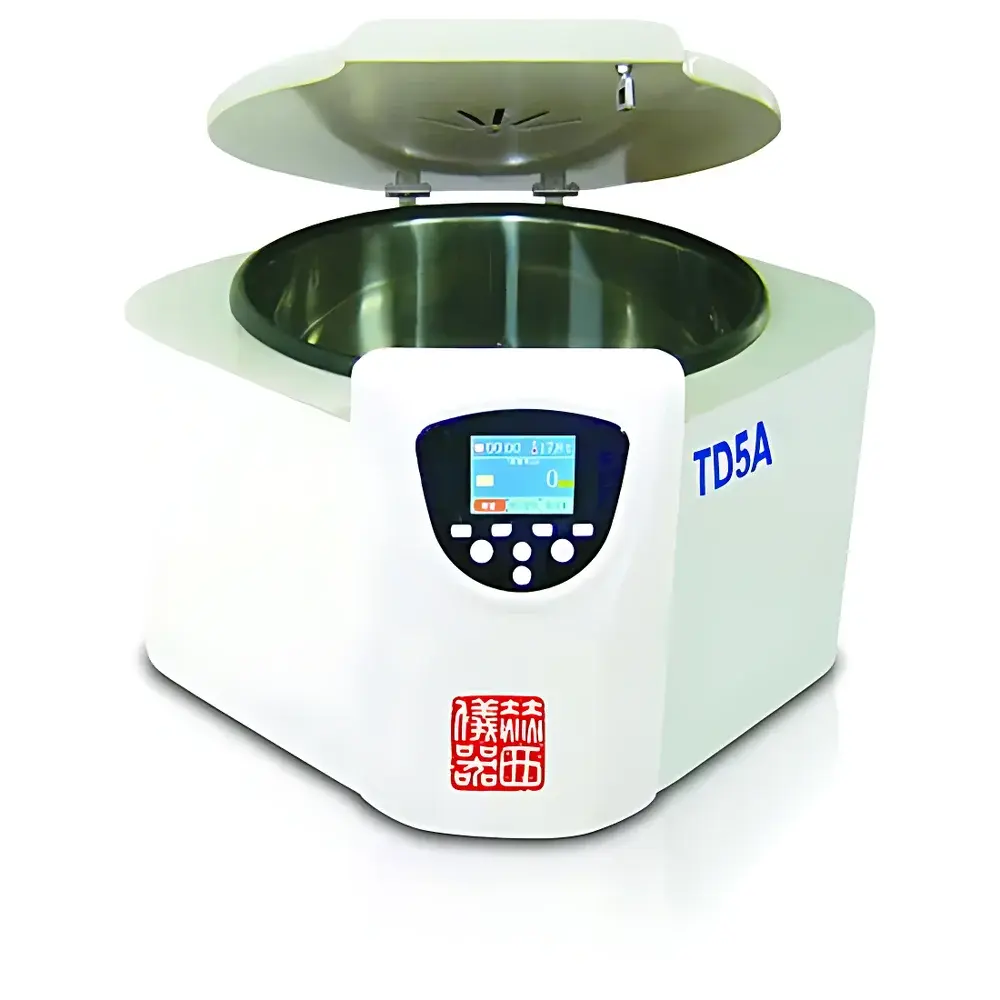
Herexi TD5A Benchtop Low-Speed Centrifuge for Clinical and Biomedical Applications
| Brand | Herexi |
|---|---|
| Model | TD5A |
| Type | Benchtop Low-Speed Centrifuge |
| Max Speed | 5500 rpm |
| Max RCF | 4800 ×g |
| Max Capacity | 4 × 250 mL |
| Dimensions (L×W×H) | 600 × 540 × 360 mm |
| Weight | 35 kg |
| Power Supply | AC 220 V, 50 Hz |
| Noise Level | ≤60 dB(A) |
| Acceleration/Deceleration | 10-step adjustable |
| Programmable Methods | 20 user-defined protocols |
| Compliance | ISO 9001:2015, ISO 13485:2016, CFDA registered |
| Rotor Types | Fixed-angle (aluminum alloy), horizontal swing-out, microplate carriers |
| Safety | Airtight biocontainment rotors (RoHS-compliant silicone gasket), triple-layer steel housing, 304 stainless-steel chamber, auto-locking lid with brushless motor actuation |
| Display | TFT-LCD touchscreen + physical keys, multilingual UI (English, Chinese, Russian, Portuguese) |
| Drive System | High-torque brushless DC motor with Infineon driver module and ELM327-based microcontroller |
Overview
The Herexi TD5A is a CE-marked, ISO 13485-certified benchtop low-speed centrifuge engineered for routine separation tasks in clinical diagnostics, blood banking, immunology, and biomedical research laboratories. Operating within the defined low-speed range (<10,000 rpm), it utilizes principles of sedimentation centrifugation—where differential particle migration under controlled gravitational force enables phase separation based on density, size, and shape. Its design prioritizes operational safety, regulatory traceability, and reproducible performance across high-volume sample workflows typical in hospital labs, public health testing centers, and contract research organizations (CROs). The instrument complies with IEC 61010-1:2010 for electrical safety and IEC 61010-2-020:2016 for centrifuge-specific mechanical hazards, supporting GLP- and GMP-aligned laboratory practices.
Key Features
- High-reliability drive architecture integrating a high-torque brushless DC motor, Infineon intelligent gate driver ICs, and an ELM327-compatible microcontroller for precise speed regulation and thermal stability.
- Triple-stage damping system combining elastomeric mounts, asymmetric mass counterbalancing, and active imbalance detection—ensuring rotor stability even at full load and preventing sample resuspension during deceleration.
- TFT-LCD color display with dual-input interface (capacitive touch + tactile keys), enabling real-time concurrent monitoring of setpoint vs. actual RCF, time remaining, rotor ID, and temperature (ambient-only operation).
- Airtight fixed-angle rotors sealed with RoHS 2015/863-compliant silicone gaskets to contain aerosols generated during biosample processing—critical for handling whole blood, serum, plasma, and PBMC isolates per CLSI H26-A3 guidelines.
- Structural integrity reinforced by a 304 austenitic stainless-steel centrifuge chamber, powder-coated steel chassis, and triple-layer front shield assembly meeting EN 61000-6-3 EMC emission standards.
- Wide-voltage compatibility (100–230 V AC, 50/60 Hz) with automatic input sensing—eliminating need for external voltage stabilizers in multi-site deployments or mobile diagnostic units.
- Brushless motor-driven lid lock mechanism engaging automatically upon closure, verified via Hall-effect sensor feedback and compliant with EN 61010-2-020 clause 7.3.3 for interlocked access control.
Sample Compatibility & Compliance
The TD5A accommodates a broad spectrum of primary and secondary containers used in clinical and life science settings: standard conical tubes (5–250 mL), vacuum blood collection tubes (K2EDTA, heparin, SST), PCR strips, 96-well microplates (flat-bottom, U/V/V-bottom), and deep-well plates. All rotors are certified for use with polypropylene, polycarbonate, and glass vessels rated for ≥4800 ×g. Regulatory documentation includes CFDA registration certificate (2022-XXXXX), ISO 13485:2016 quality management system certification, and ISO 9001:2015 audit reports. Device firmware supports audit trail generation per FDA 21 CFR Part 11 requirements when connected to validated LIMS environments via optional RS-232 output.
Software & Data Management
While the TD5A operates as a standalone instrument, its embedded controller logs all run parameters—including date/time stamp, rotor ID, speed profile, acceleration/deceleration ramps, total runtime, and fault codes—for local recall. Twenty programmable methods can be named, edited, and protected by password-level access control. Export functionality is available through optional USB-C data dump (CSV format), enabling integration with ELN platforms such as LabArchives or Benchling. Firmware updates are performed offline via FAT32-formatted USB drives, with SHA-256 checksum verification to ensure code integrity.
Applications
This centrifuge serves core workflows across multiple regulated domains: hematocrit and erythrocyte sedimentation rate (ESR) determination per CLSI EP10-A3; platelet-rich plasma (PRP) preparation for orthobiologics; viral transport media clarification prior to RT-qPCR; bacterial pellet concentration from stool or sputum samples; and cell culture supernatant harvesting in vaccine development pipelines. Its 4 × 250 mL capacity supports batch processing of donor blood units in transfusion medicine, while the 2×2×96-well enzyme plate rotor enables high-throughput serological screening under CLIA-waived conditions.
FAQ
Is the TD5A suitable for BSL-2 applications?
Yes—the airtight rotor design with integrated silicone sealing meets containment requirements for centrifuging potentially infectious clinical specimens when used with capped tubes and appropriate PPE.
Does it support rotor recognition or auto-RPM-to-RCF conversion?
Yes—each rotor carries an embedded RFID tag; the system auto-detects type and displays corresponding RCF values in real time without manual lookup.
Can it operate continuously for extended periods?
Yes—rated for continuous duty cycle at ≤4000 rpm; thermal protection circuitry interrupts operation if ambient temperature exceeds 40°C or internal motor temperature rises above 85°C.
What maintenance intervals are recommended?
Biannual inspection of rotor threads, gasket elasticity, and brake pad wear is advised; no lubrication required due to brushless motor and sealed bearing design.
Are spare rotors and adapters supplied with traceable calibration certificates?
All factory-supplied rotors include individual calibration reports conforming to ISO/IEC 17025:2017, with RCF validation performed using NIST-traceable tachometers and gravimetric reference standards.



