
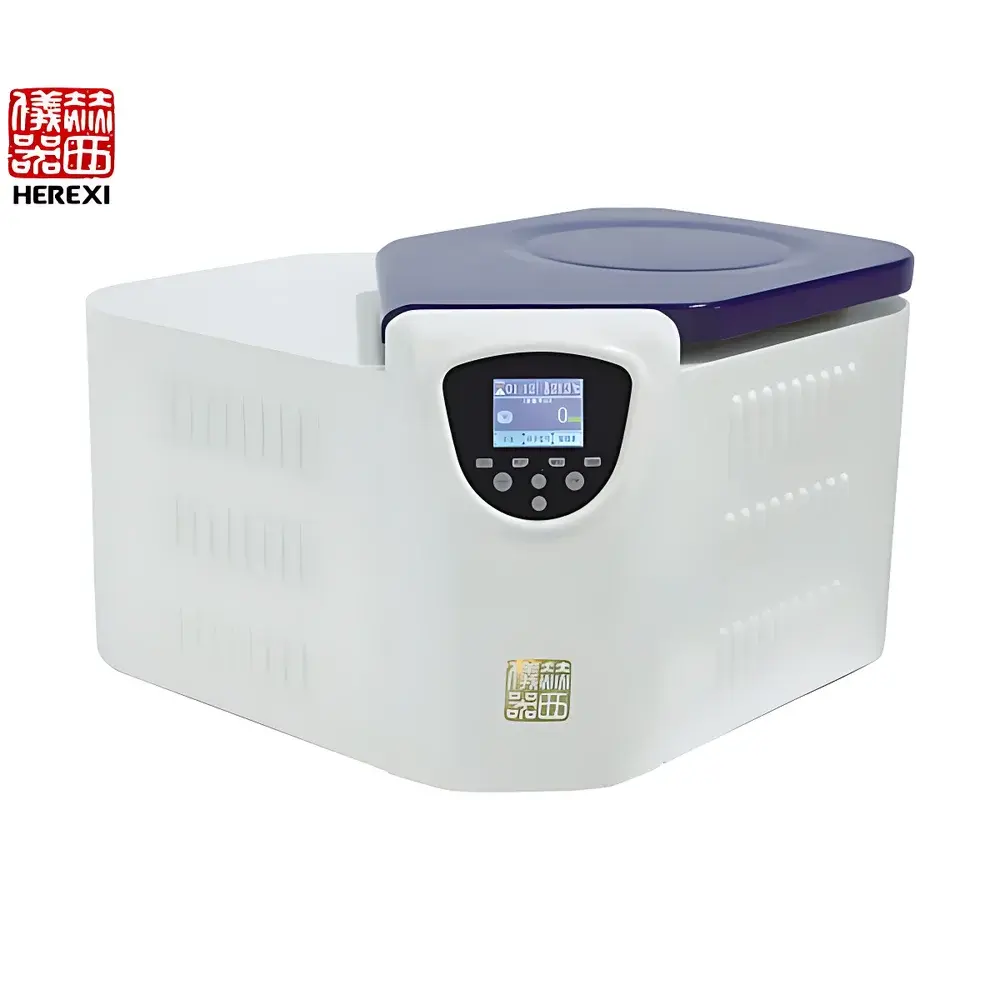
Herx 3H26RI Intelligent High-Speed Refrigerated Centrifuge
| [Brand | Herx |
|---|---|
| Origin | Hunan, China |
| Model | 3H26RI |
| Instrument Type | Benchtop Refrigerated Centrifuge |
| Speed Range | 10,000–26,000 rpm (max 26,000 rpm) |
| Max RCF | 46,900 ×g |
| Max Capacity | 4 × 100 mL (swinging bucket rotor) |
| Temperature Range | –20 °C to +40 °C |
| Temp Control Accuracy | ±1 °C |
| Refrigerant | R404a |
| Noise Level | ≤65 dB(A) |
| Power Supply | 220 V, 50 Hz |
| Dimensions (L×W×H) | 710 × 630 × 350 mm |
| Weight | 75 kg |
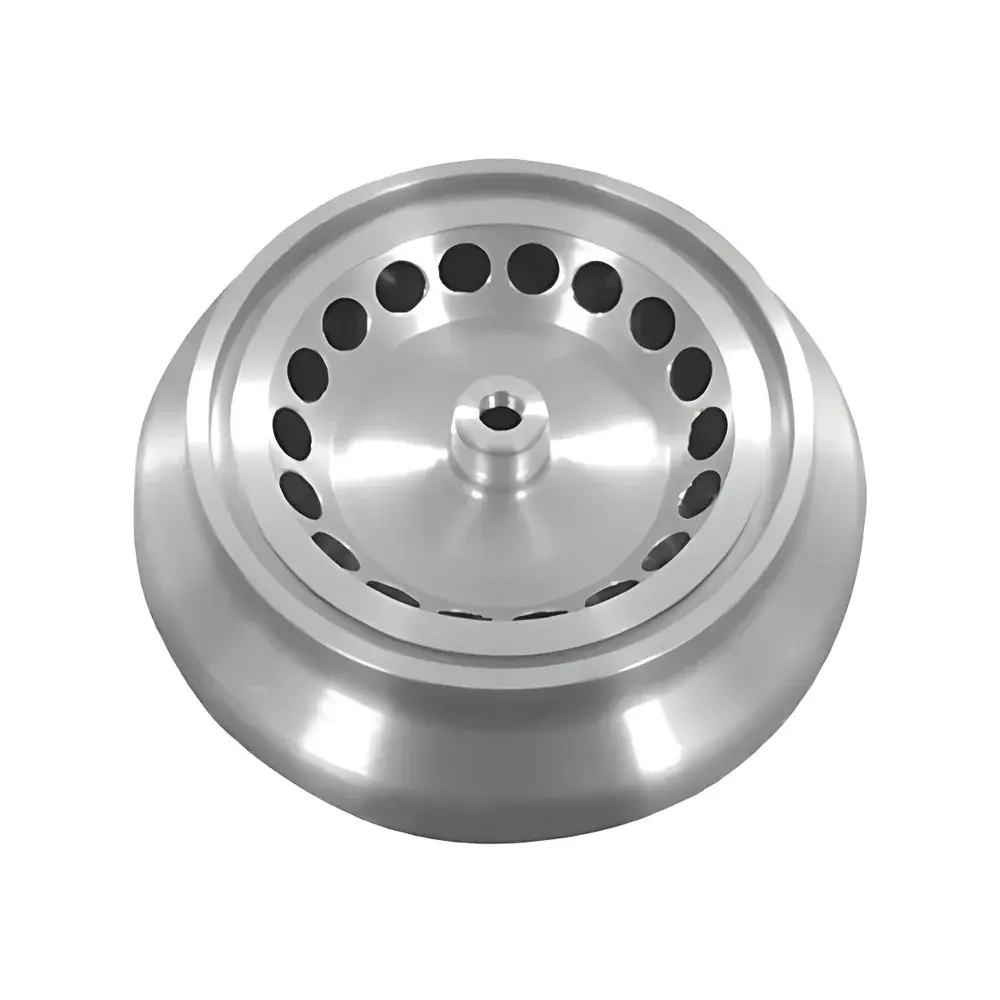
| Rotor Options | Fixed-angle titanium rotors (12 × 1.5/2.0 mL, max 26,000 rpm / 46,900 ×g |
| Acceleration/Deceleration | 10 programmable rates |
| Run Programs | 100 user-defined protocols |
| Display | TFT color touch screen |
| Safety | Rotor imbalance detection, overspeed protection, overtemperature cutoff, triple-layer steel rotor chamber, automatic door lock, standby pre-cooling] |
Overview
The Herx 3H26RI Intelligent High-Speed Refrigerated Centrifuge is a precision-engineered benchtop instrument designed for demanding separation tasks in life science and clinical laboratories. Operating on the principle of sedimentation under controlled centrifugal force, it enables rapid isolation of subcellular components—including mitochondria, lysosomes, microsomes, and viral particles—based on differences in density, size, and shape. Its refrigerated architecture maintains sample integrity during high-speed operation, making it suitable for temperature-sensitive biomolecules such as enzymes, nucleic acids, and labile protein complexes. The system integrates a high-torque brushless frequency-controlled motor with dsPIC30F microcontroller-based real-time regulation, ensuring stable rotational dynamics across extended run durations. Designed for compliance with international laboratory infrastructure standards, the 3H26RI supports GLP- and GMP-aligned workflows through audit-ready parameter logging and reproducible rotor acceleration profiles.
Key Features
- Brushless frequency-controlled motor delivering high torque and thermal stability up to 26,000 rpm, with ±50 rpm speed accuracy and 10-step programmable acceleration/deceleration profiles.
- Advanced refrigeration system using R404a refrigerant and imported hermetic compressors, maintaining precise temperature control from –20 °C to +40 °C (±1 °C) even at maximum rotor speeds.
- TFT full-color capacitive touchscreen interface supporting multilingual operation, simultaneous display of setpoints and real-time parameters (rpm, RCF, time, temperature), and intuitive touch-driven protocol navigation.
- Triple-layer reinforced stainless-steel rotor chamber with integrated mechanical and electronic safety interlocks—including automatic imbalance detection, overspeed cutoff, and overtemperature shutdown—meeting IEC 61010-2-020 requirements for centrifuge safety.
- Standby pre-cooling function: initiates refrigeration while the rotor remains stationary, reducing sample equilibration time prior to run initiation.
- Electromechanical auto-locking door mechanism with force-sensing engagement verification, eliminating manual latching errors and ensuring secure containment during operation.
- 100 programmable run protocols with persistent memory, enabling rapid recall of validated methods for routine QC assays or multi-step purification workflows.
Sample Compatibility & Compliance
The 3H26RI accommodates a broad spectrum of sample formats via interchangeable rotor configurations. Fixed-angle titanium rotors support high-RCF pelleting of small-volume samples (e.g., 12 × 1.5/2.0 mL tubes at 46,900 ×g), while swinging-bucket rotors enable gentle, high-capacity processing of larger volumes—including 4 × 100 mL centrifuge bottles (2,140 ×g) and 2 × 2 × 48-well microplates (1,408 ×g). All rotors are certified to ISO 15197 and ASTM F2119 standards for dimensional tolerance and fatigue resistance. The system’s firmware architecture supports timestamped event logging and parameter traceability—features essential for laboratories operating under FDA 21 CFR Part 11, ISO/IEC 17025, or EU Annex 11 regulatory frameworks. No external calibration certificates are required for routine operation; however, optional NIST-traceable speed and temperature validation kits are available upon request.
Software & Data Management
While the 3H26RI operates autonomously via its embedded controller, optional USB data export functionality allows transfer of run logs—including start/stop timestamps, rotor ID, speed/temperature/time profiles, and fault codes—to external PCs for integration into LIMS or ELN systems. Each protocol stores rotor-specific RCF calculations automatically, eliminating manual conversion errors. The system does not require proprietary software installation; exported CSV files are compatible with standard spreadsheet and statistical analysis platforms. Audit trail records include operator ID (if configured via external authentication), method name, and modification history—supporting full ALCOA+ data integrity principles (Attributable, Legible, Contemporaneous, Original, Accurate, Complete, Consistent, Enduring, Available).
Applications
- Isolation of organelles (mitochondria, nuclei, peroxisomes) from mammalian, plant, or microbial cell lysates.
- Purification of enveloped and non-enveloped viruses for vaccine development or diagnostic antigen production.
- Clarification and concentration of monoclonal antibodies, recombinant proteins, and extracellular vesicles (EVs) in bioprocessing workflows.
- Routine plasma/serum separation in clinical chemistry and transfusion medicine settings (e.g., blood bank operations, donor screening labs).
- Preparative ultracentrifugation steps in nucleic acid extraction protocols, including ribosome profiling and RNA-seq library prep.
- High-throughput sample preparation for food safety testing (e.g., pathogen enrichment, mycotoxin extraction) and environmental microbiology.
FAQ
What is the maximum RCF achievable with the standard 12 × 1.5/2.0 mL fixed-angle titanium rotor?
The 12-position titanium rotor achieves a maximum relative centrifugal force of 46,900 ×g at 26,000 rpm, optimized for rapid pelleting of cellular debris and subcellular fractions.
Does the centrifuge support validation for regulated environments (e.g., pharmaceutical QC labs)?
Yes—the system provides configurable event logging, user-accessible run history, and deterministic rotor identification. When paired with third-party IQ/OQ documentation packages, it meets baseline requirements for GLP and GMP applications.
Can the 4 × 100 mL swinging-bucket rotor be used at full speed (26,000 rpm)?
No—maximum speed for the 4 × 100 mL rotor is 4,000 rpm, generating 2,140 ×g. Rotor-specific speed limits are enforced by firmware to prevent mechanical overload.
Is remote monitoring or network connectivity supported?
The base model operates as a standalone device. Ethernet or Wi-Fi modules are not included but may be integrated via OEM partnerships for facility-wide fleet management systems.
What maintenance intervals are recommended for the refrigeration system?
Compressor performance should be verified annually using calibrated thermocouples and pressure gauges. Refrigerant charge integrity is assessed during preventive maintenance visits; no routine recharge is required under normal ambient conditions (15–30 °C).



