
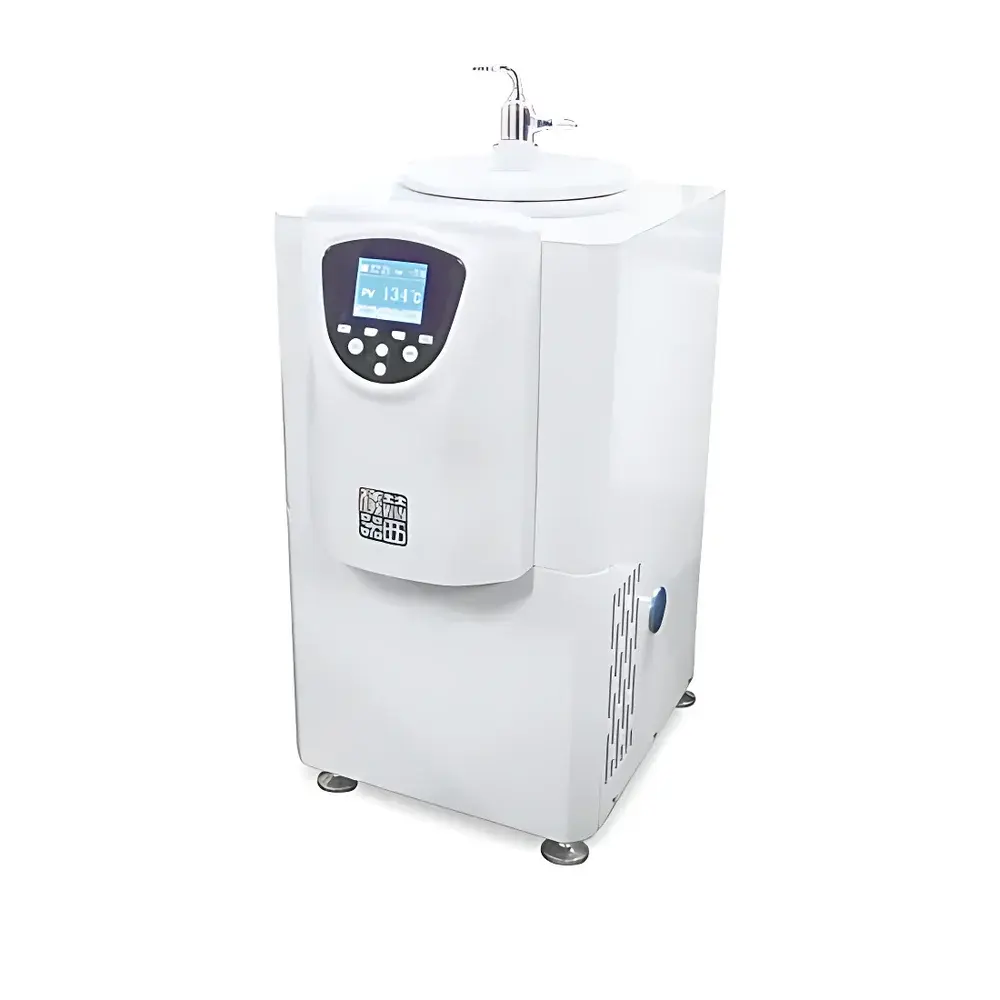
Hershey CT-6 Cryo-Cold Trap for Vacuum Centrifugal Concentrators
| Brand | Hershey |
|---|---|
| Model | CT-6 |
| Type | Cryogenic Cold Trap (Cryo-Cold Trap) |
| Cooling Temperature Range | Ambient to –40 °C |
| Temperature Control Accuracy | ±1 °C |
| Cold Trap Capacity | 4 L |
| Condensate Collection Volume | 200 mL |
| Refrigeration Power | 300 W |
| Refrigerant | R404a |
| Vacuum Port Diameter | φ10 mm |
| Timer Range | 1 min – 99 h 59 min |
| Net Weight | 44 kg |
| Dimensions (L×W×H) | 440 × 340 × 630 mm |
| Display | 4.3″ TFT True-Color Touchscreen with Dual Control Interface |
| Cooling System | Hermetically Sealed, Eco-Friendly Refrigeration Unit |
| Circulation Type | Closed-Loop Internal Circulation |
| Compliance | Designed for ISO/IEC 17025-aligned laboratory environments and compatible with GLP/GMP workflows requiring traceable condensate capture and vacuum integrity |
Overview
The Hershey CT-6 Cryo-Cold Trap is a purpose-engineered auxiliary unit designed exclusively for integration with vacuum centrifugal concentrators in analytical, pharmaceutical, and molecular biology laboratories. Operating on the principle of cryogenic condensation, the CT-6 provides a thermally stabilized cold surface—maintained between ambient temperature and –40 °C—to selectively trap volatile solvents, water vapor, and low-boiling-point analytes during vacuum-based sample concentration. Unlike passive desiccant or liquid nitrogen traps, the CT-6 employs a closed-loop, compressor-driven refrigeration system using environmentally compliant R404a refrigerant, eliminating dependency on consumables and enabling continuous, unattended operation over extended durations. Its primary function is to protect downstream vacuum pumps from solvent-laden vapors, thereby extending pump service life, maintaining stable ultimate vacuum pressure (typically improving base vacuum by one to two orders of magnitude), and preventing cross-contamination between sequential runs. The unit is not a standalone concentrator but an essential vacuum integrity component—its performance directly influences evaporation kinetics, sample recovery fidelity, and reproducibility in protocols involving ethanol, acetone, ethyl acetate, chloroform, and aqueous buffers.
Key Features
- Hermetically sealed refrigeration system with 300 W cooling capacity and precise digital temperature regulation (±1 °C) across a range of ambient to –40 °C
- 4-liter cryo-chamber volume optimized for high-capacity solvent capture during multi-sample or large-volume concentration workflows
- Dedicated 200 mL condensate collection reservoir with level visibility and leak-resistant drainage interface
- 4.3-inch TFT true-color touchscreen with intuitive dual-control logic—enabling simultaneous parameter setting and real-time thermal monitoring
- φ10 mm standardized vacuum inlet/outlet ports compatible with common vacuum tubing (e.g., silicone, Viton®) and concentrator manifolds
- Closed-loop internal circulation architecture minimizes thermal drift and ensures uniform cold surface distribution across the condensing coil geometry
- Integrated programmable timer (1 min to 99 h 59 min) supporting scheduled pre-cooling and synchronized operation with concentrator run cycles
- Robust mechanical design (44 kg net weight, reinforced steel chassis) suitable for benchtop deployment in regulated laboratory spaces
Sample Compatibility & Compliance
The CT-6 is validated for use with a broad spectrum of volatile and semi-volatile solvents commonly employed in nucleic acid purification, protein precipitation, metabolite extraction, and HPLC sample preparation—including methanol, acetonitrile, isopropanol, and dichloromethane—provided their vapor pressures fall within the operational condensation envelope at –40 °C. It does not support cryogenic trapping of gases with boiling points below –40 °C (e.g., CO₂, N₂O, or low-molecular-weight hydrocarbons). The unit complies with IEC 61010-1 safety standards for laboratory electrical equipment and meets CE marking requirements for electromagnetic compatibility (EMC) and low-voltage directive (LVD) conformity. While not certified as a medical device, its design supports 21 CFR Part 11–ready data logging when interfaced with compatible concentrator controllers and audit-trail-enabled software platforms. Documentation packages include factory calibration certificates traceable to NIST standards for temperature sensor verification.
Software & Data Management
The CT-6 operates via embedded firmware without external PC dependency; however, its touchscreen interface logs timestamped temperature setpoints, actual chamber temperatures, runtime duration, and fault events (e.g., compressor overload, sensor disconnect). All records are stored internally for up to 1,000 cycles and exportable via USB flash drive in CSV format. When paired with Hershey-compatible vacuum concentrators (e.g., AL series), bidirectional RS-485 communication enables coordinated start/stop sequencing, interlock validation, and synchronized parameter recall. For GLP/GMP environments, optional integration with LabArchives ELN or Thermo Fisher SampleManager LIMS allows metadata association (e.g., batch ID, operator, protocol version) with each cold trap session—supporting full traceability under ISO/IEC 17025 clause 7.7 and FDA guidance on electronic records.
Applications
- Routine concentration of DNA/RNA eluates post-column purification prior to sequencing library prep
- Removal of residual organic solvents following solid-phase extraction (SPE) of environmental water samples
- Stabilization of thermolabile peptides and glycoproteins during lyophilization pre-concentration steps
- High-throughput metabolomics workflows requiring parallel processing of >24 samples with consistent solvent removal efficiency
- QC/QA testing in pharmaceutical manufacturing where solvent residue limits must comply with ICH Q3C guidelines
- Environmental analysis labs performing EPA Method 525.3 (drinking water) or 8270 (semivolatiles) requiring quantitative recovery of target analytes
FAQ
Can the CT-6 be used with non-Hershey vacuum concentrators?
Yes—provided the concentrator features a standard vacuum outlet (φ10 mm) and operates within compatible vacuum ranges (≤0.1 mbar ultimate pressure). Mechanical and vacuum interface compatibility must be verified prior to integration.
Is R404a refrigerant compliant with current EU F-Gas regulations?
R404a is subject to phase-down under EU Regulation (EU) No 517/2014; however, the CT-6’s sealed system qualifies for continued service use under Article 11 exemptions for equipment placed on the market before 2020. Replacement units utilize next-generation blends pending regulatory approval.
What maintenance intervals are recommended for long-term reliability?
Compressor oil inspection every 24 months; condenser coil cleaning every 6 months in high-humidity environments; annual verification of temperature sensor accuracy using calibrated dry-well calibrators.
Does the CT-6 require external ventilation or exhaust ducting?
No—it is designed for free-air convection cooling; however, minimum 10 cm clearance around rear and side vents is required to maintain thermal efficiency and prevent compressor overheating.
How does cold trap temperature affect solvent recovery efficiency?
Lower cold trap temperatures increase condensation efficiency for higher-vapor-pressure solvents (e.g., acetone at –40 °C achieves >99.2% capture vs. ~92% at –20 °C), directly impacting final sample concentration factor and minimizing pump oil contamination.



