
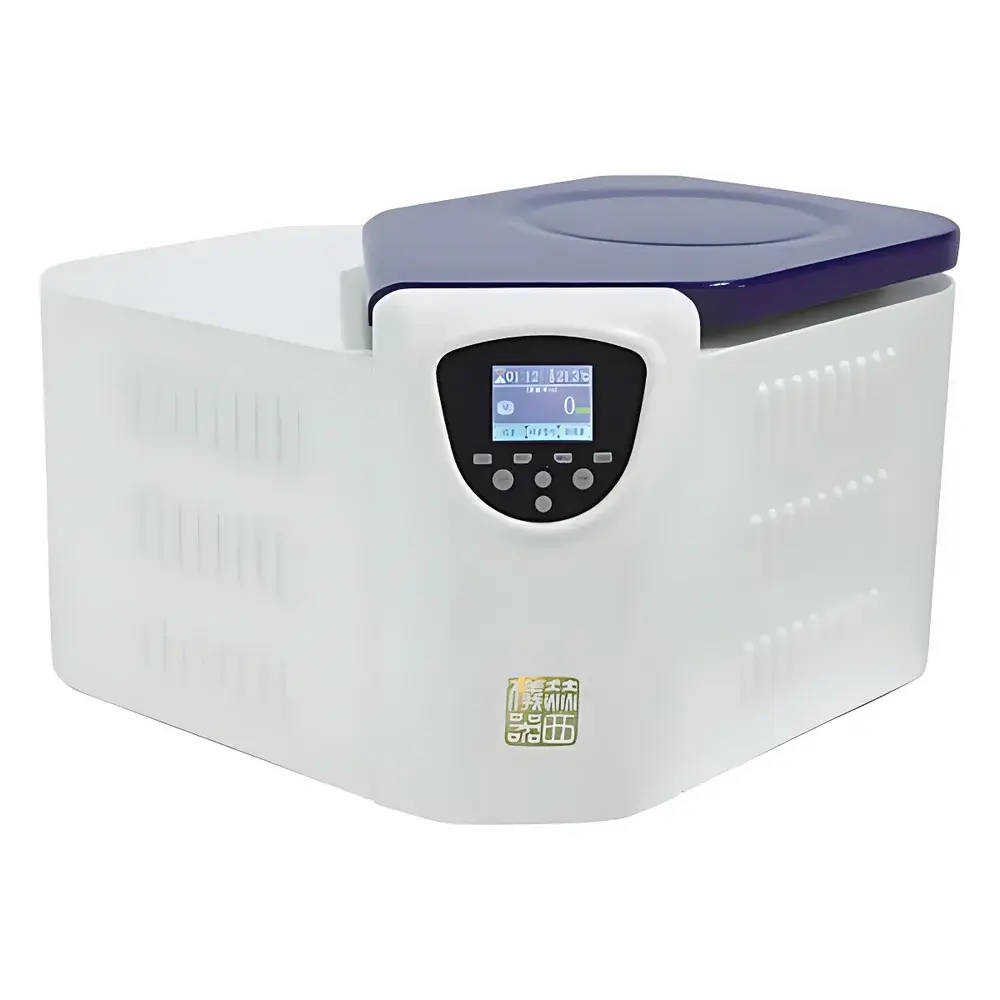
Herxi HR/T20M Benchtop High-Speed Refrigerated Centrifuge
| Brand | Herxi |
|---|---|
| Origin | Hunan, China |
| Model | HR/T20M |
| Instrument Type | Benchtop Centrifuge |
| Speed Range | 10,000–30,000 rpm (Max. 20,000 rpm) |
| Refrigeration Function | Yes |
| Rotor Type | Fixed-Angle |
| Max. Capacity | 4×100 mL or 6×50 mL |
| Max. Speed | 20,000 rpm |
| Max. RCF | 28,800 ×g |
| Temperature Range | −20 °C to +40 °C |
| Temp. Accuracy | ±1 °C |
| Acceleration/Deceleration | 10-step control |
| Noise Level | ≤60 dB(A) |
| Power Supply | AC 220 V, 50 Hz |
| Dimensions (L×W×H) | 710×630×350 mm |
| Weight | 73 kg |
| Certifications | ISO 9001:2015, ISO 13485:2016, CFDA Registered |
| Compliance | EU CE, RoHS 2015/863, IEC 61131-2:2007, NEMA 4, 2014/30/EU EMC Directive |
Overview
The Herxi HR/T20M Benchtop High-Speed Refrigerated Centrifuge is an engineered solution for precise, reproducible separation of biological and biochemical samples under controlled thermal conditions. Designed around the principles of rotor dynamics and thermally stabilized sedimentation, it delivers high relative centrifugal force (RCF) up to 28,800 ×g at 20,000 rpm—enabling efficient pelleting of mammalian cells, bacteria, subcellular organelles, and macromolecular complexes. Its refrigerated architecture maintains sample integrity during extended runs by sustaining temperature setpoints from −20 °C to +40 °C with ±1 °C accuracy, critical for heat-sensitive analytes such as enzymes, nucleic acids, and primary cell suspensions. The system integrates a brushless AC frequency-controlled motor, low-inertia aluminum rotors, and multi-stage damping to ensure mechanical stability, minimal vibration transmission, and consistent RCF delivery across all speed ranges.
Key Features
- Refrigeration system based on fluorine-free R404a compressor with pre-cooling, standby cooling, and automatic defrost functions
- PLC-based control architecture (Mitsubishi FX series, compliant with IEC 61131-2:2007 and EU EMC Directive 2014/30/EU) coupled with a NEMA 4-rated Weinview touchscreen HMI
- TFT-LCD color display showing real-time RPM, RCF, temperature, time, acceleration/deceleration curves, and integrated centrifugation profiles
- Triple-stage damping system—including elastomeric suspension, asymmetric counterbalance, and reinforced base isolation—to suppress resonance and prevent sample resuspension
- Biocontainment-compliant fixed-angle rotors sealed with RoHS-certified silicone gaskets (EU Directive 2015/863), minimizing aerosol leakage during high-speed operation
- Stainless steel 304 centrifuge chamber, powder-coated steel housing, and triple-layer reinforced front panel for structural integrity and operator safety
- Mechanical interlocked lid with auto-engaging latch mechanism; requires no electronic solenoid or external power for secure closure
- 10 programmable acceleration and deceleration profiles, 16 user-defined protocols with editable rotor-specific parameters, and full traceability of run history
- Optional aerospace-grade forged aluminum angle rotors and polyamide fiber adapters supporting diverse tube formats (1.5–100 mL)
- Adjustable leveling feet with casters for stable positioning and ergonomic relocation within shared laboratory spaces
Sample Compatibility & Compliance
The HR/T20M supports routine and regulated workflows in clinical diagnostics, biopharmaceutical QC, academic research, and food safety testing. Its rotor configurations accommodate standard microcentrifuge tubes (1.5–2.0 mL), conical-bottom 5–50 mL tubes, and specialized formats including PCR strips and cryovials. All rotors are validated for use with common biological matrices—whole blood, serum, plasma, bacterial lysates, yeast cultures, and tissue homogenates—without compromising pellet morphology or supernatant clarity. Regulatory alignment includes ISO 9001:2015 (quality management) and ISO 13485:2016 (medical device manufacturing), along with CFDA registration for in vitro diagnostic applications in China. While not FDA 510(k)-cleared or CE-IVDR certified, its electrical safety and EMC performance conform to EN 61010-1 and EN 61326-1 standards, supporting GLP-compliant documentation when paired with audit-trail-enabled software extensions.
Software & Data Management
The embedded firmware logs timestamped operational metadata—including speed ramping profiles, thermal deviation alerts, rotor ID recognition, and cumulative runtime—for each centrifugation cycle. Exportable CSV reports capture RCF integration, temperature drift, and fault codes (e.g., imbalance detection, overtemperature, voltage fluctuation). Although the base unit lacks network connectivity, optional USB data export enables integration into LIMS environments via standardized file ingestion. Firmware updates are performed offline using FAT32-formatted USB drives, preserving system integrity during validation cycles. Language localization includes English and Simplified Chinese UI layers, with future expansion planned for German, French, and Spanish interfaces per IEC 62366 usability requirements.
Applications
- Isolation of peripheral blood mononuclear cells (PBMCs) and platelet-rich plasma (PRP) in clinical labs
- Purification of plasmid DNA, viral vectors, and exosomes via differential centrifugation protocols
- Clarification of fermentation broths and cell culture supernatants in upstream bioprocessing
- Concentration of environmental waterborne pathogens for PCR-based detection assays
- Preparative separation of membrane fractions and ribosomal subunits in structural biology workflows
- Routine quality control of vaccine adjuvants, monoclonal antibody formulations, and sterile filtration validation samples
FAQ
What is the maximum RCF achievable with the 6×50 mL conical rotor?
The HR/T20M achieves 15,120 ×g at 12,000 rpm with the 6×50 mL sharp-cone rotor.
Does the centrifuge support continuous temperature monitoring during operation?
Yes—real-time chamber temperature is displayed continuously and logged at 10-second intervals throughout each run.
Can the instrument be validated for GMP environments?
It meets foundational requirements for IQ/OQ documentation (mechanical calibration, thermal mapping, rotor balance verification); however, formal PQ must be conducted in situ using site-specific SOPs and reference standards.
Is rotor identification automated or manual?
Rotor type is manually selected via touchscreen interface; no RFID or barcode scanning is implemented in the base configuration.
What safety certifications apply to the refrigeration system?
The R404a compressor assembly complies with EN 378-1:2016 for refrigerant handling and pressure equipment, and has passed leak-tightness testing per ISO 13849-1 PLd.
Related Products



