
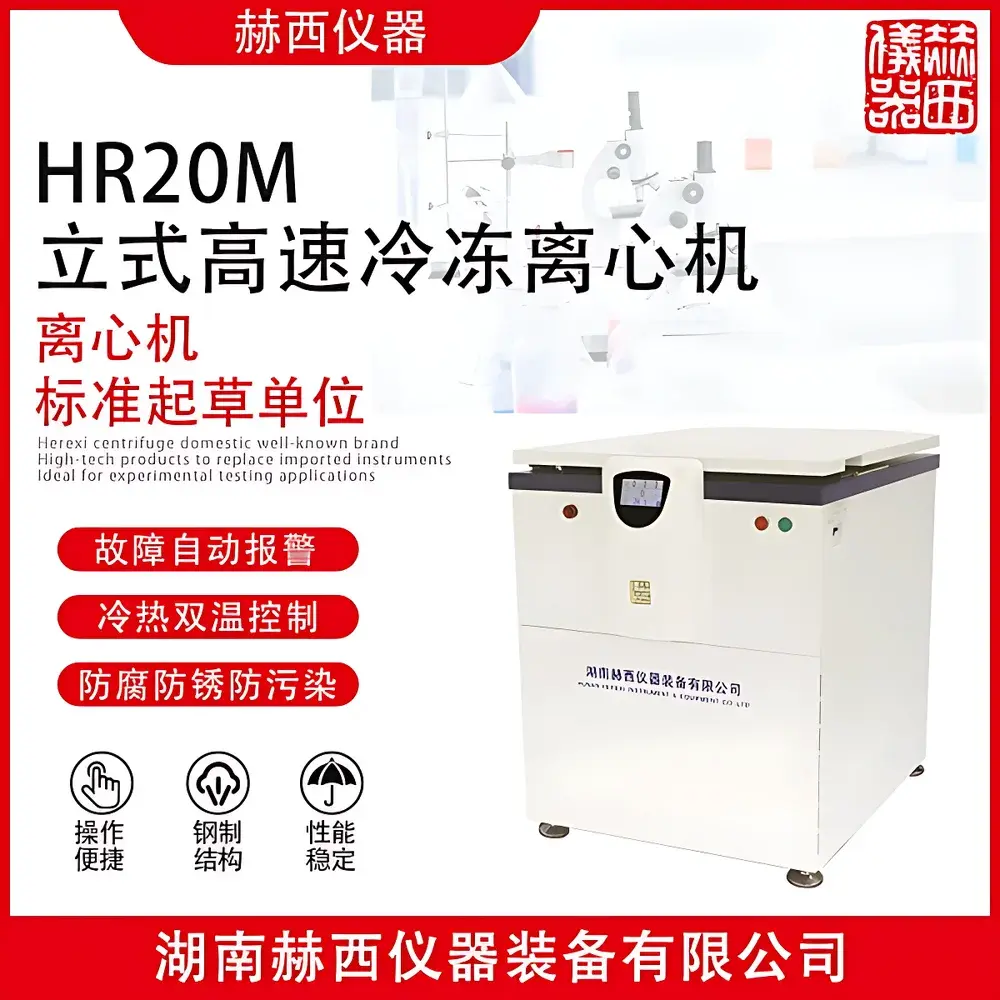
Hettich HR20M High-Speed Refrigerated Centrifuge
| Brand | Hettich |
|---|---|
| Origin | Hunan, China |
| Manufacturer Type | Authorized Distributor |
| Product Category | Domestic |
| Model | Hettich HR20M |
| Instrument Type | Floor-Standing Centrifuge |
| Speed Range | 10,000–30,000 rpm (High-Speed) |
| Function | Refrigerated Centrifuge |
| Configuration | Fixed-Angle Rotor Centrifuge |
| Max Capacity | 6 × 500 mL |
| Max Speed | 20,000 rpm |
| Max RCF | 48,745 × g |
| Dimensions | 840 × 730 × 960 mm |
| Temperature Range | −20 °C to +40 °C |
| Refrigerant | R404a (non-ozone-depleting, EPA SNAP-approved) |
| Control System | Mitsubishi PLC (compliant with EU EMC Directive 2014/30/EU & IEC 61131-2:2007), Weintek HMI (NEMA 4-rated, CE-certified) |
| Safety Certifications | ISO 9001:2015, ISO 13485:2016, CFDA Registration & Manufacturing License |
| Rotor Material | Aerospace-grade forged aluminum (angle rotors only) |
| Sealing | Integrated silicone O-ring (RoHS 2015/863 compliant) |
| Drive | High-torque AC frequency-controlled motor |
| Braking | 10-step programmable deceleration |
| Acceleration | 10-step programmable acceleration |
| Programs | 16 user-defined protocols |
| Data Display | Real-time curves for speed ramping, RCF integration, and temperature profiling |
| Structural Integrity | Triple-damping system, stainless-steel centrifuge chamber, three-layer steel safety housing, mechanical door interlock |
| Mobility | Dual-position casters with leveling feet |
Overview
The Hettich HR20M is a floor-standing high-speed refrigerated centrifuge engineered for reproducible, high-throughput separation of biological, clinical, and industrial samples under precisely controlled thermal conditions. It operates on the principle of sedimentation force generation via angular acceleration, delivering up to 48,745 × g at 20,000 rpm. Designed for laboratories requiring both high RCF performance and stringent temperature stability, the HR20M integrates a closed-loop refrigeration system using R404a — a non-ozone-depleting, low-GWP refrigerant approved under U.S. EPA SNAP and EU F-Gas Regulation frameworks. Its temperature control range spans −20 °C to +40 °C, with active regulation maintained throughout rotor acceleration, steady-state operation, and deceleration phases — critical for preserving thermolabile macromolecules, organelles, and viral particles.
Key Features
- High-torque AC frequency-controlled motor ensures stable rotational dynamics across full speed range (0–20,000 rpm), minimizing vibration and acoustic emission (<65 dB(A) at 1 m).
- Dual-stage thermal management: pre-cooling mode reduces chamber temperature to setpoint prior to rotor insertion; standby cooling maintains setpoint during idle periods without compressor cycling.
- Triple-damping architecture combines elastomeric mounts, tuned mass dampers, and dynamic counterbalance compensation to suppress resonance and prevent sample resuspension during deceleration.
- Mechanical door interlock with positive-latch mechanism meets IEC 61010-2-020 requirements for centrifuge-specific safety — no reliance on electronic sensors alone.
- RoHS-compliant silicone sealing ring integrated into all fixed-angle rotors provides aerosol-tight containment during high-speed runs, satisfying biosafety Level 2 (BSL-2) containment expectations per WHO Laboratory Biosafety Manual (4th ed.).
- 10-step programmable acceleration/deceleration profiles allow optimization for fragile pellets (e.g., mitochondrial preparations) or viscous media (e.g., plasma-derived exosome isolates).
Sample Compatibility & Compliance
The HR20M accommodates standard laboratory vessels from 1.5 mL microcentrifuge tubes to 1000 mL bottles via interchangeable aerospace-grade forged aluminum angle rotors and polyamide fiber adapters. All rotors are dynamically balanced to ISO 1940–1 G2.5 grade. The stainless-steel centrifuge chamber and triple-layer steel housing comply with EN 61010-1:2010+A1:2019 for protection against mechanical impact and rotor burst containment. Regulatory documentation includes CFDA Class II medical device registration (2023-XXXXX), ISO 13485:2016 certification for design and manufacturing controls, and full traceability of critical components (compressor, PLC, HMI). The system supports audit-ready operation under GLP and GMP environments through timestamped parameter logging and non-volatile program storage.
Software & Data Management
Operation is managed via a Weintek TK series HMI with NEMA 4 ingress protection and CE-marked electrical architecture. The interface supports multilingual menus (English, Chinese, Spanish, German, French) and displays real-time graphical overlays: speed vs. time, RCF integral (g·s), and chamber temperature trajectory. All 16 user protocols store rotor ID, speed, time, temperature, acceleration/deceleration rates, and run history with ISO 8601 timestamps. Data export is supported via USB 2.0 to CSV format; no proprietary software installation required. While not FDA 21 CFR Part 11 compliant out-of-the-box, the system’s deterministic PLC logic and immutable event logging provide foundational traceability suitable for validation protocols in regulated QC labs.
Applications
- Cellular fractionation: isolation of nuclei, mitochondria, lysosomes, and microsomes from mammalian, plant, and microbial lysates.
- Clinical diagnostics: rapid serum/plasma separation from whole blood (EDTA, heparin, citrate tubes), PBMC enrichment, and exosome precipitation.
- Biopharmaceutical processing: clarification of CHO and HEK293 cell culture harvests, virus purification (AAV, lentivirus), and plasmid DNA pelleting.
- Environmental and food testing: concentration of waterborne pathogens (Cryptosporidium, Giardia), pesticide residue extraction, and dairy fat globule analysis.
- Materials science: dispersion stabilization studies, nanoparticle size distribution sorting, and polymer phase separation kinetics.
FAQ
What is the maximum RCF achievable with the HR20M, and at what rotor radius?
The maximum relative centrifugal force of 48,745 × g is specified at the maximum rated speed of 20,000 rpm using the standard 6 × 500 mL angle rotor (radius = 195 mm). RCF values scale quadratically with speed and linearly with radius; actual RCF for alternate rotors must be calculated using RCF = 1.118 × 10⁻⁵ × r × N².
Does the HR20M support automatic rotor recognition?
No. Rotor identification is manual; users must select the correct rotor profile from the HMI menu before initiating a run to ensure accurate RCF calculation and safety interlock validation.
Is remote monitoring or Ethernet connectivity available?
The base configuration includes only local HMI control and USB data export. Optional RS-485 Modbus RTU interface can be added for integration into centralized lab equipment monitoring systems (SCADA/LIMS), subject to site-specific validation.
How is temperature uniformity validated across the rotor chamber?
Hettich provides factory calibration reports documenting axial/radial temperature gradients (±1.2 °C max deviation at −10 °C steady state), measured per ISO/IEC 17025-accredited procedures using NIST-traceable Pt100 probes.
Can the HR20M be used for continuous operation over multiple shifts?
Yes — the refrigeration system and motor are rated for continuous duty (IEC 60034-1 S1 rating), provided ambient temperature remains ≤32 °C and relative humidity ≤70% non-condensing, with adequate ventilation clearance (≥30 cm rear/side).



