
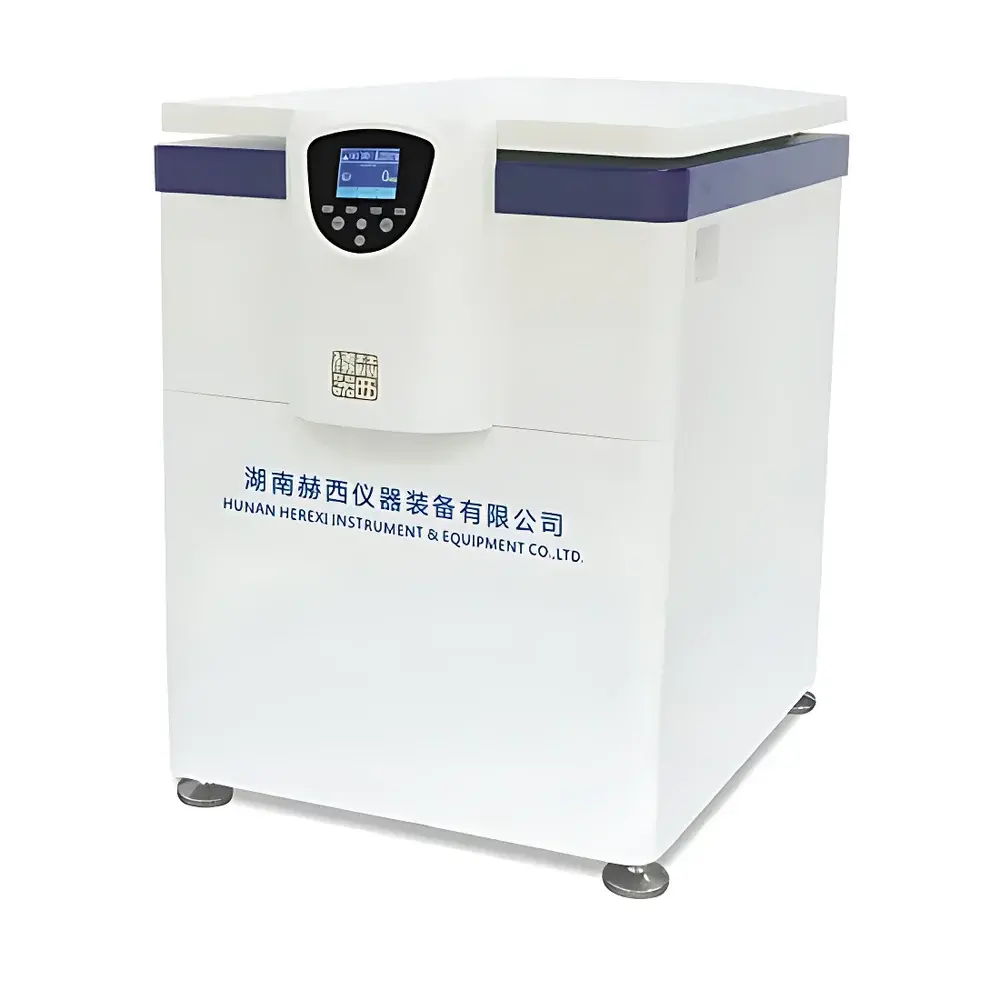
HeXi LT5Y Crude Oil Water Content Determination Centrifuge
| [Brand | HeXi |
|---|---|
| Model | LT5Y |
| Type | Floor-standing Low-speed Centrifuge |
| Max Speed | 5000 rpm |
| Max RCF | 4500 ×g |
| Max Capacity | 4 × 100 mL (horizontal rotor) |
| Temperature Range | Ambient to 70 °C |
| Temp. Accuracy | ±2 °C |
| Speed Accuracy | ±50 rpm |
| Timer Range | 1 min – 99 h 59 min |
| Noise Level | ≤65 dB(A) |
| Dimensions (W×D×H) | 600 × 490 × 760 mm |
| Weight | 70 kg |
| Compliance | GB/T 6533–2012, IEC 61131-2:2007, EN 61000-6-3:2011 (EMC), CE, NEMA 4-rated HMI] |
Overview
The HeXi LT5Y Crude Oil Water Content Determination Centrifuge is a purpose-built floor-standing low-speed centrifuge engineered for standardized quantitative separation of water and sediment from crude oil samples in accordance with GB/T 6533–2012 (“Determination of Water and Sediment in Crude Oil — Centrifuge Method”). This method relies on controlled centrifugal force to accelerate phase separation between immiscible components—primarily free water, emulsified water, and solid particulates—within a defined sample volume under regulated thermal conditions. Unlike general-purpose centrifuges, the LT5Y integrates precise temperature control (ambient to 70 °C), programmable timing, and rotor-specific acceleration/deceleration profiles optimized for petroleum matrix behavior. Its design prioritizes repeatability in ASTM D96-23 and ISO 9030-compliant workflows, making it suitable for routine QC testing in upstream production labs, refinery quality assurance departments, and independent petroleum testing laboratories operating under GLP or ISO/IEC 17025 frameworks.
Key Features
- Microprocessor-controlled AC/DC variable-frequency drive motor delivering high torque at low speeds (up to 5000 rpm), ensuring stable rotational dynamics and minimal mechanical drift during extended runs.
- Dual-display interface: Optional PLC-based LCD panel or LED digital display—both support real-time parameter monitoring (speed, temperature, elapsed time) and in-run modification of setpoints without interrupting operation.
- Temperature-regulated centrifugation chamber with uniform heating elements and ±2 °C thermal stability across the full 0–70 °C range, critical for maintaining consistent viscosity and interfacial tension during separation.
- Reinforced centrifuge cavity constructed from austenitic 304 stainless steel, enclosed within a fully powder-coated steel housing and integrated triple-layer safety shroud meeting IEC 61010-1 mechanical integrity requirements.
- Dual-stage vibration damping system with automatic rotor imbalance compensation—enabling visual confirmation of static balance prior to run initiation and eliminating need for manual counterweight adjustment.
- NEMA 4-rated Weintek HMI touchscreen and Mitsubishi programmable logic controller compliant with EU Electromagnetic Compatibility Directive 2014/30/EU and IEC 61131-2:2007 standards.
- Electromechanical door lock mechanism with silent actuation and interlocked safety cutoff, preventing lid opening during rotation or when RCF exceeds safe thresholds.
- Adjustable leveling feet with casters and carbon-steel height-compensation blocks for rapid instrument relocation and horizontal alignment verification using built-in bubble level indicators.
Sample Compatibility & Compliance
The LT5Y accommodates standard petroleum sample containers—including calibrated 100 mL centrifuge tubes and 25 mL conical vials—mounted in its fixed-angle or horizontal rotors (4 × 100 mL or 16 × 25 mL configurations). It supports both batch-mode and continuous-duty operation modes per GB/T 6533–2012 Annex A protocols. All electrical subsystems carry CE marking and conform to EN 61000-6-3:2011 (emission) and EN 61000-6-2:2016 (immunity). The control firmware logs all operational events—including start/stop timestamps, parameter changes, and fault codes—with audit-trail capability aligned with FDA 21 CFR Part 11 data integrity expectations when paired with validated LIMS integration.
Software & Data Management
While the LT5Y operates as a standalone instrument, its PLC architecture enables optional RS-485 or Ethernet communication modules for integration into centralized laboratory networks. Parameter logs and run histories can be exported via USB port in CSV format for traceability documentation. Firmware supports user-defined method templates stored in non-volatile memory, allowing up to 10 preconfigured protocols—including temperature ramp profiles, multi-step speed gradients, and hold periods—to reduce operator variability and support ISO/IEC 17025 clause 7.2.2 procedural consistency requirements.
Applications
- Quantitative determination of total water content and bottom sediment in crude oil per GB/T 6533–2012, ASTM D96-23, and IP 356.
- Preparative separation of water-in-oil emulsions for downstream Karl Fischer titration or gravimetric analysis.
- Stability assessment of demulsifier formulations under controlled thermal–centrifugal stress conditions.
- Field-deployable QA/QC verification in offshore platform labs where footprint, robustness, and power efficiency are prioritized over ultra-high RCF performance.
- Teaching and method development in petroleum engineering curricula requiring reproducible, standards-aligned separation instrumentation.
FAQ
Does the LT5Y meet international standards for crude oil water testing?
Yes—it is explicitly designed and verified for compliance with GB/T 6533–2012, which aligns technically with ASTM D96 and ISO 9030 methodologies.
Can the centrifuge operate continuously for extended durations?
Yes, the timer supports up to 99 hours and 59 minutes; combined with thermal management and brushless motor design, it supports unattended overnight runs.
Is rotor imbalance detection automated?
The dual-damping system provides passive stabilization, and visual balance verification is sufficient per standard operating procedure—no active sensor-based imbalance correction is implemented.
What safety certifications apply to the electrical system?
CE marking, EN 61000-6-3 EMC compliance, NEMA 4-rated HMI enclosure, and IEC 61010-1 mechanical safety certification are all documented in the factory test report.
How is temperature uniformity maintained across the rotor chamber?
Through distributed resistive heating elements and PID-controlled feedback loop with platinum RTD sensing—ensuring ≤±2 °C deviation at any point within the chamber during steady-state operation.



