
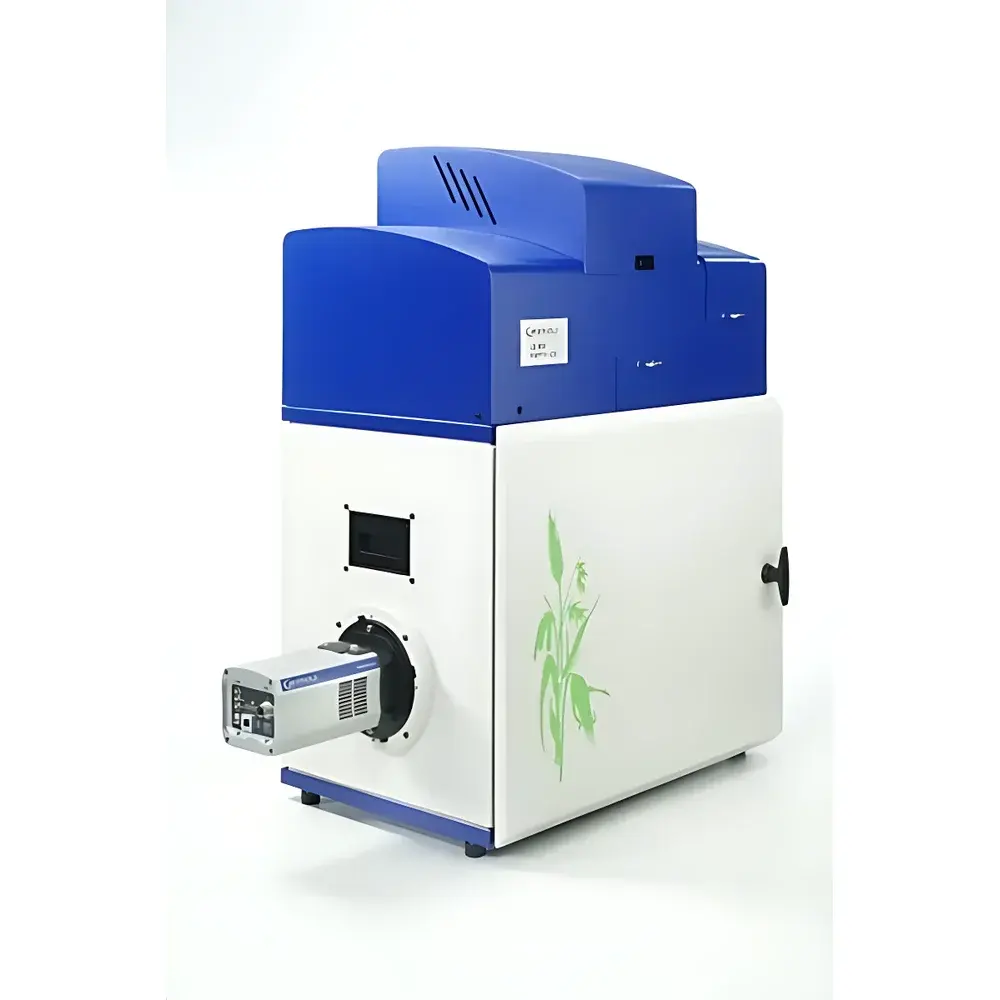
Berthold NightSHADE LB985 Plant In Vivo Imaging System
| Brand | Berthold |
|---|---|
| Origin | Germany |
| Model | LB985 |
| Imaging Modality | Optical Bioluminescence & Fluorescence Imaging |
| Detector | 12-Megapixel Cooled EMCCD (–20 °C operating temperature) |
| Quantum Efficiency Peak | 500–750 nm |
| Imaging Modes | Bioluminescence/Chemiluminescence (LULu), Ultra-Low-Noise CCD (IKLu), Dual-Mode Bioluminescence + Fluorescence (LUFlu) |
| Illumination | LED-based Simulated Sunlight (Top Illumination), Side Illumination Module |
| Sample Stage | Motorized X-Y Translation + 360° Rotational Platform |
| Environmental Control | Integrated Temperature & Humidity Regulation |
| Software | indiGO™ v6.x with Hardware Synchronization, Audit Trail, and GLP-Compliant Data Archiving |
Overview
The Berthold NightSHADE LB985 Plant In Vivo Imaging System is a purpose-engineered optical imaging platform designed specifically for non-invasive, quantitative monitoring of biological processes in living plant specimens. Building upon the proven architecture of Berthold’s NightOWL series—widely adopted in preclinical small-animal imaging—the LB985 adapts core photon-counting principles to the unique optical and physiological constraints of plant biology. It operates on high-sensitivity electron-multiplying charge-coupled device (EMCCD) detection, enabling single-photon resolution under ultra-low-light conditions essential for detecting weak bioluminescent signals (e.g., luciferase reporter activity) or chemiluminescent responses (e.g., luminol-enhanced ROS bursts). Its spectral response (peak QE 500–750 nm) aligns precisely with common plant-compatible reporters—including firefly luciferase (FLuc), Renilla luciferase (RLuc), GFP variants, and red-shifted fluorophores such as mCherry and Cy5—ensuring optimal signal capture without spectral crosstalk.
Key Features
- 12-megapixel thermoelectrically cooled EMCCD detector operating at –20 °C to suppress dark current and maximize signal-to-noise ratio during long-exposure acquisitions
- Dual illumination architecture: top-mounted LED array simulating natural daylight spectra for photomorphogenic studies, plus side-illuminated white LED module for oblique-angle fluorescence excitation and shadow-free morphological documentation
- Motorized X-Y translation stage with precision 360° rotational capability, enabling multi-angle acquisition of intact seedlings, rosettes, or vertically grown plants without manual repositioning
- Integrated environmental chamber with independent PID-controlled regulation of temperature (range: 15–35 °C ±0.3 °C) and relative humidity (30–85% RH ±3%) to maintain physiological relevance during time-lapse experiments
- Modular optical configuration supporting three distinct operational modes: LULu (bioluminescence/chemiluminescence only), IKLu (ultra-low-noise CCD for high-dynamic-range fluorescence), and LUFlu (dual-mode with integrated GFP filter set and excitation optics)
- Optical path optimized for low-autofluorescence transmission—minimizing chlorophyll interference through spectral gating and background subtraction algorithms embedded in indiGO™ software
Sample Compatibility & Compliance
The LB985 accommodates diverse plant sample formats: Petri dishes (up to 150 mm diameter), standard 6–96-well microplates, custom growth trays, and upright hydroponic or soil-based pots (max height: 25 cm). Its open-stage design permits imaging of whole Arabidopsis thaliana plants, Nicotiana benthamiana leaves, Medicago truncatula root systems, fungal colonies (e.g., Botrytis cinerea), and germinating cereal seedlings. All hardware and firmware comply with IEC 61000-6-3 (EMC emissions) and IEC 61010-1 (safety for laboratory equipment). The system supports audit trail generation, user access levels, and electronic signature functionality per FDA 21 CFR Part 11 requirements when configured with indiGO™ GLP mode—making it suitable for regulated phenotyping workflows in academic core facilities and industrial R&D labs conducting GLP/GMP-aligned crop trait validation.
Software & Data Management
indiGO™ software (v6.4+) serves as the unified control and analysis environment. It provides synchronized hardware triggering across illumination, stage movement, and detector acquisition; real-time photon-counting histogram visualization; and batch-processing pipelines for ROI-based quantification across time-series datasets. Built-in calibration routines include flat-field correction, dark-frame subtraction, and wavelength-specific sensitivity mapping. Export formats include TIFF (16-bit), HDF5 (for metadata-rich archiving), and CSV (for statistical integration with R or Python). Data integrity is enforced via SHA-256 checksums, timestamped versioning, and immutable raw-data retention—enabling full traceability from acquisition to publication-ready figure generation.
Applications
The LB985 enables rigorous investigation of dynamic plant physiology across multiple domains: circadian rhythm analysis via luciferase-fused clock gene reporters (e.g., CCA1::LUC); spatiotemporal mapping of pathogen-induced ROS bursts using luminol chemiluminescence; subcellular localization of GFP-tagged transporters under abiotic stress; high-throughput screening of phytohormone-responsive promoters in microplate-based assays; and longitudinal tracking of root architecture changes during drought acclimation. Its sensitivity and environmental fidelity make it especially valuable for studies requiring extended kinetic monitoring (>72 h) under controlled photoperiods and stress gradients—applications routinely cited in Nature Plants, The Plant Cell, and Plant Physiology.
FAQ
What is the minimum detectable photon flux for bioluminescent imaging?
The system achieves sub-100 photons/sec/cm² detection limit under standard LULu mode with 5-min integration, validated using calibrated luciferase standards traceable to NIST SRM 2921.
Can the LB985 image chlorophyll autofluorescence without spectral bleed-through?
Yes—via sequential acquisition with 680/30 nm and 740/30 nm bandpass filters, combined with indiGO™’s linear unmixing algorithm to separate PSII emission from reporter signals.
Is remote operation supported for unattended overnight imaging?
Fully supported via TLS-secured indiGO™ WebServer interface; scheduled protocols include automatic stage repositioning, multi-wavelength switching, and failure-triggered email alerts.
Does the system meet ISO/IEC 17025 requirements for method validation?
While not certified per se, its documented linearity (R² > 0.999 over 4-log dynamic range), repeatability (CV < 3.2% across 10 replicates), and traceable calibration procedures align with ISO/IEC 17025 clause 5.4.5 for measurement uncertainty estimation.
Are third-party analysis plugins compatible with indiGO™ output files?
Yes—TIFF and HDF5 exports are natively readable by ImageJ/Fiji, MATLAB, and Python (via h5py and tifffile libraries); custom macro integration is supported through indiGO™’s Python API extension module.



