
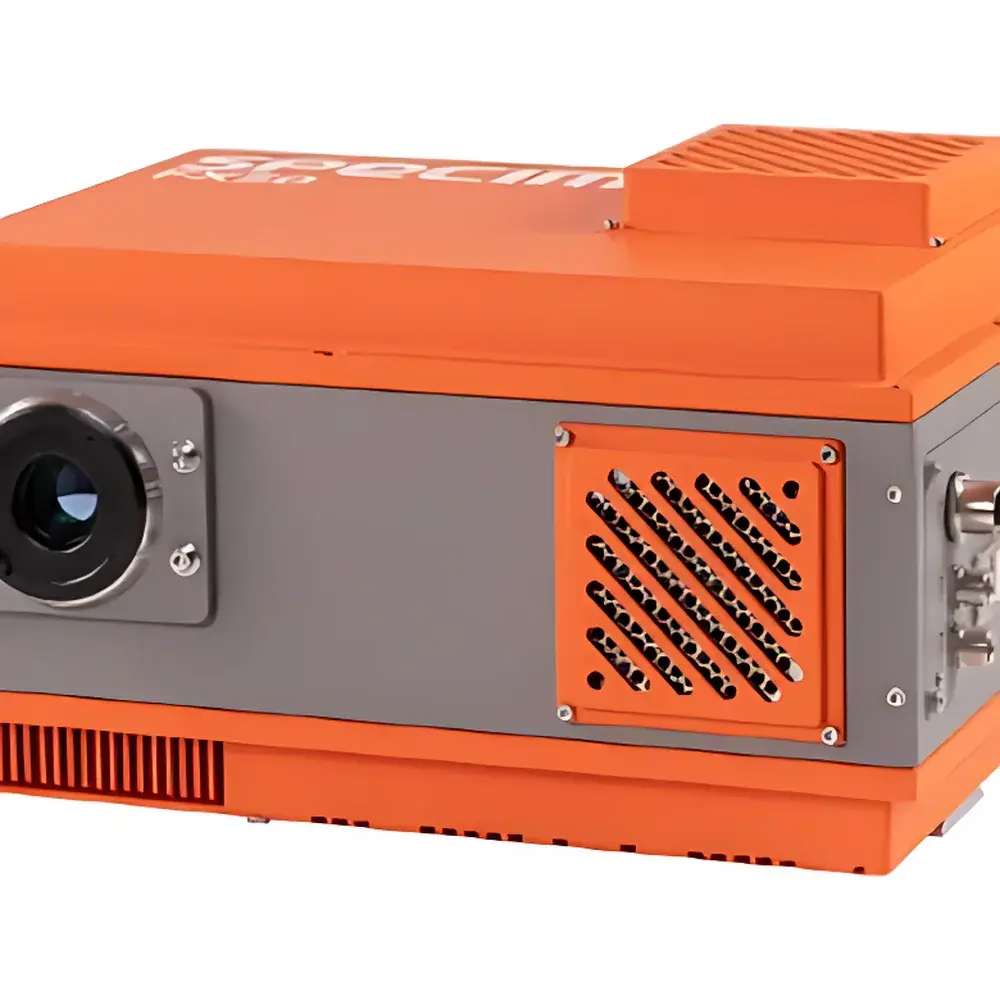
Specim FX50 Mid-Wave Infrared Hyperspectral Imaging Camera
| Brand | Specim |
|---|---|
| Origin | Finland |
| Model | FX50 MWIR |
| Spectral Range | 2.7–5.3 µm |
| Spatial Resolution | 640 pixels |
| Frame Rate | 377 fps |
| SNR | 1300:1 |
| Interface | GigE Vision |
| Cooling | Thermoelectrically Stabilized Optics |
| Onboard Dark Current Compensation | Integrated Shutter |
| Spectral Calibration | Factory-Performed Per-Pixel Uniformity |
| ROI Capability | Multiple Regions of Interest (MROI) |
| Software Compatibility | SpecimONE Platform |
| Integration Ready | PhenoTron®-HSI, Conveyor-Based & Mobile HSI Systems |
Overview
The Specim FX50 Mid-Wave Infrared (MWIR) Hyperspectral Imaging Camera is a turnkey spectral imaging solution engineered for robust, real-time material identification and quantification in industrial automation environments. Operating on the principle of push-broom hyperspectral imaging, the FX50 captures contiguous spectral data across the 2.7–5.3 µm wavelength range—spanning fundamental molecular absorption bands of C–H, O–H, and N–H functional groups. This spectral window enables high-contrast discrimination of organic compounds that are optically indistinguishable in visible or short-wave infrared (SWIR) bands—particularly critical for black polymer sorting, hydrocarbon mapping, mineralogical analysis, and thin-film contaminant detection on metallic substrates. Its monolithic optical architecture integrates a cooled MCT (Mercury Cadmium Telluride) detector array with thermoelectric stabilization, ensuring radiometric stability over extended operational cycles and minimizing drift-induced calibration errors.
Key Features
- Compact, self-contained hyperspectral imager with no external spectrometer or scanning mechanics required
- Native spectral coverage from 2.7 to 5.3 µm—optimized for vibrational absorption features of polymers, lubricants, adhesives, and inorganic oxides
- 640-pixel spatial resolution along the line-scan direction, supporting sub-millimeter feature discrimination at typical working distances (e.g., 300–800 mm)
- Maximum acquisition speed of 377 full hyperspectral frames per second—synchronized to conveyor speeds up to 3 m/s without motion blur
- Onboard non-uniformity correction (NUC), dark current subtraction via integrated mechanical shutter, and per-pixel spectral response calibration traceable to NIST-traceable blackbody sources
- Thermoelectric cooling maintains detector and optical path temperature within ±0.1 °C, preserving radiometric fidelity across ambient fluctuations (10–40 °C operating range)
- GigE Vision-compliant interface ensures plug-and-play integration with standard industrial vision hardware and third-party frame grabbers
Sample Compatibility & Compliance
The FX50 is validated for non-contact, non-destructive analysis of heterogeneous solid-phase samples under ambient lighting or controlled illumination. It supports reflective, transmissive, and emissive measurement modes depending on sample emissivity and setup configuration. The system complies with CE marking requirements for industrial equipment and meets electromagnetic compatibility (EMC) standards per EN 61326-1. Data acquisition workflows align with Good Manufacturing Practice (GMP) and ISO/IEC 17025 documentation expectations when deployed with audit-trail-enabled software (e.g., SpecimONE with logging extension). While not intrinsically rated for hazardous locations, it may be installed in Class 1 Div 2 environments with appropriate enclosure certification.
Software & Data Management
The FX50 is fully supported by SpecimONE—a modular, API-accessible software platform designed for rapid application development in industrial spectral analytics. SpecimONE provides real-time visualization, spectral library matching (using Euclidean distance, SAM, or SID algorithms), multivariate statistical tools (PCA, PLS-DA), and configurable MROI masking to reduce data throughput by up to 90% without sacrificing classification accuracy. Raw data is saved in standard ENVI-compatible BIL format with embedded metadata (wavelength grid, calibration coefficients, exposure settings). Integration with Python (via specim-sdk) and MATLAB enables custom algorithm deployment. For regulated environments, optional add-ons support FDA 21 CFR Part 11 compliance—including electronic signatures, user role management, and immutable audit logs.
Applications
- Black plastic sorting: Discriminates ABS, PP, PE, PC, PS, and POM based on unique C–H stretching and bending harmonics—achieving >98% classification accuracy on fragmented post-consumer waste streams
- Adhesive & lubricant verification: Detects presence, coverage uniformity, and chemical degradation of silicone-, epoxy-, and ester-based formulations on assembled components
- Mineral and ore characterization: Identifies carbonate, sulfate, and silicate phases in mining feedstock via diagnostic absorption near 4.0–4.5 µm
- Surface contamination monitoring: Localizes sub-micron hydrocarbon residues or coolant films on machined aluminum or stainless steel surfaces
- Pharmaceutical coating analysis: Quantifies film thickness and composition heterogeneity in tablet coatings containing polymeric excipients (e.g., HPMC, Eudragit)
FAQ
What spectral calibration standards are used during factory calibration?
Factory calibration employs NIST-traceable blackbody sources at multiple temperatures (250–600 K) to establish absolute radiance response; spectral channel positions are verified using gas-cell emission lines (e.g., CO, N₂O).
Can the FX50 operate in high-vibration environments such as conveyor systems?
Yes—the housing meets IEC 60068-2-6 vibration resistance specifications (5–500 Hz, 2 g rms), and the solid-state optical design eliminates moving parts susceptible to misalignment.
Is radiometric calibration maintained after field reinstallation or lens replacement?
A full NUC and spectral recalibration must be performed using the included calibration source; SpecimONE supports user-initiated recalibration with validation reporting.
Does the camera support synchronized triggering with external PLCs or encoders?
Yes—TTL-compatible trigger input/output ports enable precise synchronization with encoder pulses or programmable logic controllers for position-resolved spectral mapping.
How is data throughput managed at 377 fps with 640 × 384 spectral cubes?
Real-time MROI selection, onboard binning (2×2 or 4×4), and GigE packet segmentation reduce bandwidth demand; typical sustained throughput is 1.2 Gbps with jumbo frames enabled.



