
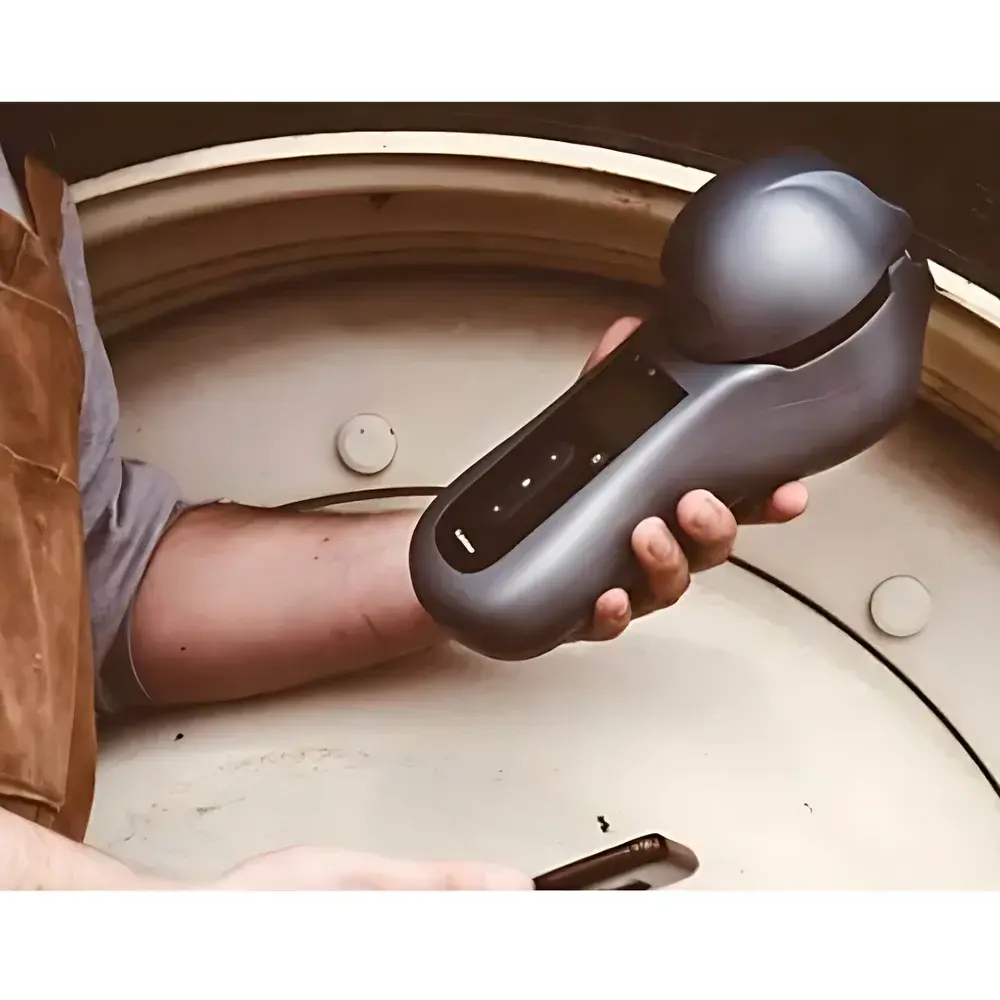
GrainSense Seed Analyzer by EcoTech
| Brand | EcoTech |
|---|---|
| Origin | Finland |
| Model | GrainSense |
| Type | Handheld / Flow-through / Benchtop NIR Seed Analyzer |
| Measurement Principle | Near-Infrared (NIR) Transmittance Spectroscopy |
| Key Parameters | Protein, Moisture, Fat, Carbohydrates |
| Sample Throughput | 3 g (handheld), ~100 g/s (flow-through) |
| Operating Temp | 5–45 °C (handheld), 0–45 °C (flow-through) |
| Communication | Bluetooth LE 5.0 (handheld), Ethernet/RS-485 (flow-through) |
| Compliance | CE, RoHS, IP65 (flow-through enclosure), GLP-supporting data logging |
Overview
The GrainSense Seed Analyzer is a modular near-infrared (NIR) spectroscopic platform engineered for rapid, non-destructive quantification of key seed composition parameters—protein, moisture, fat, and carbohydrates—in real time and under field-relevant conditions. Based on transmittance-mode NIR spectroscopy with 360° integrating sphere illumination, the system delivers high reproducibility across diverse cereal and oilseed matrices without chemical reagents or sample preparation. Its optical architecture leverages calibrated spectral response in the 900–1700 nm range, optimized for grain kernel density, size heterogeneity, and surface reflectivity variations. Unlike reflectance-based systems, the transmittance geometry minimizes scattering artifacts and enables robust calibration transfer between instrument variants—handheld, flow-through, and benchtop—ensuring method consistency from breeding trials to post-harvest quality control.
Key Features
- Modular deployment: Three physically and functionally distinct configurations—handheld (field scouting), flow-through (in-line process monitoring), and benchtop (lab-grade validation)—share identical spectral models and calibration databases.
- Integrating sphere optics: Ensures uniform illumination and collection efficiency across irregular seed geometries (e.g., round wheat kernels vs. flat rapeseed), reducing orientation-dependent bias.
- Real-time calibration management: Embedded chemometric engine supports local model updates using user-acquired reference data; all calibrations are traceable to NIST-traceable reference materials and validated per ASTM E1655 guidelines.
- Ruggedized design: Handheld unit meets IP54 for dust resistance and transient moisture exposure; flow-through variant rated IP65 with stainless-steel housing suitable for grain elevator and dryer environments.
- Battery-agnostic operation: Handheld model operates on standard AA cells (50–150 measurements per set) or optional rechargeable Li-ion pack; flow-through unit supports 220–230 V AC input with surge protection for industrial settings.
Sample Compatibility & Compliance
The GrainSense Analyzer is validated for routine analysis of major agronomic species including Triticum aestivum (wheat), Hordeum vulgare (barley), Secale cereale (rye), Avena sativa (oats), Brassica napus (rapeseed), Helianthus annuus (sunflower), Zea mays (maize), and Glycine max (soybean). Calibration models are developed using AOAC-certified reference methods (AOAC 992.15 for moisture, AOAC 984.13 for crude protein) and cross-validated against ISO 20483:2013 (cereals — determination of nitrogen content) and ISO 15170:2001 (oilseeds — determination of oil content). All instruments comply with EU Directive 2014/30/EU (EMC), 2014/35/EU (LVD), and RoHS 2011/65/EU. Data integrity features—including electronic signatures, audit trails, and secure user access levels—support compliance with FDA 21 CFR Part 11 and GLP/GMP documentation requirements when used with GrainSense Desktop Software v3.2+.
Software & Data Management
GrainSense App (iOS/Android) provides intuitive field acquisition, GPS-tagged measurement logging, and instant export to CSV or PDF. The desktop GrainSense Software suite offers advanced chemometric tools: PLS regression model editing, outlier detection via Hotelling’s T² and Q-residuals, batch reporting with statistical process control (SPC) charts, and integration with LIMS via ODBC or REST API. All raw spectra are stored in HDF5 format with embedded metadata (instrument ID, timestamp, ambient RH/T, operator ID). Audit logs record every calibration change, user login, and data export event—retained for ≥36 months and exportable for regulatory review.
Applications
- Plant breeding programs: High-throughput phenotyping of segregating populations for protein/moisture QTL mapping.
- Grain trade & procurement: On-site verification of contractual specifications at elevators, ports, and cooperatives.
- Post-harvest processing: Real-time feedback control of dryer temperature and airflow based on continuous moisture tracking.
- Seed certification labs: Compliant testing for national seed quality standards (e.g., ISTA, OECD Seed Schemes).
- Academic research: Non-invasive longitudinal studies of seed maturation, dormancy, and stress-induced compositional shifts.
FAQ
Does GrainSense require destructive sample preparation?
No. All configurations operate on intact, unground seeds using non-contact NIR transmittance.
Can calibration models be transferred between handheld and flow-through units?
Yes. Shared spectral preprocessing algorithms and unified PLS model architecture ensure quantitative equivalence across platforms.
Is the system compatible with existing farm management software?
Yes. GrainSense Desktop Software supports direct integration with Farm Management Information Systems (FMIS) via standardized JSON/CSV exports and configurable webhooks.
What is the minimum sample volume required for reliable results?
Handheld mode: ≥3 g (species-dependent); flow-through mode: continuous stream at ≥100 g/s with stable mass flow rate.
How often must calibration models be re-validated?
Annual re-validation is recommended; however, stability monitoring using control samples enables extended intervals per ISO/IEC 17025:2017 Clause 7.7.2.




