
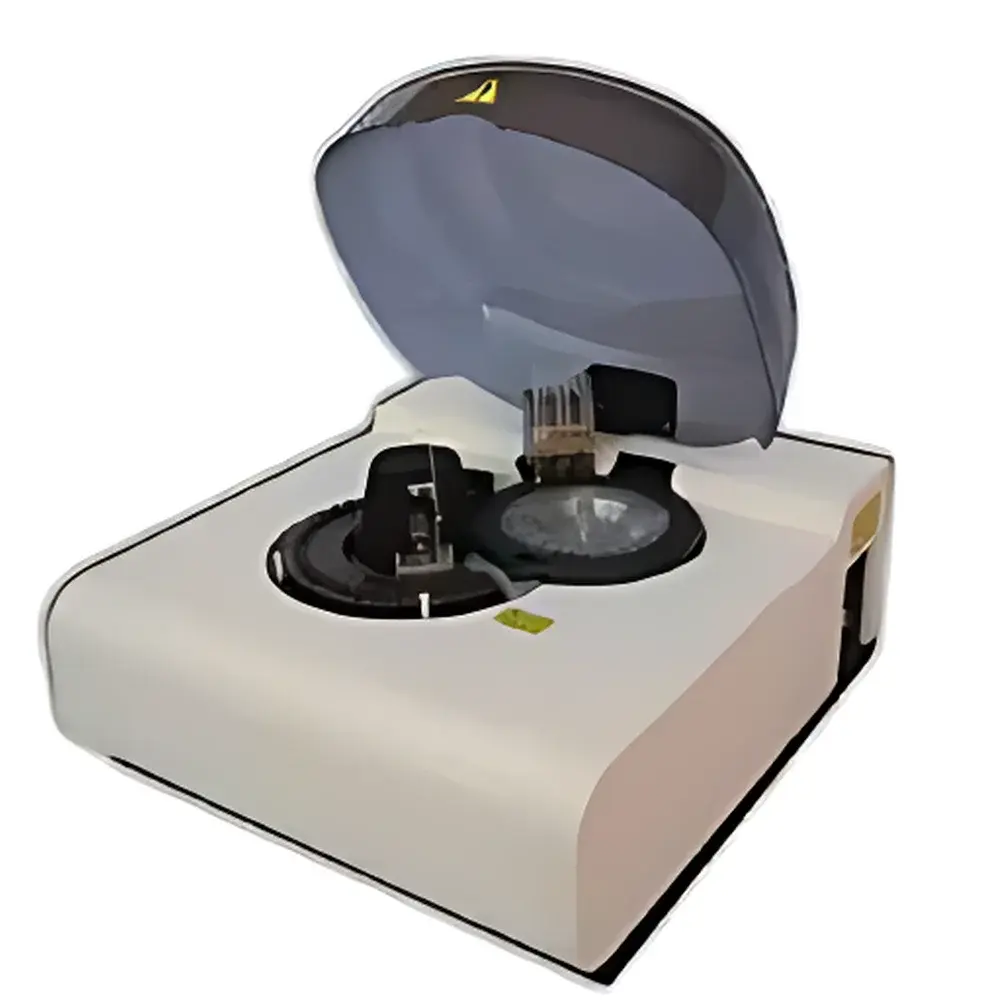
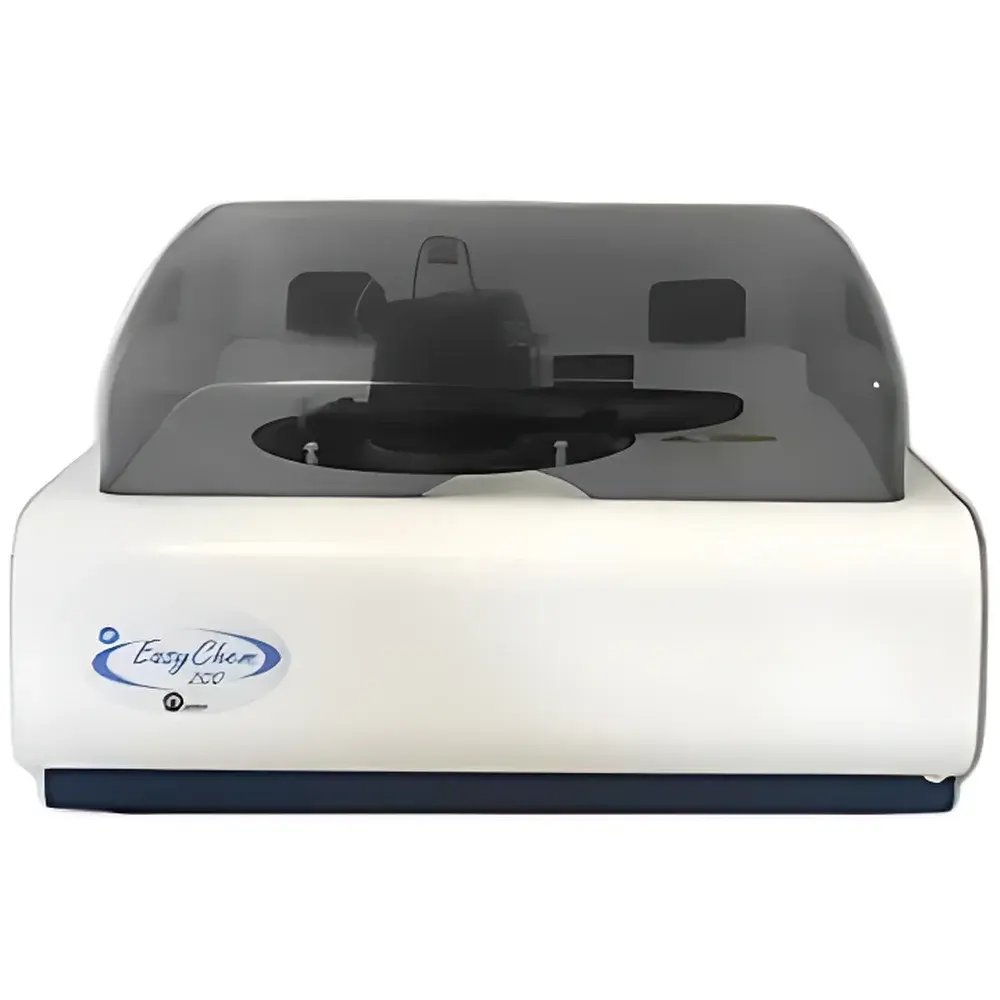
EasyChem 200 Automated Multi-Ion Analyzer
| Origin | Italy |
|---|---|
| Manufacturer Type | Authorized Distributor |
| Origin Category | Imported |
| Model | EasyChem 200 |
| Pricing | Upon Request |
| Instrument Type | Multi-Parameter Ion Analyzer |
Overview
The EasyChem 200 Automated Multi-Ion Analyzer is a benchtop, discrete wet-chemistry analyzer engineered for high-precision, multi-parameter quantification of inorganic and organic analytes in environmental, agricultural, food & beverage, and clinical sample matrices. It operates on the principle of automated discrete photometric analysis—replacing traditional segmented-flow (SFA) or continuous-flow systems with a true discrete reaction architecture. Each sample and reagent is handled independently using computer-controlled micro-syringe dispensing, eliminating cross-contamination inherent in flow-based methodologies. The system employs dual-beam digital photometry across a broad spectral range (340–880 nm), enabling simultaneous measurement of up to 16 parameters per sample without hardware reconfiguration. Designed for compliance with ISO 15195, ASTM D129, EPA Methods 300.0/353.2/365.4, and EN ISO 11732, the EasyChem 200 supports routine monitoring in accredited water quality laboratories, municipal wastewater facilities, soil testing centers, and wineries requiring trace-level accuracy and audit-ready data integrity.
Key Features
- Discrete reaction architecture with independent sample/reagent handling—no shared fluidic pathways ensures zero carryover between samples.
- Integrated 9-position interference filter wheel (340, 405, 480, 505, 546, 578, 630, 670, 880 nm ±2 nm) plus one blank position; automatic wavelength selection per method.
- High-precision microdispensing: 1000 µL syringe with mechanical resolution of 0.3 µL; volumetric accuracy ±0.5% over 2–350 µL range.
- Programmable reaction block: 90-position heated reaction carousel (temperature control ±0.1°C, max 50.0°C) with integrated mixing and timed incubation.
- Automated pre- and post-analysis dilution: single- or multi-step dilution of out-of-range samples with full traceability.
- Refrigerated 27-position reagent carousel (Peltier-cooled, 4–12°C) with liquid-level sensing and low-volume alarm.
- 60-position sample tray with positional memory, color-coded marking for diluted samples, and QC/control placement flexibility.
- Dual-beam photometer with <0.5% linearity error (0–2.5 O.D.), noise <±2 mAbs at 340 nm, and auto-zeroing across all wavelengths.
Sample Compatibility & Compliance
The EasyChem 200 accepts liquid samples from diverse sources—including raw and treated drinking water, surface and groundwater, seawater, wastewater effluents, soil extracts (e.g., CaCl₂ or Mehlich-3 leachates), plant tissue digests, grape must, wine, juice, and dairy beverages. Its discrete design eliminates matrix interference common in flow injection systems, particularly for viscous or particulate-laden samples. Method validation aligns with ISO/IEC 17025 requirements for calibration verification, limit of detection (LOD) determination, and repeatability assessment. Instrument operation supports GLP-compliant workflows through electronic audit trails, user access controls, and 21 CFR Part 11–ready software modules (including electronic signatures, change logs, and secure data export). All analytical methods are documented per ISO 8466-1 for calibration curve construction (linear or polynomial regression) and include built-in QC level monitoring (5-tier control scheme with configurable acceptance criteria).
Software & Data Management
The EasyChem Control Suite runs natively on Windows 7/8/10/11 and provides a fully graphical, instrument-mimetic interface for method setup, batch definition, and real-time status monitoring. Users define sample IDs (alphanumeric), assign standards/QCs, select analytical methods, and configure dilution protocols—all prior to run initiation. The software automatically generates calibration curves from 1–16 standards, stores historical calibration data, and applies drift correction algorithms when enabled. Raw absorbance (O.D.) values, calculated concentrations, timestamps, operator IDs, and QC flags are stored in structured ASCII/CSV format. Integrated LIMS connectivity enables direct data push to laboratory information management systems via configurable network paths or mapped drives. All data operations—including manual overrides, recalculations, and report generation—are timestamped and logged with user attribution. Diagnostic reports include thermal stability logs, photometer performance metrics, syringe wear diagnostics, and wash-cycle efficacy summaries.
Applications
- Environmental Monitoring: Alkalinity, ammonia-N, chloride, Cr(VI), cyanide, hardness (Ca²⁺/Mg²⁺), soluble Fe, nitrite, nitrate, nitrate+nitrite, hydrazine, orthophosphate, phenols, silicate, total phosphorus, total nitrogen, sulfate, sulfide, fluoride, manganese, aluminum, calcium, magnesium.
- Soil & Plant Analysis: Ammonium-N, nitrate-N, nitrite-N, phosphate, potassium, sulfate, total N/P/K, COD (via dichromate digestion), extractable metals.
- Wine & Beverage Testing: Acetic acid, citric acid, lactic acid (D- and L-isomers), malic acid, tartaric acid, glucose+fructose, free/total SO₂, urea, α-amino nitrogen, total polyphenols (Folin-Ciocalteu), anthocyanins, catechins, glycerol, copper, iron.
FAQ
What regulatory standards does the EasyChem 200 support?
It is validated for use with EPA Methods 300.0 (anions), 353.2 (nitrate/nitrite), 365.4 (phosphorus), ASTM D129 (sulfur), and ISO 11732 (ammonia); full traceability meets ISO/IEC 17025 and 21 CFR Part 11 requirements.
Can the system handle turbid or high-solids samples?
Yes—discrete sampling avoids clogging risks associated with flow cells; optional filtration or centrifugation steps can be integrated upstream per method SOPs.
Is method development supported?
Yes—the open software architecture allows custom assay configuration, including reaction timing, temperature profiles, dilution schemes, and calibration models.
How is data security ensured?
Role-based user accounts, encrypted local database storage, immutable audit logs, and password-protected method editing ensure data integrity and compliance with GDPR and HIPAA-aligned practices.
What maintenance is required?
Daily: Syringe cleaning cycle, optical window wipe. Weekly: Reagent line priming, photometer baseline verification. Quarterly: Filter wheel calibration and thermal block validation per manufacturer’s PM checklist.
Related Products







