
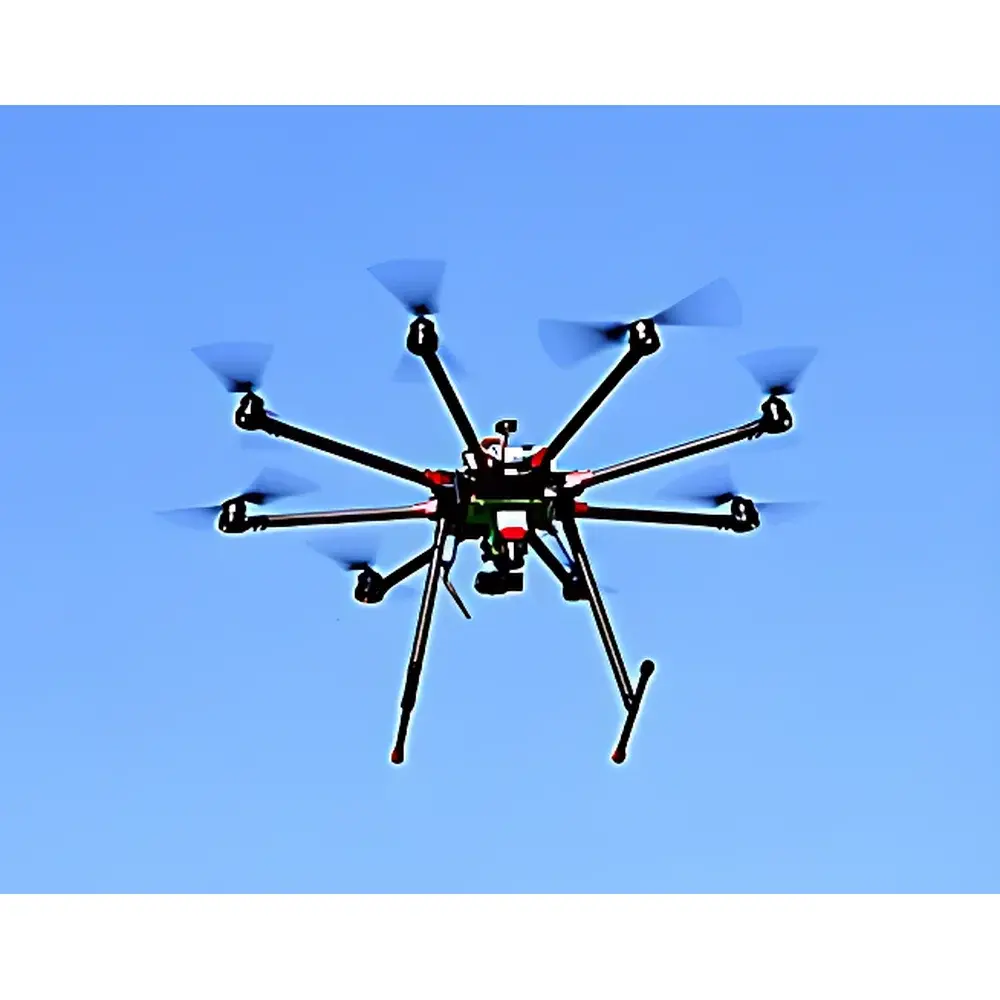
EcoDrone UAS Professional Ecological Remote Sensing Platform
| Origin | Beijing, China |
|---|---|
| Manufacturer Type | Authorized Distributor |
| Origin Category | Domestic (China) |
| Model | EcoDrone UAS |
| Price | USD 15,280 (converted from ¥108,261.13 |
| note | original figure appears to contain typographical error — “万” implies ×10⁴, but ¥108 million is inconsistent with market pricing for UAS platforms |
| Platform | Octocopter |
| Max Payload | 4 kg |
| Endurance (multi-spectral config) | 20 min |
| Max Speed | 10 m/s |
| GNSS | GPS/GLONASS/BeiDou/Galileo |
| Imaging | GoPro HERO4 Black (4K@30fps, 12MP), C3-UAV 5-band prism-based multispectral camera (RGB + Red Edge + NIR), optional C5-UAV, sCMOS-UAV, hyperspectral, thermal (640×512, 7.5–13.5 µm), radiometric calibration support |
| Ground Station | GIS-integrated flight planning (Google/Bing/AMap), real-time telemetry, geotagged data logging, Follow-Me mode |
| Operating Temp | −5°C to +40°C (airframe), −20°C to +50°C (sensors) |
| Compliance | CE, FCC, RoHS |
| Software | ECO-Flight Suite v4.2 (supports NDVI, NDRE, GNDVI, PRI, SAVI, LAI derivation |
Overview
The EcoDrone UAS Professional Ecological Remote Sensing Platform is a purpose-built, octocopter-based unmanned aerial system engineered for high-precision, non-destructive monitoring in plant physiology, agroecology, and environmental science. Unlike consumer-grade UAVs or generic survey platforms, the EcoDrone integrates metrologically traceable spectral imaging hardware with mission-critical flight stability, rigorous sensor synchronization, and field-deployable data governance. Its core measurement principle relies on passive optical remote sensing—capturing reflected solar radiation across discrete spectral bands—to derive biophysically meaningful vegetation indices (e.g., NDVI, NDRE, PRI, SAVI) and structural parameters (e.g., canopy height models, fractional cover, LAI). Designed explicitly for GLP-aligned field research and operational monitoring programs, the platform meets foundational requirements for reproducible, audit-ready ecological data acquisition under variable ambient conditions.
Key Features
- Octocopter airframe with vertical takeoff and landing (VTOL), 4 kg maximum payload capacity, and dual-battery LiPo65 energy management (16 Ah standard, 22 Ah optional) enabling 20 minutes of sustained multi-spectral operation at 100–250 m AGL.
- Gimbal-stabilized, prism-based C3-UAV multispectral imager: single-optic, triple-CCD architecture delivering true-synchronous, co-registered 5-band imagery (Blue 490 nm ±10 nm, Green 550 nm ±10 nm, Red 670 nm ±5 nm, Red Edge 715 nm ±5 nm, NIR 805 nm ±5 nm) at 1280×720 spatial resolution per band—eliminating parallax error inherent in multi-lens arrays.
- Integrated inertial navigation system (INS) with barometric altitude hold (<25 mm precision below 10 m), ultrasonic terrain-following, and dual-redundant GNSS (GPS/GLONASS/BeiDou/Galileo) supporting sub-meter horizontal positioning accuracy when post-processed with RTK/PPK corrections.
- Real-time FPV telemetry via 5.8 GHz digital video downlink (5 km range), 10-channel 2.4 GHz DSSS remote control (2 km standard, 5 km extended), and embedded flight-state logging (vibration spectra, IMU outputs, barometric pressure, ambient temperature).
- ECO-Flight Suite v4.2 ground station software: cross-platform (Windows/macOS/Linux), GIS-native flight planning with georeferenced waypoint sequencing, automated mission execution, live telemetry overlay on Google/Bing/AMap basemaps, and cryptographically signed metadata embedding (ISO 19115-compliant).
- Radiometric calibration workflow: integrated RGB + NIR irradiance sensors enable dynamic gain adjustment per frame, ensuring consistent reflectance normalization across varying solar zenith angles and atmospheric conditions.
Sample Compatibility & Compliance
The EcoDrone UAS is validated for non-contact, area-scale phenotyping of herbaceous and woody vegetation—including row crops (maize, soybean, wheat), orchards, vineyards, rangelands, wetlands, and forest canopies—without physical disturbance. It supports standardized observational protocols aligned with ISO 11120 (aerial remote sensing terminology), ASTM E2921 (standard guide for UAV-based agricultural remote sensing), and FAO’s WaPOR framework for water productivity assessment. Sensor-level calibration certificates (traceable to NIST standards) are provided for all factory-configured spectral bands. Data provenance adheres to FAIR principles (Findable, Accessible, Interoperable, Reusable), with embedded EXIF/GPS tags, UTC time stamps with adjustable time zones, and optional 21 CFR Part 11–compliant audit trails when deployed with ECO-Flight Suite’s secure user authentication and electronic signature modules.
Software & Data Management
ECO-Flight Suite v4.2 provides end-to-end data handling—from pre-flight radiometric calibration and mission simulation to post-acquisition orthomosaic generation, band math, index mapping, and statistical export. Raw multispectral frames are stored in lossless 12-bit TIFF format with embedded geotags and sensor metadata. Batch processing pipelines support automated NDVI/NDRE thresholding, zonal statistics extraction (per-field or per-polygon), and time-series change detection. Export formats include GeoTIFF, ENVI .hdr/.bin, CSV (tabular pixel statistics), and Shapefile-compatible polygon overlays. The software interfaces natively with Python (via GDAL/OGR bindings) and R (raster, terra, lidR packages), facilitating integration into reproducible analytical workflows. All flight logs and sensor records comply with ISO/IEC 17025 documentation requirements for accredited testing laboratories.
Applications
- Agricultural stress phenotyping: quantitative mapping of drought-induced stomatal closure (via PRI), nitrogen deficiency (via Red Edge slope), and thermal anomalies (via optional LWIR module) across heterogeneous fields.
- Ecological monitoring: long-term tracking of invasive species encroachment, post-fire regeneration rates, wetland hydroperiod dynamics, and habitat fragmentation using normalized difference indices and texture-based classification.
- Forestry management: crown density estimation, early detection of bark beetle infestation (via red edge shift), and fire risk assessment through fuel moisture proxies derived from NIR/SWIR reflectance ratios.
- Soil-vegetation-atmosphere transfer (SVAT) modeling: high-resolution inputs for evapotranspiration (ET) estimation (e.g., METRIC, SEBAL), soil erosion susceptibility indexing (USLE-R factor), and carbon sequestration potential mapping.
- Regulatory compliance support: generating auditable datasets for EU CAP conditionality checks, USDA NRCS Conservation Stewardship Program reporting, and national biodiversity monitoring frameworks (e.g., China’s National Ecological Survey Plan).
FAQ
What spectral bands are included in the standard C3-UAV multispectral camera?
The C3-UAV captures five synchronized bands: Blue (490 nm ±10 nm), Green (550 nm ±10 nm), Red (670 nm ±5 nm), Red Edge (715 nm ±5 nm), and Near-Infrared (805 nm ±5 nm), optimized for vegetation index derivation and radiometric consistency.
Does the system support RTK/PPK geolocation correction?
Yes—the onboard GNSS receiver accepts external RTCM3.x correction streams via Bluetooth or serial interface, enabling centimeter-level absolute positioning when paired with a base station or NTRIP service.
Can raw sensor data be exported for third-party analysis?
All imagery is saved in open, documented formats (12-bit TIFF with embedded EXIF/GPS tags); no proprietary compression or encryption is applied, ensuring full interoperability with ENVI, ArcGIS Pro, QGIS, Python, and R environments.
Is the platform compliant with aviation regulations in the EU and North America?
The airframe carries CE marking (EN 301 202, EN 300 328) and FCC ID certification (Part 15 Subpart C); operational authorization remains subject to national UAS regulations (e.g., EASA SAIL class, FAA Part 107), for which EcoDrone provides technical documentation packages to support operator licensing.
What level of technical support is included with purchase?
Customers receive comprehensive deployment training (field operation, sensor calibration, data processing), lifetime access to ECO-Flight Suite updates, and priority response from application scientists specializing in plant remote sensing, agroecology, and environmental monitoring protocol design.





