
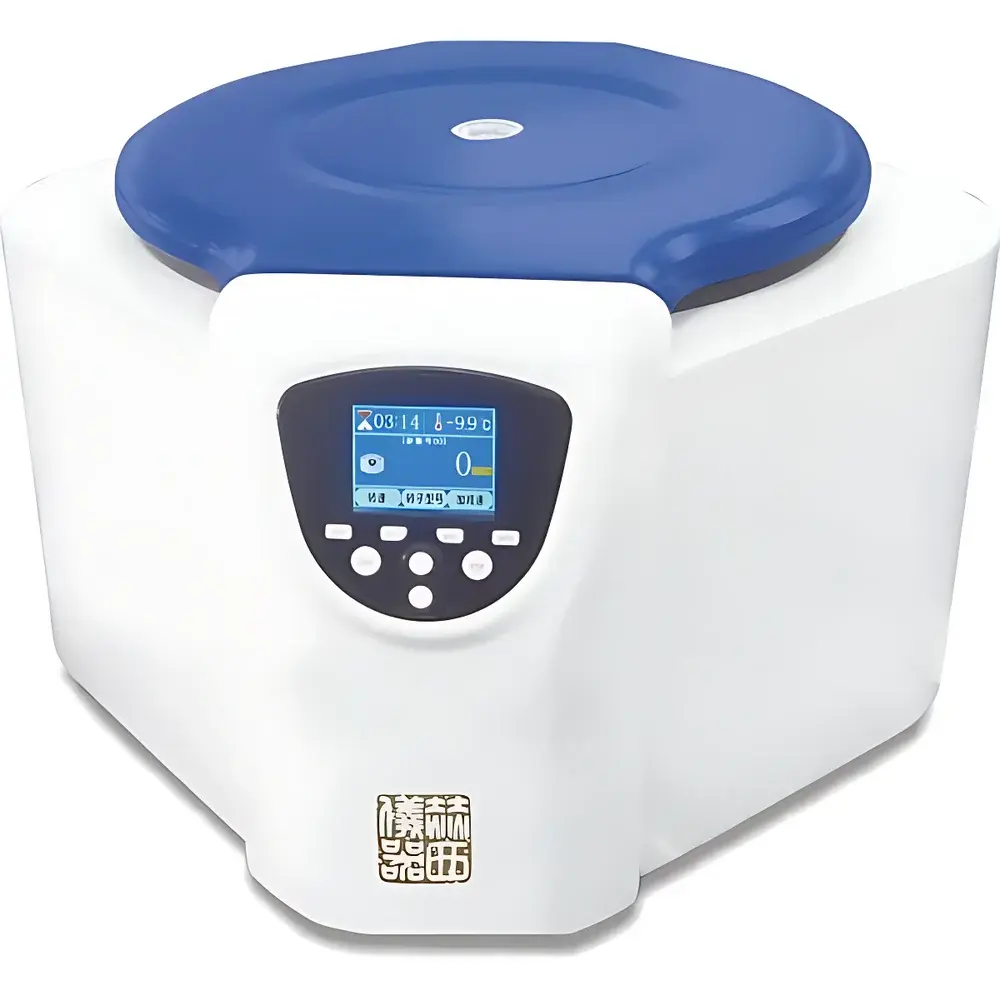
Hesley TD5A PRP & Adipose Tissue Centrifuge – Benchtop Low-Speed Horizontal Rotor Centrifuge
| Brand | Hesley |
|---|---|
| Origin | Hunan, China |
| Model | TD5A |
| Instrument Type | Benchtop Centrifuge |
| Maximum Speed | 4000 rpm |
| Maximum RCF | 2650 ×g |
| Maximum Capacity | 4 × 50 mL |
| Rotor Type | Horizontal (Swinging-Bucket) Rotor |
| Acceleration/Deceleration Control | 10-step programmable |
| Timer Range | 1–99 h 59 min, continuous, or short-spin mode |
| Speed Accuracy | ±50 rpm |
| Power Supply | AC 220 V, 50 Hz |
| Noise Level | ≤60 dB(A) |
| Dimensions (L×W×H) | 600 × 540 × 360 mm |
| Weight | 35 kg |
| Certifications | CFDA Registered Device, ISO 9001:2015 & ISO 13485:2016 Certified |
| Compliance | RoHS 2015/863 (Silicone Sealing Ring), FDA-recognized design principles for clinical specimen processing |
Overview
The Hesley TD5A PRP & Adipose Tissue Centrifuge is a CE-marked, ISO 13485-certified benchtop centrifuge engineered specifically for clinical and aesthetic medicine applications requiring high-reproducibility, low-speed density-gradient separation. It operates on the principle of sedimentation-based differential centrifugation under controlled gravitational forces (RCF), enabling precise isolation of platelet-rich plasma (PRP) from whole blood and stromal vascular fraction (SVF)-enriched adipose tissue suspensions without thermal or mechanical damage to bioactive components. Designed for use in certified aesthetic clinics, dermatology practices, and regenerative medicine labs, the TD5A supports sterile, closed-system processing—critical for autologous therapies compliant with Good Manufacturing Practice (GMP)-aligned handling protocols per ISO 22870 and CLSI GP44-A4 guidelines. Its horizontal rotor architecture ensures uniform sedimentation profiles across all tube orientations, minimizing inter-sample variability during PRP layering or adipocyte purification steps.
Key Features
- High-stability DC brushless motor with intelligent frequency control delivers consistent rotational performance at 4000 rpm (max), with <±50 rpm speed accuracy and <60 dB(A) operational noise—optimized for quiet clinical environments.
- Horizontal swinging-bucket rotor system with autoclavable stainless-steel buckets (304 austenitic grade) and integrated silicone gasket seals (RoHS 2015/863 compliant) prevents aerosol leakage and ensures biosafety during PRP or adipose-derived cell processing.
- TFT-LCD full-color touchscreen interface with dual-input operation (touch + physical keys), multilingual menu support (English, Chinese, Russian, Portuguese), and real-time display of both setpoint and actual RCF, time, and speed parameters.
- 10-step programmable acceleration and deceleration profiles prevent sample resuspension and preserve delicate cellular fractions—especially critical for maintaining platelet activation state and adipocyte membrane integrity.
- Triple-stage damping system with composite shock-absorbing mounts and dynamic imbalance detection ensures vibration-free operation even with asymmetric loads up to 4 × 50 mL.
- Integrated safety architecture includes over-speed, over-temperature, imbalance, under-voltage, and door-lock failure detection; reinforced 3-layer steel housing and electrostatically coated front panel meet IEC 61010-2-020 requirements for medical electrical equipment.
Sample Compatibility & Compliance
The TD5A accommodates standard clinical consumables without adapter modification: 10 mL, 20 mL, and 50 mL Luer-lock syringes (sterile, pyrogen-free); commercial PRP collection tubes (e.g., RegenLab, Eclipse, or Harvest systems); and custom adipose processing kits. All rotors and adapters are validated for repeated autoclaving (121°C, 20 min, 15 psi), supporting terminal sterilization between patient procedures. The device complies with ISO 13485:2016 for medical device quality management systems and carries CFDA registration as a Class II in vitro diagnostic-related instrument. While not FDA-cleared, its design aligns with FDA 21 CFR Part 820 and ASTM F2656-22 recommendations for centrifugal separation devices used in autologous biologic preparation.
Software & Data Management
The TD5A features embedded firmware with non-volatile memory for storing ≥100 user-defined protocols—including time, speed, RCF, acceleration/deceleration ramp rates, and rotor identification. Audit-trail functionality logs start/stop timestamps, error codes, and parameter modifications—supporting GLP-compliant documentation for clinic accreditation (e.g., AAAASF or JCI). Optional RS232 or USB-C data export enables integration into laboratory information management systems (LIMS) for traceability in multi-site aesthetic practice networks. No cloud connectivity or proprietary software installation is required—ensuring data sovereignty and HIPAA-aligned local storage.
Applications
- Isolation of platelet-rich plasma (PRP) for facial rejuvenation, hair restoration, osteoarthritis intra-articular injection, and chronic wound healing protocols.
- Purification of stromal vascular fraction (SVF) from lipoaspirate for fat grafting enhancement and regenerative soft-tissue augmentation.
- Preparation of platelet lysate (PL) for cell culture supplementation in ex vivo expansion workflows.
- Density-gradient separation of mononuclear cells (MNCs) from peripheral blood or bone marrow aspirates in research settings.
- Routine hematocrit determination and serum/plasma separation in point-of-care diagnostic workflows.
FAQ
Can the TD5A process whole blood directly in syringes without transfer to tubes?
Yes—the horizontal rotor accepts sterile 10 mL, 20 mL, and 50 mL Luer-lock syringes upright, eliminating open handling and reducing contamination risk during PRP preparation.
Is rotor autoclaving validated per ISO 17665?
All metal rotor components are validated for ≥100 cycles of steam sterilization at 121°C (20 min, 15 psi); silicone sealing rings require replacement every 50 cycles per manufacturer specifications.
Does the TD5A support regulatory audit requirements for clinical documentation?
Yes—embedded event logging captures operator ID (via optional RFID badge reader), protocol execution history, and fault diagnostics, fulfilling traceability mandates under ISO 22870 and AABB standards.
What is the maximum allowable load imbalance tolerance?
The system detects and halts operation if mass asymmetry exceeds 5 g between opposing positions—a safeguard preventing rotor deformation and ensuring long-term mechanical reliability.
Can custom rotor geometries be developed for proprietary PRP kits?
Yes—Hesley offers OEM engineering support for application-specific rotor and adapter design, including compatibility verification with third-party tube formats under NDA-protected development agreements.



