
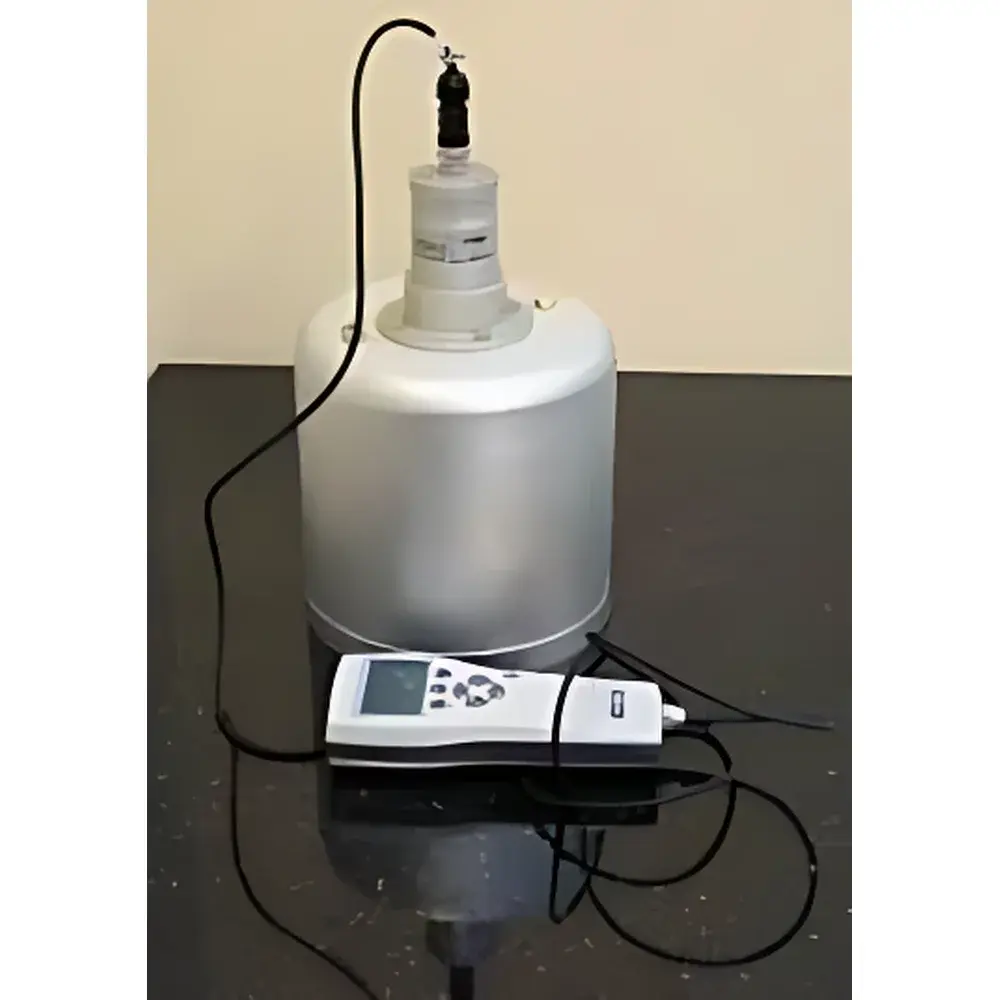
Soilbox-343 Portable Soil Respiration Measurement System
| Origin | USA |
|---|---|
| Manufacturer Type | Authorized Distributor |
| Origin Category | Imported |
| Model | Soilbox-343 |
| Price | Upon Request |
Overview
The Soilbox-343 Portable Soil Respiration Measurement System is a field-deployable, modular instrumentation platform engineered for high-fidelity, in situ quantification of soil CO2 efflux (soil respiration) and related biophysical parameters. It operates on the principle of dynamic closed-chamber or open-path gas exchange analysis, leveraging non-dispersive infrared (NDIR) spectroscopy with single-beam dual-wavelength detection to deliver stable, temperature- and pressure-compensated CO2 concentration measurements. Designed for ecological flux studies, climate change monitoring, agronomic carbon accounting, and soil health assessment, the system supports both short-term pulse measurements and extended time-series observations—enabling rigorous partitioning of autotrophic and heterotrophic respiration components when deployed in paired transparent/non-transparent chamber configurations.
Key Features
- Modular architecture supporting four operational modes: single-channel closed chamber (C-B), dual-channel closed chamber (B/B or B/W), and two open-system configurations (O-B and O-W) for long-duration (hours to 24 h) carbon flux monitoring.
- Integrated diffusion-based NDIR CO2 sensor (0–1000 ppm range, ±1.5% accuracy, 3 ppm resolution, <1 W power draw) eliminating need for external sampling pumps in closed-chamber mode.
- Reflective silver-anodized aluminum chamber housing (cross-sectional area: 0.0314 m²; height: 19.8 cm) minimizes radiative heating and suppresses greenhouse-effect artifacts during solar-exposed measurements.
- Dual-sensor chamber variants include co-located air temperature (±0.2 °C), relative humidity (±2% RH), and photosynthetically active radiation (PAR) or broadband solar irradiance (±5%) sensors—critical for environmental normalization and physiological interpretation.
- Optional TRIME-PICO handheld probe for concurrent volumetric soil water content (0–70%, ±2%), soil temperature (−20 to +50 °C, ±0.5 °C), and bulk electrical conductivity (±10%)—with optional GPS geotagging capability.
- Portable dual-channel data logger featuring backlit LCD display, 2700-point internal memory, programmable sampling interval (1 s to 12 h), and >8 h battery life per charge (400 g unit mass).
Sample Compatibility & Compliance
The Soilbox-343 is compatible with heterogeneous soil substrates—including mineral soils, organic peats, agricultural plots, forest floors, and restored wetlands—without requiring soil homogenization or core extraction. Its non-invasive chamber insertion method preserves natural soil structure and microclimate. All sensor modules comply with IEC 60529 (IP65-rated enclosures), and the CO2 analyzer conforms to ISO 8573-1:2010 Class 4 purity requirements for sampled air streams. Data acquisition firmware supports audit-trail logging and timestamp synchronization via embedded real-time clock (RTC), facilitating GLP-aligned field data collection. While not FDA 21 CFR Part 11 certified (as it is a research-grade environmental instrument), raw data export formats (CSV, ASCII) are fully traceable and interoperable with third-party statistical and modeling platforms used in IPCC Tier 2/3 reporting frameworks.
Software & Data Management
Data are stored locally on the handheld logger and exported via USB interface to PC-based configuration and analysis software (Windows-compatible, no cloud dependency). The software enables post-hoc calculation of CO2 flux using standard linear or exponential regression models (e.g., Hutchinson & Mosier, 1981), automatic application of temperature and pressure corrections, and batch processing of multi-site datasets. Exported files contain full metadata headers—including chamber ID, GPS coordinates (if enabled), sensor calibration IDs, and environmental context tags—ensuring FAIR (Findable, Accessible, Interoperable, Reusable) data principles. No proprietary binary formats are used; all outputs conform to CF Metadata Conventions v1.8 for climate science interoperability.
Applications
- Quantifying diurnal and seasonal soil respiration dynamics across land-use gradients (e.g., cropland vs. native prairie vs. afforested sites).
- Assessing impacts of drought, nitrogen fertilization, tillage practices, or biochar amendment on belowground carbon turnover rates.
- Partitioning net ecosystem exchange (NEE) into gross primary production (GPP) and ecosystem respiration (Reco) via simultaneous transparent/non-transparent chamber deployment (B/W configuration).
- Validating eddy-covariance tower data at plot scale under heterogeneous terrain where footprint representativeness is limited.
- Supporting UNFCCC GHG inventory development and verification protocols for national agricultural monitoring systems.
- Long-term soil carbon sequestration monitoring in regenerative agriculture and soil health certification programs.
FAQ
What chamber configurations support PAR measurement?
Only the B/W (transparent + non-transparent) and O-W (open-system transparent) configurations include integrated PAR sensors. The B/B and C-B configurations use broadband solar radiation sensors instead.
Can the system operate unattended for >24 hours?
Yes—when paired with the O-B or O-W open-system configuration and an external 12 V DC power source, continuous operation exceeds 48 hours. Battery-only operation is limited to ~8 h for the handheld logger and ~6 h for the pump module.
Is calibration traceable to NIST standards?
CO2 sensor factory calibration is traceable to NIST-certified gas standards (SRM 1662a). Field recalibration kits (zero/span gases) are available as optional accessories.
Does the system meet ASTM D6340 for soil CO2 efflux measurement?
While not formally certified to ASTM D6340 (which applies to laboratory-based static chamber methods), the Soilbox-343 implements all core procedural requirements—chamber deployment duration, temperature stabilization criteria, and linear flux calculation methodology—as defined in the standard’s field-adapted annexes.
How is data synchronized across dual chambers in B/B or B/W mode?
The dual-channel logger acquires timestamps from a single internal RTC and interleaves readings from both chambers at user-defined intervals, ensuring temporal alignment within ±10 ms—sufficient for flux calculations under typical field conditions.







